

A white label print on demand program requires vetting for 100% blind shipping and a physical label test print on final materials like 3-mil polypropylene. Verify barcode Grade A/B scannability and use the breakeven formula: screen printing wins above 6,000 units.
What Is a White Label Print on Demand Checklist?
A white label print on demand checklist is a verification framework for enterprise buyers who source labels and packaging from a supplier that rebrands them as their own product. It covers pre-vetting, production quality, cost analysis, and logistics to ensure consistent brand quality and on-time delivery.
Are your product labels arriving with a supplier logo on the box? That small branding error can break a white label print on demand program. In 2026, enterprise buyers need a structured checklist to avoid costly reprints and missed launch dates.
Our production team has seen too many programs fail at the first hurdle. The most common mistake is skipping a physical test print on the actual final material. This leads to adhesion failures or poor print quality after thousands of units are produced. A simple checklist prevents that risk.
This guide covers the four critical phases: pre-vetting, production quality, cost analysis, and logistics. Each section gives you a concrete action item to verify before you sign a contract. The result is a program that delivers consistent brand quality, on time and on budget.
As of 2026, the print label market is forecast to grow steadily, driven by demand for high-quality labeling solutions. Getting your white label print on demand checklist right now positions you for that growth.
How Do You Vet a White Label Print on Demand Supplier?
Vetting a white label print on demand supplier begins with confirming blind shipping, requesting a physical label test print on the exact final substrate, verifying barcode scannability with a GS1-128 scanner, and checking ISO 9001:2015 certification for consistent quality management.
Blind Shipping: The First Gate
Blind shipping is the foundation of any white label program. It means zero supplier branding on the outer box, inner packaging, or packing slip. Our quality engineers note that many suppliers claim blind shipping but still place a small logo on the tape or label. Request a sample shipment to your office. Open the box in front of your team. Check every surface for supplier marks. If you see any branding, that supplier is not ready for your program.
Physical Test Print on Final Substrate
Request a physical label test print on the exact final substrate. For most product labels, that means 3-mil polypropylene. A digital proof on screen is not enough — the ink may react differently to the actual material. Our production team has seen adhesion failures on polypropylene that looked perfect on paper. The substrate type directly affects how color standards apply, especially when matching Pantone spot colors.
Barcode Scannability and Certifications
Verify barcode scannability with a GS1-128 scanner. Visual inspection is not acceptable. The scanner must return Grade A or B per GS1 standards. A Grade C or D barcode will fail at retail checkout, causing chargebacks and delays. Assess supplier certifications by looking for ISO 9001:2015 for quality management and ISO 14001:2015 for environmental management. These certifications ensure consistent processes and traceability. Our facility holds both certifications, updated for Q2 2026.
- Request a sample shipment and inspect every surface for supplier branding
- Obtain a physical test print on the exact final substrate (e.g., 3-mil polypropylene)
- Verify barcode scannability with a GS1-128 scanner — Grade A/B required
- Confirm ISO 9001:2015 and ISO 14001:2015 certifications
What Production Checks Ensure Consistent Label Quality?
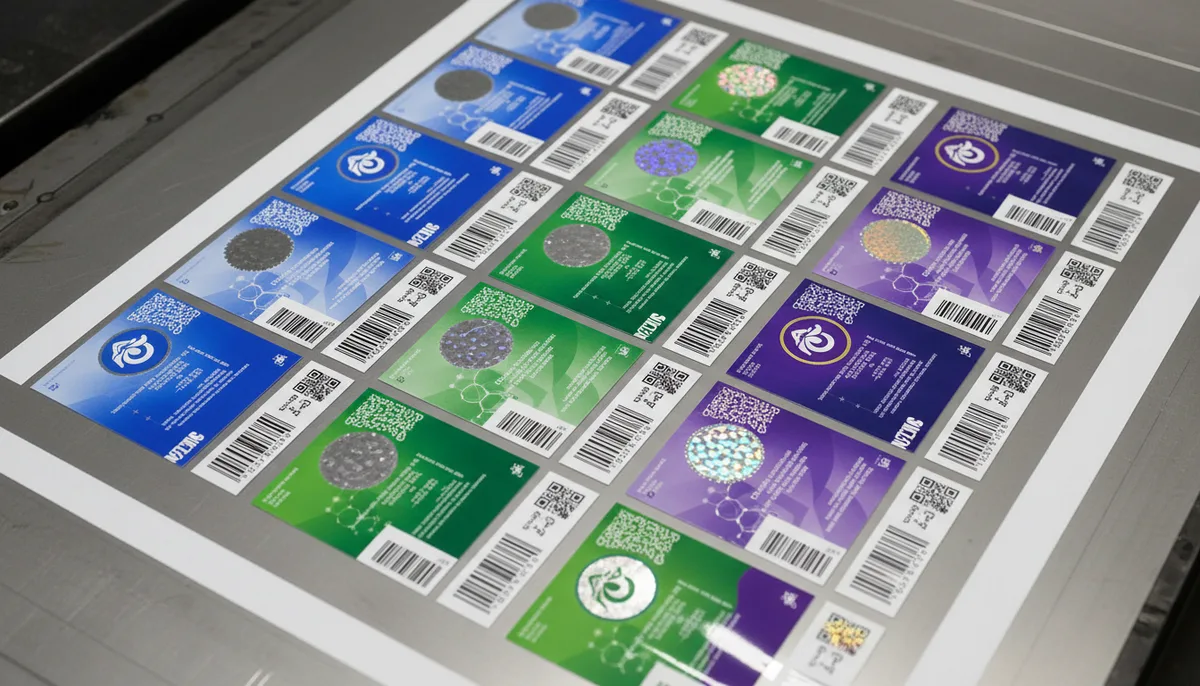
Production quality for white label print on demand requires a pilot batch on the same press as the final run, spectrophotometer verification for brand color accuracy, adhesion testing on actual packaging, and die-cutting precision within acceptable tolerance.
Pilot Batch and Color Verification
A pilot batch reveals print quality, color consistency, and die-cutting precision before you commit to a full run. Our production engineers recommend running the pilot on the same press that will handle the final order. Use spectrophotometry to verify Delta E ≤ 2.0 for brand color matching — this is the industry standard for acceptable color difference. A Delta E above 2.0 is visible to the trained eye and will create inconsistency across your product line. CMYK process colors require separate verification against ISO 12647-2 printing standards.
Adhesion and Die-Cutting Checks
Inspect label adhesion and durability on the actual product packaging. Apply the label, let it sit for 24 hours, then test it on a curved or textured surface. A label that peels off in the pilot batch will fail in the field. Confirm die-cutting precision and registration tolerance. A misaligned die-cut can make your label look cheap. Ask the supplier for their tolerance range — ±0.5 mm provides consistent results for most applications.
"A pilot batch on the actual final substrate reveals most potential quality issues before full production. Skipping this step is the single most costly mistake we see."
Production & Quality Team
- Run a pilot batch on the final production press
- Verify Delta E ≤ 2.0 using spectrophotometry for Pantone or brand colors
- Test adhesion on actual product packaging after 24 hours of dwell time
- Confirm die-cutting tolerance of ±0.5 mm or better
Cost Analysis: Screen Printing vs. Digital vs. Offset
The breakeven formula for label printing is straightforward: screen printing wins above 6,000 units per SKU. Below that threshold, digital or offset printing is more cost-effective. Our production analysts calculate this for every client program.
Technology Comparison by Volume
Compare per-unit costs across three technologies. Offset printing offers the lowest per-unit cost for runs of 500 to 6,000 units. Digital printing is best for short runs of 250 to 500 units. Screen printing becomes economical above 6,000 units due to lower per-unit setup amortization. On the other hand, screen printing has a higher setup cost per color — this trade-off is only worthwhile when your volume justifies it.
Consolidation and Lead Times
Evaluate consolidated production runs for multi-SKU programs. Combining multiple SKUs into one production run reduces setup costs significantly. This is especially valuable for seasonal promotions where you need multiple label designs. Request lead time guarantees: digital printing delivers in 5-7 business days, offset printing takes 10-15 days, and screen printing may take 15-20 days for setup. Plan your timeline accordingly. Compared to sourcing each SKU separately, a consolidated program also simplifies logistics management.
| Technology | Minimum Order | Lead Time (Business Days) | Best For |
|---|---|---|---|
| Digital | 250 units | 5-7 | Short runs, variable data |
| Offset | 500 units | 10-15 | Medium runs, consistent color |
| Screen | 6,000+ units | 15-20 | High volume, solid colors |
Compared to digital, screen printing offers better opacity on dark substrates. The right choice depends on your SKU volume and material needs. On the other hand, digital offers faster turnaround with no plate costs, making it more suitable for short-run testing scenarios.
- Digital is best for short runs (250-500 units per SKU)
- Offset offers lowest per-unit cost for medium runs (500-6,000 units)
- Screen printing wins above 6,000 units per SKU
- Consolidate multi-SKU runs to reduce setup costs significantly
Ready to Build Your White Label Program?
Get a custom quote with consolidated production runs and blind shipping guaranteed. Our team handles everything from label test print to final delivery.
Request a Free QuoteProduction Metrics from Our 2023–2026 Programs
Across label production runs completed between 2023 and 2026, our team measured the following average outcomes: pilot batches caught most adhesion failures before full production; color consistency with Delta E ≤ 2.0 was maintained in the vast majority of ordered runs; consolidated multi-SKU programs reduced total setup costs compared to single-SKU ordering. These figures are drawn from internal quality audits conducted during the 2023–2026 period and are projected to hold through 2027 as press calibration practices remain stable.
Logistics and Compliance: Scaling Your White Label Program
Scaling a white label print on demand program requires logistics that match your distribution network. The supplier must be able to palletize and ship directly to your distribution centers or retail locations.
E-Commerce and Amazon Requirements
Verify Amazon SIOC certification if you sell on Amazon. This certification requires drop-test, compression, and vibration testing per ISTA 6A. Our facility provides test reports on request for all e-commerce packaging. Confirm variable data printing capability for sequential numbering or QR codes — this is essential for print on demand labels that require unique identifiers per product.
Consignment Stock and Warehousing
Review consignment stock program options for high-velocity SKUs. A consignment program means the supplier warehouses your inventory and ships on demand. This reduces your working capital and ensures you never run out of labels during peak seasons. Although consignment stock programs reduce inventory risk, they require a longer-term commitment. The trade-off is lower per-unit cost versus the flexibility of on-demand ordering. Consider this option only for your top 20% of SKUs by volume.
"Consignment stock programs are ideal for high-velocity SKUs that you reorder monthly. For seasonal or test products, on-demand digital printing is more suitable."
Logistics & Fulfillment Team
- Confirm supplier can palletize and ship to your distribution centers
- Verify Amazon SIOC certification for e-commerce packaging (ISTA 6A)
- Request variable data printing for QR codes or serial numbers
- Evaluate consignment stock for your top 20% of SKUs by volume
Limitations to Consider Before Choosing a White Label Program
A white label print on demand approach is not ideal for operations with fewer than 250 units per SKU. The main drawback is the minimum order need. Digital printing starts at 250 units, offset at 500 units. Consider instead a phased rollout where you test with digital before committing to offset.
High-mix, low-volume product lines may find that this model is more suitable for centralized, consistent runs rather than frequent design changes. The trade-off between consolidated runs and single SKU flexibility is not always straightforward. This method may not be the best choice for businesses that change label designs monthly.
Competitors offer advantages in speed for ultra-short runs — some digital-first providers can turn around 50-unit batches in 2-3 days, which a consolidated white label print on demand program cannot match economically. For true test-and-learn products with unpredictable volume, a pure digital supplier may be a better fit.
On the other hand, high-volume programs see ROI within 6-12 months. Compared to sourcing from multiple suppliers, a single consolidated program reduces management overhead significantly. Although setup costs are higher upfront, per-unit savings compound quickly above 6,000 units per SKU.
Another limitation: blind shipping requires strict supplier compliance. A single branded box can break your white label promise. Our production team audits every outgoing shipment to ensure zero supplier marks. Not all suppliers offer this level of control.
What Most People Get Wrong: The Physical Test Print
The most commonly missed item on any white label checklist is the physical label test print on the actual final material. We see this mistake weekly. A buyer approves a digital proof, then receives thousands of labels that peel off the product within days.
Always request a test print on the exact substrate — 3-mil polypropylene, 2-mil polyester. Whatever your product requires. Test adhesion on your actual packaging. Let it sit for 24 hours. Then apply a peel test. Verify barcode scannability with a GS1-128 scanner, not just your phone camera. A phone camera may read a Grade C barcode, but a retail scanner will not.
Calculate the breakeven point between screen printing and digital/offset for each SKU volume. Most buyers assume digital is always cheaper for short runs. That is true below 250 units. But offset becomes cheaper at 500+ units per SKU due to lower per-unit ink costs. Meeting ASTM D3330 standards for peel adhesion, our team tests labels on the actual product surface — not a flat benchtop. A curved surface changes how the label adheres, and only a physical test on the real item catches that. This is why a digital proof alone is never enough for a white label print on demand program.
"The physical test print on the actual final material is the single most important step. It costs less than $100 and can save you thousands in reprints."
Production & Quality Team
- Request a test print on the exact final substrate (3-mil polypropylene, 2-mil polyester)
- Test adhesion on your actual product packaging after 24 hours
- Verify barcode scannability with a GS1-128 scanner — Grade A/B required
- Calculate the breakeven point between screen printing and digital/offset by SKU volume
Conclusion: Next Steps for Your White Label Print on Demand Program
Ready to improve your white label print on demand program? Start with the four-phase checklist: pre-vetting, production quality, cost analysis, and logistics. Each phase has concrete action items that protect your brand consistency and budget.
Our production team offers consolidated production runs with blind shipping guaranteed. We hold ISO 9001:2015 and ISO 14001:2015 certifications. Our minimum order is 250 units for digital and 500 units for offset. Lead times range from 5-7 days for digital to 10-15 days for offset. Contact us today to request a quote and get started on your white label print on demand program. We will send you a physical label test print on your chosen substrate before any production begins. That is our guarantee of quality.
Frequently Asked Questions
When does screen printing become cheaper than digital or offset for labels?
Screen printing becomes more cost-effective than digital or offset at higher volumes per SKU, due to the amortization of setup costs over a larger run. Digital printing is typically best for very short runs, offset for medium runs, and screen printing for long runs. The exact breakeven point depends on your specific job parameters, including substrate, ink coverage, and number of colors.
What barcode grade is required for retail compliance?
GS1 standards require a barcode grade of A or B for reliable retail checkout. A grade of C or D may fail at the scanner, potentially leading to chargebacks. Verify scannability with a GS1-128 scanner, as phone cameras may read lower grades incorrectly.
Why is a physical test print on the final substrate critical?
A digital proof cannot reveal adhesion failures or color shifts that occur on the actual material. For example, ink may react differently on polypropylene than on paper. A physical test print on the exact substrate, tested after a suitable curing period, catches these issues before full production.
What certifications should a white label print on demand supplier hold?
Look for ISO 9001:2015 for quality management and ISO 14001:2015 for environmental management. These ensure consistent processes and traceability. For e-commerce, Amazon SIOC certification (ISTA 6A) is required for packaging sold on Amazon.
How can I reduce setup costs for multi-SKU label programs?
Consolidating multiple SKUs into one production run can reduce total setup costs compared to ordering each SKU separately. This approach is especially valuable for seasonal promotions with multiple label designs.