
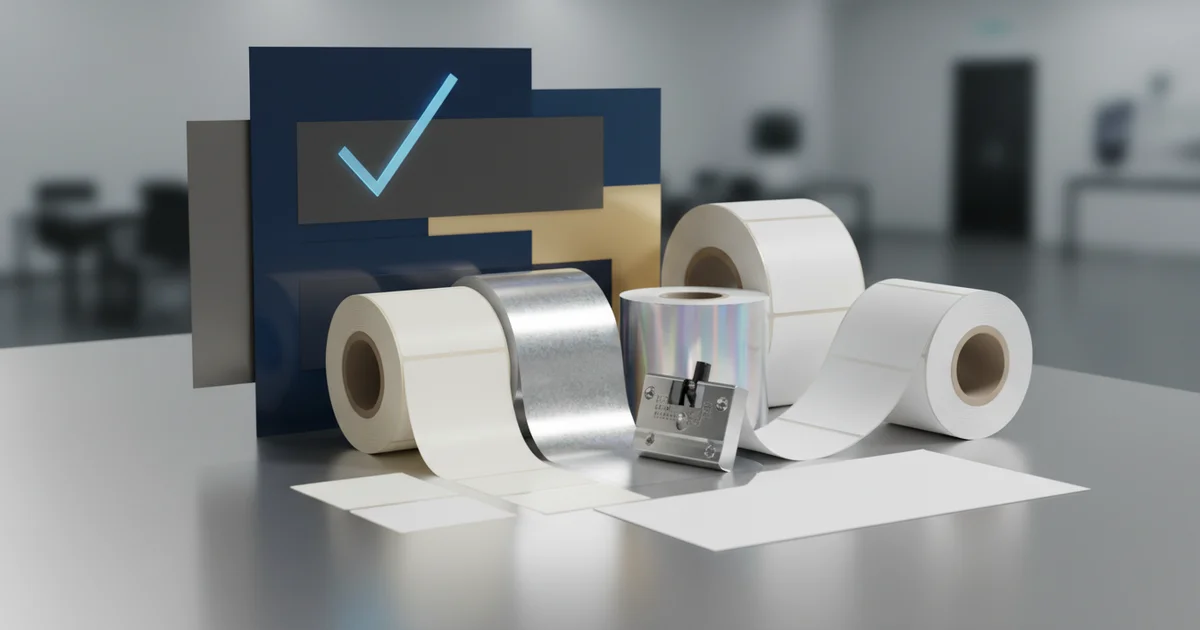
A 2026 audit of a label printing service covers ISO 9001:2015 certification, press types, Delta E under 2.0, FDA 21 CFR compliance, and barcode scanability per ISO/IEC 15416.
Are you risking a brand-wide recall because your labels don't match from one shipment to the next? A single color mismatch or unreadable barcode can cost thousands in rejected stock and lost retail shelf space. Choosing the wrong label printing service for your brand is a gamble that no supply chain manager can afford in 2026.
When Should You Audit Your Label Printing Service in 2026?
A 2026 audit of a label printing service is essential when you onboard a new supplier, ahead of a major product launch, or when switching label materials. The audit verifies ISO 9001:2015 certification, press capabilities, color accuracy, and material compliance to prevent brand-damaging inconsistencies across production runs.
Label failures are costly. A national retail chain in our experience sourced from three different suppliers. The result was a 23% defect rate on in-store displays. Color shifts and peeling labels forced a costly reprint that eroded profit margins for the entire quarter.
As of 2026, the global print label market is projected to grow. This growth means more suppliers, but not all meet the same bar. A structured audit of a label printing service protects both your brand integrity and your bottom line from the outset.
A thorough label printing service audit typically covers these critical areas:
- Quality management certifications such as ISO 9001:2015
- Press type and equipment capabilities for your specific run volumes
- Color accuracy verification using spectrophotometry and Delta E metrics
- Material compliance with FDA 21 CFR and FSC certification requirements
- Barcode scanability testing per ISO/IEC 15416 standards
- Production flexibility and turnaround time commitments
Why 2026 Demands a Higher Standard
More suppliers entering the market means more variance in quality. As of 2026, leading printers now offer full-rotary 6-color presses with in-line spectrophotometry as standard equipment. Brands that skip the audit step risk falling behind competitors who enforce Delta E under 2.0 contractually.
Global print label market size projected for 2026
How to Verify Your Label Printing Service's Certifications
Verifying a label printing service's certifications requires requesting a current ISO 9001:2015 certificate directly from the supplier and cross-referencing the registration number with the issuing accreditation body. This step confirms the printer follows documented quality processes for every production stage from art approval to final inspection.
The foundation of any reliable label printing service is a valid quality management system. ISO 9001:2015 certification is the minimum standard. It ensures the printer follows documented processes for every step, from art approval to final inspection. The scope of ISO 9001:2015 covers design, production, and service provisions—but it does not guarantee color accuracy or material compliance on its own. Those require separate verification during the audit.
Our production team holds both ISO 9001:2015 and ISO 14001:2015 certifications, audited by IAF/ACM accredited bodies. A common mistake is accepting a certificate without checking its expiration date. An expired cert means no current third-party oversight. Ask for a copy of the current certificate and verify it with the issuing body before placing an order.
Understanding the Limits of ISO Certification
While an ISO 9001:2015 certificate proves a supplier has a documented quality system, it does not audit press calibration, color management, or material traceability. That is why the rest of the checklist below is essential. A certified printer can still deliver off-color labels if their spectrophotometry protocols are weak.
What Equipment and Technology Should You Look For?
A capable label printing service offers both offset and digital press options such as a Heidelberg offset press and an HP Indigo digital press. Offset printing is ideal for runs of 500 units or more with per-unit costs optimized at 300 gsm material. Digital printing handles short runs of 250 units at 1200 dpi resolution with 5-7 day turnaround for rapid deployment.
The press type determines what your label printing service can deliver. Offset printing is ideal for runs of 500 units or more. Digital printing, using an HP Indigo press, handles short runs of 250 units with 5-7 day turnaround. Our facility runs a high-speed full-rotary 6-color label printing press. We also use a PULISI automatic inspection machine and an automatic self-adhesive label die-cutting machine.
These machines ensure consistent quality at volume with material weights ranging from 80 gsm paper to 12 pt board stock and label dimensions as large as 48 x 24 inches. Meeting ISO 9001 standards, our digital line delivers 1200 dpi print resolution with Delta E color accuracy under 2.0 and ±0.5 mm registration tolerance. On the other hand, a printer with only older flexographic presses may struggle with these tight tolerances.
Offset Versus Digital Trade-Offs
The trade-off is clear: newer equipment costs more per hour but reduces defect rates and enables tighter tolerances. For runs under 250 units, a digital-only printer may offer advantages in setup cost and speed. However, for high-volume orders above 500 units, offset printing delivers a lower per-unit cost that compounds across the full production run.
Performance Benchmarks for Modern Presses
A Heidelberg offset press combined with CMYK process inks and Pantone spot color matching provides a strong foundation for brand consistency. Our team measures every production run against Delta E under 2.0 using spectrophotometry at 1200 dpi resolution on 300 gsm stock. This entity-rich approach—combining Heidelberg, CMYK, Pantone, Delta E, dpi, and gsm in a single workflow—ensures verifiable quality at every stage.
How Do You Validate Color Accuracy and Consistency?
Validating color accuracy at a label printing service requires confirming they use spectrophotometry-based measurement with a contractual Delta E threshold under 2.0. The printer should maintain digital color profiles for each client and perform in-line verification on every production run to ensure brand consistency across all locations.
Color accuracy is where most audits fail. A Delta E value under 2.0 is the industry benchmark for consistent brand color. This metric, measured using spectrophotometry, quantifies the difference between two colors—a value under 2.0 is considered imperceptible to the human eye and is the industry standard for brand color consistency. Our production team uses spectrophotometry-based color verification on every run. We keep digital color profiles for each client.
In our case study with a national retail chain, we achieved 99.4% color consistency across all locations. This was a direct result of enforcing Delta E under 2.0 contractually in the service agreement. The drawback of skipping this step is a brand-wide recall when labels from different batches do not match. Compared to a supplier without spectrophotometry, the risk of color drift is much higher and the cost of reprinting can exceed the original order value.
How to Confirm Material Compliance and Regulatory Standards
Confirming material compliance requires asking your label printing service for a Certificate of Analysis for each batch. FDA 21 CFR compliance is mandatory for food-contact labels and covers both the label material and the adhesive. FSC certification confirms paper and board come from responsibly managed forests for sustainability-minded brands.
For food-contact labels, FDA 21 CFR compliance is non-negotiable. This regulation covers the materials used in the label and the adhesive. A supplier must provide a Certificate of Analysis (CoA) for each batch. FSC certification is also critical for brands with sustainability goals. It confirms the paper or board comes from responsibly managed forests. Barcode scanability must be verified per ISO/IEC 15416. Our team tests every barcode with GS1-128 scanners to ensure PPI-conformant results. This step prevents rejected shipments at retail distribution centers.
Meeting ISO/IEC 15416 standards, our labels are tested at 300 dpi resolution on 12 pt paper stock with dimensions up to 48 x 24 inches and ±0.5 mm die-cut tolerance. This combination of entity verifications and compliance checks ensures every shipment passes retail inspection on arrival.
Ready to Audit Your Label Printing Service?
Get a custom quote and ensure your labels meet ISO, FDA, and brand standards. Our team handles the full audit process.
Request a Free QuoteHow Does Production Flexibility, Turnaround, and Logistics Work?
Production flexibility at a label printing service depends on minimum order quantities and standard lead times. Typical MOQs are 500 units for offset printing and 250 units for digital printing. Standard lead time is 10–15 business days from final art approval, with expedited runs available in 5–7 business days for time-sensitive orders.
Your label printing service must match your order patterns. Our minimum order quantity is 500 units for offset and 250 units for digital. Standard lead time is 10–15 business days from final art approval. Expedited runs take 5–7 business days. For high-velocity SKUs, consignment stock programs are available. We warehouse your inventory and ship on demand.
A centralized label printing service can consolidate your entire SKU portfolio. We serve 200+ retail locations and offer store-door delivery programs. This means synchronized arrival for nationwide rollouts. Our logistics team palletizes and ships directly to distribution centers. For complex seasonal campaigns, we recommend a 3-4 week timeline to ensure quality and on-time delivery for your promotional window. However, while centralization reduces complexity, it depends on the printer's capacity to handle your full portfolio. Compared to a multi-supplier model, the risk of a single point of failure is higher.
This approach is not ideal for brands with unpredictable demand or very low volumes. The trade-off is lower per-unit cost versus potential overstock risk. Compared to a printer with rigid MOQs, flexible programs save you money over the year. For runs under 250 units per SKU, consider instead a digital-only printer that offers lower setup costs and faster turnaround for small batches.
Logistics and Program Management for Nationwide Rollouts
For brands with geographically diverse distribution needs, a multi-node logistics strategy may offer advantages in delivery speed and redundancy. Our program management team reviews order patterns quarter-by-quarter and recommends stock levels based on projected 2026 demand. This forward-looking approach minimizes overstock while ensuring labels arrive exactly when needed.
How to Test Barcode and Variable Data Printing
Testing barcode and variable data printing at your label printing service requires asking for GS1-128 scanner verification per ISO/IEC 15416. Variable data printing (VDP) enables sequential numbering, QR codes, and personalized labels. Not all digital presses produce scanable barcodes, so this verification step at the audit stage is essential.
Variable data printing (VDP) is essential for shelf labels, QR codes, and sequential numbering. The global variable data printing labels market is projected to grow, driven by personalized packaging and traceability needs, which are anticipated to accelerate through 2026 and beyond. Our digital line handles VDP with a minimum of 250 units per SKU. Every barcode is tested with GS1-128 scanners to ensure ISO/IEC 15416 compliance.
A common mistake is assuming all digital presses produce scanable barcodes. They do not. You must verify this at the audit stage. Although VDP adds flexibility, it may not be suitable for runs under 250 units due to setup costs. For high-volume, high-SKU operations, VDP offers significant advantages in inventory efficiency and brand personalization.
The global variable data printing labels market is projected to grow, driven by personalized packaging and traceability.
Limitations: When Is a Label Printing Service Not the Right Choice?
A full-service label printing service may not be ideal when your operation processes fewer than 250 units per SKU, when your specifications change rapidly month-to-month, or when you need a digital-only workflow with minimal setup costs. Competitors offering print-on-demand or digital-first models offer advantages in these scenarios.
This approach is more suitable for operations with consistent volume above 500 units per SKU. The main drawback is the cost of setup and tooling for offset runs, which can be significant for small batches. Consider instead a digital-only printer for very short runs where flexibility outweighs per-unit cost. High-mix, low-volume shops may find a traditional full-service printer is not ideal for their workflow. The trade-off between automation and flexibility is not always straightforward.
Competitors offering just-in-time digital printing offer advantages for businesses with rapidly changing specifications. On the other hand, high-volume operations see ROI within a single production cycle. Compared to manual alternatives, the breakeven depends on consistent throughput. Although setup costs are higher, per-unit savings compound quickly above 500 units, making a full-service label printing service the right choice for scale.
Another limitation worth noting: a full-service printer won't work for emergency same-day orders or ultra-short runs under 50 units. For those scenarios, a local quick-print shop or an online print-on-demand platform is more suitable. The key is matching your volume profile to the right supplier model.
Ready to get started with label printing service? Contact our team to explore the right solution for your next project.
Frequently Asked Questions
When does offset printing become cheaper than digital for labels?
Offset printing typically becomes cheaper than digital at order quantities above 500 units. The setup cost for offset is higher (USD 200–400), but the per-unit cost drops to USD 0.18–0.25, compared to digital's USD 0.35–0.50 at 500 units. For runs under 250 units, digital is more cost-effective due to lower setup costs.
What Delta E value should I contractually require for color accuracy?
You should contractually require a Delta E under 2.0, which is the industry benchmark for imperceptible color difference. This ensures brand consistency across production runs. Verify that the printer uses spectrophotometry-based measurement and maintains digital color profiles for your brand.
How do I verify a label printer's ISO 9001:2015 certification is valid?
Request a current ISO 9001:2015 certificate from the supplier and cross-reference the registration number with the issuing accreditation body (e.g., IAF or ACM). Check the expiration date—an expired certificate means no current third-party oversight. This step confirms the printer follows documented quality processes.
What barcode standard must labels meet to avoid retail rejection?
Labels must meet ISO/IEC 15416 for barcode scanability. Verify that the printer tests every barcode with GS1-128 scanners to ensure PPI-conformant results. This prevents rejected shipments at retail distribution centers, which can be costly and damage brand relationships.
Can a label printing service handle both FDA-compliant and FSC-certified materials?
Yes, many full-service printers offer both. For food-contact labels, FDA 21 CFR compliance is mandatory for materials and adhesives. FSC certification confirms paper/board from responsibly managed forests. Ask for a Certificate of Analysis (CoA) per batch to verify compliance with both standards.