Repeat-Ready Label and Packaging Production
- ■Press Technologyour offset press 6-Color Offset + our digital press Digital
- ■Minimum Order500 units (offset) / 1 unit (digital)
- ■Maximum Sheet Size720 × 1,020 mm
- ■Registration Tolerance±0.1 mm
Repeat label and packaging production for agencies, resellers, and multi-SKU brands that need approved files, color references, version control, and reliable reorders managed in one production workflow.
What Sets Our Custom Print Production Apart
our offset press 6-Color Offset Press
Industry-leading our offset press presses deliver registration accuracy within ±0.1mm and support up to 8-color process printing for Pantone-precise brand reproduction.
On-Demand Digital Production
Variable data printing and short-run digital production enable rapid prototyping, versioning, and market testing without plate charges or minimum commitments.
Color Management System
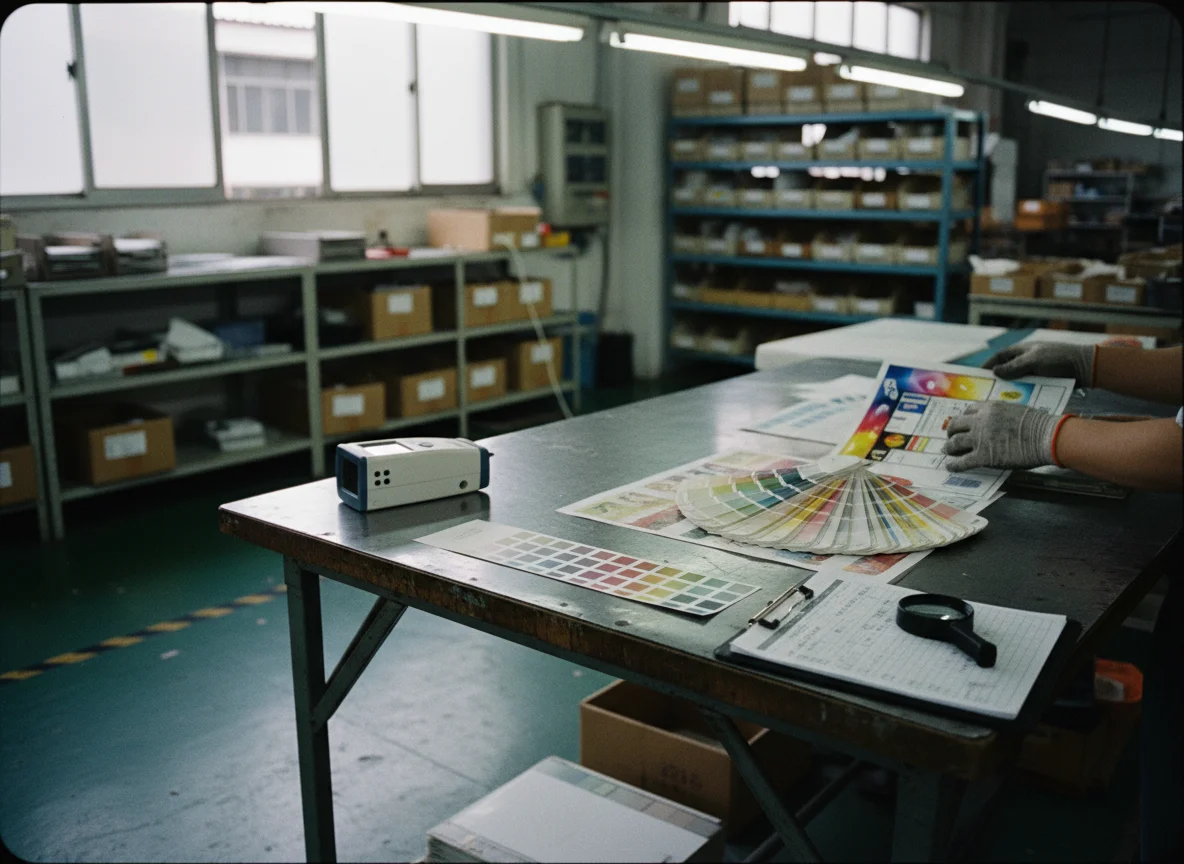
Spectrophotometer-verified color matching ensures Delta E < 2.0 consistency across production runs, with physical proofs provided before every production order.
Gang-Run Scheduling
Intelligent job scheduling groups orders on shared press sheets to reduce per-unit costs by up to 30% without sacrificing quality or turnaround time.
Multi-Substrate Capability
Print on paper, card stock, synthetic films, metallic substrates, and specialty materials — all on the same production line with calibrated color profiles for each.
Technical Specifications
- C1S / C2S Coated Paper
- Uncoated Bond & Offset Paper
- SBS & FBB Card Stock
- Corrugated Board (E, B, C flute)
- Synthetic Polypropylene (PP)
- Metallic Foil Board
- Recycled & FSC-Certified Stock
- ■Product packaging & retail boxes
- ■Labels & hang tags
- ■Product inserts & instruction manuals
- ■Marketing collateral & brochures
- ■Point-of-sale displays
- ■Catalog & booklet production
Frequently Asked Questions
Our minimum order for offset printing is 500 units. For smaller runs or prototyping, we offer digital production with no minimum order requirement. We can help determine the most cost-effective method based on your quantity and specifications.
We use spectrophotometer-verified color management with Delta E < 2.0 tolerance. Every production run begins with a physical proof approval, and in-line color monitoring checks consistency throughout the run at regular intervals.
Absolutely. Many enterprise clients use offset for high-volume core SKUs and digital for short-run seasonal variants or regional versions. We manage both production streams under a single program with consistent color calibration across methods.
We accept press-ready PDF/X-1a and PDF/X-4 files as standard. We also work with Adobe Illustrator (.ai), InDesign packaged files, and high-resolution TIFF/PSD files. Our prepress team provides free file checks before production.
Woven labels with polyester thread and satin weave withstand 50+ industrial washes without fading. Printed labels on polyester substrate last 20-30 washes. For industrial laundry, specify woven labels with 180+ thread count and Pantone color references to maintain legibility.
At 500 units, woven labels cost $0.35/unit vs printed at $0.25/unit. At 1,000 units, woven drops to $0.20/unit and printed to $0.15/unit. Printed labels are cheaper per unit up to about 2,000 units; beyond that, woven labels become more cost-effective due to lower per-unit costs at volume.
Full revalidation is required when changes affect the sterile barrier, such as a new material supplier, package design change, or equipment relocation. Partial revalidation may suffice for non-sterile changes like artwork updates. Consult your ISO 11607 compliance checklist to determine the appropriate level based on the change's impact.
Verification confirms that design outputs (artwork, dimensions) meet input specifications. Validation proves that the final package consistently meets user needs under real-world conditions. For example, verifying a die-cut template dimension is verification; seal integrity testing per ASTM F88 on production samples is validation.
Manual embossers typically support 1/4-inch to 3/4-inch tape, while digital printers handle media up to 4 inches wide. Dymo offers 1/4-inch, 3/8-inch, and 1/2-inch tape; Motex offers 1/2-inch and 3/4-inch. Always check the tape width compatibility before buying refills.
The breakeven point is around 500 labels per month. At 200 labels per month, manual is cheaper. At 500 labels per month, digital wins due to lower per-label cost ($0.03–$0.08 vs $0.15). For volumes between 200 and 500, either works depending on upfront budget.
FSMA requires packaging to be included in your food safety plan under supply-chain preventive controls. You must conduct a hazard analysis for each material (e.g., board, ink, adhesive), verify suppliers with certificates of analysis, and maintain records for at least two years. The focus is on process, not just material compliance with FDA 21 CFR.
FDA 21 CFR 174-178 governs material safety (e.g., limits for inks and adhesives), while FSMA governs the process: hazard analysis, preventive controls, supplier verification, and recordkeeping. You need both: a letter of compliance for materials (FDA) and a supplier verification program with audit results (FSMA).
Label shift causes printed content to drift from the intended position, leading to misaligned barcodes, text, or graphics. This results in scrapped labels and production delays. A 0.25-inch drift after 30-50 labels can waste an entire roll if undetected, increasing material costs and downtime.
Upgrading a printer costs $2,000–$5,000, while adjusting settings costs nothing. The breakeven point is when shift exceeds 0.5 inches consistently after applying all seven fixes. For most cases, settings adjustments resolve the issue, making upgrades unnecessary unless drift persists.
Offset printing becomes cheaper per card above 1,000 units because the plate setup fee ($50–150 per color) is spread across more cards. At 500 cards, digital is typically cheaper; at 1,000 cards, offset's per-unit cost drops to $0.10–0.15, undercutting digital's $0.12–0.18. The exact breakeven depends on finishes and stock weight.
16pt (350 gsm) stock offers the best balance of cost and perceived quality. It costs about 20–30% more than 14pt but feels substantial in hand. Both digital and offset can handle 16pt, though offset supports thicker options like 18pt or 24pt for ultra-premium cards.
FDA labeling under 21 CFR 801 requires a 14-character UDI DI and English-only text, while EU MDR under Annex I requires a 13-character DI with labels in all 24 official EU languages. EU mandates ISO 15223-1 symbols; FDA prefers ANSI Z535 text warnings. A single label design may not satisfy both markets without regional variants.
The top five mistakes are incorrect UDI data, missing ISO 15223-1 symbols, poor label durability for cold-chain or autoclave conditions, wrong language variants across 24 EU languages, and barcode readability failures. Each is preventable with automated visual inspection and a structured checklist.
Print speed directly impacts throughput and labor cost. A faster printer reduces the time operators spend waiting for labels, freeing them for other tasks. However, speed must be balanced with reliability; a printer that jams frequently negates speed gains. For high-volume operations, an industrial printer printing 8-12 inches per second at 300 DPI is recommended.
The breakeven point is typically around 10,000 labels per month. Below that volume, the upfront cost of a printer may not be justified. At 100,000 labels per year, savings from in-house printing range from $2,000 to $12,000 annually, allowing a $5,000 printer to pay for itself in 5 to 30 months.
Explore More Capabilities
Specialty Materials
Material and application review for labels and printed components, covering surface, adhesive, exposure, handling, finish, and sample requirements before production.
Learn more →Custom Shapes & Premium FinishesDie-Cut & Finishing
Die-cutting and finishing for multi-SKU labels, packaging, and campaign components, with shared shape, tooling, finish references, and approval points.
Learn more →Campaign, Display & Signage PrintingLarge Format Production
Large-format printing for retail campaigns, events, displays, and multi-location rollouts that require consistent artwork, versions, packing, and destination control.
Learn more →Industries Using Custom Print Production
Have files and a live production need?
Share the product, quantity, material, finish, artwork status, delivery market, or repeat-order reference you already have.