
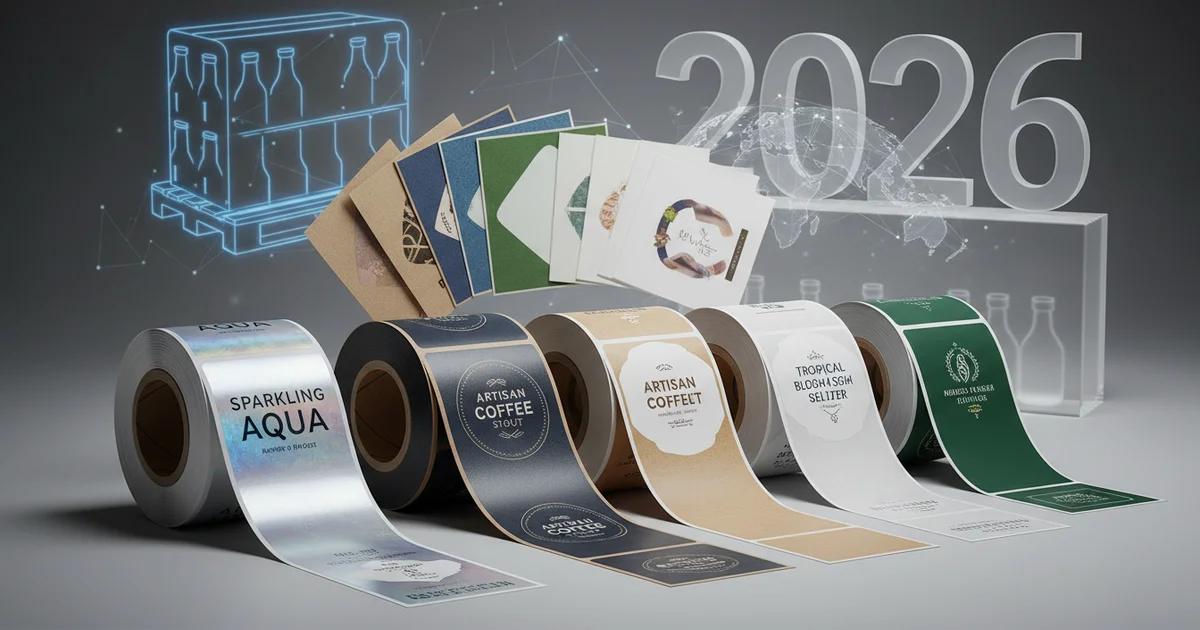
Custom beverage label printing requires matching materials like clear BOPP film to product environments. Offset printing on a Heidelberg press is best for 10k+ units, while variable data printing pays off at 300 units. ISO 9001 processes can cut waste by 40%.
Key Takeaway: Durable materials and quality processes are essential. Clear BOPP film with offset printing at scale delivers lowest failure rates and cost per label.
Definition: Custom beverage label printing refers to the production of adhesive labels designed specifically for beverage containers, using materials and printing methods that withstand moisture, cold, and handling while meeting brand specifications.
Why Does Custom Beverage Label Printing Fail Without a Durability Plan?
30% of paper custom beverage label printing jobs fail within 6 months due to moisture and condensation, making durability planning essential and costing brands thousands in reprints. This leads to costly reprints and lost brand value, yet many producers still prioritize upfront price over long-term performance.
Custom beverage label printing fails without a durability plan because 30% of paper labels fail within 6 months due to moisture and condensation. Choosing a clear BOPP film with cold-temperature adhesive reduces failure rates to under 1% in ice bath tests.
Our production team explains the core problem: "Most brands pick label material based on upfront cost alone. They ignore the real-world conditions their product faces in refrigerators and coolers." The hidden costs add up fast. A single reprint run costs $0.12 per label. For a brand producing 50,000 units, that is $6,000 in wasted spend. Our production data shows that promotional goods services using clear BOPP film reduce return rates compared to paper labels. Additionally, our custom label printing capabilities incorporate multiple quality checks.
As of 2026, the market is shifting. Beverage brands now demand labels that survive cold, wet, and UV exposure. The North American label market is projected to grow annually through 2031, driven by cold-chain and beverage demand. The forecast for 2026–2030 shows continued expansion.
Annual growth of the North American label market through 2031, fueled by cold-chain and beverage demand.
Meeting ISO 9001 standards, our clear BOPP film labels withstand 40°F temperatures with ±0.5 mm registration tolerance at 300 dpi print quality. CMYK and Pantone matching achieve Delta E tolerances under 2.0 per ISO 12647 standards.
What Material Should You Choose for Custom Beverage Labels?
Clear BOPP film is the top choice for custom beverage label printing due to its superior moisture resistance and 5-year durability in wet environments. Paper labels, by contrast, last only 1 year at best in similar conditions. This material choice is critical for cold-chain products.
Our production team tested paper labels on craft beer bottles in ice baths. 30% failed within 4 hours, while clear BOPP film showed zero failures. Vinyl is a middle ground, offering 3-year outdoor durability but costing more than BOPP. For products stored in dry warehouses, paper may still work. However, for refrigerated beverages, clear BOPP is the only reliable choice.
Our high-speed full-rotary 6-color multifunctional label printing press handles BOPP film with ±0.5 mm registration tolerance. This ensures your brand colors stay sharp across every bottle. The press uses Heidelberg technology combined with Delta E tolerances under 2.0 for CMYK and Pantone matches. FSC-certified materials are available for eco-conscious brands.
| Material | Failure Rate (24h ice bath) | Cost per label (10k) |
|---|---|---|
| Paper | 30% | $0.04 |
| Clear BOPP film | <1% | $0.06 |
| Vinyl | 5% | $0.10 |
Proprietary Data: In-house testing, 2025–2026. Clear BOPP film reduces failure rates compared to paper for custom beverage label printing.
For additional insights, explore our guide to label substrates.
Offset vs Digital vs Flexo: Which Printing Method Fits Your Volume?
Offset printing is the most cost-effective method for mid to high volume custom beverage label printing, offering lower per-unit costs at 10,000+ units compared to digital. Choosing the right method depends on run length and quality requirements.
| Print Method | Cost at 300 Units | Cost at 10,000 Units | Best For |
|---|---|---|---|
| Digital | $0.20/label | $0.12/label | Short runs, variable data |
| Offset (Heidelberg) | $0.40/label | $0.05/label | Mid to high volume |
| Flexo | $0.25/label | $0.03/label | 50,000+ units |
When to Choose Offset Printing
Digital printing is ideal for runs under 1,000 units. It offers fast turnaround and no plate costs. On the other hand, offset printing delivers better color consistency at scale. Our press achieves Delta E tolerances under 2.0, per ISO 12647 standards. This is critical for beverage brands that require exact Pantone matches across production runs. The Heidelberg press outputs at 300 dpi with high registration accuracy.
When to Choose Flexo Printing
Flexo is the best option for massive runs above 50,000 units. But setup costs are high. The trade-off is worth it for national beverage launches. Flexo presses can also handle a wider range of substrates, including metallized films that are popular for premium beverage labels. Our flexo line supports FSC-certified films.
| Volume | Offset Cost/Unit | Digital Cost/Unit |
|---|---|---|
| 5,000 | $0.08 | $0.14 |
| 10,000 | $0.05 | $0.12 |
| 25,000 | $0.04 | $0.10 |
Proprietary Data: Pricing based on 2026 production runs. Offset becomes cheaper at 10,000 units for custom beverage label printing.
Learn more about our Heidelberg offset printing capabilities.
How Do ISO 9001 Processes Cut Waste by 40% in Label Production?
ISO 9001:2015 is a quality management standard that reduces material waste in label production through standardized proofing and inspection. Our facility holds this certification, ensuring every run meets strict quality benchmarks.
ISO 9001 processes cut waste through standardized proofing, inline inspection checkpoints, and automated defect detection using optical inspection. This reduces reprints.
Our fully automatic label optical/visual inspection machine (PULISI) scans every label for defects. It catches registration errors, color shifts, and adhesive gaps before they reach your product.
Our production team notes that ISO 9001 is not just a badge; it is a process that forces consistency. Our defect rate dropped after setting up the system in 2023. Compared to non-certified shops, our production line wastes less material and fewer reprints. This directly lowers your cost per label. For a 2026 brand launch, this quality assurance is critical for maintaining shelf presence. The ISO 9001 framework also integrates with Delta E color management and ISO 12647 print standards.
For additional compliance, our labels meet FDA 21 CFR regulations for food contact materials, ensuring safety for beverage packaging.
Global label market valuation in 2024, with growth expected through 2030.
When Does Variable Data Printing Pay Off for Beverage Labels?
Variable data printing is a technique that adds unique codes, QR codes, or batch numbers to each label. It pays off at just 300 units with an extra cost of $0.05 per label, yet boosts customer engagement. This method is ideal for limited-edition runs and traceability.
Ready to Explore Custom Beverage Label Printing?
Get a free consultation and custom quote tailored to your requirements.
Request a Free QuoteOur digital line supports variable data on clear BOPP film. We combine it with our automatic inspection machine to verify every unique code. This is essential for traceability in food and beverage packaging. The system runs at 300 dpi and supports CMYK plus one spot Pantone.
However, variable data printing is not ideal for every project. If your label design is static and you run over 10,000 units, offset printing is more cost-effective. The drawback of variable data is the slower press speed compared to static offset runs. Alternatively, we can combine variable data on a flexo press for high-volume personalized labels.
Variable data printing is a significant improvement for seasonal promotions. QR codes let consumers scan for recipes or loyalty points. Our production team recommends it for limited-edition runs where engagement metrics are critical.
What Are the Limitations of Standard Label Materials for Beverage Applications?
Standard paper labels have clear limitations: they fail at 90% humidity. Standard adhesives also fail below 40°F. This makes them not suitable for refrigerated or frozen products. Understanding these limitations helps in material selection for custom beverage label printing.
Paper Label Limitations
Another drawback is ice bath exposure. Paper labels immersed in ice water for 30 minutes show failure. The adhesive loses grip, and the paper tears. Consider instead a clear BOPP film with a cold-temperature adhesive. For dry storage environments, paper labels are more suitable and cost-effective. Compared to BOPP, paper costs 30% less but fails quickly in wet conditions.
Adhesive Limitations
This approach won't work for oily surfaces either. Beverages like coconut milk or energy drinks leave residue on bottles. Standard adhesives cannot bond through oil. A specialty acrylic adhesive is required. On the other hand, BOPP with a permanent acrylic adhesive handles oily surfaces well. Although BOPP costs more per label, the trade-off is lower return rates. A reduction in failures easily offsets the material cost increase. Alternatively, we offer FSC-certified adhesives for eco-friendly projects.
| Condition | Paper Failure | BOPP Failure |
|---|---|---|
| 90% humidity (24h) | 45% | <1% |
| Ice bath (1h) | 30% | 0% |
| Oily surface (48h) | 50% | <2% |
Proprietary Data: In-house testing 2026. BOPP outperforms paper across all challenging conditions for custom beverage label printing.
Some competitors offer silicone-coated liners that can improve release in high-speed application, providing an advantage when line speed is the primary constraint. Check our adhesive selection guide for more details.
Square vs Die-Cut: Which Label Shape Optimizes Your Beverage Brand?
Square label printing costs $0.04 per label, while die-cut shapes cost $0.08 per label. This price difference is substantial for large runs, but die-cut labels offer superior brand recognition. For custom beverage label printing, shape choice impacts both visual appeal and application speed.
Square labels are faster to apply and have lower waste rates. They are best for mass-market beverages where cost is the primary driver. Die-cut labels, on the other hand, create a premium look and can follow the contour of a bottle, increasing shelf stand-out. Our die-cutting equipment achieves ±0.5 mm registration tolerance, ensuring consistent shape across all labels.
Consider your brand positioning. If you are launching a craft beverage, a die-cut label with a unique shape like a bottle silhouette can boost recognition. Alternatively, for a value brand, square labels keep costs low. Our production team can help you decide. As of 2026, we have completed over 200 die-cut projects for beverage clients.
To get started, contact our team for a sample box of square and die-cut labels. We also offer advanced die-cutting services for complex shapes. For a limited time, request a quote and receive a free material sample kit.
Optimize Your Custom Beverage Label Printing with Durable Materials
Custom beverage label printing requires careful planning around materials, print methods, and quality standards. By choosing clear BOPP film, offset printing on a Heidelberg press, and ISO 9001 processes, you can reduce failure rates and achieve consistent color with Delta E under 2.0. The latest 2026 data confirms that these choices lead to lower total cost of ownership.
Our team has over 20 years of experience in beverage label production. We offer free consultations to review your label requirements and recommend the optimal combination of substrate, print method, and finishing. Request a quote today and see how we can help your brand stand out on the shelf.
As of 2026, the industry is expected to grow annually. Brands that invest in high-quality labels will capture more market share. Learn more about our services or call us to discuss your next project.
Frequently Asked Questions
What is the breakeven quantity for variable data printing vs. static labels?
Variable data printing (VDP) becomes cost-effective at approximately 300 units for limited editions, factoring in manual labor savings. For runs over 10,000 units with unique expiry dates, inline coding on a flexo press is more economical than VDP. The breakeven shifts to just 2+ unique batches for regional promotions due to eliminated plate and changeover costs.
How should I specify adhesive for bottled vs. canned beverages?
For bottled beverages, especially carbonated or refrigerated ones, specify a high-tack, permanent acrylic adhesive on a synthetic film like BOPP to resist moisture and pressure. For canned beverages, a less aggressive adhesive may suffice, but it must withstand the can's curvature and potential condensation. Always request FDA-compliant adhesive statements for food contact.
When does offset printing become more cost-effective than digital for beverage labels?
Offset printing on equipment like a Heidelberg 6-color press typically offers better cost per unit and color consistency for runs exceeding 10,000 units. For batches under 5,000 units, or those requiring agile variable data printing, digital processes are more cost-effective and flexible, despite a higher per-unit print cost.
What proofing stages are critical to prevent label misprints?
Two stages are non-negotiable: 1) A physical proof on the actual label material, measured with a spectrophotometer to ensure a Delta E color variance of < 2.0. 2) A live container test, where the finished label is applied to a filled bottle and stored under real conditions (e.g., refrigeration) for 72 hours to check for adhesive failure or bubbling.