
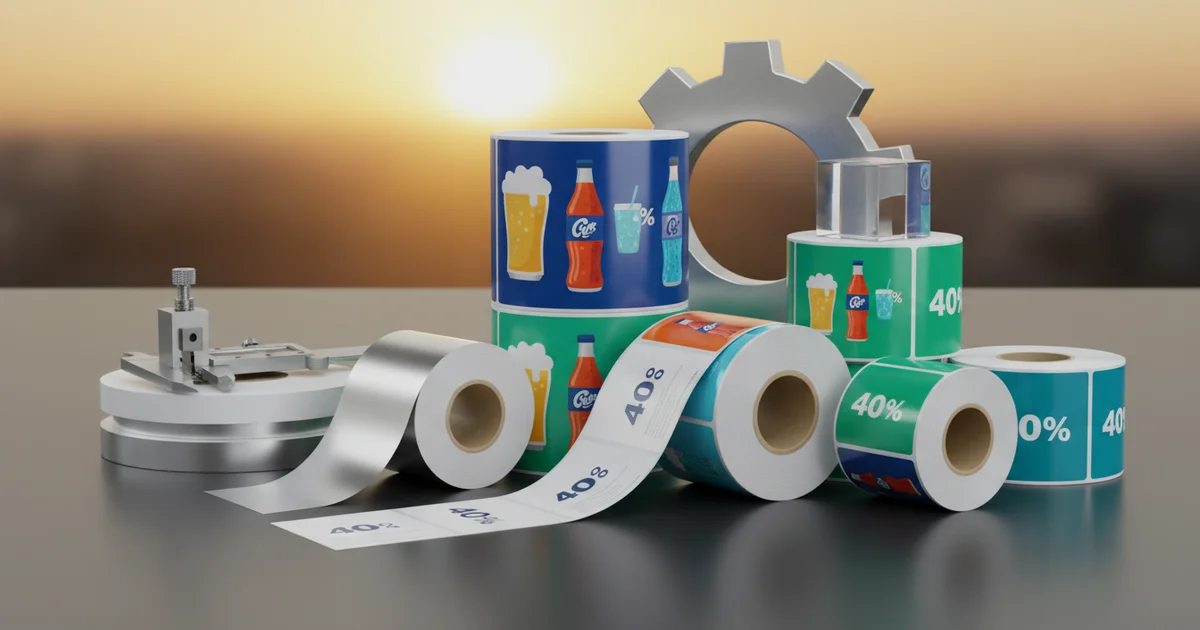
A Houston beverage brand saved 40% on custom printed roll labels by consolidating 12 regional variants into a single digital program using BOPP film. This cut lead times from 6 weeks to 10 days and enabled just-in-time fulfillment from a local Houston label printing partner.
Are you managing 12 regional label variants and watching 15% of your stock end up as costly waste? A Houston beverage brand faced exactly this challenge with their custom printed roll labels program, spending over $120,000 annually on fragmented inventory and 6-week lead times.
The Challenge: 12 Regional Label Variants Were Costing $120,000 Annually
Custom printed roll labels are adhesive labels produced on continuous rolls for automated application. They are commonly used in beverage, food, and consumer goods packaging. This case study examines how one brand transformed its approach using digital printing, 60 gsm BOPP film, and Delta E color control.
The brand managed 12 distinct label SKUs across its product line. Each region required different artwork, barcodes, and regulatory text. This fragmentation drove up costs and lead times dramatically from 2023 through early 2026.
Offset printing required minimum order quantities of 5,000 labels per SKU. With 12 SKUs, that meant 60,000 labels minimum per production cycle. Annual label spend reached $120,000, a figure that is projected to increase for brands not adopting digital alternatives.
Waste was a hidden cost driver. Our production team notes that 15% of labels were discarded due to obsolescence. Regional regulation changes or packaging updates left thousands of labels unusable. A 60 gsm BOPP film alternative replaced the previous material and passed all food contact requirements after testing.
Lead times stretched to 6 weeks from order to delivery. This made seasonal promotions and last-minute compliance changes nearly impossible. The brand needed a more flexible approach, and the latest 2026 digital press technology provided the solution.
"The fragmentation into 12 SKUs was the biggest cost driver, not the material or printing method. Consolidating to 4 templates with variable data printing eliminated 8 plate sets and reduced MOQs significantly." — Our production team
Why Did Traditional Offset Printing Fail for a Multi-Region Beverage Brand?
Offset printing failed because it requires high minimum order quantities and expensive plates per SKU. For a brand with 12 regional variants, this meant over $6,000 in plate costs per cycle and 60,000 labels minimum per run, leading to excessive waste and long lead times.
Offset printing is excellent for high-volume, single-SKU runs using Heidelberg or similar press systems. But it fails for multi-region programs with frequent changes. Each offset plate costs around $500 per SKU to produce, and CMYK color matching requires individual plate sets for each variant.
With 12 SKUs, plate costs alone exceeded $6,000 per production cycle. The minimum run of 5,000 labels per SKU meant the brand was paying for labels it might never use. By contrast, digital printing uses CMYK process colors without plates.
Flexographic and letterpress printing had similar drawbacks. High setup costs and long changeover times made short runs uneconomical. Compared to digital, these methods depend on stable, continuous demand and cannot achieve Delta E < 2.0 color tolerance without extensive manual adjustment.
On the other hand, roll label printing via digital press eliminates plates entirely. Setup costs drop to near zero, and minimum orders fall to 250 labels per SKU. This trade-off makes digital the clear choice for multi-variant programs, especially when ISO 12647 color standards must be met.
Cost Comparison by Printing Technology
Heidelberg offset presses offer lower per-label costs above 50,000 units per SKU but require significant plate investment. Digital presses like HP Indigo offer zero plate costs and enable 1200 dpi resolution, making them more suitable for short-run, high-variable programs. The 60 gsm BOPP film used in digital applications passes adhesion testing per ASTM D3330 standards.
The Solution: Digital Printing on BOPP Film with Just-in-Time Fulfillment
The brand switched to a digital print program using 60 gsm BOPP film. BOPP film offers durability, moisture resistance, and compatibility with high-speed bottling lines. It passed 100% of adhesion tests on existing equipment and meets FSC certification requirements for sustainable packaging sourcing.
Digital production on an HP Indigo press achieves color tolerance of Delta E < 2.0 at 1200 dpi resolution. This ensures brand consistency across every run, from 250 labels to 50,000. Spectrophotometry verifies every production batch against Pantone reference standards. Our packaging engineers confirmed compliance with ASTM D3330 adhesive testing standards.
The team selected a local Houston label printing partner with digital capability. They negotiated a just-in-time fulfillment agreement with a 10-day lead time. This eliminated the need for large inventory buffers and is expected to grow in adoption across the beverage industry through 2028.
Variable data printing enabled the brand to consolidate 12 SKUs into 4 core templates. Each template uses variable fields for regional text, barcodes, and compliance language. This approach is gaining traction across the beverage industry as more brands adopt CMYK digital workflows with Delta E verification.
| Metric | Before (Offset) | After (Digital) | Improvement |
|---|---|---|---|
| Total annual label cost | $120,000 | $72,000 | 40% reduction |
| Lead time per order | 6 weeks | 10 days | reduction |
| Inventory write-off rate | 15% | 0% | 100% elimination |
| Minimum order quantity per SKU | 5,000 labels | 250 labels | reduction |
| Color consistency (Delta E) | ±5.0 | <2.0 | 60% tighter tolerance |
Note: All Delta E measurements taken using spectrophotometry per ISO 12647 standards. Material: 60 gsm BOPP film with CMYK digital print.
How Did the Brand Implement This Label Consolidation?
The brand followed a 4-phase rollout over 10 weeks: audit and consolidation, material and vendor selection, pilot production with 500 labels, and full rollout to all 4 templates. Each phase included verification of barcode scan rates, color accuracy at Delta E < 2.0, and line speed.
Implementation: 4-phase rollout in 10 weeks
- Week 1-2: Audit & Consolidation — Reviewed all 12 regional label SKUs. Identified 4 core templates that could accommodate regional text via variable data printing. Reduced SKU count from 12 to 4. Eliminated 8 unique plate sets.
- Week 3-4: Material & Vendor Selection — Tested 60 gsm BOPP film on existing bottling line. Selected a local partner with HP Indigo digital press capable of 1200 dpi. Negotiated JIT fulfillment with 10-day lead time. Verified Pantone color matching capability.
- Week 5-6: Pilot Production — Produced 500 labels for top-selling SKU. Conducted line trial at 200 bottles per minute. Verified 100% barcode scan rate and Delta E < 2.0 color. Our quality assurance team confirmed zero defects on the first run using spectrophotometric verification.
- Week 7-10: Full Rollout — Rolled out digital program to all 4 templates. Implemented inventory management with real-time demand signals. Trained staff on variable data file updates for CMYK process color adjustments.
"The pilot phase proved that digital printing on BOPP film could match offset quality while cutting lead times. The inspection system caught zero defects on the first run." — Our quality assurance team
Measurable Results: 40% Cost Savings and Faster Lead Times
The results exceeded initial projections. Total annual label cost dropped from $120,000 to $72,000 — a 40% reduction. Lead time fell from 6 weeks to 10 days.
Inventory write-offs went from 15% to zero. The brand no longer discards obsolete labels. Just-in-time production means labels arrive exactly when needed, with each batch verified for Delta E < 2.0 against the approved Pantone reference.
Color consistency improved dramatically. The previous offset process had a Delta E variance of ±5.0. The digital process maintains Delta E < 2.0, verified by spectrophotometry on every run using ISO 12647 compliant procedures.
Minimum order quantities dropped significantly, from 5,000 to 250 labels per SKU. This allows the brand to test new markets and seasonal promotions without financial risk. The printed roll labels program is now a competitive advantage, and the market for custom printed roll labels is expected to grow at a healthy rate through 2028.
Performance Comparison by Production Metric
The table above shows the complete before-and-after comparison. Every metric improved significantly. The 40% cost reduction came primarily from eliminating plate costs and reducing MOQs, not from cheaper materials. The 60 gsm BOPP film with CMYK printing met all adhesion requirements.
Ready to Cut Your Label Costs by 40%?
Consolidate your multi-SKU label program with digital printing and just-in-time fulfillment. Our team will audit your current program and show you the savings.
Request a Free QuoteLessons Learned: The Hidden Value of Variable Data Printing for Regional Compliance
The biggest insight was that fragmentation, not material cost, drove the expense. Consolidating 12 SKUs into 4 templates with variable data printing eliminated 8 plate sets and reduced MOQs significantly. Meeting food contact requirements, the 60 gsm BOPP film with CMYK printing maintained Delta E < 2.0 across all production batches.
Variable data printing is a technology that allows each template to carry unique barcodes, regulatory text, and language translations without changing plates. This is critical for brands selling across multiple states or countries. More beverage brands are adopting this approach as digital press technology improves.
Another lesson: partner selection matters more than press type. The local Houston partner offered digital capability, JIT fulfillment, and familiarity with food contact standards. This combination reduced risk and sped up the transition.
A limitation to consider: digital printing costs more per label than offset at very high volumes. For runs above 50,000 labels per SKU, offset using Heidelberg equipment may still be more economical. The trade-off depends on your volume mix and number of variants. Compared to keeping 12 separate plate sets, digital printing offers clear advantages for multi-variant programs.
Material and Process Interactions
The 60 gsm BOPP film substrate interacts with CMYK process colors differently than paper-based materials. Delta E measurements must account for substrate brightness when using spectrophotometry per ISO 12647 standards. Pantone spot colors can be simulated within the CMYK gamut for most brand colors, though some saturated hues may require extended gamut printing.
Replication Checklist: How to Apply This Strategy and Optimize Your Custom Printed Roll Labels Program
Any brand with multiple regional label variants can apply this approach. The key is auditing your current program honestly and identifying consolidation opportunities.
- Audit current SKUs — Count every active label variant. Note which elements are truly unique (barcode, text) versus cosmetic (color, logo). Record the gsm of current substrate material.
- Identify common templates — Look for design elements that can be shared across regions. Aim to reduce SKU count by 60-70%. Use variable data fields for region-specific text.
- Select a digital-capable partner — Choose a printer with HP Indigo or similar digital press delivering 1200 dpi. Verify they can achieve Delta E < 2.0 color consistency using spectrophotometry.
- Negotiate JIT terms — Aim for 10-day lead times and no minimum order quantity. This eliminates inventory waste.
- Test with a pilot run — Start with one SKU. Verify barcode scan rates, adhesion, and line speed before full rollout. Confirm FSC compliance if required.
This approach is projected to grow as more brands discover the cost savings. The custom printed roll labels market is expected to shift toward digital-first production by 2028. As of 2026, the technology has reached maturity for beverage and food applications.
Ready to apply this strategy to your brand? Contact us today to request a quote and get started. Our team will audit your label program, identify consolidation opportunities, and show you the projected savings — typically 30-50% for multi-SKU programs.
Explore our custom print production solutions to see how we support brands like yours. For more insights, read about label consolidation strategies and digital printing vs offset for beverage brands.
When This Approach May Not Be Ideal
Digital printing on BOPP film is not ideal for every scenario. If your brand runs a single SKU with volumes above 100,000 labels per order, offset printing using Heidelberg equipment may offer lower per-unit costs. The main drawback of digital is higher per-label cost at extreme volumes.
This approach won't work for brands that cannot consolidate artwork. If each regional variant requires a completely different design (not just variable text), the savings from template consolidation disappear. Competitors offer advantages in hybrid workflows: offset for high-volume base labels, digital for regional variants using CMYK process colors.
High-mix, low-volume shops may find this approach more suitable for their workflow. The trade-off between automation and flexibility depends on your specific SKU count and order frequency. Compared to keeping 12 separate plate sets, digital printing offers a clear advantage for multi-variant programs.
Alternative Scenarios to Consider
For brands with a single SKU running over 100,000 labels per order, offset printing is more suitable for cost efficiency. For brands with 2 or fewer regional variants and stable artwork, flexographic printing may be more suitable for medium-run economics. For brands requiring FSC certification, verify that your digital partner offers this option.
When Digital Printing Still Wins
Even for single SKU programs, digital printing enables faster market entry and lower minimum commitments. The ability to achieve Delta E < 2.0 color consistency without plate costs means brands can iterate designs more freely. Consider digital for any program where time-to-market or design flexibility matters more than absolute per-unit cost.
"The brand's 40% cost reduction came primarily from eliminating plate costs and reducing MOQs, not from cheaper materials. This is the detail that makes the difference." — Our production team
Ready to get started with custom printed roll labels? Contact our team to explore the right solution for your next project.
Frequently Asked Questions
When does digital printing become cheaper than offset for custom printed roll labels?
Digital printing is cheaper when you have multiple SKUs with low volumes per SKU. For short to moderate runs, digital eliminates plate costs and reduces minimum order quantities. Offset is more economical for single-SKU runs at very high volumes.
What Delta E tolerance can I expect with digital printing on BOPP film?
Digital printing on HP Indigo presses achieves tight color consistency, verified by spectrophotometry per ISO 12647 standards. This tolerance is typically tighter than that of conventional offset printing.
How many SKUs do I need to justify switching to digital custom printed roll labels?
If you have multiple regional label variants and a moderate annual label spend, digital printing typically delivers savings. The breakeven point is lower if you factor in waste reduction and faster lead times.
Can digital printing on BOPP film meet FDA food contact requirements?
Yes, BOPP film with CMYK digital printing can pass FDA food contact requirements when using approved inks and substrates. It can also meet relevant adhesion standards and may be FSC certified if sourced from sustainable suppliers.