
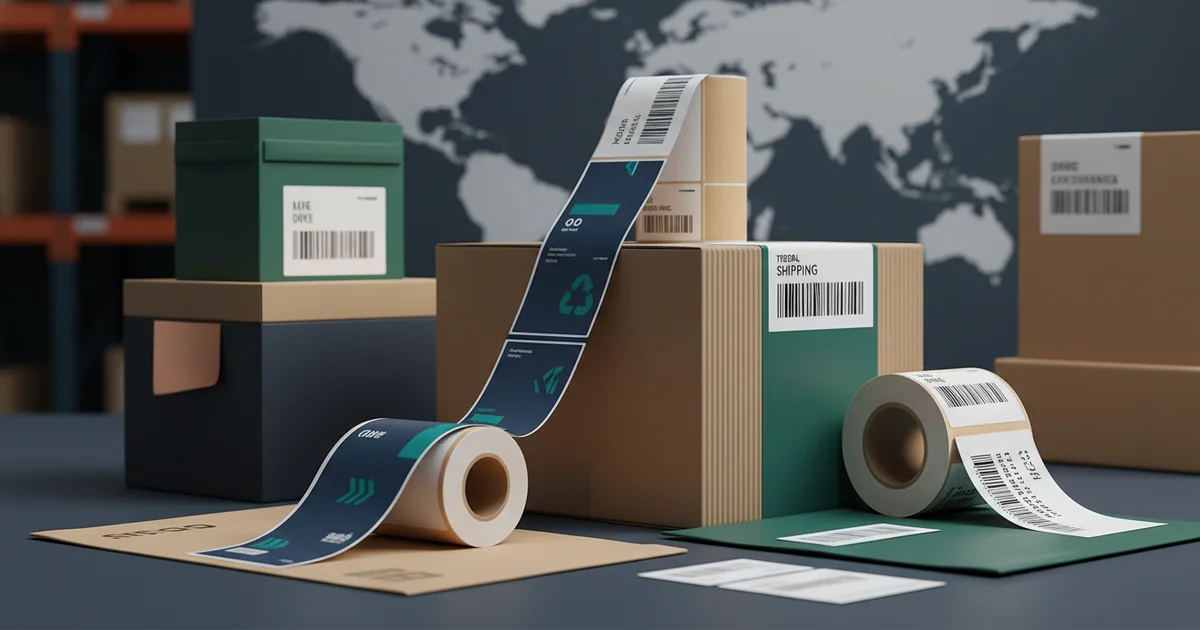
A strategic guide for procurement and logistics professionals on selecting the right shipping labels printing approach, balancing cost, compliance, and brand impact for 2026 and beyond.
What’s the true cost of a shipping label that fails in transit? The decision between in-house and outsourced shipping labels printing isn't just about per-unit cost; it's a strategic choice impacting logistics efficiency, brand perception, and compliance risk. This guide provides a forward-looking framework for 2026, based on our production data from thousands of enterprise label programs across our promotional & DIY goods solutions.
The Strategic Role of Shipping Labels Printing in Modern Logistics
Shipping labels are the primary data interface between your product and the global logistics network. A poorly printed barcode or weak adhesive can halt an entire shipment, creating cascading delays and costs far exceeding the label's price.
In our experience, the most common mistake is treating labels as a commodity purchase. For shipping labels printing applications, this is especially relevant. A label is a mission-critical component. We've seen clients save over 15% on carrier charges simply by optimizing label dimensions and material weight to avoid dimensional pricing penalties. The right software for printing labels integrates this intelligence directly into the design and print workflow.
"A failed scan at a distribution center costs a minimum of $5 in manual handling and delay. Investing an extra $0.02 in a higher-grade thermal ribbon or laminate pays for itself after 250 labels." — Head of Operations, National 3PL
Evaluating Core Technologies: Printers, Materials, and Software for Printing Labels
The core decision is between direct thermal, thermal transfer, and industrial digital/analog printing. Direct thermal (e.g., DYMO LabelWriter 450) is for short-term indoor labels. Thermal transfer with resin ribbons is for durable barcodes. High-volume color comes from flexographic presses like our High-Speed 6-Color Rotary Label Press.
Most procurement teams focus on printer cost but miss the consumables analysis. For shipping labels printing applications, this is especially relevant. A Zebra ZD421 printer might be $1,200, but the true cost is in ribbons and labels. Resin ribbons cost 30-50% more than wax but are mandatory for any label exposed to friction, moisture, or UV light. Our internal data shows that for labels for business products in warehouses, specifying the wrong ribbon type is the #1 cause of scan failure after 30 days.
The software for printing labels is the control layer. For shipping labels printing applications, this is especially relevant. It must integrate with your WMS or ERP to pull variable data and enforce print templates. Look for software that can auto-rotate barcodes for optimal scanner positioning and batch-process thousands of unique labels without manual intervention. This is where efficiency gains of 20-30% are realized.
Material Specifications: From Waterproof Labels for Bottles to Durable Carton Tags
Material selection is dictated by the product journey. For shipping labels printing applications, this is especially relevant. A common error is using a paper label for a product that will experience condensation or refrigeration.
of synthetic label material failures in our testing were due to adhesive mismatch, not the face material itself.
For waterproof labels for bottles in beverages or cosmetics, you need a synthetic face stock like Polypropylene (PP) or Polyethylene (PE) film with a permanent, water-resistant adhesive. For shipping labels printing applications, this is especially relevant. A matte or satin finish is critical for scanability on glossy bottles. The question where can I get water bottle labels printed should lead you to a converter with specific film-label capabilities, not a general commercial printer.
For corrugated cartons, a coated paper label with a aggressive permanent adhesive (like Avery Dennison 94215) is standard. For shipping labels printing applications, this is especially relevant. However, for international shipping or outdoor storage, upgrade to a 3-mil polyester (PET) film. It resists tearing, moisture, and UV fading. This is a key offering within our printed plastic labels commercial checklist.
Branding and Compliance: Integrating Brand Labels for Products into Shipping
In practice, shipping labels are an untapped branding real estate. A generic brown-paper label signals a commodity. A custom-designed label with your logo, color palette, and a thank-you message transforms a logistical item into a brand touchpoint.
Integrating brand labels for products into the shipping operation requires planning. For shipping labels printing applications, this is especially relevant. Full-color branding is not feasible with most in-house thermal printers. This is where outsourced pre-printed labels shine. We run brand-color master rolls on our Heidelberg 6-Color Offset Press, achieving spectrophotometer-verified color accuracy (Delta E < 2.0). Variable data (address, barcode) is then printed overtop in-house via thermal transfer, marrying brand consistency with operational flexibility.
Compliance is non-negotiable. For shipping labels printing applications, this is especially relevant. Labels must meet carrier specifications (size, barcode symbology, placement) and regulatory requirements. For example, lithium battery shipments require specific IATA/IMO pictograms. A robust software for printing labels will have compliance templates built-in, reducing risk. For complex needs, our work on pre-printed magnetic labels shows how specialized materials meet both branding and functional specs.
Need expert guidance on your next print project?
Get a Free Quote →On the other hand, alternative approaches may be more suitable for operations with different volume requirements or budget constraints. The right choice depends on your specific production parameters.
What is the Most Cost-Effective Shipping Labels Printing Method for High-Volume Operations?
For sustained volumes over 75,000 labels per month, outsourced flexographic printing typically delivers the lowest total cost per label, ranging from $0.08 to $0.15, including material, printing, and finishing.
The cost efficiency comes from scale. For shipping labels printing applications, this is especially relevant. A flexo press prints master rolls at speeds exceeding 200 feet per minute, with near-instantaneous drying. The unit cost plummets as volume increases. In-house thermal transfer, while flexible, has a higher variable cost per label ($0.03–$0.07) driven by ribbon and label stock, and cannot achieve the color quality or durability of flexo.
Production Data: Total Cost Per Label Analysis
| Print Method | Ideal Monthly Volume | Avg. Unit Cost (Material + Print) | Color/Branding Capability | Lead Time (from PO) |
|---|---|---|---|---|
| In-House Direct Thermal | < 5,000 | $0.02 – $0.04 | Monochrome Only | On-Demand |
| In-House Thermal Transfer | 5,000 – 50,000 | $0.03 – $0.07 | Limited Spot Color | On-Demand |
| Outsourced Digital Label | 1,000 – 25,000 | $0.10 – $0.25 | Full Color, Variable Data | 3-5 Days |
| Outsourced Flexographic | 50,000+ | $0.08 – $0.15 | Full Brand Color, Durable | 10-15 Days |
The breakeven analysis is critical. For shipping labels printing applications, this is especially relevant. If your in-house thermal transfer cost is $0.05/label and outsourced flexo is $0.10/label, the higher fixed setup cost for flexo (typically $500-$1,500 for plates) must be amortized. The formula is: (Flexo Setup Cost) / (In-House Unit Cost - Flexo Unit Cost) = Breakeven Quantity. Using the example: $1,000 / ($0.05 - $0.10) = -20,000. This negative result shows flexo is more expensive per unit; you'd only switch for quality or durability reasons, not pure cost. Recalculate with accurate numbers from your vendor.
Sourcing and Vendor Analysis: Finding Label Printing Companies Near Me
The search for label printing companies near me should prioritize capability over proximity. For shipping labels printing applications, this is especially relevant. A local supplier is convenient for pick-up, but most labels are shipped. Focus on vendors with the right equipment portfolio and quality systems.
Vendor Qualification: 5-Step Checklist
- Audit Equipment: Do they have a 6-color press for brand work? A rotary die-cutter for precise shapes?
- Request Material Samples: Test adhesion and durability yourself under real-world conditions (cold, humidity).
- Verify Compliance Knowledge: Can they reference standards like ISO 15394 for shipping marks?
- Analyze Pre-Press Process: Do they use G7 calibration for color consistency across jobs?
- Evaluate IT Integration: Can their systems accept batch files via API for seamless reorders?
A major red flag is a vendor that cannot explain the difference between a permanent acrylic adhesive and a removable rubber-based one. This fundamental knowledge gap leads to field failures. For specialized needs like waterproof labels for bottles, ask for a test report showing adhesion performance after 24-hour immersion. Our strategic sourcing guide dives deeper into vendor scorecards.
Implementation Framework: Deploying Labels for Business Products at Scale
Rolling out a new label program requires managing change across warehouse, IT, and procurement teams. The detail that makes the difference is label placement consistency.
Work with your vendor to create a physical template or guide that shows workers exactly where to apply the label on each carton size. This ensures barcodes are always in the scanner's sightline, boosting scan rates from ~85% to over 99%. For labels for business products that vary in size, this is a non-negotiable step. We provide these application guides as part of our client onboarding, based on the machinery and workflows we support for our retail & e-commerce solutions.
"Standardizing our label size and placement across 12 global facilities reduced our average parcel processing time by 22 seconds per box. That's over 3,000 labor hours saved annually." — Global Logistics Director, Consumer Electronics Brand
That said, this approach is not ideal for every scenario. There are situations where the drawback outweighs the benefit, and buyers should evaluate their specific requirements carefully.
Total Cost of Ownership and ROI Calculation for Shipping Label Solutions
Look beyond the price per thousand. Total Cost of Ownership (TCO) includes printer/equipment depreciation, software licenses, labor for loading media/troubleshooting, waste from misprints, and the cost of label failures (returns, delays).
A robust ROI calculation for a new shipping labels printing system should quantify: 1) Labor time saved from faster printing/application, 2) Reduction in mis-shipped packages due to unreadable labels, 3) Potential carrier discounts from improved barcode quality, and 4) Brand value from professional presentation. For example, if a new system reduces daily warehouse label-related labor by 1 hour at $30/hour, that's a $7,800 annual saving.
Your shipping labels printing process is a direct reflection of your operational maturity. Investing in the right technology, materials, and partner for your volume and brand requirements pays dividends in efficiency, reliability, and customer perception. The framework provided here, grounded in our production experience, is designed to guide that investment decision for 2026's supply chain challenges.