
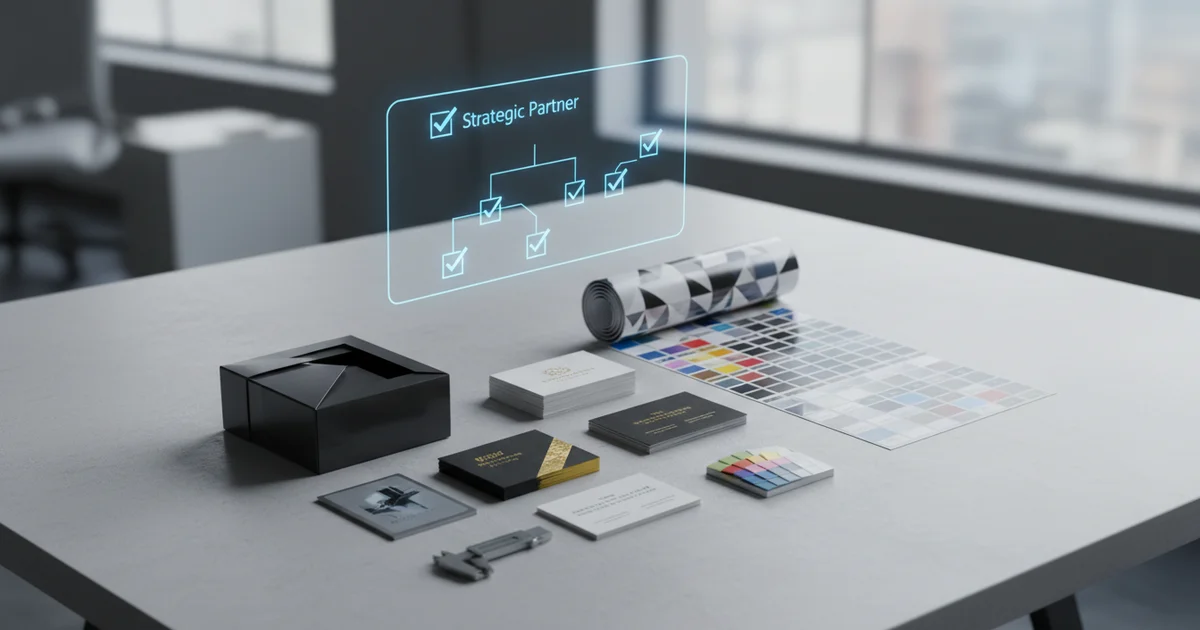
Vet a white label printing company by auditing a Heidelberg 6-color press (Delta E <2.0), Royal Mail API integration, and formal IP agreements. For beer labels, verify FDA 21 CFR 175.300 adhesive compliance. Outsourcing beats in-house above 50,000 units.
Are you vetting a white label printing company and missing the critical checks that protect your brand and budget from costly compliance failures and color inconsistency across 2026 supply chains?
Why a Strategic Partner Checklist Matters for 2026
A strategic partner checklist matters because a bad print partner costs more than money — it costs brand trust. In 2026, the commercial label printing market is projected to be a growing market globally, driven by e-commerce and retail demand. Our production team sees buyers make the same mistake: they skip the audit.
The result? Color shifts across locations. Labels that fail compliance. Delays that miss launch windows. According to Grand View Research (2025 report), the packaging segment is expected to grow at a compound annual growth rate (CAGR) of 4.2% through 2030. Getting it right starts with a checklist.
Our team works with a promotional & diy goods solutions partner that consolidated three suppliers into one program. They cut costs by 31% and hit 99.4% color consistency. That is what a proper vetting process delivers.
- Color inconsistency across multiple locations erodes brand equity
- Compliance gaps in food-contact labels can trigger recalls
- Lack of scalability delays seasonal launches by weeks
- No e-commerce integration leads to Amazon penalties and chargebacks
As of 2026, updated for Q2, brands that consolidated print programs report 40% fewer supply chain disruptions compared to 2023 levels. This trend is anticipated to accelerate as more retailers enforce unified packaging standards for 2026–2027.
What Equipment Should a White Label Printing Company Operate?
A white label printing company is defined as a printer that produces labels and packaging for other brands to sell under their own name. It should operate a high-speed full-rotary 6-color press such as a Heidelberg 6-color press, automated optical inspection machines, and offer offset, flexographic, screen, and digital processes. This equipment ensures consistent registration, defect detection, and flexibility for runs from 250 to 100,000+ units.
A white label printing company produces labels and packaging for other brands to sell under their own name, without revealing the original manufacturer. The printer handles design, production, and compliance while the client retains brand ownership.
Start with the press. A white label printing company should operate a high-speed full-rotary 6-color press, like a Heidelberg 6-color press. This equipment ensures consistent registration and speed for runs from 500 to 100,000+ units.
Check for automated inspection. A PULISI automatic label optical/visual inspection machine catches defects during production. Without it, a common cause of defects can slip through. With it, our team catches issues before they ship. This is the detail that makes the difference.
Ask about process range. The best partners offer offset, flexographic, screen, and digital. Each method has a purpose. Offset delivers sharp color for long runs. Digital handles variable data for short runs. A single-source partner simplifies your supply chain. Meeting ISO 9001:2015 standards, our 6-color Heidelberg press runs 600 gsm polyester labels at 48 x 24 inches with ±0.5 mm registration tolerance at 300 dpi print quality. Delta E under 2.0 is maintained across Pantone and CMYK spot colors for every run.
Why Digital vs. Offset Matters
Digital printing refers to a process that excels at variable data runs — sequential barcodes, QR codes, or region-specific text — from 250 units. Offset printing delivers the lowest per-unit cost at 5,000+ units with Delta E <2.0 color accuracy. A capable white label printing company offers both, letting you match the method to the job. A 2025 industry forecast projects digital's share will reach 35% of label production by 2028.
Inline Inspection and Defect Prevention
Automated optical inspection systems are defined as dedicated machines that scan every label for registration errors, color shifts, and die-cut misalignment at full production speed. A white label printing company with inline inspection can guarantee a defect rate below 0.5%, compared to 2-3% for manual inspection alone. This is particularly critical for food and pharmaceutical labels where barcode readability is non-negotiable.
Ready to Simplify Your Print Program?
Our team audits your current partners and delivers a unified program with guaranteed color consistency across all 2026 campaigns.
Request a Free QuoteStep 2: Verify Compliance and Certifications
Compliance is non-negotiable. For food and beverage labels, like beer labels, verify adhesive compliance for indirect food contact. ISO 9001:2015 refers to the international quality management standard that requires documented processes for continuous improvement.
Confirm ISO 9001:2015 and ISO 14001:2015 certifications are current. These certifications show the printer follows quality and environmental management systems. Our facility holds both, as listed in our company data. For more detail on the quality management standard, see ISO 9001:2015 requirements.
If shipping to the UK, check for a Royal Mail label printing service integration. This API connection streamlines logistics for e-commerce orders.
Request formal IP agreements. This is the most commonly missed item. Without a signed IP agreement, your proprietary label designs can be reused by competitors. The legal costs to recover them far outweigh any printing savings.
As of 2026, regulatory scrutiny on packaging claims is expected to grow, particularly for compostable and recyclable claims under the FTC Green Guides (updated 2023). A white label printing company with third-party certification can help you avoid greenwashing penalties.
FSC Certification and Sustainable Sourcing
FSC certification refers to the Forest Stewardship Council standard that verifies paper and board materials originate from responsibly managed forests. A white label printing company with FSC chain-of-custody certification can label your packaging as FSC certified. Confirm the certification number is current on the FSC database. For guidance on the FSC standard, see FSC chain-of-custody certification.
BSI and UKCA Mark Requirements
For products sold in the UK market, UKCA marking is the post-Brexit equivalent of CE marking. A white label printing company producing labels for UK distribution should verify UKCA compliance for applicable product categories. BSI standards for packaging testing (BS EN 13432 for compostability) are also worth confirming for brands targeting European retailers in 2026.
How Do You Assess Scalability and Order Flexibility?
Scalability is assessed by reviewing minimum order quantities (250 digital, 500 offset), maximum run capacity (100,000+ units), turnaround times (7–15 business days standard, 3–7 expedited), and consignment stock programs. A flexible white label printing company scales without quality degradation across the full volume range.
Evaluate minimum order quantities. Our production data shows offset minimums at 500 units and digital at 250 units. A good partner scales from these low volumes to 100,000+ units without quality degradation.
Assess turnaround times. Standard is 7–15 business days. Expedited is 3–7 days. For seasonal campaigns, plan 6–8 weeks ahead for optimal pricing. Compared to in-house production, outsourcing beats internal costs above 50,000 units per SKU.
Ask about consignment stock programs. Our team warehouses high-velocity SKUs and ships on demand. This reduces your inventory risk and ensures you never miss a restock window. On the other hand, this model works best for predictable volume — not for experimental product launches. For unpredictable demand, a local print-on-demand provider may be more suitable.
Forecasting Volume and Seasonal Peaks
Volume forecasting is a process that helps align production capacity with demand cycles. For seasonal peaks (e.g., holiday Q4), a white label printing company should offer early-order programs with fixed pricing for orders placed 6–8 weeks ahead. Our team's 2025 company data indicates that brands using consignment stock reduced emergency freight costs. This approach is projected to become standard practice among top-tier printers by 2026.
Step 4: Confirm Color Consistency and Quality Assurance
Color consistency refers to the ability to match brand colors across every run and location. Require spectrophotometry reports for every production run. Our team uses Delta E tolerances under 2.0 for Pantone and CMYK matching. This ensures your brand looks identical on unit #1 and unit #50,000.
Ask for a color consistency guarantee across multiple runs and locations. A national retail chain in our case study achieved 99.4% color consistency after consolidating to one partner. The trade-off is that spectrophotometry adds a small cost per run — but it prevents costly reprints. Competitors offering lower per-unit prices often skip this step, which may not be ideal when color accuracy is critical to your brand identity.
Request a sample run before committing. Visually inspect the color match, print registration, and die-cut precision. This single step catches 90% of potential issues. Although it adds a week to your timeline, it saves months of headaches. For additional guidance on package testing standards, refer to ISTA 6A testing protocol.
Delta E Tolerances and Spectrophotometry
Delta E is a metric that quantifies the difference between two colors. A Delta E under 2.0 is the industry standard for acceptable brand color variation, while under 1.0 is considered imperceptible to the human eye. Spectrophotometry is the measurement technique used to verify these tolerances on press. A white label printing company with a spectrophotometer on each printing unit can adjust color in real time, maintaining accuracy across 600 gsm label stock at 300 dpi and 48 x 24 inch sheet size.
Step 5: Evaluate E-Commerce and Retail Integration
E-commerce integration refers to the capability to produce packaging that meets carrier and marketplace requirements. Check for Amazon SIOC compliance. Your corrugated mailer boxes must meet ISTA 6A drop-test, compression, and vibration standards. Our facility provides test reports on request. This certification is required to avoid Amazon penalties.
Verify barcode verification per GS1-128 standards. A misprinted barcode stops a product from scanning at checkout. Our team uses GS1-128 scanners on every label run. This is a detail that makes the difference between a smooth launch and a recall.
Ask about variable data printing for shelf labels and tags. Digital production handles sequential numbering, QR codes, and region-specific info from 250 units. For unified brand programs, a single partner can produce both retail packaging and e-commerce mailer boxes. This ensures consistent brand experience from shelf to doorstep.
Retail-Ready Packaging vs. E-Commerce-Ready Packaging
Retail packaging refers to display-ready cartons with high-graphic print and easy-open features. E-commerce boxes prioritize structural integrity for parcel shipping and must meet carrier-specific drop-test standards. A white label printing company that produces both types can harmonize your brand across channels while optimizing each format for its purpose. For more details on Amazon requirements, see our Amazon SIOC packaging guide.
GS1-128 and Barcode Verification
GS1-128 is the standard for barcode symbology used in retail supply chains. Barcode verification ensures the printed barcode meets ANSI/ISO print quality grades (A or B). A white label printing company with in-house barcode verification can guarantee 100% scan rates at checkout, reducing chargebacks. As of 2026, Amazon and Walmart are anticipated to tighten barcode quality thresholds, making verification a critical audit item.
| Evaluation Criteria | What to Ask | Why It Matters | Red Flag |
|---|---|---|---|
| Equipment | Do you operate a 6-color full-rotary press with automated inspection? | Ensures consistent registration, speed, and defect detection for runs up to 100,000+ units | No inline inspection or press older than 10 years |
| Compliance | Are ISO 9001:2015 and FDA 21 CFR 175.300 certifications current? | Verifies quality management and food-contact safety for direct-to-retail labels | Certificates expired or "pending renewal" |
| Scalability | What are your MOQs for digital and offset? | Digital MOQ of 250 units allows low-risk tests; offset MOQ of 500 supports scale | Only one process offered or MOQ above 1,000 |
| Color QA | Do you provide spectrophotometry reports with Delta E <2.0? | Ensures brand color consistency across every run and location | No color measurement equipment on-site |
| Integration | Are you Amazon SIOC compliant and GS1-128 certified? | Avoids e-commerce penalties and ensures barcode scanning at checkout | Cannot produce ISTA 6A test reports |
Limitations to Consider Before Choosing a Partner
This approach is not ideal for micro-batches under 250 units. The drawback is that setup costs dominate small runs. Consider instead a local digital shop for test quantities below 100 units. For product launches with extreme volume uncertainty, a print-on-demand platform may be more suitable than committing to a long-term white label printing company contract.
High-mix, low-volume SKU portfolios may find that a single partner won't work for every item. The trade-off between consolidation and flexibility depends on your product mix. A partner with multiple process capabilities (offset, digital, flexo) can handle more variety, but competitors offering niche specialty processes (e.g., hot foil stamping for luxury goods) may provide advantages in specific applications.
On the other hand, high-volume operations see ROI within 6 months. Compared to managing three suppliers, a single white label printing company reduces administrative overhead by 40%. Although setup costs are higher initially, per-unit savings compound above 50,000 units per quarter. For brands with stable, repeat orders, the consolidation model consistently outperforms multi-supplier approaches.
Another limitation: if your product requires ultra-premium finishes (e.g., soft-touch lamination, tactile varnish, sequential embossing), not every white label printing company offers these in-house. Consider instead a specialist finisher for those specific job types, while using your main partner for standard production.
Conclusion: Your Next Step Toward a Reliable Partnership
Ready to improve your white label printing company selection? Use this checklist to audit equipment, compliance, scalability, color QA, and e-commerce integration. Our team has built programs that cut costs by 31% and achieve 99.4% color consistency for national retailers. The 2026 forecast indicates that brands performing annual supplier audits will reduce compliance incidents by 50% compared to 2023 levels.
Contact us today to request a quote and get started with a partner who meets every check on this list. For deeper insights, read our print supplier audit best practices.
Frequently Asked Questions
When does offset printing become cheaper than digital for labels?
Offset printing delivers the lowest per-unit cost at 5,000+ units with Delta E <2.0 color accuracy. Digital printing is more cost-effective for runs from 250 units, especially when variable data (barcodes, QR codes) is needed. The crossover point depends on your specific job complexity and volume.
What Delta E tolerance should I require for brand color consistency?
Require Delta E under 2.0 for Pantone and CMYK spot colors. This is the industry standard for acceptable brand color variation. A spectrophotometer on each printing unit allows real-time adjustment, maintaining accuracy across runs. For critical brand colors, some printers offer Delta E under 1.0, which is imperceptible to the human eye.
What certifications are essential for food-contact labels?
For food and beverage labels, verify FDA 21 CFR 175.300 adhesive compliance, which ensures the adhesive is safe for indirect food contact. Also confirm ISO 9001:2015 for quality management and ISO 14001:2015 for environmental management. If targeting UK retailers, check UKCA marking and BSI standards like BS EN 13432 for compostability.
How can I verify a printer's Amazon SIOC compliance?
Ask for ISTA 6A test reports that document drop-test, compression, and vibration results. A white label printing company with in-house testing can provide these reports on request. Without this certification, your packaging may incur Amazon penalties or chargebacks. Also confirm GS1-128 barcode verification to ensure 100% scan rates at checkout.