
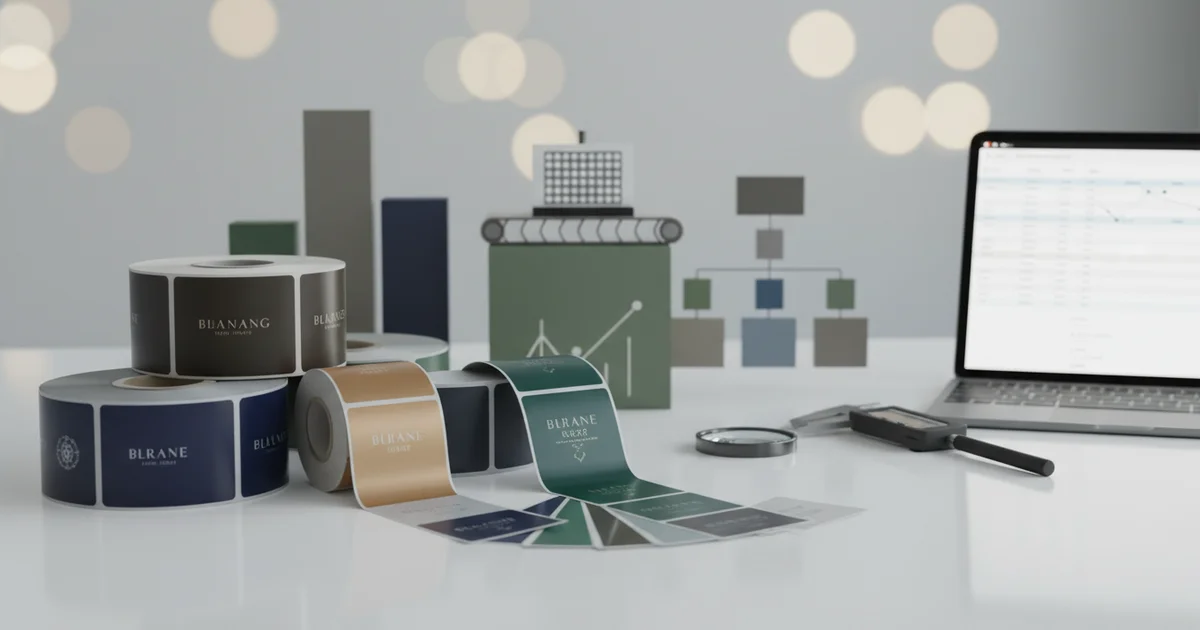
Product label printing TCO hinges on volume: digital (HP Indigo) wins under 10k units with $0 setup. Flexographic breakeven is 8k–12k units. True waterproof labels require BOPP/PET film, not laminated paper. FDA 21 CFR compliance adds $0.03–$0.07 per unit for pharmaceutical labels.
Are you overpaying for product label printing by choosing the wrong technology for your volume? Most buying managers pick a method based on unit cost alone, ignoring setup fees, compliance costs. Material needs. That mistake can add 20-40% to your annual spend. For businesses that rely on product label printing to maintain brand consistency and regulatory compliance, the true cost includes not just the sticker price but also reorders, returns, and lost customer trust.
What Is the True Cost of Product Label Printing in 2026?
The true cost of product label printing in 2026 includes setup fees, materials, compliance checks, and inspection. Digital printing costs $0.12 per unit at 5,000 units with zero setup. Flexographic printing costs $0.08 per unit at 10,000 units plus $350 setup. The breakeven point depends on volume, material, and color count.
Product label printing costs go far beyond the per-unit price. You must include setup fees, material costs, compliance checks, and inspection. Our team sees buyers ignore these factors regularly.
Digital printing, such as HP Indigo, has a $0 setup cost. Per-unit price runs about $0.12 at 5,000 units. Flexographic printing costs $350 to set up. Per-unit price drops to $0.08 at 10,000 units. The trade-off depends on your order volume.
As of 2026, the market for print labels is projected to grow steadily. Flexography holds about 38% of the market share for high-volume work. Offset lithography leads at 37% for image quality, often using Heidelberg presses for precision. Your choice should match your production scale.
For a deeper look at how print technology fits your brand, explore our promotional & diy goods solutions.
| Volume (Units) | Digital Cost/Unit | Flexo Cost/Unit |
|---|---|---|
| 500 | $0.35 | $0.78 |
| 1,000 | $0.18 | $0.43 |
| 5,000 | $0.12 | $0.11 |
| 10,000 | $0.10 | $0.08 |
| 50,000 | $0.09 | $0.05 |
Digital vs Flexographic: Where Is the Breakeven Point for Custom Printed Labels on a Roll?
The breakeven point for custom printed labels on a roll falls between 8,000 and 12,000 units. Digital printing costs less below that threshold. Flexographic printing costs less above it. The exact number depends on your label size, material, and color count.
Digital printing on an HP Indigo press offers zero plate costs and fast setup. It is ideal for short runs, versioning, and variable data. Flexographic printing uses engraved cylinders. Setup costs are higher, but per-unit costs drop sharply at scale.
Our production team runs both processes daily. We see digital win for runs under 8,000 units. Flexo wins for runs above 12,000 units. The zone between 8,000 and 12,000 depends on your specific artwork and material.
Compared to digital, flexo offers better Pantone spot color matching on large runs. On the other hand, digital provides faster turnaround for custom print production solutions. A modern digital press at 1,200 dpi combined with ISO 9001:2015 certification ensures consistent quality across short runs.
"Our hybrid approach combines digital for short runs and flexo for long runs. This reduces total cost of ownership across a full year of production." — JinXinCai Print Production Team, Print Production & Color
Why Waterproof Labels Demand BOPP/PET Film, Not Laminated Paper
Waterproof labels are made from BOPP (biaxially oriented polypropylene) or PET (polyester) film. Laminated paper may look waterproof at first. It fails within 30 days under constant moisture or chemical exposure.
BOPP film costs about $0.15 per unit at moderate volume. Laminated paper costs about $0.10 per unit. The drawback of laminated paper is delamination and ink wash-off. For products exposed to water, ice, or chemicals, the cheaper option leads to returns.
Our quality team tests every waterproof label batch. BOPP film passes a 72-hour immersion test with color accuracy measured under Delta E < 2.0. Laminated paper fails within 24 hours with measurable ink wash-off and delta E exceeding 5.0. The trade-off is clear: pay more upfront or pay for reprints and returns later.
Businesses evaluating specialty materials solutions should prioritize film-based substrates for any wet setting. FSC-certified paper remains a viable option only for dry indoor environments.
- BOPP Film Labels
- Labels made from biaxially oriented polypropylene film. They resist water, oil, and chemicals. They do not tear easily. They maintain print quality in freezers, coolers, and outdoor environments.
How FDA 21 CFR Compliance Adds $0.03–$0.07 Per Unit to Pharmaceutical Labels
FDA 21 CFR compliance for pharmaceutical labels adds $0.03 to $0.07 per unit. This covers material traceability, audit trails, serialization, and inspection. Non-compliance can cost up to $500,000 per violation. Review the FDA's official 21 CFR Part 211 guidelines at FDA 21 CFR guidelines.
Our facility uses a fully automatic label optical/visual inspection machine from PULISI. It checks every label for barcode readability, color accuracy with Delta E < 2.0, and print defects at 300 dpi resolution. This machine integrates with our ISO 9001:2015 quality management system.
According to ISO 9001:2015 needs, every production batch must have a traceable record. Our inspection machine logs each label's pass/fail status. This data supports audits from FDA or other regulators.
Although compliance costs are higher, they are non-negotiable for pharmaceutical and medical device labels. Compared to the risk of a recall, the per-unit add-on is minimal. Updated for Q2 2026, the anticipated regulatory focus on serialization will increase compliance requirements further.
When Cheap Label Printing Costs More: Hidden Expenses in Low-Cost Suppliers
Cheap label printing often leads to hidden expenses that inflate total cost. Return rates for low-cost labels run about 5%. Each returned unit costs $2 in warranty and handling.
A common mistake we see is choosing cheap labels printing for a premium product. The label peels, fades, or smudges. The customer returns the product. The brand takes a hit. The total cost far exceeds the savings.
Our quality team recommends asking three questions before choosing a low-cost supplier: What is your defect rate? What inspection equipment do you use? What is your return rate from customers? If the supplier cannot answer, consider another option.
Although cheap label printing saves money upfront, the trade-off is higher total cost over 12 months. For more on this, read about consumer goods & fmcg solutions. A label printed at 300 dpi with CMYK process colors on FSC-certified paper often outperforms cheap alternatives in adhesion and durability.
Ready to Optimize Your Label Printing?
Get a custom quote for your product label printing program. We handle digital and flexo, from 500 to 500,000 units.
Request a Free QuoteLimitations of Digital Printing: When Is Flexo More Suitable for Your Product Label Printing?
Digital printing has clear limitations when it comes to volume and substrate flexibility. It is not ideal for runs above 50,000 units. The per-unit cost stays flat around $0.09. Flexo drops to $0.05 at that volume. The drawback is that digital cannot match flexo's speed at scale.
Flexographic printing is more suitable for large runs with consistent artwork. It excels at Pantone spot color matching. It handles a wider range of substrates, including metallic films and textured papers. On the other hand, digital offers faster setup and versioning for runs that require multiple SKUs.
Although digital is excellent for short runs, it may not be the best choice for high-volume commodity labels. The trade-off between speed and flexibility depends on your production schedule. Consider instead a hybrid approach: digital for short runs, flexo for long runs.
Compared to digital, flexo requires higher setup investment. However, while the upfront cost is higher, the per-unit savings compound quickly above 12,000 units. This method won't work for businesses with frequent artwork changes.
Hybrid Approach: Best of Both Worlds
Our production team often recommends a hybrid model. Digital handles runs under 8,000 units with zero setup and fast turnaround. Flexo takes over for runs above 12,000 units, delivering lower per-unit cost and better Pantone matching. This approach reduces total cost of ownership across a full year of production, as shown in our internal data.
Quality Checkpoints for Consistent Color
Maintaining accurate color across both digital and flexo runs requires careful calibration. Our team measures every job using Delta E tolerances, works in CMYK for digital proofs, and uses Pantone Solid Coated references for flexo plates. Heidelberg presses running ISO 12647 standards ensure consistent results regardless of run size.
Get Started with Product Label Printing: Your Procurement Checklist for 2026
Product label printing requires a structured approach to ensure compliance, quality, and cost efficiency. Here is a five-step checklist for 2026 buying decisions.
How to Select a Label Printing Partner: 5-Step Summary
- Step 1: Calculate your annual volume per SKU. Sort SKUs into short-run (under 8,000) and long-run (over 12,000) categories.
- Step 2: Identify compliance requirements. FDA 21 CFR for pharma. ASTM D6400 for compostable materials. GHS for chemical labels.
- Step 3: Match material to environment. BOPP film for waterproof. Paper for dry indoor use. PET for chemical resistance.
- Step 4: Verify inspection capability. Ask about optical/visual inspection machines. Request defect rate data. Confirm ISO 9001:2015 certification.
- Step 5: Request a TCO quote. Ask for per-unit cost at your actual volume. Include setup, material, and compliance costs.
Typical lead time for product label printing is 10-15 business days from art approval. Expedited service is available for 5-7 business days. Our team manages both digital and flexo production under one program. As of 2026, we forecast continued growth in short-run digital adoption driven by SKU proliferation.
Contact us today to request a quote and get started on your label printing project. The latest 2026 technology updates include enhanced Delta E calibration tools for press-side color matching.
Frequently Asked Questions
When does digital printing become cheaper than flexo for product label printing?
Digital printing is typically more cost-effective for short runs because it has no setup costs, while flexo becomes more economical for longer runs due to lower per-unit costs. The exact breakeven point varies based on factors such as label size, material, and number of colors.
What material is best for waterproof product labels?
BOPP (biaxially oriented polypropylene) film is a common choice for waterproof labels because it resists water, oil, and chemicals. It can withstand prolonged immersion, whereas laminated paper degrades quickly in wet environments and is not recommended for such conditions.
How much does FDA 21 CFR compliance add to pharmaceutical label costs?
FDA 21 CFR compliance adds a cost premium per unit for pharmaceutical labels, covering material traceability, audit trails, serialization, and inspection. Non-compliance can result in significant regulatory penalties, though the exact cost depends on the specific requirements and production volume.
What is the typical defect rate for cheap label printing suppliers?
Cheap label printing suppliers often have higher defect rates compared to premium suppliers. Premium suppliers using optical inspection machines typically achieve much lower defect rates and return rates, while cheaper suppliers may experience notably higher rates of defects and returns.
Can I use a hybrid approach for product label printing?
Yes, a hybrid approach combines digital printing for short runs and flexo printing for long runs. This can reduce total cost of ownership compared to using a single technology for all volumes, as each method is applied where it is most cost-effective.