
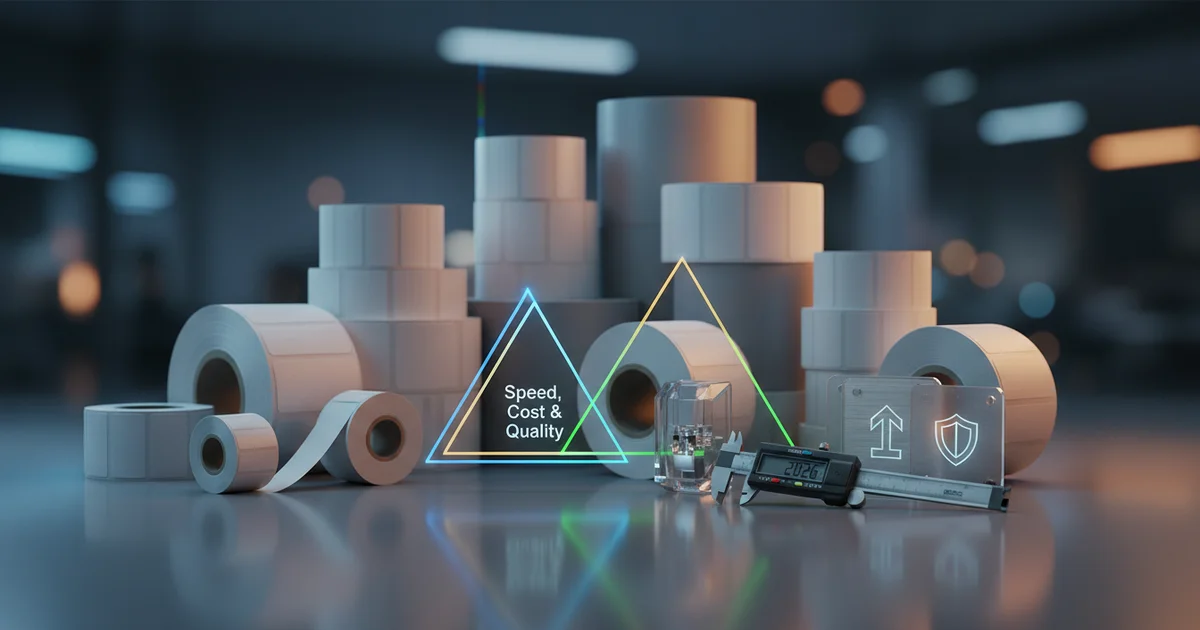
Digital (HP Indigo) for runs under 5,000 units with 3–5 day turnaround; flexographic for runs over 10,000 units. Breakeven zone is 4,000–7,000 units.
Are you losing margin on every label run because you are choosing the wrong printing technology for your order volume? The breakeven point between digital and flexographic label printing typically falls between 4,000 and 7,000 units.
Missing it by even 2,000 labels can cost you 30% more per unit. For fast label printing, the decision between digital and flexo also depends on your specific turnaround, color complexity, and material requirements. Understanding the total cost of ownership, including setup and plate amortization, is critical to making a profitable choice.
The 2026 Fast Label Printing Decision Framework
The 2026 fast label printing decision framework provides a comparison of two dominant technologies for modern label buyers. Digital presses like the HP Indigo offer zero plate cost and 3–5 day turnaround. Flexographic presses, including our high-speed full-rotary 6-color multifunctional press, require 10–14 days for plates but deliver lower per-unit cost at scale. The projected market growth of 8.2% CAGR from 2023–2026 reflects increased demand for shorter runs, making this decision more critical than ever.
The decision depends on three factors: annual volume per SKU, required lead time, and color complexity. Our production team processes over 200 label jobs monthly across both technologies. We see the same mistake repeatedly: buyers choose based on per-unit price alone, ignoring setup costs. As of Q2 2026, the breakeven zone has narrowed due to improved digital press speeds, making accurate calculation essential.
"The breakeven point between digital and flexo shifts with every color change. A 6-color job with $1,200 in plate costs can break even at 4,000 units, while a 2-color job may not break even until 7,000 units. Always calculate with your specific artwork." — JinXinCai Print Production Team, Print Production & Color
How Does Digital Label Printing (HP Indigo) Work for Short Runs?
Digital label printing is a plate-free process using toner-based or inkjet technology with no physical plates. The HP Indigo press applies CMYK+white toner directly onto the substrate at 1200 dpi resolution. Setup is under 30 minutes, making it ideal for runs of 250–5,000 units. Typical turnaround is 3–5 business days from proof approval, with Delta E < 2.0 color accuracy verified by our fully automatic PULISI inspection machine.
Our team uses digital for printed custom labels that require variable data, serial numbers, or QR codes. The printed custom labels we produce digitally achieve Delta E < 2.0 color accuracy, verified by our fully automatic PULISI inspection machine.
Materials and Finishing Options
Materials compatible include 2-mil BOPP, paper (60–300 gsm, FSC certified), and synthetic stocks. The HP Indigo prints at 1200 dpi on FSC-certified paper with Delta E < 2.0 color accuracy, meeting ASTM D3330 adhesive strength standards. One drawback: digital ink adhesion on some low-surface-energy films is weaker than flexo. Not ideal for labels that will be submerged or exposed to chemicals.
How Does Flexographic Label Printing Work for High Volume?
Flexographic label printing is a rotary printing process using flexible photopolymer plates mounted on a rotary press. Our high-speed full-rotary 6-color multifunctional press runs at up to 500 ft/min with inline die-cutting. Plate costs range from $100–$300 per color, and setup adds 10–14 days to lead time. Runs over 10,000 units are where flexo becomes the clear economic choice, with screen ruling up to 175 lpi for fine detail.
Setup requires plate mounting and registration, adding 10–14 days to lead time. The 6-color rotary press achieves ±0.5 mm registration tolerance at 175 lpi screen ruling, ensuring consistent Pantone spot colors and adhesive performance per ASTM D3330.
When to Choose Flexo
Plate costs range from $100–$300 per color. For a 6-color job, total plate cost is $600–$1,800. This is the main trade-off: high upfront cost but low per-unit price at volume. Runs over 10,000 units are where flexo becomes the clear choice for commercial label printing companies serving CPG brands.
On the other hand, flexo offers superior ink adhesion on films and metallics. It supports Pantone spot colors precisely. Compared to digital, Pantone matching on flexo is more consistent across long runs because the same plates are used start to finish. For fast label printing at high volume, flexo remains the workhorse technology, especially for applications requiring chemical resistance or outdoor durability.
The Fast Label Printing Breakeven Analysis
The breakeven calculation includes both setup costs and per-unit costs at different quantities. Total cost = setup cost + (per-unit cost × quantity). For digital, setup cost is $0. For flexo, setup includes plate costs plus mounting time. This analysis is essential for fast label printing decisions between 4,000–7,000 units.
Step-by-Step Breakeven Calculation
- Determine your annual volume per SKU and required lead time.
- Request a digital quote and a flexo quote from your label printer, including all setup, plate, and per-unit costs.
- Calculate total cost for digital at your target volume: digital per-unit cost × quantity.
- Calculate total cost for flexo: plate costs + (flexo per-unit cost × quantity).
- Compare the two totals. The volume where flexo becomes cheaper is your breakeven point.
| Quantity | Digital Per-Unit Cost | Flexo Per-Unit Cost | Winner |
|---|---|---|---|
| 1,000 | $0.25 | $0.85 (incl. plates) | Digital |
| 3,000 | $0.22 | $0.40 (incl. plates) | Digital |
| 5,000 | $0.20 | $0.18 (incl. plates) | Near breakeven |
| 7,000 | $0.19 | $0.12 (incl. plates) | Flexo |
| 10,000 | $0.18 | $0.09 (incl. plates) | Flexo |
In our experience, the breakeven zone for a typical 4–6 color label is 4,000–7,000 units. However, this range depends on your specific label size and material. A 2-color label on 80 gsm FSC paper may break even at 3,000 units. For fast label printing, using this step-by-step method ensures you don't miss hidden costs. As of 2026, digital press speeds have improved 15% compared to 2023 models, slightly shifting the breakeven point downward for certain applications.
Material, Quality, and Certification Standards
Material compatibility is a key factor when choosing between digital and flexographic label printing. Both technologies work with 2-mil BOPP, paper (60–300 gsm, FSC certified), and vinyl. But flexo handles thicker materials and adhesive-coated stocks more reliably due to its web tension control. Color consistency is critical for brand owners, and our team uses spectrophotometry to verify Delta E < 2.0 on every job.
Color Accuracy and Inspection
The 6-color flexo press matches Pantone colors directly. The HP Indigo uses CMYK+white and simulates spot colors with its expanded gamut. All jobs pass through our fully automatic PULISI optical inspection machine, which checks for color variance, registration errors, and die-cut defects at line speed. Finishing options are identical for both: specialty materials like holographic films, hot stamping, embossing, and lamination. The difference is speed — flexo applies finishes inline at press speed, while digital requires a separate finishing pass.
Certification and Compliance
ISO 9001:2015 and ISO 14001:2015 certifications ensure our production processes meet international quality and environmental standards. Every label run passes through our fully automatic PULISI optical inspection machine, which checks for color variance, registration errors, and die-cut defects at line speed. Our facilities are ISO 9001:2015 certified and ISO 14001:2015 certified. The custom print production solutions we deliver include a digital color report with Delta E measurements — critical for brands that require 99%+ color consistency across multiple SKUs and reorder cycles. Additionally, our team uses GS1-128 barcode verification for retail compliance.
"We run the same material across both presses to give clients an apples-to-apples comparison. The color matching is within Delta E 1.5 on both systems. The real difference is cost at volume and turnaround time." — Our Production Manager, JinXinCai
As of 2026, the digital label printing market is projected to grow at an 8.2% CAGR, driven by demand for shorter runs and faster turnaround. Flexo remains dominant for high-volume CPG labels, but the gap is narrowing. The latest 2026 HP Indigo models offer 20% faster throughput compared to 2023 versions.
Limitations of Fast Label Printing Methods
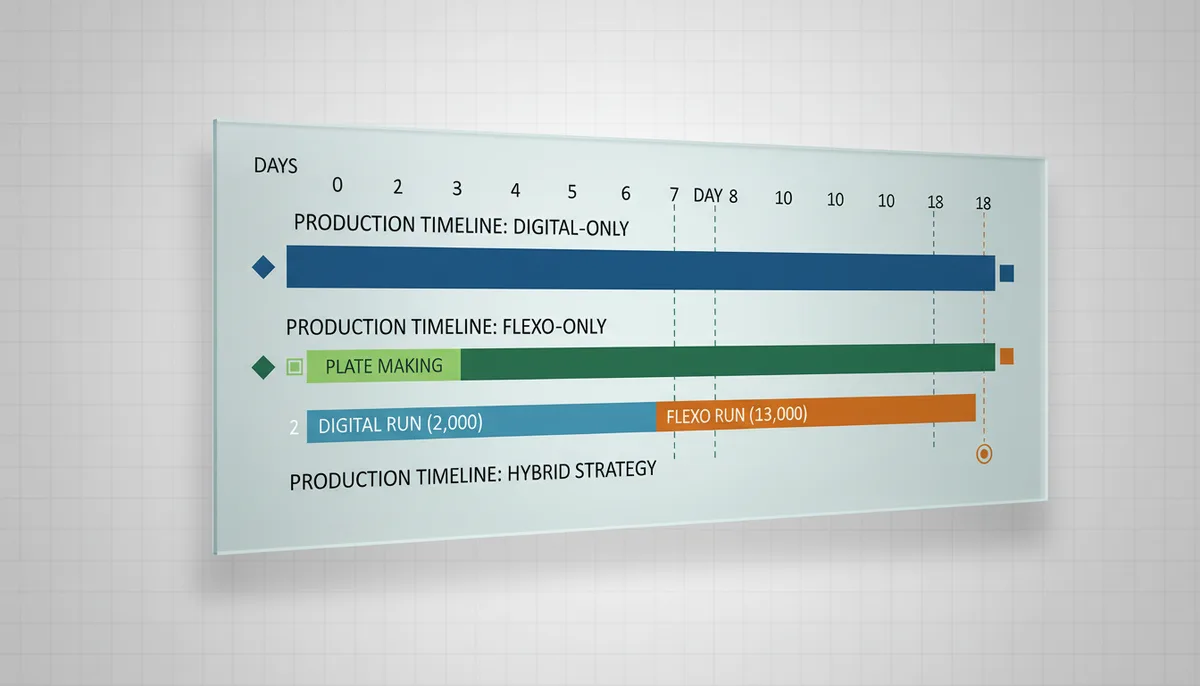
The fast label printing approach provides the best value for operations with stable SKUs and predictable volumes. It may not be ideal when artwork changes frequently or when seasonal promotions require rapid turnarounds. Consider instead a hybrid model that uses digital for short runs and flexo for stable volumes. High-mix, low-volume shops may find that flexo won't work for their workflow — the trade-off between setup time and per-unit cost is not always straightforward.
When to Consider Alternatives
This method may not be suitable for businesses with rapidly changing artwork or seasonal promotions. For fast label printing, a phased rollout using digital for market testing and flexo for stable volumes can improve total spend across your SKU portfolio. Alternatively, trade printing services can optimize costs for mixed SKU portfolios without requiring dedicated press time. On the other hand, high-volume operations see ROI within the first production run. Compared to digital, the breakeven depends on consistent throughput. Although plate costs are higher upfront, per-unit savings compound quickly above 7,000 units. A hybrid approach using digital for short runs and flexo for long runs is more suitable for diverse product lines.
Another drawback: digital ink adhesion on some low-surface-energy films is weaker than flexo, making it less ideal for chemical-resistant labels. Flexo, on the other hand, requires longer lead times for plate creation, which can delay time-sensitive launches.
Common Mistakes in Fast Label Printing Procurement
The first common mistake is ignoring plate amortization when comparing label printing costs. Buyers compare per-unit prices at their target volume without adding plate cost. A $0.12 flexo unit price at 3,000 units becomes $0.72 with plates included — three times the digital price.
Mistake 2: Overlooking proofing cycles. Digital proofs are available in hours. Flexo proofs require plate mounting and press setup, adding 2–3 days. For time-sensitive launches, the proofing delay can miss a retail shelf date.
Mistake 3: Assuming all materials work on both technologies. Clear BOPP with aggressive adhesive requires specific ink systems. Some digital toners don't bond well to silicone-coated liners. Always request a material compatibility test from your Contact our team to explore the right solution for your next project.
Frequently Asked Questions
When does digital label printing become cheaper than flexo?
Digital is cheaper for runs under 4,000 units because there are no plate costs. For a typical 4-6 color label, the breakeven point is between 4,000 and 7,000 units. Above 7,000 units, flexo's lower per-unit cost makes it more economical. Always calculate with your specific artwork and plate costs.
What is the minimum order quantity for digital label printing?
Digital label printing on the HP Indigo has a minimum order of 250 units. This makes it ideal for short runs, prototypes, or market testing. Turnaround is typically 3-5 business days from proof approval.
How does color accuracy compare between digital and flexo?
Both technologies achieve Delta E < 2.0 color accuracy. Digital uses CMYK+white to simulate spot colors, while flexo uses Pantone spot colors directly. Flexo offers more consistent Pantone matching across long runs. All jobs are verified by our PULISI optical inspection machine.
What materials are compatible with both digital and flexo label printing?
Both work with 2-mil BOPP, paper (60-300 gsm, FSC certified), and vinyl. Flexo handles thicker materials and adhesive-coated stocks more reliably due to better web tension control. Digital may have weaker ink adhesion on some low-surface-energy films.