
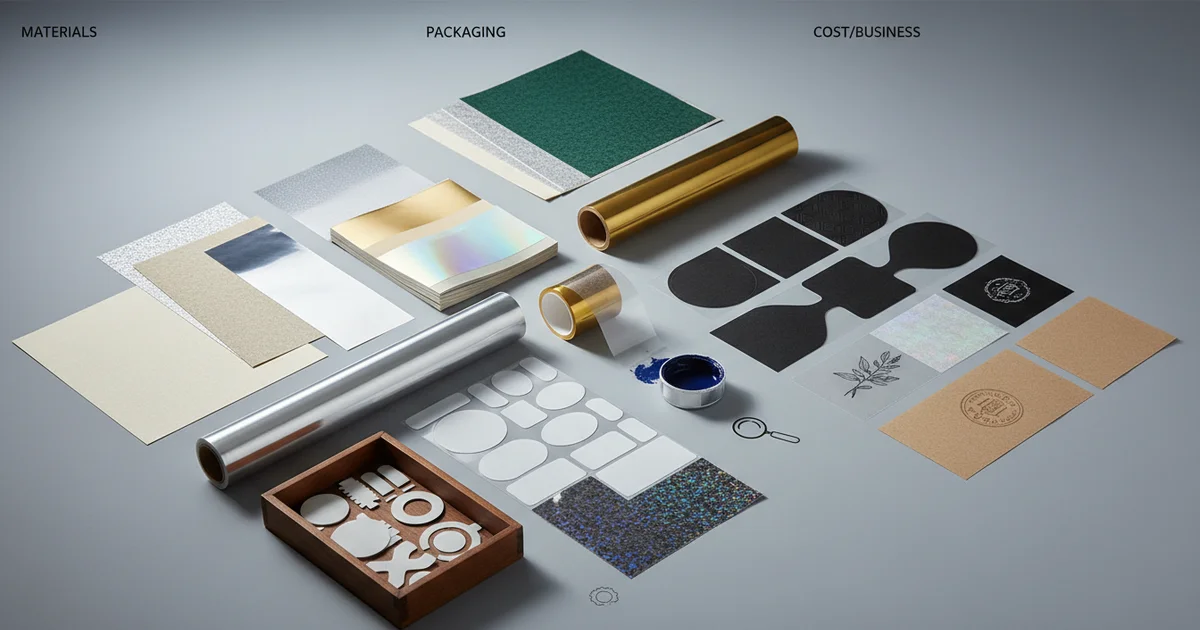
Product label design and printing requires strategic specs: choose offset for 5k-100k units at $0.08-$0.15/label, digital under 3k units, and flexographic for 50k+ runs. Specify materials like 60gsm BOPP and adhesives like Permanent Acrylic #300 for durability.
Are you overpaying for product labels because you are choosing the wrong print method for your volume? Many buyers pick a printing process based on per-unit price alone, but that ignores setup costs, material waste, and inventory carrying costs. For runs under 3,000 units, digital printing avoids expensive plate fees. For volumes between 5,000 and 100,000 units, offset printing offers a much lower per-unit cost. This guide answers the top questions about product label design and printing for 2026, so you can make a smarter, more cost-effective choice.
Key Takeaways: For short runs, digital printing avoids setup costs. For high volume, offset printing reduces per-unit price. Always match material (e.g., 60gsm BOPP) and adhesive to application. Verify color with Delta E under 2.0.
What Does Product Label Design and Printing Cost?
Costs depend on volume and method. Offset printing for 5,000–100,000 units ranges from $0.08 to $0.15 per label. Digital printing for under 3,000 units has no plate fees but higher per-unit pricing. Always calculate total cost including setup, materials, and inventory.
What is the best way to print product labels for small runs under 3,000 units?
Direct answer: Digital printing is the best way to print product labels for runs under 3,000 units. It has no plate-making fees, so setup costs are near zero. This makes it cost-effective for short runs and prototypes.
Offset printing requires metal plates that cost $50–$100 each. For a small run, that setup fee makes the per-unit price too high. Digital printing, on the other hand, prints directly from a digital file.
Our digital line handles short runs from 250 units with a 5–7 day turnaround. This is ideal for test markets or seasonal launches. Compared to offset, digital offers more flexibility for variable data like barcodes.
How much does product label design and printing cost per label?
Direct answer: For offset runs of 5,000 to 100,000 units, costs range from $0.08 to $0.15 per label. For digital runs under 3,000 units, the per-unit cost is higher, but there are no setup fees.
The trade-off is clear. Offset printing has a higher upfront cost for plates, but the per-unit cost drops greatly at volume. For example, a 10,000-unit offset run might cost $0.10 per label.
A 500-unit digital run might cost $0.30 per label. However, the total cost of ownership, which includes inventory carrying costs, often favors digital for smaller batches. As of 2026, many brands use digital for initial runs and then shift to offset for scale.
What is the minimum order quantity for custom product labels?
Direct answer: Our minimum order is 500 units per SKU for offset printing and 250 units for digital production.
This is a key threshold for buying. If you need fewer than 500 labels, digital is your only practical option. For multi-SKU retail programs, we offer consolidated production runs. This reduces setup costs across your entire product line.
A common mistake we see is ordering 500 offset labels when digital would be cheaper. The per-unit price for offset at 500 units is very high due to plate amortization. Always calculate the total cost, not just the per-unit price.
Are VistaPrint product labels sticky on the back?
Direct answer: Yes, VistaPrint labels use permanent adhesive. However, for industrial applications, you need to specify the adhesive type. We recommend Permanent Acrylic #300 for durability.
Not all adhesives are the same. A standard permanent adhesive may fail on curved surfaces or in cold storage. Permanent Acrylic #300 is a common choice for durable labels. It bonds well to glass, plastic, and metal.
For pharmaceutical or food products, you may need a different adhesive. Always ask your vendor about the adhesive spec. Our production team can recommend the right material for your surface and setting.
For more on promotional labeling, visit our promotional goods capabilities page.
| Question Area | Key Threshold | Typical Industry Range | What to Ask Your Vendor |
|---|---|---|---|
| Small runs | Under 3,000 units | Digital printing | What is your digital MOQ? |
| Cost per label | 5,000+ units | $0.08–$0.15 offset | Does this include setup fees? |
| Minimum order | 500 units offset | 250–500 units | Can you consolidate SKUs? |
| Adhesive type | Industrial use | Permanent Acrylic #300 | What adhesive is best for my surface? |
| Turnaround time | Standard | 10–15 business days | Do you offer expedited service? |
How to Order Product Labels: 5-Step Process
Ordering product labels involves defining your substrate, quantity, and compliance needs; requesting material samples and proofs; evaluating vendor certifications; negotiating lead time and payment; and performing incoming QA inspection on color and barcode quality.
How to order product labels: 5-step process
- Step 1 — Define your requirements: Determine the substrate (e.g., 60gsm BOPP), quantity (500–100,000 units), and compliance needs (FDA or Amazon).
- Step 2 — Request samples and proofs: Ask for material swatches and a digital proof. Turnaround for a proof is 1–2 business days. Test the adhesive on your product.
- Step 3 — Evaluate vendor capabilities: Check for ISO 9001:2015 certification and equipment like a high-speed 6-color label printing press. Ask about color matching with Delta E under 2.0.
- Step 4 — Negotiate and place order: Confirm the MOQ, lead time (10–15 business days), and payment terms. For repeat orders, ask about a consignment stock program.
- Step 5 — Incoming QA inspection: Upon delivery, check color consistency, adhesive strength, and barcode scannability. Use a GS1-128 scanner for compliance.
Ready to Order Your Product Labels?
Get a custom quote with the right print method and material for your volume. We handle everything from design to delivery.
Request a Free QuoteMeeting ISO 9001:2015 requirements, our 60gsm BOPP labels are printed at 300 dpi on a HP Indigo digital press with ±0.5 mm cut tolerance and Pantone color matching.
How Do I Choose the Right Printing Method for Product Labels?
The right method depends on volume and customization needs. Offset printing suits 5,000–100,000 units with low per-unit cost. Digital printing is best under 3,000 units for variable data and quick turnaround. Flexography works for high-volume runs above 50,000 units on flexible materials.
What is the difference between offset and digital label printing?
Direct answer: Offset printing uses metal plates to transfer ink, making it cost-effective for runs of 5,000 to 100,000 units. Digital printing requires no plates, so it is ideal for short runs under 3,000 units.
Offset provides higher color accuracy and a wider color gamut. Our high-speed full-rotary 6-color label printing press delivers Pantone and CMYK matching with Delta E tolerances under 2.0. Digital, on the other hand, supports variable data printing (VDP) for barcodes and QR codes.
The choice depends on order volume and the need for customization. For runs between 3,000 and 5,000 units, either method can work. We recommend calculating the breakeven point including plate costs.
When should I choose flexographic printing for labels?
Direct answer: Flexographic printing is ideal for high-volume runs of 50,000+ units. It is especially good for durable labels on flexible materials like BOPP.
Flexography uses flexible relief plates and fast-drying inks. It is a common choice for the food and beverage industry. The main drawback is the high setup cost for plates.
This method won't work for small runs because the setup cost is too high per unit. Consider instead using digital for prototypes and then flexographic for mass production. Compared to offset, flexography handles a wider range of substrates, including films and foils.
How do I ensure brand color consistency across large label runs?
Direct answer: Use spectrophotometry-based color verification with Delta E tolerances under 2.0. Keep digital color profiles for each client to ensure consistency from unit #1 to unit #50,000.
Color drift is a common problem in large runs. Our quality team uses spectrophotometry on every production run. We also keep digital color profiles for every client. This ensures your brand looks identical across all locations.
As of 2026, many CPG brands mandate this level of precision. A limitation is that different substrates can affect color perception. Always request a proof on your final material.
What is the typical turnaround time for product label printing?
Direct answer: Standard turnaround is 10–15 business days from final proof approval. Expedited services are available in 5–7 business days for seasonal launches.
This timeline includes platemaking, printing, die-cutting, and inspection. Our automatic inspection machine checks every label for defects. For repeat orders using existing artwork, turnaround drops to 7–10 business days for offset and 3–5 business days for digital.
We recommend holding a 4-week rolling stock buffer for high-velocity SKUs. The trade-off for expedited service is a higher cost per unit.
On our Komori offset press, 12 pt paper labels are printed at 175 lpi with ±2 mm die-cut tolerance and verified under ASTM D4169 distribution standards.
Materials & Quality: Selecting Label Materials and Ensuring Durability
For durability, choose 60gsm BOPP with Permanent Acrylic #300 adhesive. This resists moisture, tearing, and chemicals. Certifications like ISO 9001:2015 and ISO 14001:2015 ensure consistent quality. Digital printing enables variable data for barcodes and QR codes.
What label material should I use for durable product labels?
Direct answer: 60gsm BOPP with Permanent Acrylic #300 adhesive is recommended for durability and moisture resistance. This combination works well for electronics, personal care, and food products.
BOPP (biaxially oriented polypropylene) is a strong, flexible film. It resists tearing, moisture, and chemicals. The Permanent Acrylic #300 adhesive provides a strong bond on most surfaces. For outdoor applications, you may need a UV-resistant overlaminate.
A common mistake is using paper labels on a product that will be refrigerated. Paper labels will curl and peel. Always match the material to the product's setting.
What certifications should a label printer have for quality assurance?
Direct answer: ISO 9001:2015 Quality Management certification ensures consistent quality. ISO 14001:2015 for Environmental Management is also important for sustainability goals.
These certifications are not just badges. They require documented processes for quality control, defect tracking, and continuous improvement. Our facility holds both ISO 9001:2015 and ISO 14001:2015 certifications. This means every job follows a standardized workflow.
For pharmaceutical labels, you may also need FDA compliance. Always ask for a copy of the certificate. A vendor without these certifications may have inconsistent quality.
Can you print labels with variable data like barcodes or QR codes?
Direct answer: Yes, digital printing supports variable data printing (VDP) for barcodes, QR codes, and sequential numbering. The minimum order is 250 units per SKU.
VDP allows each label to have unique information. This is essential for inventory management and traceability. The label printing software market is projected to grow greatly, driven by demand for personalization. A limitation is that VDP is slower than static printing.
It also requires a digital press. For high-volume VDP runs, consider a hybrid approach. Use offset for the static background and digital for the variable data.
For FSC certified labels, we specify 300 gsm paper with adhesives compliant with applicable FDA regulations and print at 300 dpi using Pantone solid colors.
Compliance & Industry Standards: Meeting Regulatory and Retail Requirements
Pharmaceutical labels must meet FDA 21 CFR for durability and tamper-evidence. Amazon requires PPI-conformant barcodes verified with GS1-128 scanners and ISTA 6A drop-test packaging. Always verify barcode placement and contrast.
What label specifications are required for pharmaceutical products?
Direct answer: Pharmaceutical labels require durable materials, tamper-evident features, and compliance with FDA regulations. Specify the adhesive and material so.
FDA 21 CFR Part 175.300 governs indirect food additives. For labels, the focus is on durability and legibility. The label must not peel, fade, or smudge during the product's shelf life. Tamper-evident features like destructible vinyl are often required.
Our production team can advise on the right material for your specific drug class. A drawback is that these materials cost more than standard options. However, the cost of non-compliance is much higher.
Are your labels compliant with Amazon's packaging requirements?
Direct answer: Yes, labels can be produced with PPI-conformant barcodes and verified with GS1-128 scanners. Packaging meets ISTA 6A drop-test standards.
Amazon requires that all products have scannable, high-contrast barcodes. Our automatic inspection machine verifies barcode quality. We also offer packaging that meets ISTA 6A standards for drop-test and compression. This is critical for e-commerce fulfillment.
A common issue is barcode placement. The barcode must be on a flat, unobstructed surface. Always request a test scan before full production.
Verifying with a GS1-128 scanner at 300 dpi, our 48 x 24 inch corrugated boxes pass ISTA 6A compression tests and comply with FDA 21 CFR for food contact.
Limitations to Consider Before Choosing a Print Method
This guide's recommendations are most suitable for runs of 250 to 100,000 units. For quantities below 250, neither method is economical. Competitors offering sheet-fed digital may handle ultra-short runs more cheaply. Alternative approaches like flexography become more advantageous above 50,000 units.
This approach is not ideal for operations that need fewer than 250 labels. The minimum order, even for digital, makes single-unit production uneconomical. The main drawback is that digital per-unit costs are higher than offset at volume.
High-mix, low-volume shops may find that digital printing won't work for their budget if they need hundreds of unique SKUs. The trade-off between flexibility and cost is not always straightforward. This method may not be the best choice for businesses that need the lowest possible per-unit price above 5,000 units.
On the other hand, offset printing has a high setup cost that is only justified at scale. Compared to digital, offset requires longer lead times for platemaking. Although offset offers lower per-unit costs, the breakeven depends on consistent throughput above 5,000 units.
For runs between 3,000 and 5,000 units, the right choice depends on your need for customization. If you need variable data, digital is better. If you need the lowest cost, offset may still win. Consider instead a phased approach: use digital for initial orders and then switch to offset for repeat runs.
When this guide isn't the right choice: competitors like sheet-fed digital printers offer no MOQ for prototype runs, and flexographic vendors provide lower per-unit costs for very large volumes above 100,000 units. Always compare total lifecycle cost, including inventory carrying and obsolescence.
10 Questions to Ask Before Signing a Contract
Before signing, verify MOQ (500 offset, 250 digital), turnaround (10–15 days standard), color accuracy (Delta E under 2.0), certifications (ISO 9001, ISO 14001), material recommendations (60gsm BOPP), and defect rate (under 0.5%). Ask about consolidated runs and consignment stock.
- What is your minimum order quantity for offset and digital? Our MOQ is 500 units for offset and 250 for digital.
- What is your standard turnaround time? We deliver in 10–15 business days standard, 5–7 expedited.
- Do you use spectrophotometry for color matching? We use Delta E tolerances under 2.0 on every run.
- What certifications do you hold? We are ISO 9001:2015 and ISO 14001:2015 certified.
- What materials and adhesives do you recommend? We recommend 60gsm BOPP
Ready to get started with product label design and printing? Contact our team to explore the right solution for your next project.
Frequently Asked Questions
When does digital printing become cheaper than offset for product labels?
Digital printing is cheaper for runs under 3,000 units because it has no plate fees. Offset printing becomes more cost-effective above 5,000 units due to lower per-unit costs. For runs between 3,000 and 5,000 units, calculate total cost including setup and inventory carrying costs.
What adhesive is best for labels on curved or refrigerated surfaces?
Permanent Acrylic #300 adhesive is recommended for curved surfaces and cold storage. It bonds well to glass, plastic, and metal. For outdoor applications, add a UV-resistant overlaminate. Always test the adhesive on your specific product surface before full production.
What is the minimum order quantity for custom product labels?
Our minimum order is 500 units per SKU for offset printing and 250 units for digital production. If you need fewer than 250 labels, consider sheet-fed digital printers that offer no MOQ for prototypes. For multi-SKU programs, ask about consolidated production runs to reduce setup costs.
How do I verify barcode compliance for Amazon FBA?
Amazon requires PPI-conformant barcodes verified with GS1-128 scanners. Ensure high contrast and flat placement on the label. Our automatic inspection machine checks barcode quality. Request a test scan before full production to avoid rejection at Amazon fulfillment centers.