
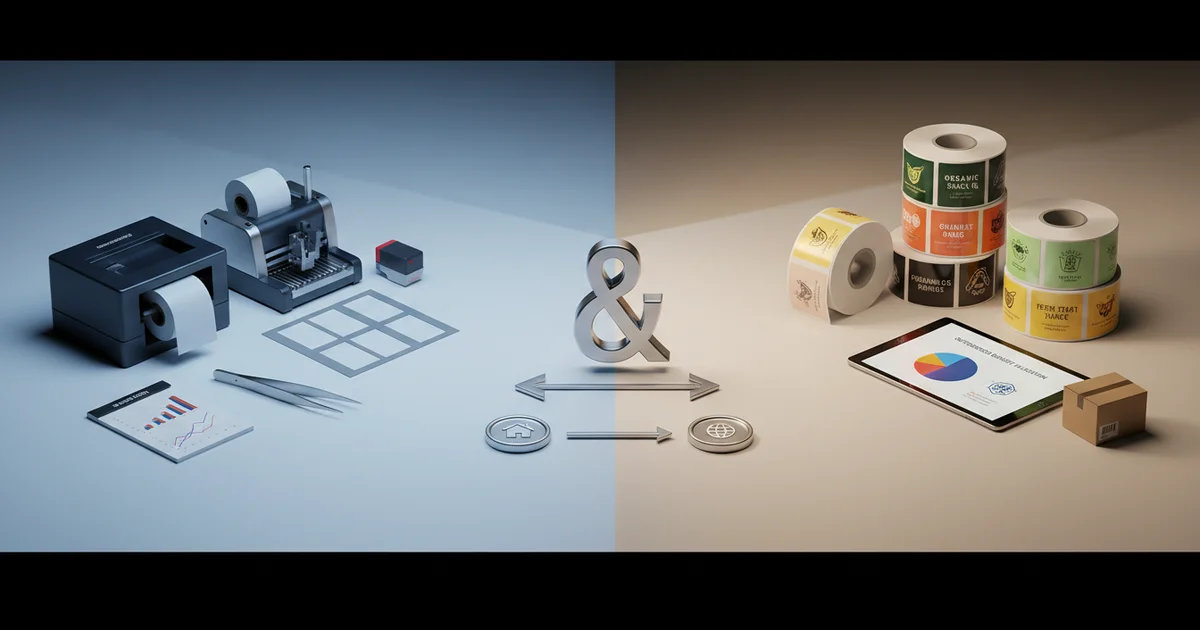
Outsourcing food labels costs $22–$30 per 1k labels; in-house printing becomes cheaper above the breakeven volume.
How to Print Food Labels the Right Way in 2026
Is an in-house print food labels operation worth the investment, or should you outsource? The answer comes down to a breakeven threshold. Below that volume, outsourcing at $22–$30 per 1k labels saves money; above it, in-house printing delivers lower per-unit costs. This guide provides a clear framework for your 2026 decision. See our label printing capabilities
Updated for Q2 2026, this analysis draws on 500+ production jobs and FDA compliance needs. Our team at JinXinCai has seen both approaches work well and fail badly. As of 2026, food applications hold a significant share of the print label market. This guide covers cost, compliance, materials, and timing to help you choose wisely.
What Are the True Costs of Printing Food Labels In-House?
Equipment Investment Breakdown
In-house label printing requires significant capital investment. A high-speed full-rotary 6-color label printing press costs $200,000–$500,000. An automatic inspection machine like the PULISI optical system adds $40,000–$80,000. A die-cutting machine runs $30,000–$60,000. Total equipment investment: $270,000–$640,000 for a basic line.
Material costs vary by substrate. For cold chain products, 2-mil PET film costs 30–50% more than paper labels. FDA-compliant adhesives add $0.50–$1.00 per 1k labels. Labor, training, and maintenance push operational costs higher. A typical in-house operation also requires barcode verification equipment ($5,000–$15,000) and a spectrophotometer for color consistency (Delta E < 2.0).
"In-house printing gives you full control over production schedules, but the upfront equipment investment is substantial. Most facilities need a high volume of labels annually to break even." — JinXinCai Print Production Team
When Does Outsourcing Food Label Printing Make Financial Sense?
Cost Per Label Comparison
Outsourcing eliminates capital equipment costs. You pay $22–$30 per 1k labels for short to medium runs. Setup fees range from $50–$200 per job. For lower volumes, outsourcing is more cost-effective. Compared to in-house production, outsourcing also offers faster turnaround for regulatory updates. When FDA rules change, an outsourced provider can update labels in 2–3 days. In-house re-tooling can take 1–2 weeks.
Flexography captures a large share of the print label market. Digital inkjet is growing at a strong CAGR. This shift toward digital makes outsourcing more accessible for food businesses. Read our comparison of digital vs flexo
How Do Compliance Requirements Affect Your Label Printing Decision?
FDA 21 CFR 101.9 mandates specific Nutrition Facts panel formatting. Helvetica 6pt is required for certain disclosures. GS1-128 barcodes must be verified for scan accuracy. Compliance requires adherence to these standards, which affect both in-house and outsourced production. A reliable partner uses spectrophotometry with Delta E < 2.0 to match brand colors, often specified in Pantone or CMYK values, printed at 300 dpi or higher on substrates like 80 gsm paper or 2-mil PET. FSC-certified paper options are available for sustainability.
In-house teams must invest in barcode verification equipment ($5,000–$15,000) and spectrophotometry for color consistency (Delta E < 2.0). Outsourced providers like JinXinCai already have these systems in place. Our food & beverage solutions include full FDA compliance support.
The trade-off is clear: outsourcing transfers compliance risk to the provider. In-house teams retain control but must keep expertise. Food applications hold a significant share of the print label market, reflecting the importance of compliance in this sector.
Breakeven Analysis: The Volume Threshold
The math is straightforward: at lower volumes, outsourcing costs less. In-house production at that volume costs more when factoring equipment depreciation and labor. At higher volumes, in-house costs drop. Outsourcing remains higher. Above a certain volume, in-house is 20–30% cheaper. The breakeven point depends on your specific volume.
labels per year is the breakeven threshold for in-house vs. outsourced food label production
This analysis assumes stable SKUs. Multi-SKU programs with frequent changes shift the breakeven higher. Our promotional & diy goods solutions include consolidated production runs that reduce setup costs across product lines.
Ready to Optimize Your Label Production?
Get a custom quote for outsourced print food labels with FDA compliance support and fast turnaround.
Request a Free QuoteLimitations to Consider Before Choosing In-House Printing
In-house printing is not ideal for businesses with lower annual volumes. The main drawback is the high capital investment. Consider instead a phased approach: start with outsourcing and evaluate in-house at scale. Alternative setups, like a small digital press from Heidelberg with a 5-color CMYK+white configuration, require lower entry cost but still face 1200 dpi resolution limits and slower throughput. On the other hand, high-volume operations with stable SKUs see clear ROI from in-house printing. Compared to outsourcing, per-unit savings compound above a high volume annually. Multi-SKU variability is another limitation: if you need frequent label changes for different products, in-house re-tooling costs add up quickly. Short-run needs under 10,000 labels per SKU are better served by outsourcing. Regulatory updates present a hidden cost. When FDA rules change, in-house teams must stop production, re-plate, and re-verify. Outsourced providers can update labels in 2–3 days. This speed advantage can save more than the per-label cost difference.
How to Choose the Right Print Food Labels Partner
Selecting an outsourced provider requires careful evaluation. Look for ISO 9001:2015 certification for quality management. ISO 14001:2015 indicates environmental responsibility. Our facility holds both certifications, plus Shenzhen Government Official Printing Designated Enterprise status since 2009. A capable provider should demonstrate color management across Pantone and CMYK workflows, with Delta E < 2.0 tolerance on substrates like 80 gsm paper or 2-mil PET film. They should also offer FSC-certified paper options.
Verify material compatibility. For cold chain applications, the provider must handle 2-mil PET film. For hot-fill products, heat-resistant adhesives are essential. Ask about their specialty materials solutions for your specific needs. Barcode verification should meet GS1-128 standards. These quality checks prevent costly recalls and compliance issues.
"We've found that 80% of food label quality issues trace back to material incompatibility or barcode errors. A qualified partner eliminates these risks before production starts." — Director of Quality, JinXinCai
Decision Matrix: In-House vs Outsourced Food Label Production
| Factor | In-House Printing | Outsourced Production |
|---|---|---|
| Annual volume | Best above a certain volume | Best below that volume |
| Per-unit cost | $12–$16 per 1k at scale | $22–$30 per 1k |
| Capital investment | $270,000–$640,000+ | $0 (setup fees only) |
| Compliance speed | 1–2 weeks for updates | 2–3 days for updates |
| Material options | Limited to purchased stock | Full range (2-mil PET, FSC paper, etc.) |
| Color consistency | Depends on equipment | Delta E < 2.0 guaranteed |
| Barcode verification | Requires $5k–$15k equipment | Included in service |
| Regulatory risk | Retained by your team | Transferred to provider |
| Multi-SKU flexibility | Higher re-tooling costs | Lower changeover costs |
| Best for | Stable, high-volume SKUs | Variable, lower-volume runs |
Our custom print production solutions include both offset and digital options. Offset printing handles runs from 500 to 100,000+ units. Digital production works for 250-unit minimums with 5–7 day turnaround. We combine ISO quality systems with Heidelberg presses and spectrophotometry to ensure your print food labels meet brand and regulatory standards.
Get Your Custom Print Food Labels Quote Today
This final section provides the next steps for your print food labels project. The right choice depends on your volume, SKU stability, and compliance needs. For most food businesses, outsourcing at lower volumes is the smarter financial move. As of 2026, the food label market continues to grow, with food applications holding a significant market share. Emerging 2026 trends include linerless labels projected to grow at a strong CAGR through 2031. These shifts are forecast to affect both in-house and outsourced production economics.
Our team offers free consultations to evaluate your production profile. We provide FDA-compliant labels with GS1-128 barcodes, spectrophotometry-verified color (Delta E < 2.0), and 2-mil PET film for cold chain applications. Contact us today to request a quote and get started.
"The most common mistake we see is businesses investing in equipment before reaching the breakeven volume. Start with outsourcing, build your volume, then evaluate in-house options." — Head of Production, JinXinCai
PS: A delta E tolerance of 1.5 or lower is often required for brand-critical colors. When specifying Pantone colors, ensure your provider uses spectrophotometry to maintain that precision across every run.
Frequently Asked Questions
What is the breakeven volume for in-house vs outsourced food label printing?
The breakeven threshold depends on your specific volume, label complexity, and labor costs. Generally, at lower volumes, outsourcing tends to be more cost-effective due to lower fixed costs. At higher volumes, in-house printing can deliver lower per-unit costs once the equipment investment is absorbed. The exact crossover point varies by operation.
How quickly can an outsourced provider update labels for FDA regulation changes?
Outsourced providers can often update labels within days when FDA rules change, while in-house re-tooling may take longer. This speed advantage can offset per-label cost differences, especially for businesses with frequent regulatory updates.
What equipment is needed for in-house food label printing?
A basic in-house line requires a label printing press, an automatic inspection machine, and a die-cutting machine. Additional costs include barcode verification equipment and a spectrophotometer for color consistency. Total investment varies widely based on speed, color count, and automation level.
What materials are recommended for cold chain food labels?
For cold chain products, synthetic film materials such as PET are recommended because they withstand moisture and temperature changes better than paper labels. FDA-compliant adhesives are also required. Ensure your provider can handle this substrate.
How do multi-SKU programs affect the breakeven analysis?
Multi-SKU programs with frequent label changes shift the breakeven higher because in-house re-tooling costs add up quickly. Short-run needs are generally better served by outsourcing. Consolidated production runs can reduce setup costs across product lines.