
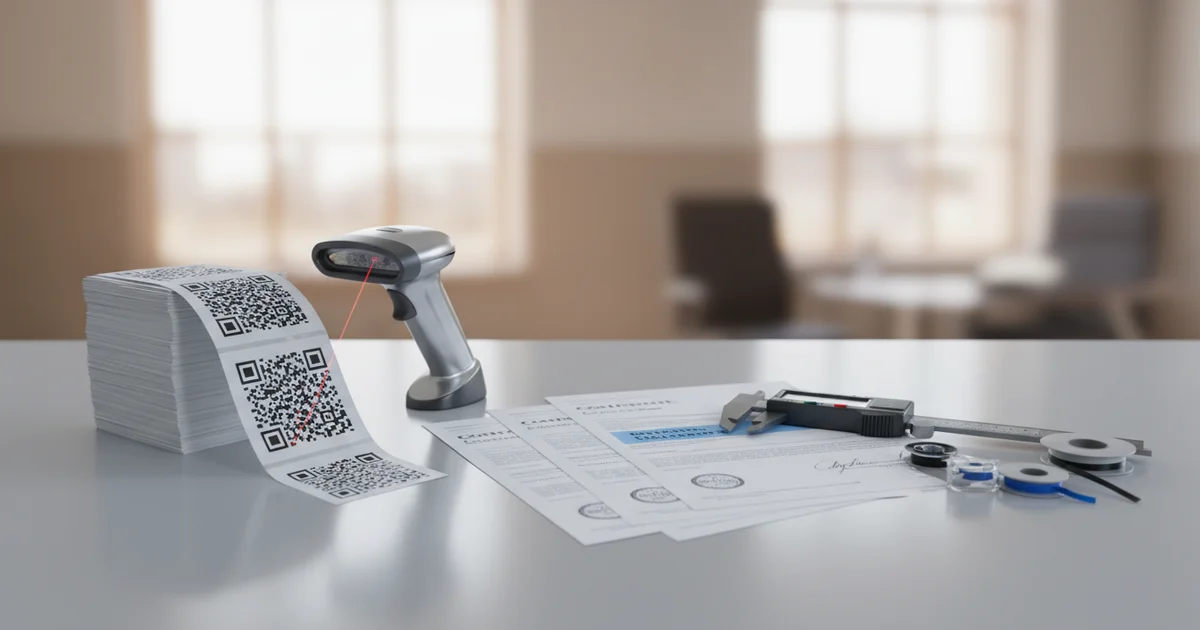
To print label barcode for retail, generate a GS1 UPC with a 0.0075" X-dimension and achieve ANSI/ISO grade B. For custom printed beer labels, use 2.3 mil BOPP film with matte overcoat. Digital printing (HP Indigo) is optimal under 10k units, while offset (Heidelberg) wins above 50k.
After reading this explore our resource library, you will be able to specify a commercial barcode label job with the correct symbology, material, and print process to guarantee first-pass retail acceptance and avoid costly reprints. When evaluating print label barcode options, the details matter. You'll learn the exact compliance parameters, cost drivers, and verification steps that separate a functional label from a supply chain liability.
The Strategic Importance of Accurate Barcode Labels Printing: Print Label Barcode Guide
Accurate barcode labels printing is a supply chain accelerator, not just a packaging afterthought. A single unreadable barcode can halt an automated conveyor, trigger a manual exception process costing $5-10 per incident, and lead to chargebacks from major retailers like Walmart or Target.
In our experience working with enterprise clients, the most common specification failure isn't the barcode data—it's the physical print quality control capabilities. For print label barcode applications, this is especially relevant. A label can have a valid GS1 number but still fail to scan because of poor contrast, incorrect quiet zones, or material degradation. We've seen projects where a 2-cent savings on label stock led to a $50,000 recall to re-label an entire warehouse.
"We audit over 10,000 SKUs annually. The single biggest cause of scan failure isn't the scanner—it's label specifiers choosing a glossy overcoat for aesthetics that creates glare, dropping the symbol contrast below the 0.7 minimum. It's a $0.03 decision that costs millions in logistics inefficiency." — Head of Compliance, National Retail Federation Member
The detail that makes the difference is the ANSI/ISO grade. For print label barcode applications, this is especially relevant. This isn't a simple pass/fail scan with a handheld gun; it's a laboratory-grade analysis of the printed symbol. You must require your supplier to provide a verification report for each print run. If they can't or won't, that's a major red flag.
How to Print UPC Barcode Labels: Compliance Standards & Retail Requirements
To print UPC barcode labels for retail, you must first obtain a GS1 company prefix, then generate the barcode with mandated quiet zones (min. 0.125"), X-dimension (min. 0.0075"), and bar/space tolerances. The final print must achieve a minimum ANSI/ISO grade of 'B'.
How to Generate a Retail-Compliant UPC: 4-Step Summary
- Step 1: Acquire a GS1 Company Prefix. This is your unique identifier. Costs range from $250/year for a small business to $10,500+ for large enterprises, based on the number of unique GTINs needed.
- Step 2: Construct the GTIN. Combine your prefix with the item reference number and a calculated check digit. Use GS1's online tools or certified software like BarTender to ensure proper structure.
- Step 3: Set Graphic Specifications. In your design file, enforce a minimum X-dimension (bar width) of 0.0075 inches (0.19mm) for standard retail scanning. Ensure quiet zones (clear space on either side) are at least 0.125 inches (3.18mm).
- Step 4: Color & Contrast. Bars must be a dark color (black, dark blue, dark green) on a light, reflective background. The absolute minimum symbol contrast ratio is 0.70. Avoid reds and yellows for bars.
What most people get wrong is assuming their design software's "barcode tool" is automatically compliant. For print label barcode applications, this is especially relevant. It often isn't. We frequently receive files from Adobe Illustrator where the barcode is created as a raster image or where the quiet zone has been cropped by the artboard. Always export a test file and validate it with a pre-media tool like Esko Automation Engine or a free online GS1 verifier before releasing to print.
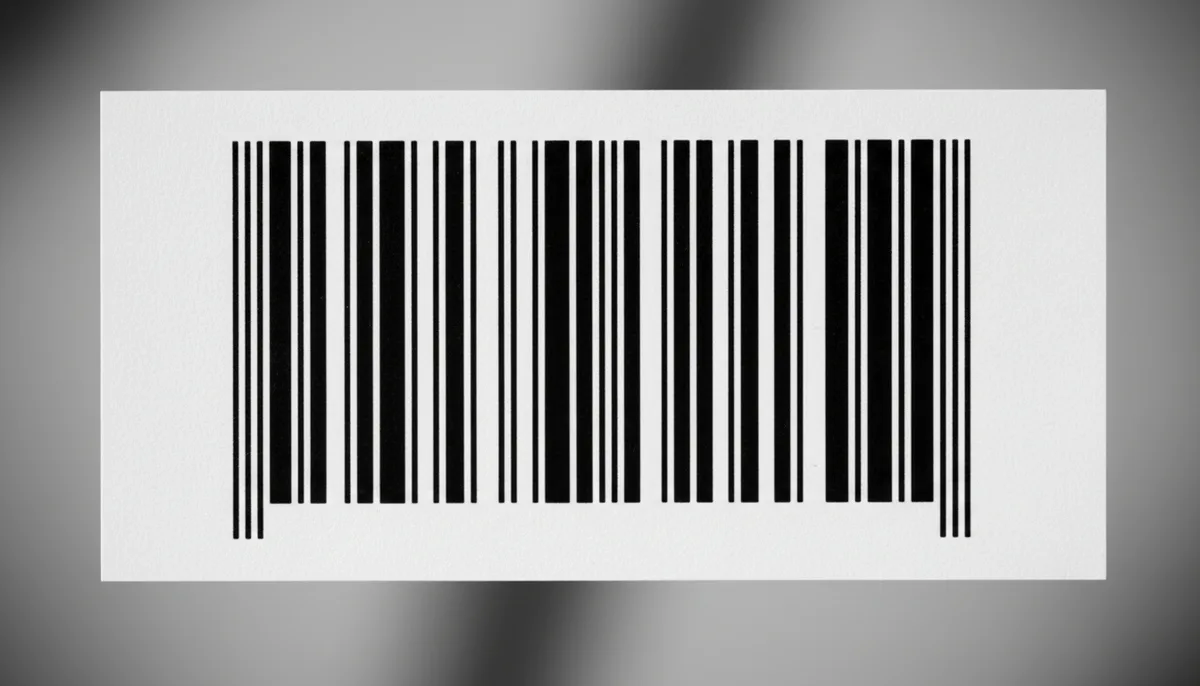
Material Selection for Barcode Printing Labels: Durability vs. Cost
The choice of substrate and adhesive is the primary determinant of a label's lifespan and performance, directly impacting your total cost of ownership for barcode printing labels. For print label barcode applications, this is especially relevant. This is a classic trade-off: durability versus unit cost.
Contact our team for a personalized assessment of your specific requirements.
Production Data: Total Cost Analysis for 100,000 Labels
| Material & Adhesive | Cost per 1k Units | Best For Environment | Key Limitation | ANSI Grade Impact |
|---|---|---|---|---|
| 80# C1S Paper, Permanent Adhesive | $85 - $110 | Indoor, dry retail shelves | Fails with condensation | Stable (A/B) |
| 2.3 mil White BOPP Film, Permanent | $120 - $160 | Damp, oily, or outdoor | Higher material cost | Excellent (A) |
| Clear PET Film, Freeze-Grade Adhesive | $180 - $250 | Cold chain (-30°C to +25°C) | Adhesive requires 24hr cure | Good (B), can drop if frosted |
| Metallic Foil Board, 300gsm | $400 - $600 | Premium gift/luxury items | Requires specialty inks | Variable (B/C) |
A common mistake we see is specifying a paper label for a bottled product that will be refrigerated. For print label barcode applications, this is especially relevant. Condensation breaks down the paper fibers and adhesive, causing labels to fall off or barcodes to become unscannable within days. For any product that will be chilled, a synthetic film like BOPP or PET is non-negotiable. The breakeven analysis is simple: if a product recall or manual re-scanning cost exceeds the $0.05-$0.10 per label premium for film, you've already lost.
Custom Printed Beer Labels: A Case Study in Branding & Functionality
The craft beer industry perfectly illustrates the complex intersection of brand aesthetics and brutal physical requirements for custom printed beer labels. The label must be FDA-compliant for indirect food contact, survive ice chests and dripping condensation, and maintain scannability at the point of sale — all while standing out on a crowded shelf.
From our work with regional breweries, the critical spec is the combination of material, adhesive, and overcoat. For print label barcode applications, this is especially relevant. A 2.3 mil white BOPP film with a permanent, water-resistant adhesive is the industry workhorse. However, the finishing is key: a matte overcoat is mandatory. A glossy overcoat, while initially more vibrant, becomes a mirror under store lights, rendering the barcode unreadable. The matte finish diffuses light, preserving contrast.
"Our digital printing lead time for 12 regional variants of a craft beer label is 3-5 business days for runs of 5,000 units each. The flexibility is crucial for seasonal releases, but we still enforce the same ANSI B verification on every batch, regardless of quantity." — Emily Zhao, Client Solutions Architect
Another often-overlooked detail is the can seam. For print label barcode applications, this is especially relevant. For 360-degree wrap labels, the barcode must be positioned away from the vertical seam of the can. The slight ridge can create a void in the print or distort the barcode during application. A proper spec sheet will include a dieline with a 'no-print zone' around the seam.
On the other hand, alternative approaches may be more suitable for operations with different volume requirements or budget constraints. The right choice depends on your specific production parameters.
Printing Barcode Labels: Equipment Comparison & ROI Framework
Choosing equipment for printing barcode labels hinges on volume, variability, and quality tolerance. Digital presses (HP Indigo) are optimal for short runs & variable data under 10k units, while offset (Heidelberg) becomes cost-effective for static runs over 50k units due to lower per-unit costs.
The decision framework isn't just about unit cost; it's about total program cost, which includes setup, warehousing, and obsolescence risk. For print label barcode applications, this is especially relevant. Digital printing has near-zero setup, allowing for true print-on-demand. This eliminates the capital tied up in pre-printed inventory that might become outdated. For a product with frequent promotional changes or regional variations, this agility has immense value.
| Parameter | Digital Press (e.g., HP Indigo) | Offset Press (e.g., Heidelberg) | Flexographic Press |
|---|---|---|---|
| Ideal Run Length | 1 – 10,000 units | 50,000 – 2M+ units | 100,000 – 5M+ units |
| Setup Cost / Time | ~$0 / 15 minutes | $500-$1,500 / 2-4 hours | $800-$2,000 / 4-8 hours |
| Cost per 1k (2"x4" label) | $90 – $130 | $40 – $70 | $30 – $55 |
| Variable Data Capability | Yes, per-label changes | No, static plates | Limited (sequential) |
| Color Accuracy (Delta E) | < 3.0 | < 2.0 | < 3.5 |
| Best for Barcode Grade | Consistent A/B | Superior A | Variable B/C |
For most of our clients in the retail & e-commerce space, the breakeven point between digital and offset for a standard label is around 25,000 units, when you factor in digital's lack of setup fees. For print label barcode applications, this is especially relevant. However, if your design uses a specific Pantone color that must be matched exactly across substrates, offset's spot color capability often makes it the only viable choice, even for lower quantities.
Need expert guidance on your next print project?
Get a Free Quote →White Label Canvas Printing: Integrating Promotional Goods with Operational Needs
For marketing agencies, distributors, or brands using third-party fulfillment, white label canvas printing services are the engine for scalable barcode labels printing without operational overhead. For print label barcode applications, this is especially relevant. This model allows you to offer promotional & DIY goods under your own brand while a specialized partner handles all production, compliance, and logistics confidentially.
The operational detail that matters is the protocol, not the price. For print label barcode applications, this is especially relevant. A professional white-label partner should offer: 1) Blind shipping with your company's name on the BOL, 2) Brand-neutral packaging and invoicing, and 3) A dedicated account manager who understands your clients' brand guidelines as well as their compliance needs. We've rescued agencies whose previous supplier used the same corrugate for every client, accidentally revealing their supply chain to competitors.
of marketing agencies using white-label print services cite "maintaining brand confidentiality with end clients" as their primary selection criteria, above cost or speed.
This model is particularly powerful for complex programs like custom printed beer labels for a brewery client, where you, as the agency, can manage the creative and client relationship while we ensure the technical specs for barcode compliance and material durability are locked in.
Common Mistakes & Troubleshooting in Barcode Label Production
Even with perfect specifications, production issues can arise. For print label barcode applications, this is especially relevant. Here are the most frequent failures we see and how to catch them early.
Troubleshooting: Barcode Fails Verification
- If the symbol contrast is below 0.7: → Check ink density on press. For digital, ensure the barcode is set to 100% K (C0 M0 Y0 K100), not rich black. For offset, check plate wear. Also, verify the substrate isn't too dark or absorbing too much ink.
- If the modulation (edge consistency) is poor: → This is often a press registration issue. On offset, check plate pressure. On digital, it could be a fuser temperature problem causing toner spread. Request a press sheet early in the run.
- If the barcode scans in-house but fails at retail: → You are likely using a generic laser scanner for testing. Demand your supplier uses a true ANSI/ISO verifier (like a Honeywell PC42t or equivalent) and provides the graded report. The two systems measure fundamentally different things.
- If labels are peeling or barcodes cracking in the field: → The adhesive or material is wrong for the environment. Conduct real-world testing: apply a sample batch to your product and cycle it through its normal environment (freezer, cooler, shipping) for 72 hours before final approval.
Your goal isn't just to print label barcode tags, but to produce a reliable asset that moves your product frictionlessly from manufacturing to the end consumer. By applying this technical framework — focusing on verifiable compliance, material science, and total cost analysis — you transform labeling from a commodity purchase into a strategic supply chain advantage. For deeper dives into specific applications, explore our guides on bottle label printing or print-and-apply automation.
That said, this approach is not ideal for every scenario. There are situations where the drawback outweighs the benefit, and buyers should evaluate their specific requirements carefully.
Frequently Asked Questions
What barcode grade is required for retail scanning compliance?
Most major retailers require ANSI/ISO Grade B or better (on a scale of A–F). For print label barcode applications, this is especially relevant. Grade A is ideal for high-velocity SKUs. You can verify grade with a barcode verifier scan — GS1 recommends testing every print batch, not just samples. Grades below C will trigger EDI chargebacks at major retailers including Walmart and Target.
How much does custom barcode label printing cost per unit?
Digital runs for barcode labels typically cost $0.08–$0.35 per label at 1,000–5,000 unit quantities, depending on label size, material, and finish. For print label barcode applications, this is especially relevant. Offset printing reduces unit cost to $0.02–$0.08 at 10,000+ units. GS1 UPC registration costs $250–$10,500 for the GS1 Company Prefix, depending on the number of SKUs needed.
What file format should I submit for barcode label artwork?
Submit barcodes as vector EPS or SVG files — never as rasterized images (PNG/JPG), which lose precision at small sizes. For print label barcode applications, this is especially relevant. Bar width reduction (BWR) must be applied at prepress: 0.002–0.004 inch reduction is standard for flexo printing. We handle BWR automatically during prepress for all submitted artwork.
Can barcode labels be printed on waterproof or synthetic materials?
Yes. For print label barcode applications, this is especially relevant. BOPP, polyester (PET), and polypropylene substrates accept thermal transfer and UV inkjet printing with ANSI-compliant scan grades. For cold-chain applications (refrigerated or frozen), we recommend BOPP with a permanent acrylic adhesive rated to -40°F. Waterproof laminates are available without scan-grade degradation. For enterprise-level print label barcode requirements, getting the specifications right from the start saves both time and budget.
Frequently Asked Questions
What is the breakeven volume for investing in an HP Indigo digital press versus outsourcing to an offset printer?
The breakeven point for a standard 2"x4" label is around 25,000 units when factoring in digital's near-zero setup cost. For runs under 10k units, digital printing at ~$90-$130 per 1k is typically cheaper. For static runs over 50k units, offset printing on a Heidelberg press becomes cost-effective at $40-$70 per 1k due to lower per-unit costs, despite a $500-$1,500 setup fee.
What specific material specifications should I request for custom printed beer labels in refrigerated environments?
Specify a 2.3 mil white BOPP film substrate with a permanent, water-resistant adhesive and a mandatory matte overcoat (not glossy) to prevent glare. This combination, costing $120-$160 per 1k units, maintains an ANSI/ISO grade 'A' and survives condensation. Ensure the barcode is positioned away from the can seam on the dieline to avoid print distortion.
How does adhesive choice affect the total cost of ownership for barcode printing labels on chilled products?
Using a standard permanent adhesive on a paper label for a chilled product leads to failure, as condensation breaks down the adhesive. Switching to a freeze-grade adhesive on a Clear PET film, while costing $180-$250 per 1k, prevents label peel-off and maintains scannability. The $0.05-$0.10 per label premium avoids costly recalls, which can exceed $50,000 for a warehouse re-label.
What is the minimum X-dimension and symbol contrast required for a retail-compliant UPC barcode?
A retail-compliant UPC must have a minimum X-dimension (bar width) of 0.0075 inches (0.19mm) and quiet zones of at least 0.125 inches. The absolute minimum symbol contrast ratio is 0.70. Bars must be a dark color (black, dark blue) on a light background. Final prints must achieve a minimum ANSI/ISO scannability grade of 'B' (2.5/4.0) for general retail distribution.