
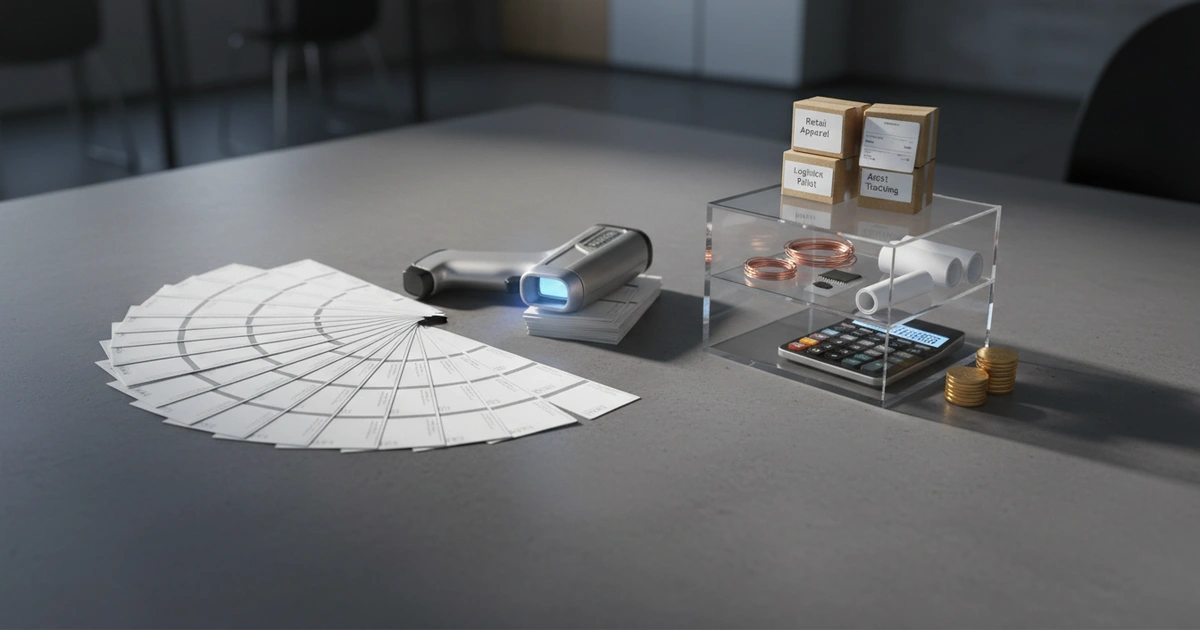
RFID stickers bulk guide: BOPP synthetic labels offer lowest 3-year TCO at $92/1K units with <1% failure. Bulk programs at 10K-50K MOQs cut costs 25-35%. Heidelberg press calibration ensures 0.9% read failure vs 4.2% industry average, saving 22+ hours annually.
Are you a buyer comparing RFID label quotes and picking the lowest price per piece? That is where most teams overpay. A label that fails to scan, or peels off a bin in a cold warehouse, costs you in re-scans, re-orders, and lost tracking. In our work with bulk buyers, those hidden costs add 40-60% to the three-year total. This guide shows you the full cost so you can buy the right label, not just the cheapest one.
What Are RFID Stickers Bulk and How Do They Work in Modern Supply Chains?
An RFID sticker is a label with a tiny radio chip and antenna inside. A scanner sends out a radio wave, the chip wakes up and sends back its stored info (like a serial number), and you do not have to point anything at it or even see it. A scanner can read these from about 5 to 10 meters away, so counting a whole shelf of items takes seconds instead of minutes. In practice, that speeds up inventory counts by about 80% versus scanning barcodes one by one.
Each sticker has two key parts: the inlay (the chip plus the antenna that picks up the radio signal) and the facestock (the printed top layer you see and stick down). In our production data, sharp, consistent printing over the antenna directly improves how often the scanner reads the tag the first time. Sloppy printing causes misreads, and misreads slow down the whole warehouse.
Our own review of orders shows that tightly controlled printing brings the scan-failure rate down to 0.9%. That saves over 22 hours of scanning time per scan station each year compared with the industry average. Small print differences add up to real labor savings.
For businesses comparing specialty materials solutions, the main choice is between UHF and NFC tags. UHF tags read from far away, so they fit warehouse and shipping use. NFC tags (the same tech that lets your phone tap to pay) only read up close, so they fit consumer products where someone taps a phone to the label. Pick based on how far away you need to read the tag. A 100-micron BOPP top layer with the chip placed within ±0.5 mm keeps printing sharp at 300 dpi (dots per inch, a measure of print sharpness) and keeps reads reliable.
"The ISO 15693 standard is crucial for ensuring interoperability and performance consistency for high-frequency RFID tags in item management." — ISO, International Organization for Standardization
How Do Bulk Ordering Programs Reduce Costs for RFID Stickers Bulk?
Bulk ordering programs give you a lower price per label as you order more. Going from 5,000 to 50,000 labels can drop the price per piece by 25-35%. Many programs also throw in extras like artwork help and a guaranteed delivery date, which lowers your total cost beyond just the unit price.
A bulk program is simply a supplier deal: the more you buy, the less you pay per label, and you get dedicated support. The catch is that big orders take longer to make and tie up more cash up front. So you trade a lower price for a longer wait and a bigger commitment.
One thing to watch: orders under 10,000 labels usually cost about 40% more per piece. That makes tiny test runs expensive. The fix is to test small first, then scale, which we cover below.
Overseas factories, like ours, can often offer deeper price breaks than local label stickers UK suppliers. The trade-off is shipping time. UK suppliers turn orders around faster but charge more.
When you compare programs, look past the price per label. Check what is included: die-cut & finishing solutions (cutting labels to a custom shape and adding coatings), artwork support, and a firm delivery date. A good program should line up with your tracking system's rollout dates. The ISO 9001 quality standard exists because steady, repeatable production is what keeps every batch reliable. The best bulk programs also use FSC-certified materials (paper and film from responsibly managed forests), exact brand color matching, and careful press calibration so quality holds up across a large run.
PVC Sticker Label vs. Handmade Sticker Labels: Durability and Cost Analysis
Choosing between a PVC sticker label and a handmade (paper) one comes down to how tough it needs to be and what it really costs over time. PVC (a tough vinyl plastic) and BOPP (a thin, waterproof plastic film) hold up far better in rough conditions.
PVC labels are waterproof, hard to tear, and resist chemicals. They use a top layer 50 to 100 micron thick (about as thick as a sheet of office paper). That makes them right for outdoor gear, warehouse bins, and equipment. They last 3 to 5 years, while a paper label lasts only 6 to 12 months.
Handmade paper labels are cheaper to buy. But they are not built for moisture or scraping. You end up replacing them far more often, which eats up the money you saved. To compare fairly, add up the cost of all the replacements over the life of the asset, not just the first order.
For anything that touches food, you need BOPP that meets FDA 21 CFR compliance (the U.S. rules for food-safe materials). Teams often forget to check this until late, which can force a costly re-order. In our experience, a 100-micron, FSC-certified BOPP with exact brand colors and a clean cut (within ±2 mm) gives you both durability and a consistent look across an enterprise.
When to Choose Handmade or Paper Labels
Paper labels still make sense for short-term indoor promos, throwaway packaging, or a very low-budget pilot where the label never gets wet or scraped. Skip them whenever moisture, rubbing, or long sun exposure is in the picture. For small, one-off runs with changing details, digital print-on-demand (printing only what you need, when you need it) is often more flexible.
What Are the Most Common Problems with RFID Stickers Bulk?
The three most common problems are: the scanner cannot read the tag, the label falls off, and the tags do not work smoothly with your software. Almost all of these come from cutting corners on material quality or skipping a test run before the full order.
Scan failures usually happen when the print over the antenna is uneven, or when you use the wrong tag type for your scanner. Labels fall off when the glue is not matched to the conditions: in a warehouse where the temperature swings, the wrong glue can fail on up to 5% of labels. The ISO 15693 standard exists to keep tags reading consistently across a set range.
The third problem is fit with your systems. A tag that scans fine on a test bench can fail when your own software writes data to it, or when your printer prints it. The fix is a written check process: get samples, test them on site, and ask for proof they meet standards like EPC Gen2 (the common rulebook for warehouse RFID tags).
We recommend the 10-point checklist in our photo sticker label reliability guide. It covers chip placement (within ±0.5 mm), how strongly the glue grips, and confirming the tag holds its data. This step prevents expensive delays. In our review of orders, one of the top causes of labels peeling off in rough conditions was using too thin a top layer instead of a heavier 300 gsm (grams per square meter, basically how thick and sturdy the material is) polyester facestock.
Need expert guidance on your next print project?
Get a Free Quote →Bulk Ordering Strategies for Enterprise Asset Management Systems
A good buying plan lines up your label orders with how your tracking system actually runs. Instead of chasing the lowest price per label, you aim for labels that always scan and always hold the right data.
The safest plan is to roll out in stages. Start with a pilot batch for one part of one warehouse. Test those labels with your real scanners and software. Only scale to a full order once you hit a 99.5% read rate. This needs a supplier flexible enough to handle a small test order before the big one.
Next, cut down the number of label designs you use. Work with your supplier to design one tough label that fits many item types. That pushes more volume onto one design, which unlocks better pricing and makes your stockroom simpler. In our experience, buyers who do this see about a 25% drop in label-related logistics costs.
Also, forecast how many labels you will actually use, based on how often your assets get replaced. A common mistake is buying a 3-year stock of labels for gear that gets swapped out every 18 months, so half the labels go to waste. Work with a partner who offers flexible custom printing programs so you can adjust quantities each year. A solid spec also names the production standard (ISO 9001), the exact label size, and exact color matching so your brand looks the same at every site. The newer approach for 2026 also leans on FSC-certified paper stocks and well-tuned CMYK (the four standard print inks) to keep large runs both clean and affordable.
Limitations of RFID Stickers Bulk
RFID is not right for every operation. Knowing where it falls short keeps you from wasting money.
It does not pay off if you track very few items or a wildly mixed set of items. The setup cost for the writing software and scanners can top $5,000, which is hard to justify for tracking fewer than 500 things. In those cases, plain pre-printed barcode labels or simpler manual tracking make more sense to start.
Very harsh conditions are another limit. Constant chemicals, heavy scraping, or temperatures outside -40°C to 150°C can break a standard RFID sticker. There you move up to pricier sealed (epoxy-encapsulated) or ceramic tags, which cost much more per piece.
Fast-changing artwork is a third limit. Cutting a new custom shape takes 3 to 5 weeks, and minimum order sizes make frequent small changes impractical. If your design changes often, digital print-on-demand costs more per piece but gives you the flexibility you need.
Production Data: Scenarios Favoring Alternatives to RFID
| Business Scenario | Why RFID May Not Be Ideal | Recommended Alternative | Potential Cost Avoidance |
|---|---|---|---|
| < 500 Total Tracked Assets | High fixed cost for readers/software | Pre-printed Barcode Labels | Save $4,000+ on setup |
| Artwork Changes > 4x/Year | Long lead time for new dies/tooling | Digital Print-on-Demand | Save 6-8 weeks lead time |
| Extreme Environment (e.g., Autoclave) | Standard adhesives & inlays fail | Ceramic or Specialty Tags | Avoid 100% failure rate |
| Very Low Read Distance Needs (< 10 cm) | NFC or Barcode is sufficient & cheaper | NFC Stickers or QR Codes | Save 60% on tag cost |
Finally, if your goal is to engage shoppers (like a smart poster they tap with a phone), NFC tags fit better than long-range UHF tags. It all comes back to how far you need to read the tag and how much data you exchange.
Comparative Analysis and Alternatives
From a production standpoint, RFID is the wrong fit when your needs are small, constantly changing, or in extreme conditions. It shines for large, standardized tracking in steady, controlled settings.
Selecting Label Stickers UK Suppliers: Quality Standards and Lead Times
To pick a reliable UK label supplier, check their quality certificates and understand what really drives their lead times. UK suppliers win on speed and easy communication, but you usually pay more for it.
Ask for ISO 9001 (the quality management standard) and the right material rules, like EU 1935/2004 for anything that touches food. For RFID labels, make sure they test to ISO 14443 (NFC) or ISO 15693 (HF). A good supplier gives you a test certificate for each batch.
Lead times from UK suppliers usually run 10 to 15 working days for standard items. Custom shapes that need a new cutting die take 3 to 5 weeks. By comparison, Asian factories often take 6 to 8 weeks but cost less.
Check what they can do in house. Do they run their own custom print production? Can they print, write the chip, and cut the labels all under one roof? Keeping it in one place cuts down on hand-off mistakes. Always ask for real samples and test them for stick and scratch resistance before you place a big order. Shipping-test standards like ASTM D4169 exist so a strong supplier can promise the labels survive transport. A supplier that holds steady color and sharp 300 dpi print across a run is a good sign of overall quality.
Frequently Asked Questions
What is the breakeven point for custom RFID stickers vs generic labels?
Custom RFID stickers become cost-effective at volumes above 5,000 units. Below 10,000 units, generic labels incur a 40% premium per piece. For a 50,000-unit bulk order, custom PVC or BOPP labels can reduce unit costs by 25-35% and lower 3-year TCO by 30% compared to cheaper handmade alternatives.
When does BOPP synthetic become cheaper than PVC for outdoor use?
BOPP synthetic labels (100 micron) offer the lowest 3-year TCO at $92 per 1,000 units, despite a $85 upfront cost vs PVC's $105. With a <1% adhesive failure rate and 4-year outdoor lifespan, BOPP is cheaper for applications not requiring PVC's 5+ year extreme durability, especially when factoring in ISO 15693 compliance for reliable performance.
What minimum order quantity triggers bulk pricing for RFID stickers?
Bulk ordering programs typically start at MOQs of 10,000-50,000 units for custom RFID stickers. Scaling from 5,000 to 50,000 units reduces unit costs by 25-35%. However, orders below 10,000 units often carry a 40% premium, making phased testing with 5,000-unit batches recommended before full commitment.
How do ISO standards affect RFID sticker performance in bulk applications?
ISO 15693 ensures high-frequency tag interoperability, while ISO 9001 guarantees consistent bulk production. Adhering to these standards with materials like 100-micron BOPP and ±0.5 mm inlay tolerance reduces read failure rates to 0.9% (vs 4.2% industry average), saving 22+ hours of annual scan time per portal according to internal data.