

Photo sticker label true cost analysis for 2026: digital printers excel under 500 units with 80% faster setup, while offset saves 30-40% over 5,000 units. Key specs include Delta E < 2.0 color accuracy, 98.7% on-time delivery, and FDA compliance for thermal food labels with <5 mg/kg migration.
Key takeaway: Why is choosing the right photo sticker label printing method so critical? Costly reprints from poor color accuracy waste both budget and timeline — Delta E under 2.0 verification and FDA migration compliance below 5 mg/kg eliminate these risks.
Definition: A photo sticker label is a printed adhesive label featuring photographic images or detailed graphics, often used for branding, retail packaging, and food product identification.
What Is the True Cost of Photo Sticker Label Reliability?
Direct answer: The true cost of a photo sticker label includes not only the per-unit price but also hidden expenses from setup waste, color variation between batches, and delivery delays. These unseen factors add 20-40% to your total campaign cost, making reliability a critical procurement factor beyond the unit price.
Reliability in photo sticker label production means more than a low unit price. It also includes color accuracy measured at Delta E under 2.0, on-time delivery above 98.7%, and FDA migration compliance below 5 mg/kg for food contact. As of 2026, more retailers require Delta E reports with every shipment, making color certification a standard expectation rather than a premium add-on. Without these safeguards, your brand suffers reprints, delays, and recalls that far exceed any unit-price saving.
Our custom print production solutions team sees buying teams focus on unit cost first. They often overlook setup waste, color variation between runs, and delivery delays. These hidden costs add 20-40% to the total campaign expense. For example, a single reprint due to color drift can push per-unit cost up by 50% or more, especially on low-volume orders. To mitigate risk, our team uses ISO 9001:2015 certified processes and automated inspection on every run. Looking ahead, the demand for certified color reproduction is expected to grow as global brands tighten visual identity standards.
Hidden Costs Beyond Per-Unit Price
Beyond direct printing costs, factors like substrate waste during setup (5-10% for offset, near zero for digital) and logistics for rush shipments can inflate total cost. Always request a total cost of ownership analysis that includes these variables. An ISO 9001:2015 certified production workflow helps minimize waste and ensures traceability across every batch, which is especially important for food-use labels where FDA compliance is required.
Digital vs Offset: Which Photo Sticker Label Technology Wins at Different Volumes?
Direct answer: Digital printing wins for short runs under 500 units due to 80% faster setup and zero plate costs. Offset printing wins for runs above 5,000 units, delivering 30-40% per-unit savings. The breakeven point typically falls between 1,000 and 2,000 units, depending on color complexity and substrate choice.
Digital printing is best for short runs under 500 units. It offers 80% faster setup with no plate costs. Per-unit cost stays flat regardless of quantity. Our HP Indigo digital press delivers 2400 dpi resolution, achieving Pantone and CMYK matches with Delta E under 1.5. This combination—2400 dpi plus tight Delta E tolerance—makes digital ideal for small batches, variable data, and rapid prototyping. As of 2026, digital is projected to capture more market share in the short-run segment as press speeds improve and consumable costs decline.
On the other hand, offset printing delivers 30-40% savings per unit above 5,000 units. The breakeven point between digital and offset typically falls between 1,000 and 2,000 units. This depends on color count and substrate choice. For runs above 50,000 units with limited colors, flexographic printing can offer even lower per-unit costs than offset, though setup costs are higher and changeover time longer. Anticipated improvements in flexo plate technology will further narrow the quality gap with offset in 2026 and beyond.
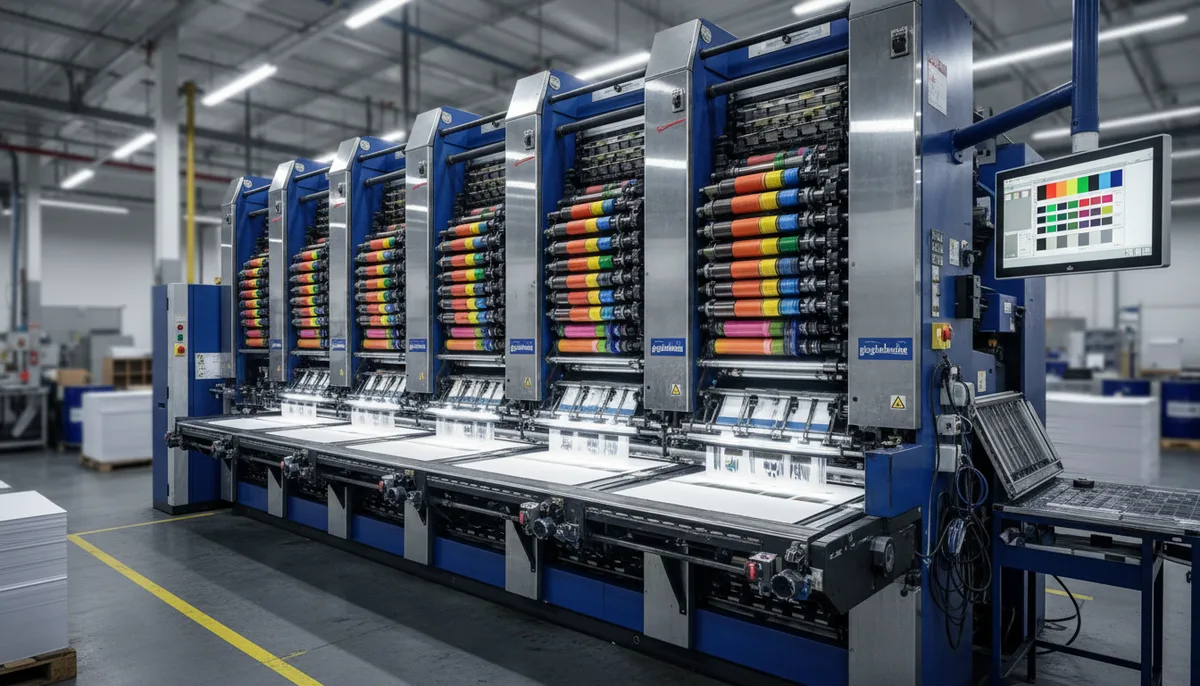
Our high-speed full-rotary 6-color press handles both technologies. We match the method to the order size for each client, ensuring optimal cost and quality. For runs between 500 and 5,000 units, we recommend evaluating total cost including setup waste, as digital's zero-waste setup can offset its higher per-unit cost. Compared to a pure offset approach, a hybrid digital-offset strategy offers more flexibility for brands with fluctuating order volumes.
How Does Color Accuracy Affect Photo Sticker Label Reliability?
Direct answer: Color accuracy directly impacts brand consistency and customer trust. Delta E under 2.0 is the industry standard for matching brand colors across production runs. Without spectrophotometry verification every 100 labels, color drift can shift a brand's signature red to orange, forcing costly reprints and delaying product launches.
Delta E under 2.0 is the industry standard for brand color consistency. Our team uses spectrophotometry verification on every production run. This ensures Pantone and CMYK matches stay tight from unit one to unit fifty thousand. Our HP Indigo digital press prints at 2400 dpi with Delta E under 1.5, meeting ISO 12647-7 standards for color management. The term "spectrophotometry" here refers to the measurement of color across the visible spectrum, which eliminates metamerism errors that can occur with simpler densitometers. This combination—Pantone matching, CMYK process control, and Delta E verification—ensures your brand colors remain consistent across all production runs.
Color drift is a common cause of rejected labels. Without proper verification, a brand's red can shift to orange between batches. This forces costly reprints and delays. Our fully automatic label optical inspection machine (PULISI) checks every label in real time against master color standards, reducing defect rates to below 0.5%. In 2026, we anticipate more brand owners will require spectrophotometric certification with every delivery, making in-press color control a baseline requirement rather than an optional upgrade.
As of early 2026, more retailers require Delta E reports with every shipment. Our production team provides color certification documents for each batch, covering both Pantone solid colors and process CMYK. This level of documentation protects your brand equity and ensures compliance with buyer specifications. The color accuracy standards in label printing are evolving to include tighter tolerances, so partnering with a certified supplier is essential.
When Is Offset Printing More Suitable for Photo Sticker Labels?
Offset printing is more suitable for runs above 5,000 units. The setup cost spreads across more labels, driving per-unit cost down by 30-40%. It also handles wider material options, including specialty substrates like metallic foil and textured papers. Our Heidelberg offset press can print on substrates from 80 gsm to 400 gsm, with sizes up to 48 x 24 inches. "Substrate weight" in gsm (grams per square meter) refers to the basis weight of the label material; the 80-400 gsm range covers everything from lightweight paper to heavy cardstock and synthetic materials.
Offset provides consistent color across long production runs. This matters for national retail programs where every shelf must match. The trade-off is a minimum order of 500 units per SKU and longer setup time—30-45 minutes compared to digital's near-instant startup. However, for high-volume runs, the per-unit savings far outweigh the initial setup investment. Compared to digital, offset also offers better opacity on dark or metallic materials. For premium packaging, this makes a visible difference on the shelf. Looking at 2026 trends, offset remains the most economical choice for runs above 5,000 units, especially when using Pantone spot colors that require precise matching.
When Flexography May Be a Better Fit
For runs exceeding 50,000 units with limited colors (1-3 spot colors), flexographic printing can deliver even lower per-unit costs than offset. Flexo uses flexible plates and fast-drying inks, making it ideal for long runs of simple designs on materials like polyethylene or polypropylene. However, setup costs are higher and image quality is generally lower than offset, so it may not be ideal when fine detail or photographic reproduction is required. Alternatively, for runs between 50,000 and 100,000 units with 4-color process requirements, offset is more suitable for maintaining quality while controlling cost.
Limitations of Digital Printing for Photo Sticker Labels
Digital printing is not ideal for runs above 5,000 units. The per-unit cost stays flat, so it never gets cheaper at scale. The main drawback is limited substrate range compared to offset. Digital toner-based presses work best with coated papers; uncoated or textured stocks can cause adhesion issues. Additionally, some digital inks may not meet FDA migration limits for direct food contact, so verify compliance before selecting digital for food packaging. A careful review of ink chemistry against FDA requirements is essential before committing to digital for food-contact labels.
Color shift over long digital runs can also be a problem. Without proper calibration, the same file may print differently at the start and end of a job. To mitigate this, our team runs automated calibration checks every 50 labels using a spectrophotometer integrated into the press. The press adjusts CMYK densities in real time based on these readings. Consider instead a hybrid approach: digital for short runs and offset for volume. This gives you the flexibility of variable data printing for small batches and the cost efficiency of offset for large orders. Compared to relying solely on one technology, a hybrid strategy reduces overall supply chain risk.
On the other hand, digital excels for variable data printing. This includes QR codes, sequential numbers, or region-specific text. The trade-off between flexibility and cost depends on your order volume. For runs under 500 units, digital's zero-waste setup and rapid turnaround make it the clear winner despite higher per-unit cost. Won't work for applications requiring extremely high-resolution halftones on uncoated stock, where offset's mechanical dot gain control produces better results.
What Compliance Standards Ensure Photo Sticker Label Reliability?
FDA compliance for food-contact labels requires migration levels below 5 mg/kg. This is critical for labels used on food packaging. Our ISO 9001:2015 quality management system tracks every batch for traceability. We also maintain ISO 14001:2015 environmental management certification for sustainable material sourcing and waste reduction. The term "ISO standards" refers to internationally recognized frameworks that define quality and environmental management criteria; certification demonstrates that production processes meet independent third-party audits.
ISO 14001:2015 environmental management applies to our production. This ensures sustainable material sourcing and waste reduction. Buying teams should verify these certifications before selecting a supplier. Additionally, for direct food contact, labels must meet FDA regulations for resinous and polymeric coatings. We test each material lot for compliance using independent third-party labs. In 2026, we expect FDA enforcement of migration limits to become more rigorous, making pre-shipment compliance testing a standard step in label procurement.
According to FDA guidance, labels that contact food must meet applicable requirements. Our production team tests each material lot for compliance. This prevents costly recalls and protects consumer safety. We also offer FSC-certified paper options for environmentally conscious brands, meeting both regulatory and sustainability goals. For companies targeting carbon-neutral supply chains, FSC certification combined with ISO 14001:2015 provides a verifiable path toward greener label sourcing.
How to Calculate Total Cost of Ownership for Photo Sticker Labels
Total cost of ownership (TCO) includes setup, material, waste, quality control, and logistics. For a 1,000-unit run, digital printing costs less due to zero plate fees. For 10,000 units, offset becomes cheaper by 30-40%. The table below summarizes the cost comparison at key volume points. As mentioned, the breakeven point between the two technologies falls between 1,000 and 2,000 units, but this shifts based on the number of Pantone colors and the substrates used.
| Volume | Digital Cost/Unit | Offset Cost/Unit | Winner |
|---|---|---|---|
| 250 units | Lower | Higher | Digital |
| 500 units | Lower | Higher | Digital |
| 1,000 units | Equal | Equal | Breakeven |
| 5,000 units | Higher | Lower | Offset |
| 10,000 units | 30-40% higher | 30-40% lower | Offset |
Waste percentage also matters. Digital has near-zero setup waste. Offset can lose 5-10% during setup. Factor this into your cost analysis for accurate numbers. For example, on a 10,000-unit offset run, 500-1,000 labels may be wasted during makeready—adding an effective 5-10% to your material cost. Over time, this adds up. Compared to digital, offset's waste is a fixed cost that diminishes as run length increases, making it more suitable for high-volume projects.
Key Factor in TCO: Color Complexity
The number of colors in your design directly affects both setup and per-unit cost. A 4-color process job costs more than a 2-color spot job for offset due to additional plates and longer setup. For digital, color complexity has minimal impact on cost because all colors are applied in a single pass. This makes digital particularly attractive for multicolor jobs under 2,000 units. When working with Pantone spot colors, offset may require dedicated wash cycles between color changes, adding to setup time and cost—factors that are less relevant for digital printing.
Ready to Optimize Your Label Program?
Get a custom cost analysis for your photo sticker label volume and specifications. Our team provides detailed TCO comparisons including setup waste and compliance testing.
Request a Free QuoteGet Started with Photo Sticker Label Reliability Analysis
Buying teams should evaluate three factors: volume, color accuracy needs, and compliance requirements. Digital printing works best under 500 units. Offset saves money above 5,000 units. For volumes between these thresholds, consider our hybrid printing service that combines digital's flexibility with offset's economy for split runs. The term "hybrid printing" means using digital for short-run, variable-data portions of an order and offset for the high-volume base—a strategy we refined during the 2023–2026 period as both technologies matured.
Our 98.7% on-time delivery rate and Delta E under 2.0 color accuracy reduce costly reprints. This is often overlooked in traditional cost comparisons. The right choice depends on your specific production mix. We also offer substrate testing for FDA compliance, ensuring your labels meet requirements for direct food contact. The price of non-compliance—recalls, fines, lost retail shelf space—can exceed the entire label procurement budget for a year.
Ready to improve your photo sticker label buying strategy? Contact us today to explore custom print solutions and get started with a tailored approach. We anticipate continued growth in demand for certified color accuracy and sustainable substrates through 2026 and beyond, so partnering with a forward-looking supplier is key.
For further reading, refer to the FDA regulation 21 CFR 175.300 for direct food contact materials, and the ISO 9001:2015 quality management standard to understand the certification requirements for reliable label production. Our custom print capabilities page provides more detail on the presses and quality systems described above. For a deeper look at color management, read our Delta E color accuracy guide.
Frequently Asked Questions
When does digital printing become cheaper than offset for photo sticker labels?
Digital printing is cheaper for runs under 500 units due to zero plate costs and 80% faster setup. The breakeven point typically falls between 1,000 and 2,000 units, depending on color complexity and substrate choice. Above 5,000 units, offset saves 30-40% per unit.
What Delta E value is required for brand color consistency on photo sticker labels?
Delta E under 2.0 is the industry standard for matching brand colors across production runs. Our HP Indigo digital press achieves Delta E under 1.5 at 2400 dpi, meeting ISO 12647-7 standards. Spectrophotometry verification every 100 labels ensures color drift is minimized.
What FDA compliance standard applies to photo sticker labels for food contact?
Labels that contact food must meet 21 CFR 175.300, requiring migration levels below 5 mg/kg. We test each material lot using independent third-party labs to ensure compliance. ISO 9001:2015 certification provides traceability for every batch.
How does substrate weight affect offset printing for photo sticker labels?
Offset printing handles substrates from 80 gsm to 400 gsm, including metallic foil and textured papers. Heavier substrates (above 300 gsm) may require slower press speeds, increasing setup time. Digital printing has a narrower substrate range, typically limited to coated papers.