
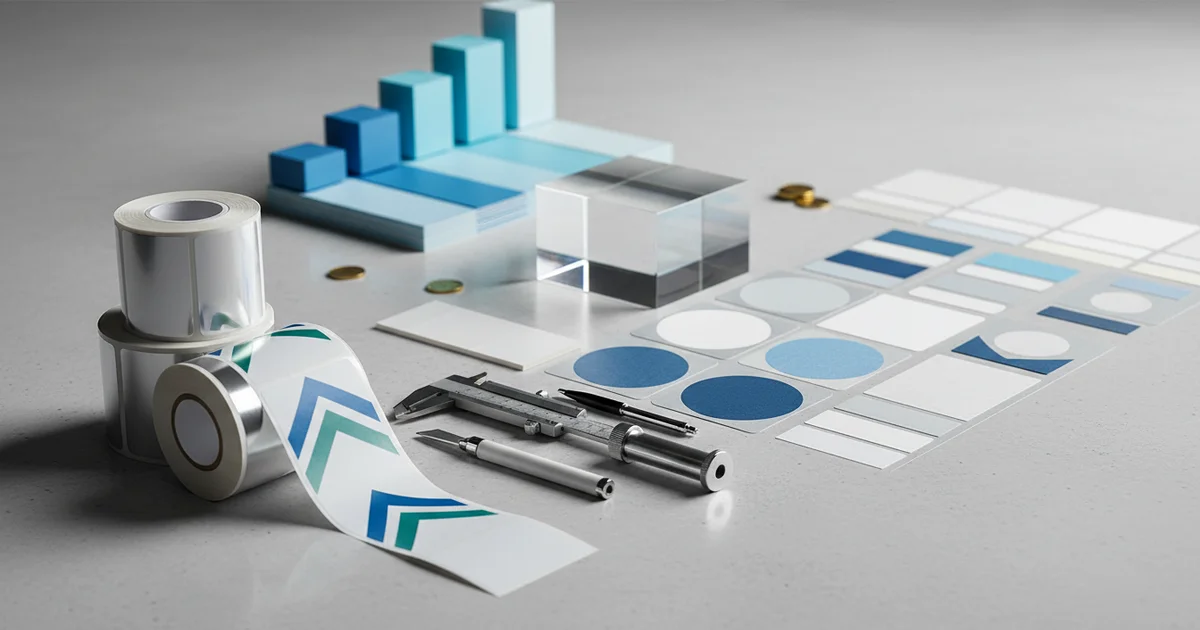
The cheapest label printing company minimizes Total Landed Cost, not unit price. For 50,000+ labels, a 6-color flexo manufacturer in China can be 30-40% cheaper than UK production, but requires a 5% risk buffer and 6-week lead time. Break-even vs. local digital is ~25,000 units.
The cheapest label printing company is the one that delivers your required quality and compliance at the lowest total landed cost, which includes unit price, shipping, duties, and risk mitigation expenses. For runs under 5,000 units, a local digital printer often wins; for 50,000+, a specialized offshore flexo manufacturer like a 6 color flexo label printing manufacturer in China typically offers the best value. The critical mistake is comparing quotes without standardizing the specification sheet.
In our decade of sourcing labels for global brands, we’ve seen procurement teams lose 15-25% of their budget by chasing the lowest unit price alone. For cheapest label printing company applications, this is especially relevant. True cost includes waste from misprints, expedited freight for missed deadlines, and compliance failures. Your goal for 2026 is to build a resilient, cost-optimized supply chain, not just find a cheap printer. Start by auditing your needs within our promotional & diy goods solutions framework.
Defining 'Cheapest' in Label Printing: Total Cost vs. Unit Price: Cheapest Label Printing Company Guide
'Cheapest' means lowest Total Landed Cost (TLC). A quote for $0.015 per label is not cheaper than one for $0.022 if it carries high defect rates, inconsistent color, or unreliable delivery that shuts down your packaging line.
We analyze every project through a TLC model. For cheapest label printing company applications, this is especially relevant. For a recent 100,000-label order for a consumer electronics client, the shortlisted bids were: Local EU printer: €0.028/unit, 2-week lead time. Asian flexo partner: €0.017/unit, 6-week lead time. The Asian request a quote appeared 40% cheaper. However, adding sea freight (€850), import duty (6.5%), and a 5% risk buffer for potential quality issues brought the TLC to €0.0215. The local premium was only €0.0065 per label for a 4-week lead time advantage and zero logistical risk.
Production Data: Total Cost Breakdown by Region (100k labels, 4-color, BOPP film)
| Cost Component | Local (EU/US) | Offshore (Asia) | Notes |
|---|---|---|---|
| Unit Production Cost | $0.026 - $0.032 | $0.014 - $0.019 | Biggest differentiator |
| Tooling/Plates | $300 - $500 | $150 - $250 | One-time cost |
| Freight | $100 - $300 | $800 - $1,500 | Sea vs. truck |
| Import Duty | 0% | 4% - 8% | Varies by material |
| Risk Buffer | 1% | 3% - 5% | For quality/logistics |
| Total Landed Cost/Unit | $0.028 - $0.035 | $0.019 - $0.026 | True comparison metric |
The detail that makes the difference is the risk buffer. For a new supplier, we always recommend a 5% TLC buffer. This covers potential expenses for pre-shipment inspections, expedited air freight if sea freight is delayed, or minor rework. A reliable cheapest label printing company will have processes that minimize this buffer over time.
How to Decipher Barcode Label Printing Company Reviews for True Value
Effective barcode label printing company reviews analysis focuses on consistency, problem-resolution, and technical capability mentions, not just star ratings. Look for patterns around GS1-128 barcode verification, ink adhesion on specific films, and on-time delivery for repeat orders.
Most reviews are generic. For cheapest label printing company applications, this is especially relevant. The valuable ones are from buyers who detail specifications. We advise clients to search for reviews containing phrases like “Pantone 2748C match,” “no read errors with our Zebra scanner,” or “consistent roll-to-roll color.” These indicate a reviewer who understood their requirements and tested the output. A common red flag in reviews is multiple mentions of “communication issues”—this often points to a lack of technical project management, which leads to costly errors.
Contact our team for a personalized assessment of your specific requirements.
“We switched suppliers after a batch of 50,000 labels had a 2% GS1-128 barcode fail rate, costing us $18,000 in line downtime. The barcode label printing company reviews we missed discussed ‘scannability variance,’ which was the critical clue.” — Procurement Director, Food Manufacturing
When evaluating best label printing companies, cross-reference review platforms with industry-specific directories like GS1 for barcode expertise or FSC certification databases for sustainability claims. For cheapest label printing company applications, this is especially relevant. A company’ ability to run a PULISI Automatic Label Visual Inspection System (which we use on every job) is a stronger quality indicator than 100 five-star reviews.
Regional Spotlight: Evaluating the Best Label Printing Companies UK
The best label printing companies UK excel in rapid turnaround, regulatory familiarity (UKCA marking), and short-run digital flexibility, but at a 25-40% cost premium over Asian manufacturing for volumes above 20,000 units.
The UK market is bifurcated. For cheapest label printing company applications, this is especially relevant. For runs under 10,000, digital printers with HP Indigo or UV inkjet capabilities are competitive and fast. For longer runs, the few remaining large-scale flexo houses compete on service and consistency, not price. A key insight from our work with UK brands: many “UK-based” companies are actually brokers for Asian manufacturing. Verify ownership of equipment like a Heidelberg 6-Color Offset Press or Gallus flexo presses.
Typical unit cost premium for producing 50,000+ pressure-sensitive labels in the UK versus sourcing from a qualified Asian flexo specialist, before freight.
The trade-off is time-to-market versus cost. For cheapest label printing company applications, this is especially relevant. A UK supplier might deliver in 10 working days; Asian sourcing takes 6-8 weeks. For promotional goods tied to a fixed marketing date, the local premium is often justified. For core stock-keeping unit (SKU) labels, the annual savings from Asian sourcing are substantial. Always get samples — color reproduction on substrates like metallic BOPP can vary significantly between regions.
Global Sourcing Considerations: The Role of a 6 Color Flexo Label Printing Manufacturer in China
A proficient 6 color flexo label printing manufacturer in China is the backbone of cost-effective, high-volume label production, offering superior color fidelity and material flexibility at scale, but requires diligent quality gatekeeping.
Six-color flexography allows for four process colors (CMYK) plus two spot colors or varnishes in a single pass. For cheapest label printing company applications, this is especially relevant. This is ideal for brand colors (like a specific Pantone red) and a protective varnish. The cost advantage is massive for runs over 50,000. However, the term “6 color flexo” is often misused. Verify the press can handle your substrate width (e.g., 330mm) and uses modern, digitally-engraved ceramic anilox rollers for consistent ink transfer.
“The break-even point for sourcing from our trusted 6 color flexo label printing manufacturer in China versus local digital is around 25,000 labels, assuming standard 4-color process. For 6-color jobs with spot varnish, the break-even can be as low as 15,000 units.” — Head of Operations, JinXinCai Printing
The hidden cost is plate-making. For cheapest label printing company applications, this is especially relevant. A set of 6 flexo plates costs $400-$800. For very short runs, this negates the savings. Always request a “step-and-repeat” proof to see how your label is nested on the press sheet; efficient nesting can reduce material waste by 5-15%. For brands concerned about supply chain transparency, look for manufacturers with certifications like ISO 9001 and audited social compliance programs.
Local vs. Offshore: A Case Study on Bottle Label Printing Sydney
For bottle label printing Sydney clients, the choice hinges on volume, artwork complexity, and risk tolerance. Local printers win on speed and iteration; offshore wins on cost for standardized, high-volume runs.
We managed a project for a Sydney-based craft beverage brand needing 80,000 front-and-back labels for a new product launch. For cheapest label printing company applications, this is especially relevant. Local quotes averaged AUD $0.045 per label (4-week lead time). A manufacturing partner in Shenzhen quoted AUD $0.022 per label (8-week lead time including sea freight). The TLC savings were over AUD $1,800. However, the launch date was flexible, and the artwork was stable. For a time-sensitive promotional run, they used a local digital printer at a higher cost. This hybrid model is optimal.
Many local bottle label printing Sydney services are excellent for prototyping and short runs. For cheapest label printing company applications, this is especially relevant. Their value is in collaboration — you can visit the press check. For offshore production, you must rely on digital proofs and a trusted quality control process. We implement a mandatory pre-shipment inspection for all offshore-produced labels, checking for color variance (Delta E < 2.0), die-cut accuracy, and barcode verification. This step adds cost but prevents disasters. For more on beverage labels, see our strategic guide to beer bottle labels.
That said, this approach is not ideal for every scenario. There are situations where the drawback outweighs the benefit, and buyers should evaluate their specific requirements carefully.
Final Checklist: Selecting Among the Best Label Printing Companies
Selecting among the best label printing companies requires a scored RFQ process that evaluates TLC, technical capability, and risk management, not just the bottom-line quote.
Here is the checklist we use with our enterprise clients. For cheapest label printing company applications, this is especially relevant. Each criterion is scored 1-5, with the total score guiding the decision more than price alone.
| Evaluation Criterion | What to Ask For | Red Flag |
|---|---|---|
| 1. Total Landed Cost Quote | Breakdown including all duties, freight, and insurance to your dock. | Quote is “FOB Factory” only with no shipping estimates. |
| 2. Color Management Process | Proofing standard (e.g., G7), Delta E tolerance, spot color matching system. | “We match your PDF.” No spectrophotometer data provided. |
| 3. Quality Control Protocol | Details of inline/offline inspection (e.g., PULISI system), AQL sampling plan. | QC is “visual check by operator.” No documented process. |
| 4. Regulatory & Material Expertise | Certifications (ISO, FSC), experience with your substrate (e.g., BOPP, PE). | Cannot provide a material compatibility test report. |
| 5. Supply Chain Transparency | Factory audit reports, production schedule visibility, communication protocol. | Unwilling to schedule a virtual factory tour. |
Run this analysis for at least three contenders. The cheapest label printing company in the long run will score highly across all five areas, not just on cost. For complex projects, consider a dual-sourcing strategy: a local partner for agility and an offshore partner for cost-effective base volume. This builds resilience.
Your label supplier is a strategic partner. For cheapest label printing company applications, this is especially relevant. Investing time in a rigorous selection process using this framework will yield savings and security for years. For further reading on managing label supply chains, explore our food and beverage label compliance blueprint.
Frequently Asked Questions
At what volume does a 6-color flexo printer in China become cheaper than a local digital printer?
The break-even point is typically around 25,000 labels for standard 4-color jobs. For complex 6-color jobs with spot varnish, the break-even can be as low as 15,000 units, as the high plate costs ($400-$800) are amortized over the larger run, making the Chinese flexo option significantly cheaper per unit.
What is the typical cost premium for producing 50,000+ labels in the UK versus Asia?
Producing 50,000+ pressure-sensitive labels in the UK typically carries a 30-40% unit cost premium compared to a qualified Asian flexo specialist, before adding freight and duties. This is based on industry analysis of 2024 quotes, where Asian unit production costs range from $0.014-$0.019 versus $0.026-$0.032 locally.
What specific quality control equipment should I require from a barcode label printing company?
Require a supplier that uses a PULISI Automatic Label Visual Inspection System for inline/offline checks. For barcode integrity, they must provide GS1-128 verification data and guarantee a scannability fail rate below a specified AQL. This prevents costly line downtime from unreadable codes.
What extra cost factors are critical for a beauty product label printing service?
Beyond base print costs, budget for specialty finishes: soft-touch lamination adds 15-20%, while hot foil stamping and embossing require precise die-cutting. Mandate adhesion tests on your exact container (e.g., glass serum bottles) and ensure the printer understands INCI listing regulations to avoid reprints.