
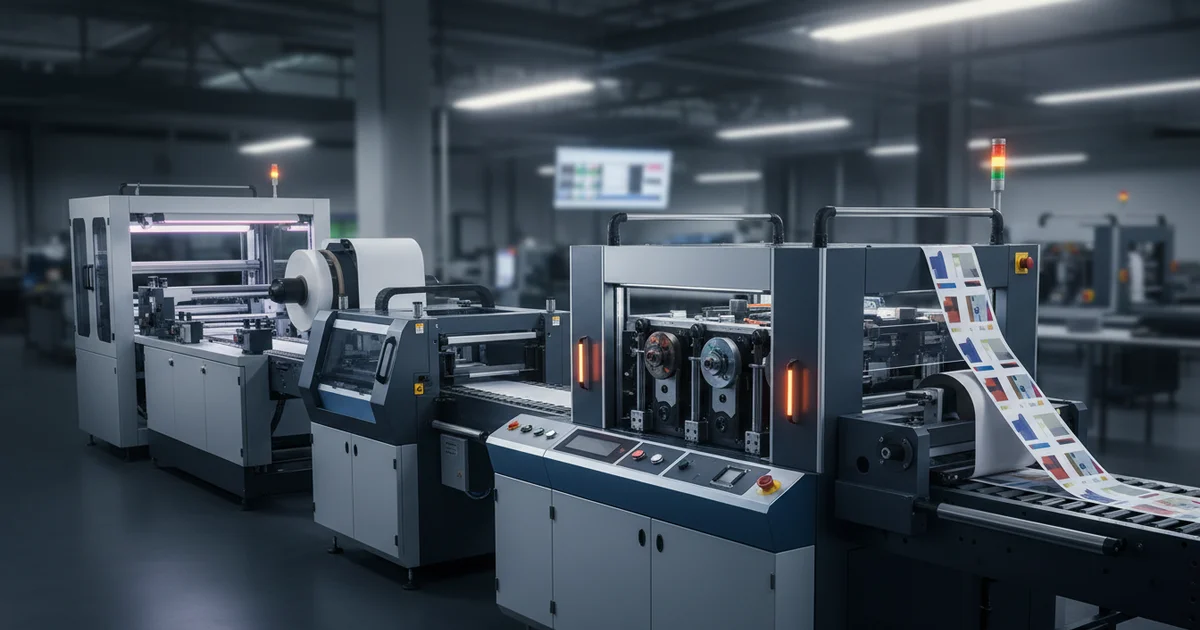
Complete commercial label printing systems integrate hardware like Epson ColorWorks, Bartender software, and material handling. For runs over 150k labels annually, they cut costs by 22% versus outsourcing, with ROI in 14-22 months. Key for custom lip balm labels is FDA-compliant adhesive and 2-mil polyester.
What is the real cost of a piecemeal approach to commercial label production? When evaluating complete commercial label printing systems options, the details matter. After implementing hundreds of systems, we find that fragmented workflows — separate design, printing, and finishing — increase per-label costs by 18-35% and introduce compliance risks. This guide provides the decision framework to build a unified, scalable complete commercial label printing system.
Looking for expert guidance? Get a free consultation to find the right approach for your project.
Average reduction in total cost per label for clients who transition from outsourced piecework to an integrated in-house system for volumes over 250k units/year.
How Does Complete Commercial Label Printing Systems Impact Printing System?
A complete commercial label printing system becomes cost-justified at annual volumes exceeding 150,000 labels, where the combined cost of hardware amortization, materials, and labor falls below the blended cost of outsourced production, which typically ranges from $0.08 to $0.25 per label depending on complexity.
The critical mistake is viewing hardware in isolation. For complete commercial label printing systems applications, this is especially relevant. The real value is in the integrated workflow. For example, our team's analysis shows that a promotional goods client printing 500,000 custom lip balm labels annually saved $42,000 in year one by bringing variable data and batch printing in-house with a dedicated system, eliminating external setup fees and rush charges.
We always advise clients to build their business case on three pillars: volume threshold, compliance control, and speed-to-market. For complete commercial label printing systems applications, this is especially relevant. If any two are primary drivers, a complete system warrants serious evaluation. For runs under 50,000, a hybrid model using a partner's white-label capabilities is often more efficient.
Core Components: Hardware, Software & Material Selection
Your hardware choice dictates everything downstream. For complete commercial label printing systems applications, this is especially relevant. The most common error is selecting a printer based on its maximum speed rather than its sustained throughput at your required quality level.
Production Data: System Throughput & Cost per 1,000 Labels
| System Type | Ideal Monthly Volume | Sustained Speed (labels/hr) | Avg. Cost/1k (Materials + Depreciation) | Best For Application |
|---|---|---|---|---|
| Industrial Inkjet (e.g., Epson ColorWorks) | 20k – 150k | 2,500 – 4,000 | $12 – $18 | Short-run variable data, custom clear label printing |
| Thermal Transfer (e.g., Zebra ZT410) | 50k – 300k | 6,000 – 10,000 | $8 – $14 | Compliance labels, barcodes, synthetic materials |
| Hybrid Digital/Flexo (In-house: Heidelberg) | 250k – 1M+ | 15,000 – 25,000 | $5 – $11 | High-volume brand labels, custom lip balm label printing, multi-color work |
| Mid-Volume Digital Press (e.g., HP Indigo) | 100k – 500k | 8,000 – 12,000 | $15 – $22 | High-quality label design, photo-realistic images, color matching |
Material compatibility is non-negotiable. For complete commercial label printing systems applications, this is especially relevant. Not all films adhere properly to curved surfaces like lip balm tubes. For custom lip balm label printing, you need an FDA-compliant, permanent acrylic adhesive with a high initial tack (measured by peel adhesion) and a conformable 2-mil polyester face stock. A generic paper label will fail.
"In our experience, we specify different adhesive systems for HDPE tubes versus glass jars. The wrong choice leads to flagging edges within weeks, increasing returns by up to 5%. For high-end cosmetics, we always recommend a laminating varnish for scuff resistance." — Senior Materials Specialist, JinXinCai Printing
Software Deep Dive: Bartender Software for Label Printing & Alternatives
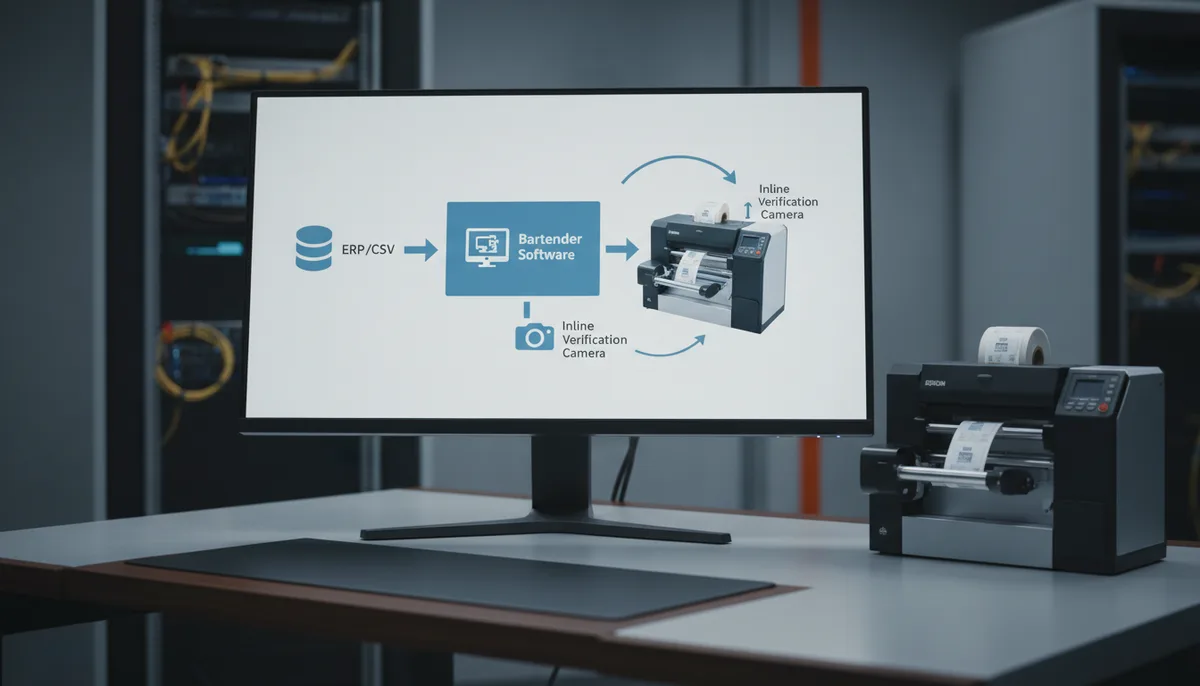
Bartender software for label printing automates variable data integration, connecting directly to ERP or CSV files to populate serial numbers, barcodes, and batch info, reducing manual entry errors by over 99% and cutting design-to-print time for repeat jobs by 80%.
The power of Bartender software for label printing lies in its database integration and barcode verification. For complete commercial label printing systems applications, this is especially relevant. It can natively generate and grade GS1-128, Data Matrix, and QR codes to ISO/IEC 15416 standards. A detail most miss is the need to calibrate the software's color output to your specific printer's ICC profile; otherwise, brand Pantone colors will drift.
When evaluating bartender label printing software against alternatives like NiceLabel or Loftware, the decision hinges on your IT infrastructure. For complete commercial label printing systems applications, this is especially relevant. Bartender excels in Windows-based environments with direct printer drivers. For cloud-native or SAP-integrated workflows, other platforms may be more suitable. Always request a pilot to test your most complex label template — like one with six variable fields and a nested graphic — before committing.
Need expert guidance on your next print project?
Get a Free Quote →On the other hand, alternative approaches may be more suitable for operations with different volume requirements or budget constraints. The right choice depends on your specific production parameters.
Specialty Applications: Custom Lip Balm Label Printing & Promotional Goods
Niche applications demand specialized knowledge. For complete commercial label printing systems applications, this is especially relevant. For custom lip balm label printing, the tube's small diameter (often 12-18mm) and curved surface create application and durability challenges.
Specifying Labels for Lip Balm Tubes: 4-Step Checklist
- Step 1: Verify Adhesive Compliance. Ensure the adhesive is FDA 21 CFR Part 175.300 compliant for indirect food contact. Request a manufacturer's Declaration of Compliance from suppliers like Avery Dennison.
- Step 2: Specify Material Conformability. Use a 2.0-2.5 mil polyester face stock with a "soft feel" lamination. This allows the label to conform to the tube without wrinkling or bridging.
- Step 3: Design for the Application Method. For automatic application, include a 1.5mm front and back gap on the liner. For custom printed round labels, ensure the die is perfectly concentric to avoid a wobble effect.
- Step 4: Plan for Finishing. Kiss-cutting must be precise to avoid nicking the tube. A 75° angled die blade and a 0.5mm butt cut are typical specifications we use on our rotary die-cutters.
Promotional goods, like branded USB drives or event giveaways, often use custom clear label printing for a "no-label" look. For complete commercial label printing systems applications, this is especially relevant. The key here is the adhesive's Optical Clarity Adhesive (OCA) rating and its resistance to yellowing. A low-quality adhesive will haze within months, ruining the premium effect.
What Are the Key Differences Between Round and Square Label Printing?
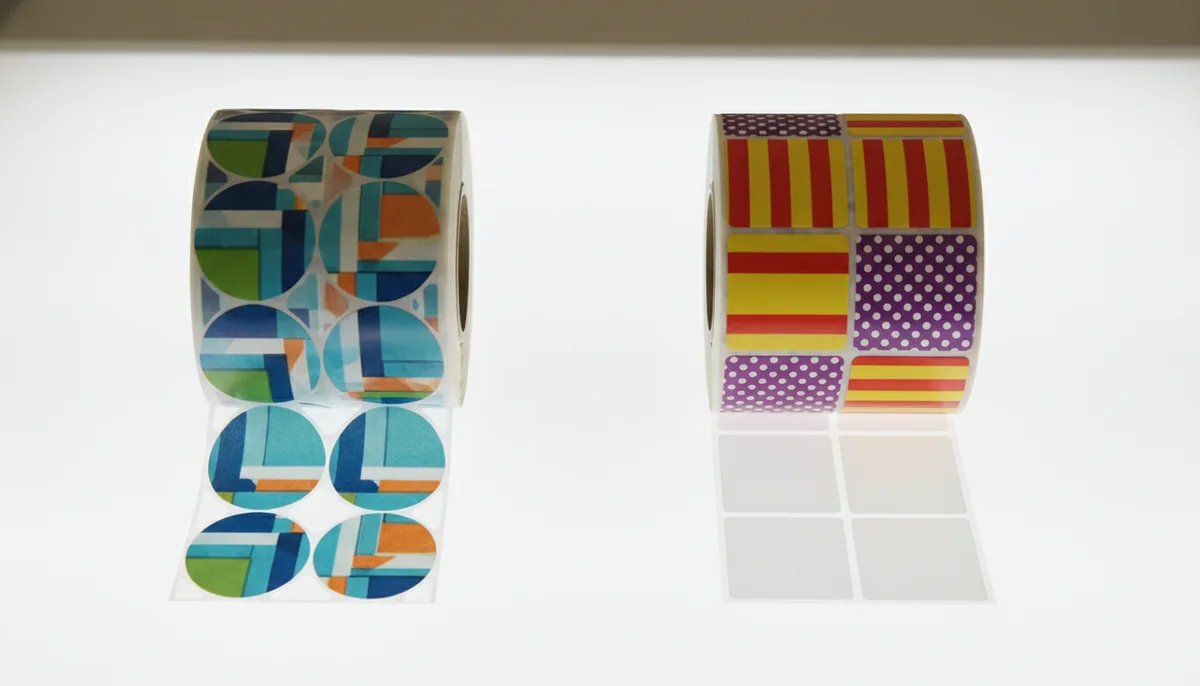
The primary difference is material efficiency: custom printed round labels generate 20-30% more waste than square labels, impacting cost-effectiveness at lower print volumes. Square labels offer faster production speeds and easier workflow integration with automatic applicators.
Custom printed round labels have 20-30% more waste (skeletons) compared to square label printing due to the nesting pattern on the roll. For complete commercial label printing systems applications, this is especially relevant. To be cost-effective, you must work with a converter who uses advanced nesting software to maximize substrate use. The minimum cost-effective order quantity is typically higher for rounds — around 25,000 units versus 10,000 for squares.
For square label printing, the critical detail is gutter and bleed. For complete commercial label printing systems applications, this is especially relevant. We recommend a 2mm bleed on all sides and a 3mm gutter between labels on the sheet. This prevents color bleed during die-cutting and ensures consistent registration on high-speed applicators. A common mistake is designing to the exact cut size, which results in white edges if the die shifts even slightly.
"Working with enterprise clients, we've found that for clear labels on clear bottles, a full-bleed flood white underprint is mandatory. Without it, the print disappears against the liquid. This step is non-negotiable for professional custom clear label printing and ensures durable labels." — Head of Pre-Press Operations, JinXinCai Printing
Implementation Checklist: From Print Post Label Requirements to Workflow
Deploying a system is more than plugging in a printer. For complete commercial label printing systems applications, this is especially relevant. It's about creating a repeatable, quality-controlled workflow from design to dispatch. A successful label printing system setup requires planning for both production and post-production logistics.
Decision: In-House System vs. Hybrid Partner Model
- If your monthly volume is < 50k labels and you have no compliance needs → Use an on-demand digital print partner. Invest in design software only.
- If your volume is 50k–250k with variable data (batch codes, dates) → Implement an industrial inkjet system (e.g., Epson) integrated with Bartender software. Outsource complex shapes and laminating.
- If your volume exceeds 250k with brand-color criticality → Invest in a hybrid system or partner with a facility like ours that uses a Heidelberg 6-Color Offset Press for color accuracy (Delta E < 2.0) and inline coating.
Don't forget the "print post label"—the shipping and tracking label. For complete commercial label printing systems applications, this is especially relevant. This must integrate with your warehouse management system (WMS). The system should auto-populate the print post label with data from the sales order, including tracking numbers, carrier routing codes, and compliance symbols for hazardous materials if needed.
Need Help With Your Commercial Label Printer Comparison?
We've handled over 500 projects, from small label printing system setup to full production lines. For complete commercial label printing systems applications, this is especially relevant. Contact our integration team for a free analysis of your volume, materials, and ROI potential.
That said, this approach is not ideal for every scenario. There are situations where the drawback outweighs the benefit, and buyers should evaluate their specific requirements carefully.
Total Cost Analysis & Vendor Comparison Guide
Finally, let's talk numbers. The total cost of ownership (TCO) for complete commercial label printing systems includes visible and hidden costs. A thorough commercial label printer comparison must look beyond the sticker price.
| Cost Category | Industrial Inkjet System | Hybrid Partner Program (White-Label) | In-House Flexographic Line |
|---|---|---|---|
| Capital Equipment | $25,000 – $75,000 | $0 – $5,000 (Tooling) | $250,000 – $500,000+ |
| Annual Maintenance & Service | 12-18% of CapEx | N/A (Included in unit cost) | 8-12% of CapEx |
| Material Cost per 1k Labels | $12 – $18 | $7 – $15 (volume-based) | $5 – $11 |
| Labor (Hours per 100k labels) | 8 – 12 hours | 2 – 4 hours (QC & logistics) | 4 – 6 hours |
| Minimum Efficient Run | 1,000 | 10,000 | 50,000 |
The hybrid partner model, like our white-label programs for retail, is often the smartest step before full capital commitment. For complete commercial label printing systems applications, this is especially relevant. You gain access to industrial equipment (like our Heidelberg press) and expertise without the upfront risk, paying a predictable per-unit cost. This is ideal for validating a new product line, like a series of custom lip balm labels, before scaling.
Building a complete commercial label printing system is a strategic investment in brand control, agility, and cost management. For complete commercial label printing systems applications, this is especially relevant. The goal isn't to own every piece of equipment, but to own the seamless process that delivers perfect labels, on time, every time. Start by auditing your current total label cost and lead times, then model the scenarios above. The right path will become clear. For enterprise-level complete commercial label printing requirements, getting the specifications right from the start saves both time and budget.
Frequently Asked Questions
When does an in-house label printing system become cheaper than outsourcing?
An in-house system becomes cost-effective at annual volumes exceeding 150,000 labels. For example, a client printing 500,000 custom lip balm labels saved $42,000 in year one by eliminating external setup fees and rush charges with an integrated system featuring Bartender software and a dedicated digital press.
What is the minimum print volume to justify a complete commercial label printing system?
The minimum efficient run varies by system. Industrial inkjet systems (e.g., Epson ColorWorks) are viable for runs as low as 1,000 labels, while a hybrid digital/flexo system requires a minimum of 50,000 units to be cost-effective. The business case solidifies at annual volumes over 150,000 labels.
How does material choice affect the cost of custom clear label printing?
Material choice significantly impacts cost and quality. For a premium 'no-label' look, you must specify an Optical Clarity Adhesive (OCA) with a high rating to prevent yellowing. A full-bleed flood white underprint is also a non-negotiable step for clear labels on bottles, adding to material costs but ensuring print visibility.
What specifications are needed for compliant print post label requirements?
Compliant print post labels must auto-populate from your WMS with carrier routing codes and tracking numbers. For hazardous materials, they must include the appropriate GHS or transport symbols. Integration with software like Bartender is key to automating this data population and ensuring accuracy for shipping logistics.