
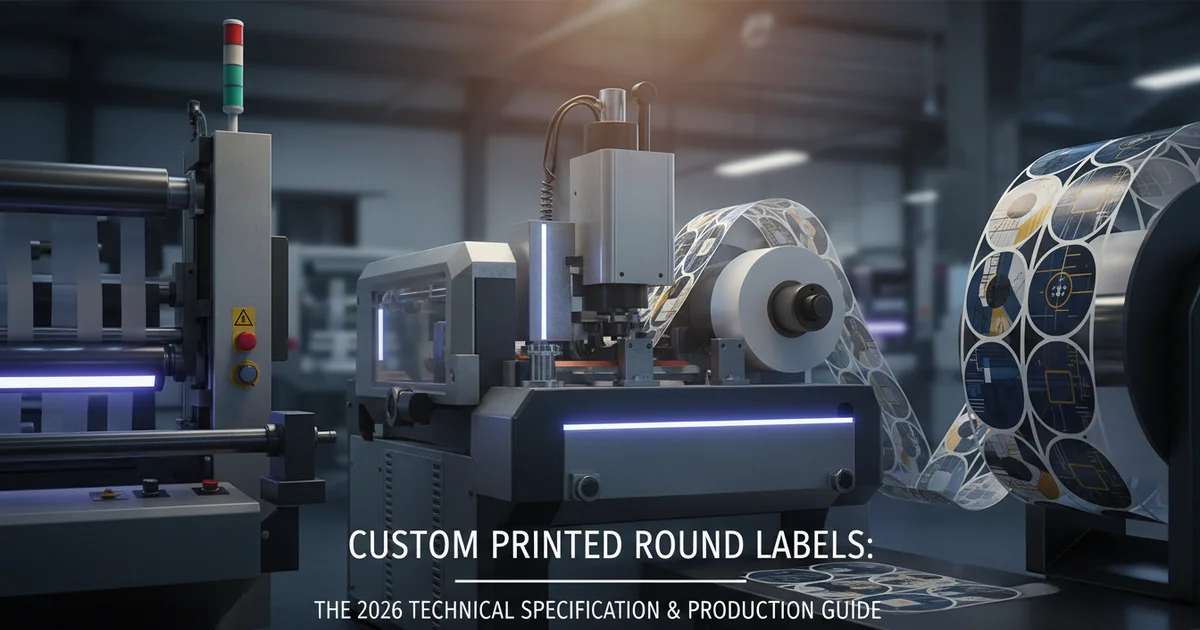
Custom printed round labels: Offset printing on 80-micron BOPP costs $0.09-$0.14/unit for 5,000+ runs. Pantone matching requires Delta E <2.0. FDA 21 CFR compliance is mandatory for food contact. Breakeven from digital to offset is 5,000 units (3,000 with spot colors).
What separates a generic sticker from a high-performance brand asset? This guide will enable you to specify custom printed round labels with the precision of a production manager, ensuring your investment delivers consistent brand impact, durability, and regulatory compliance. You'll learn to navigate the critical trade-offs between materials, printing processes, and finishes to achieve commercial-grade results.
of specification errors on custom printed round labels originate from incorrect material or adhesive selection for the application environment.
Strategic Applications of Custom Printed Round Labels in B2B
Custom printed round labels serve as critical touchpoints for brand identification, regulatory compliance, and premium presentation across industries. Their primary commercial applications include product branding (cosmetics, beverages), certification seals (organic, safety), premium packaging accents, and durable asset tagging.
In our experience working with enterprise clients, the most common commercial diameters range from 1" (25.4mm) for small product seals to 6" (152.4mm) for premium packaging accents. Order volumes typically start at 1,000 units for digital production and scale efficiently into the hundreds of thousands for offset runs. A common mistake we see is clients ordering a 2" diameter label for a curved surface without accounting for material flexibility, leading to application failures.
These labels are a cornerstone of effective promotional & DIY goods solutions, offering a versatile canvas for brand expression. For food and beverage sectors, they transition from pure branding to mandatory FDA compliance labels, requiring a completely different specification framework.
Material & Print Technology Comparison: Balancing Cost and Performance
Is your label destined for a freezer door or a wine bottle? The application environment dictates the material, which then dictates the optimal print process for your full color labels. This is the core decision matrix.
Production Data: Cost-Per-Unit Analysis for 2" Round Labels (5,000 Unit Run)
| Material & Process | Avg. Cost/Unit | Ideal Application | Lead Time | Color Gamut |
|---|---|---|---|---|
| 80µ BOPP, Digital Print | $0.18 – $0.25 | Short runs, waterproof needs | 7–10 days | Wide CMYK |
| 80µ BOPP, Offset Print | $0.09 – $0.14 | Runs >5K, outdoor durable | 10–15 days | Pantone + Process |
| 300gsm C1S Board, Offset | $0.12 – $0.17 | Premium feel, wine labels | 12–18 days | Excellent solid coverage |
| Paper, Removable Adhesive, Digital | $0.07 – $0.11 | Indoor promo, temporary | 5–8 days | Standard CMYK |
The detail most people get wrong is assuming "waterproof" means all-purpose. BOPP (50-100 micron) is waterproof and chemical-resistant, ideal for bottles or outdoor use. C1S coated board (250-400 gsm) offers a premium, rigid feel perfect for custom printed wine labels but is not inherently waterproof without lamination. For offset printing on runs over 5,000, our Heidelberg 6-color press runs at speeds up to 15,000 sheets per hour with inline coating, providing the best unit economics for full color labels.
"The breakeven between digital and offset for round labels is typically at 5,000 units, but that shifts to 3,000 if you require multiple Pantone colors. The makeready for spot colors on offset is fixed, so the cost per unit drops faster." — Head of Operations
How Does Pantone Color Matching Ensure Absolute Brand Consistency?
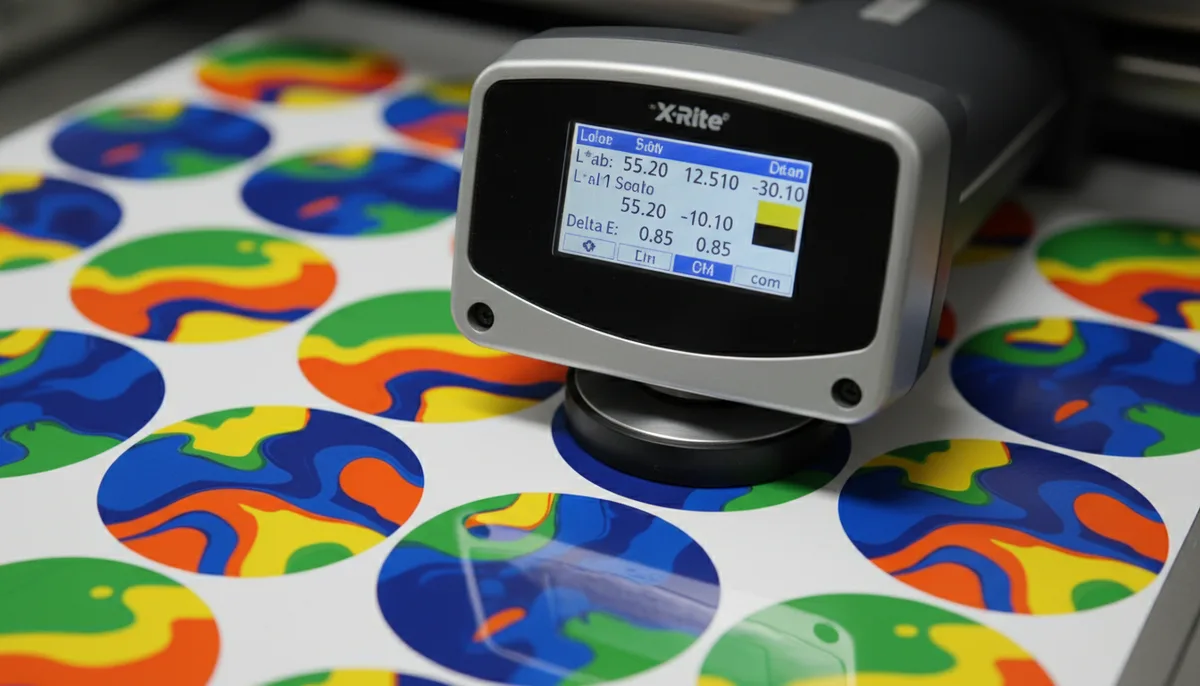
Pantone color matching uses standardized ink formulations to achieve exact brand colors across print runs and materials, critical for logos and brand assets. It requires specifying Pantone PMS numbers and a Delta E tolerance, typically <2.0, verified with a spectrophotometer on press.
In practice, pantone color matching is non-negotiable for corporate branding. The process isn't just about specifying a PMS number; it's about controlling the tolerance. We run G7-calibrated proofing and measure every press sheet with an X-Rite spectrophotometer. A Delta E (ΔE) value below 2.0 is visually indistinguishable to the average observer under standard lighting.
Where clients often stumble is assuming CMYK "process" printing can match a solid Pantone. It can't, especially for vibrant oranges, bright greens, or deep blues. For a 2-color brand logo on a custom printed round label, using two Pantone spots is often cheaper and more accurate than a four-color process simulation. This is a key consideration when developing your print packaging label strategy.
Need expert guidance on your next print project?
Get a Free Quote →Specialized Considerations for Custom Printed Wine Labels
Custom printed wine labels operate under unique constraints: they must be aesthetically premium, resistant to condensation and chilling, and apply smoothly to a curved, often damp surface. This demands a specific material and finishing combination.
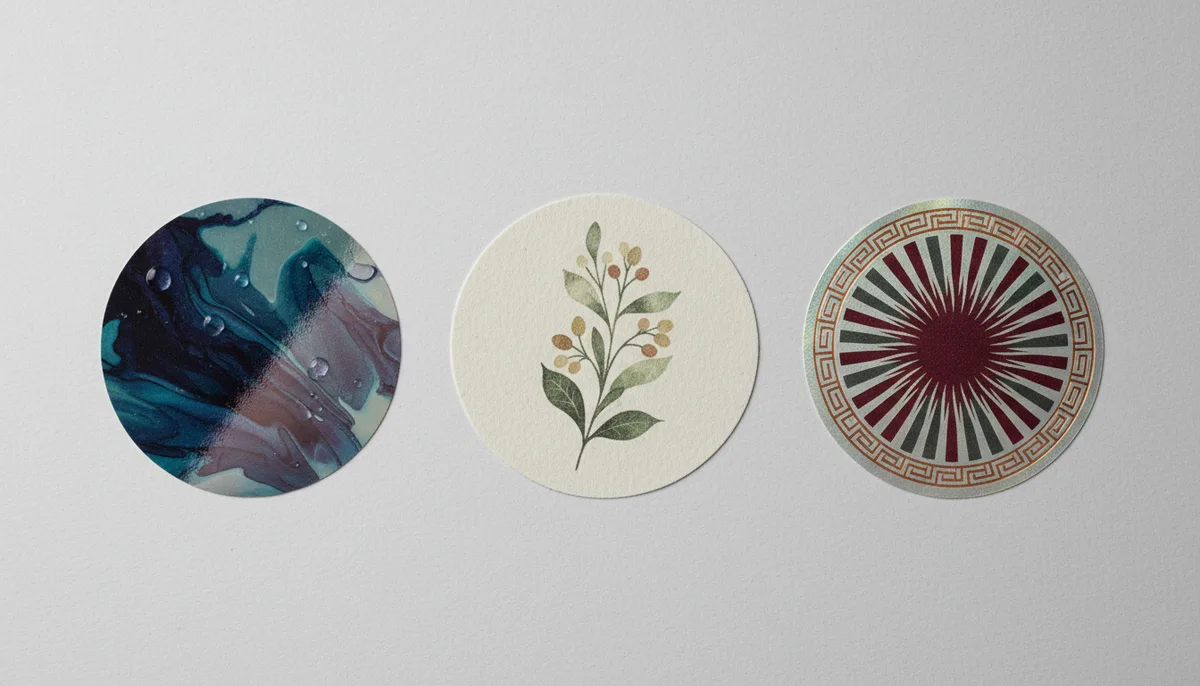
Standard paper labels will cockle and fail when chilled. The industry standard is a moisture-resistant C1S board, typically 300-350 gsm, with a waterproof adhesive. Aesthetically, custom printed wine labels often employ metallic Pantone inks, embossing, or delicate foil stamping. Our Heidelberg press's inline coating unit allows for a spot UV gloss over specific design elements, creating texture and shine that elevates the brand.
The critical detail is testing. Before finalizing a 10,000-unit run, always request a sample batch for a real-world application test. Apply labels to bottles, chill them to 4°C (39°F), and check for adhesive failure or edge lifting after 24 hours. This simple step prevents costly batch rejections. For more on beverage labeling, see our framework for beverage label durability.
Developing Your Specification Sheet for Print Packaging Label Projects
A vague brief guarantees variable results. A comprehensive technical specification sheet is your primary tool for ensuring the final product matches your vision for your print packaging label project.
How to Build a Label Spec Sheet: 5-Step Summary
- Step 1: Define Physical Specs. Specify exact diameter (e.g., 2.5" ±0.15mm tolerance), material (e.g., 80-micron White BOPP), and adhesive type (permanent acrylic, removable).
- Step 2: Provide Print-Ready Artwork. Supply vector files (AI/EPS) with a 3mm bleed and a dieline layer. Confirm color mode: CMYK for photos, Pantone PMS numbers for brand colors.
- Step 3: Specify Print & Color Standards. State print process (offset/digital) and color tolerance (Delta E < 2.0 for Pantone matches).
- Step 4: Detail Finishing Requirements. List any coatings (overall matte laminate, spot UV gloss) and packing method (rolled on cores, sheeted).
- Step 5: Include Compliance & Logistics. Reference any regulations (FDA 21 CFR 175.300) and provide shipping destination for logistics planning.
This document becomes the objective benchmark for quality control. It also allows vendors to provide accurate, comparable quotes. Omitting the die-cut tolerance (±0.15mm is standard for precision work) is a common mistake that leads to labels not fitting application targets consistently.
Vendor Evaluation Framework: From Proofing to Fulfillment
Your label's quality is inextricably linked to your printer's capabilities and processes. Evaluating a vendor requires looking beyond the quote at their proofing, color management, and quality control systems.
Always request a hard-copy, color-managed proof for approval, not just a PDF. A professional printer will provide a press proof for offset jobs, showing exact colors on the actual substrate. Ask about their color measurement process — if they don't mention a spectrophotometer and Delta E, walk away. For complex projects like custom printed wine labels or FDA compliance labels, audit their material certification files and ask for a sample of a previous similar job.
"We've seen clients save 15% on unit costs but incur 30% more in internal QA time due to color variance. The cheapest price often omits the robust pre-press and proofing that prevents expensive mistakes." — Client Solutions Architect
Standard lead times for a complex round label job are 10-15 business days from proof approval. Ensure your vendor understands your full supply chain needs, which you can explore further in our broader strategic sourcing guide for custom labels.
Common Mistakes & Troubleshooting for Round Label Production
Even with a good spec sheet, pitfalls remain. Here are the most frequent issues we resolve and how to avoid them.
| Common Mistake | Result | Preventive Action |
|---|---|---|
| Using paper adhesive on a cold, damp surface (e.g., beverage bottle) | Label falls off | Specify waterproof, freezer-grade adhesive |
| Providing low-resolution JPEG artwork | Pixelated, blurry print | Always supply vector files or high-res (300+ DPI) PDFs |
| Omitting bleed from artwork | White unprinted edges after die-cut | Extend background art 3mm beyond the dieline |
| Assuming CMYK matches Pantone 072C (blue) | Dull, inaccurate brand color | Use Pantone color matching for critical brand colors |
| Not specifying roll orientation for auto-application | Labels dispense incorrectly on line | Confirm machine direction (MD) during quoting |
Investing in properly specified custom printed round labels delivers measurable ROI through enhanced brand perception, reduced application failures, and compliance assurance. By applying the frameworks and technical parameters outlined here, you can approach your next print packaging label project with the confidence of a production expert, ensuring your labels perform as flawlessly as they look.
Frequently Asked Questions
What is the typical breakeven quantity for moving from digital to flexographic printing for custom printed round labels?
The breakeven point is typically 5,000 units for standard CMYK jobs. However, if your design requires multiple Pantone spot colors, the breakeven can drop to 3,000 units due to the fixed makeready costs for spot colors on a Heidelberg 6-color offset press, making it more cost-effective sooner.
How does Pantone color matching impact lead times and cost for small batches?
For batches under 5,000 units, Pantone color matching on an offset press adds 2-3 days for ink formulation and press setup, increasing unit cost by 15-20%. For digital printing, Pantone simulation is less accurate but adds minimal time. Always specify a Delta E tolerance of <2.0 for brand-critical colors.
What specific adhesive properties should I specify for outdoor or cold-chain application?
For outdoor use, specify a permanent acrylic adhesive on 80-micron BOPP material. For cold-chain applications like beverage bottles, a waterproof, freezer-grade adhesive is mandatory. Standard paper adhesives fail below 4°C (39°F), leading to label detachment.
When does offset printing on C1S board become more cost-effective than digital on BOPP for a premium wine label?
Offset printing on 300gsm C1S board becomes more cost-effective than digital on BOPP at approximately 3,000 units for a 2" label, with costs dropping to $0.12-$0.17 per unit. This is due to the superior color coverage and premium feel of offset, which is the standard for custom printed wine labels.