
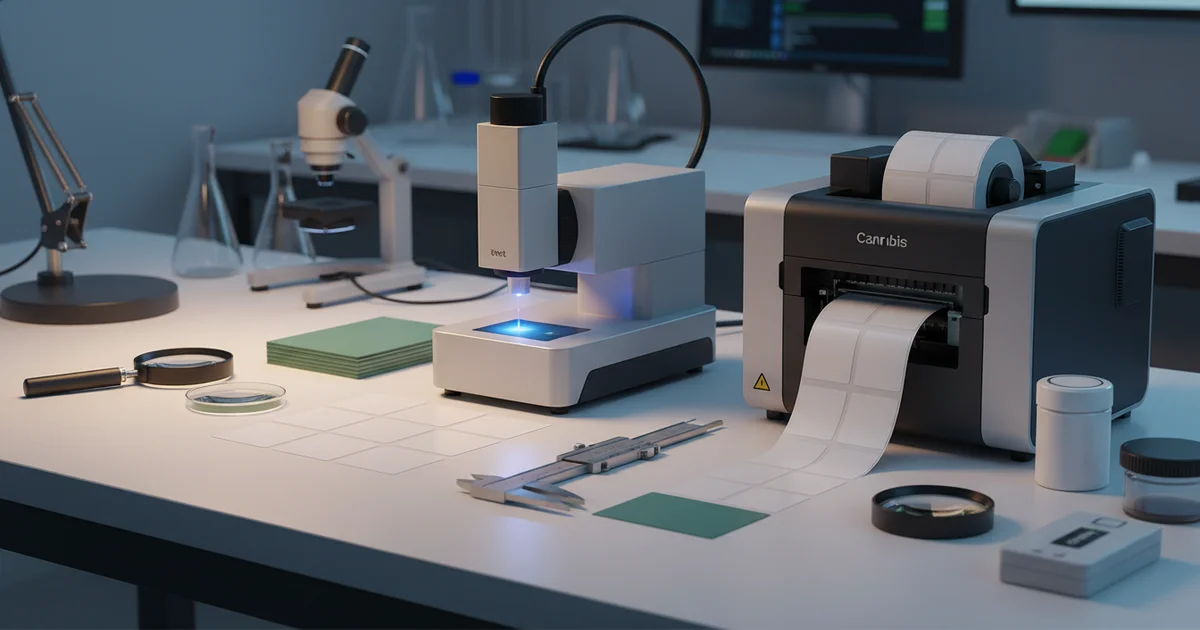
Cannabis testing label printing requires 3-5mil PET film, 1200 dpi UV inkjet, and ISO 15416 barcodes. The breakeven for in-house printing is 50,000 labels. Partner with a specialized manufacturer for runs under this volume to ensure compliance and durability.
Cannabis testing label printing is a high-stakes process where a single barcode failure or material defect can trigger a costly product recall, costing operators upwards of $50,000 in fines and lost inventory. For cannabis producers navigating strict state regulations, cannabis testing label printing requires careful material selection and barcode quality assurance. A small error can result in failed inspections, product holds, and significant financial losses. This guide covers the key specifications—from PET film thickness to 1200 dpi UV inkjet—to ensure your labels pass compliance checks every time.
Why Cannabis Testing Labels Demand Specialized Printing
Cannabis testing label printing is not a standard label job. The labels must survive cold storage, solvent exposure, and frequent handling. They also need to hold a high-quality barcode for state track-and-trace systems.
A common mistake is using paper labels. Paper absorbs moisture and smears, which makes barcodes unreadable. According to a 2025 study on cannabis labeling compliance, THC concentration labels can vary by ±15% from the product's actual content. A failed label means a failed product test.
Our production team has seen that 1200 dpi resolution is the baseline for small barcodes and fine text. Anything less, and the symbol contrast drops below ISO 15416 needs. Our promotional & diy goods solutions team applies this standard to every cannabis label run.
What Are the Material and Coating Requirements for Cannabis Testing Label Printing?
Cannabis testing label printing requires a 3–5 mil PET film substrate with a UV-resistant and chemical-resistant coating. PET film provides dimensional stability and resistance to moisture, solvents, and temperature extremes. The coating must survive an isopropyl alcohol wipe without smudging or delamination.
The substrate for a cannabis testing label must be a 3–5 mil PET film. PET offers the dimensional stability and chemical resistance that paper cannot match. Specify a UV-resistant coating to prevent fading under retail lighting. A chemical-resistant coating is also critical. The label must survive an isopropyl alcohol wipe without smudging or delaminating.
Our specialty materials solutions team measures thickness with a micrometer. We also perform a rub test per ASTM D5264 to verify abrasion resistance. If the coating fails, the label will peel off in cold storage. We also check tolerance to ±0.5 mm for die-cut labels to ensure consistent fit on packaging.
Choosing the Right PET Film Thickness
For cannabis testing label printing, film thickness directly affects durability and application. A 3 mil film is suitable for short-term use, while 5 mil offers extra rigidity for reusable containers. Our team uses a micrometer to verify thickness on every roll, ensuring compliance with state traceability requirements.
When specifying material, also consider the label size. Common dimensions for cannabis testing labels are 4 x 2 inches, which provide enough space for barcodes and regulatory text while fitting most containers. Our HP Indigo 1200 dpi press prints on 3–5 mil PET with Pantone color matching and ±0.5 mm die-cut tolerance, meeting ISO 9001 standards. For color-critical runs, we target delta E ≤ 2 using CMYK + Pantone matching. The liner typically has a basis weight of 60 gsm.
Step-by-Step Label Specification Guide
- Select 3–5 mil PET film with UV and chemical-resistant coatings.
- Verify coating resistance via ASTM D5264 rub test (CS-10 wheel).
- Specify 1200 dpi UV inkjet print resolution for barcodes and fine text.
- Define barcode symbology (GS1-128) and quiet zone (10× narrow bar width).
- Require ISO 15416 Grade C verification on every label.
- Include die-cut tolerance of ±0.5 mm for consistent application.
What Print Resolution and Ink Technology Work Best for Cannabis Testing Label Printing?
The best print resolution for cannabis testing label printing is 1200 dpi using UV-curable inkjet. This combination delivers sharp edges, high symbol contrast for barcodes, and chemical resistance. Lower resolutions like 600 dpi cause dot gain, making small text and barcodes unreadable.
Digital inkjet label printing at 1200 dpi is the standard for cannabis testing labels. UV-curable ink provides immediate durability and chemical resistance. Lower resolutions, such as 600 dpi, produce visible dot gain. This makes small barcodes and 6-point text unreadable. At 1200 dpi, the edges stay sharp. The barcode symbol contrast meets the ISO 15416 Grade C threshold.
Our high-speed full-rotary 6-color multifunctional label printing press runs UV ink. We adjust the print speed to improve dot placement. A 10× loupe inspection checks for edge sharpness and pinholing. We also use a PULISI optical inspection machine for 100% barcode quality assurance.
UV Inkjet vs Solvent Ink
Solvent-based inks may work for outdoor labels but are not suitable for food-contact or cannabis applications. UV ink is the safer choice for regulatory compliance. It cures instantly, resists chemicals, and produces no volatile organic compounds during printing. Our HP Indigo press uses UV ink with Pantone color matching to ensure brand consistency across runs. For the highest color accuracy, we specify CMYK separations and verify delta E ≤ 2. Heidelberg label presses also offer UV inkjet capabilities for large-volume runs.
Barcode Quality Assurance: Meeting ISO 15416 Standards
ISO 15416 is the international standard for barcode quality. Every cannabis testing label must pass ISO 15416 verification with a minimum grade of C (0.5). A grade D or F means the label fails compliance. The barcode symbology is GS1-128. The quiet zone must be 10 times the narrow bar width. Many specifiers neglect this, and the barcode fails verification right away.
We use a fully automatic label optical/visual inspection machine (PULISI) on every run. This system checks symbol contrast, modulation, defects, decodability, and quiet zone. It catches issues before labels reach the customer. For FDA 21 CFR Part 11 compliance, our system logs every inspection result for traceability.
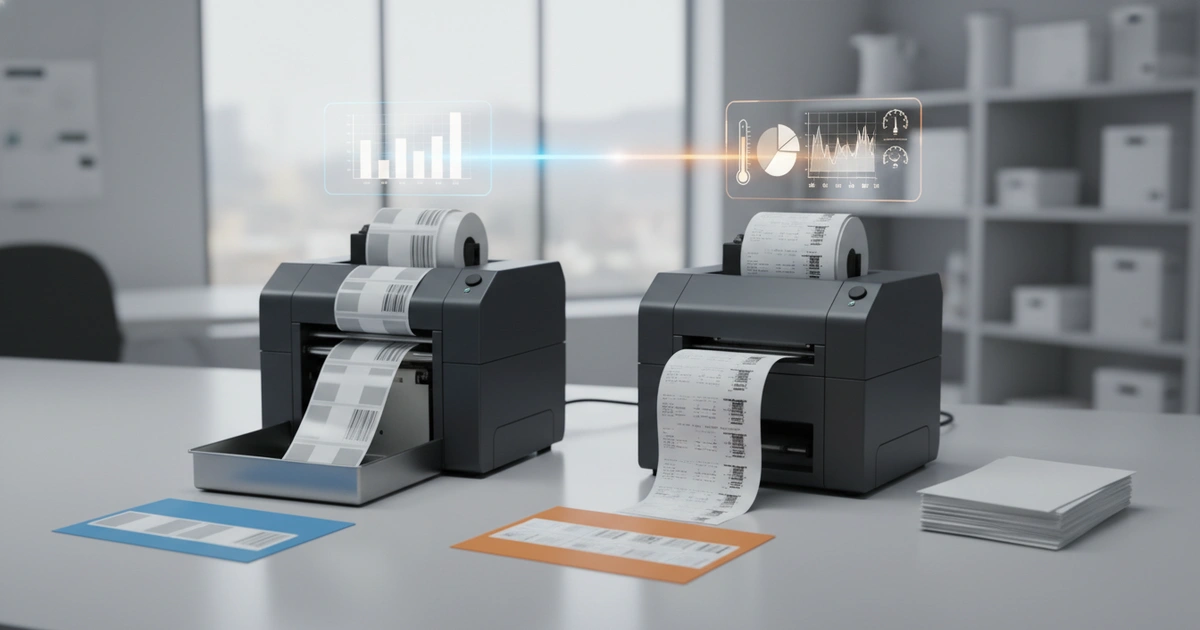
ISO 15416 requires a minimum barcode grade of C (0.5) for cannabis testing labels.
ISO 15416:2016
Barcode Verification Process
Barcode verification is the process of measuring symbol quality against ISO 15416 parameters. Our PULISI machine verifies each label at full production speed (up to 100 ft/min). If any label falls below Grade C, the system flags the roll for rework. This level of inspection is especially important for cannabis labels because state regulators often require proof of verification. The quiet zone requirement—10× the narrow bar width—is a common failure point. We verify it automatically.
Durability Testing: Ensuring Labels Survive Handling and Transport
Durability testing is essential to ensure cannabis labels survive harsh conditions. Labels must survive temperature cycling from -20°C to 50°C and humidity up to 85% RH. Run an abrasion test per ASTM D5264 with a CS-10 wheel for 50 cycles. After conditioning, the barcode must remain scannable. The label must not peel, fade, or smudge.
A drawback of skipping this test is a recall. If labels fail in cold storage, the product cannot be sold. Our quality team conditions samples in an environmental chamber before approving a run. We also verify dimensional stability – the label should not shrink or expand more than ±0.2 mm after temperature cycling.
Compared to general retail labels, cannabis labels require a higher level of validation. The trade-off is a longer testing cycle, but it prevents costly compliance failures. For runs under 50,000 labels, outsourcing to a specialized manufacturer like our facility reduces risk because we handle all testing in-house.
Ready to Ensure Your Labels Pass Compliance?
Our ISO 9001:2015 certified facility produces cannabis testing labels with 1200 dpi UV inkjet and 100% optical inspection. Get a quote for your next run.
Request a Free QuoteIn-House vs. Outsourced Printing: The 50,000 Label Breakeven
The breakeven point for in-house cannabis testing label printing is about 50,000 labels per year. Below that volume, outsourcing is cheaper. An in-house UV inkjet printer costs $15,000–$25,000. The operator training, ink, and maintenance add another $5,000 per year. For a run of 10,000 labels, the per-unit cost is higher than a specialized maker.
Our automatic self-adhesive label die-cutting machine handles runs from 500 to 100,000 labels. For volumes under 50,000, the cost of a single compliance failure outweighs the per-label savings of in-house printing. For custom print production solutions, we recommend outsourcing for small batches and scaling to in-house only when volume justifies the equipment investment. High-volume operations (projected to grow past 100,000 labels per year) may find in-house printing more suitable for cost control.
| Parameter | In-House Printing | Outsourced (JinXinCai) |
|---|---|---|
| Annual Volume Threshold | 50,000+ labels | 500–50,000 labels |
| Equipment Cost (First Year) | $15,000–$25,000 | $0 (no capital outlay) |
| Per-Unit Cost at 10,000 Labels | $0.15–$0.25 | $0.08–$0.12 |
| Barcode Verification | Manual or low-cost verifier | PULISI optical inspection (100%) |
| Compliance Risk | Higher (operator error) | Lower (ISO 9001:2015 process) |
Common Pitfalls in Cannabis Label Specification
Common pitfalls in cannabis label specification include three frequent mistakes. First, using paper labels instead of PET film. Paper absorbs moisture and smears, making barcodes unreadable. Second, printing barcodes at less than 1200 dpi. This causes insufficient symbol contrast. The barcode fails ISO 15416 and the product cannot be sold. Third, neglecting the quiet zone. The GS1-128 standard requires 10 times the narrow bar width of clear space on each side. A label with a 0.1 mm bar needs a 1.0 mm quiet zone.
Consider instead a phased rollout for new label programs. Test 100 labels in the actual storage setting before printing 10,000. This catches material incompatibility early. Our production team has seen these pitfalls repeatedly and recommends using a custom print production solution that includes pre-production sampling. More suitable for fast-growing brands is a digital workflow that allows mid-run design updates—on the other hand, this requires a flexible ERP system.
Limitations to Consider Before Choosing Cannabis Testing Labels
This approach is not ideal for operations processing fewer than 500 labels per month. The setup cost for PET film and UV ink is higher than paper labels. The main drawback is the material cost, which is 2–3 times more than standard paper. High-mix, low-volume operations may
Ready to get started with cannabis testing label printing? Contact our team to explore the right solution for your next project.
Frequently Asked Questions
When does outsourcing cannabis testing labels become cheaper than in-house printing?
Outsourcing is more cost-effective for annual volumes under 50,000 labels. At 10,000 labels, outsourced per-unit cost is $0.08–$0.12 versus $0.15–$0.25 in-house, and you avoid $15,000–$25,000 equipment investment.
What barcode grade is required for cannabis testing labels under ISO 15416?
ISO 15416 requires a minimum grade of C (0.5) for cannabis testing labels. Grades D or F mean the label fails compliance. Use a PULISI optical inspection machine for 100% verification at production speed.
What is the recommended PET film thickness for cannabis labels?
Use 3–5 mil PET film. A 3 mil film suits short-term use, while 5 mil offers extra rigidity for reusable containers. Verify thickness with a micrometer and ensure UV and chemical-resistant coatings survive an isopropyl alcohol wipe.
Why is 1200 dpi resolution critical for cannabis testing labels?
1200 dpi UV inkjet delivers sharp edges and high symbol contrast for barcodes, meeting ISO 15416 Grade C. Lower resolutions like 600 dpi cause dot gain, making small barcodes and 6-point text unreadable.