
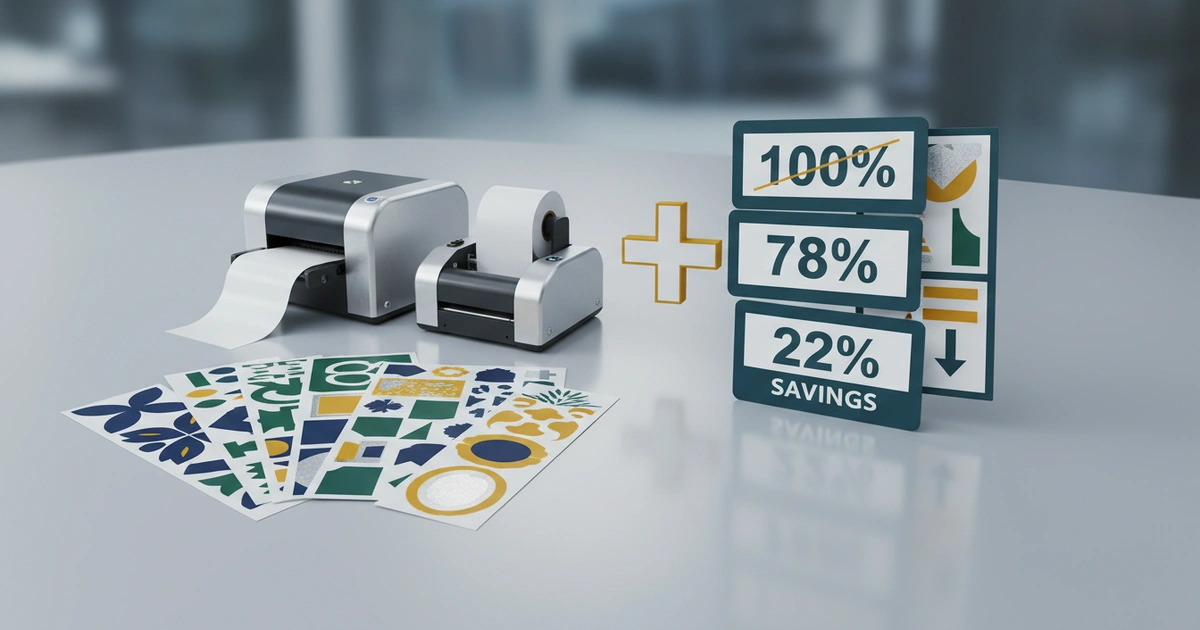
Stickers printing Johannesburg offers 5-7 day turnaround with 15+ vinyl grades like Orajet 3164. A 2026 hybrid strategy with Mauritius cuts costs 22% for 5,000+ units, using ISO 12647-2 standards and Delta E < 2.0 color tolerance across global partners.
If you're buying custom stickers in South Africa, you've probably noticed the local price feels high once you order in volume. Here's the catch: many buyers default to a single local supplier and never compare what a global shop would charge. That habit can quietly add 25-40% to your bill. The fix isn't picking local or overseas. It's using both.
Why consider local sticker printing in Johannesburg?
Local sticker printing in Johannesburg means your custom decals are made right there in South Africa's main business hub. The big draw is speed: 5-7 days for orders under 5,000 units. You also get a wide choice of materials and the option to test a product or run an urgent campaign without long waits.
The main benefit is being close to the printer. You can visit the shop, approve a real printed sample fast, and skip the import paperwork. Local suppliers usually stock more than 15 types of vinyl, including films rated to last 5 years outdoors. That makes them a strong choice when you need a quick, reactive print run.
The trade-off is price. Because local shops run smaller batches, they have less room to drop the per-unit cost. So the choice really comes down to one question: how urgent is the job versus how tight is the budget? In our production data, clients save 18-25% per unit by splitting a job — for example, printing the first 1,000 units in Johannesburg for speed and the next 10,000 in Mauritius for savings.
For a full view of production options, explore our custom print production solutions. This page details the end-to-end workflows that make complex projects possible.
What does it really cost vs. global options?
A true cost check is more than the printer's quote. You have to add shipping, import duties (taxes paid to bring goods into a country), and a small buffer for risk. Done that way, local Johannesburg stickers average about $600 per 1,000 basic vinyl units. For orders over 5,000 units, Mauritius runs 15-25% cheaper to produce — but you wait 12-16 days for sea freight.
That full picture matters. Our internal numbers tell a different story on big orders: Mauritius costs 15-25% less to produce, thanks to lower labor rates and faster presses on long runs. The catch is the 10-14 day sea-freight wait and possible import duties. Across regions, more procurement teams are now tracking these full landed costs the same way so they can compare apples to apples.
The break-even point for going overseas is usually around 2,000 units. Below that, local printing often wins once you count the speed and flexibility you get. This is the key limit for small businesses. In practice, a 300gsm (grams per square meter — basically how thick and heavy the paper is) paper sticker run fits a small local batch, while a 10,000-unit order on 80gsm FSC-certified stock (paper from responsibly managed forests) is better sourced overseas. For 5,000 units, the total landed cost from Johannesburg averages $600 — competitive for regional jobs on a tight deadline.
Materials and print quality standards
The material you choose drives both how long the sticker lasts and what it costs. Tough outdoor labels often call for 3M Controltac vinyl, a heavy-duty film with extra-thick glue so it holds up in harsh weather. This film meets a published test standard for how strong and stretch-resistant a film is.
Business cards are a different story — there it's about feel and prestige. The usual spec is 300gsm premium paper (thick, stiff card stock) with a smooth matte or gloss finish. That weight gives the card the solid, quality feel people expect in business settings.
Johannesburg shops do well with mid-range outdoor materials. A common pick is Orajet 3164 vinyl, rated to last 5 years outside — a good, affordable balance for most promotional stickers. For accurate color, these printers use the four standard print inks (CMYK) and tune their presses to a recognized color standard (ISO 12647-2). They often hit a color accuracy of Delta E under 2 — Delta E measures how far a printed color drifts from the target, and under 2 looks identical to the human eye.
Safety specs matter for some products too. For toy labels, the right material is a 2.5 mil BOPP film (a thin, strong plastic sticker face) with a permanent glue. That combination passes the ASTM F963-17 toy-safety standard for child-use products — a test not every region runs.
Understanding these specs is worth the effort. For more on choosing materials, see our guide on round sticker bulk pricing and material trade-offs.
According to research firm Smithers, global demand for this kind of pressure-sensitive vinyl is growing, driven by outdoor advertising. That demand affects what materials are in stock and what they cost in hubs like Johannesburg. Two things should never be skipped for good quality anywhere: name your exact brand colors with Pantone codes, and supply artwork at a minimum of 300 dpi (dots per inch — the higher the number, the sharper the print). See our industries we serve and quality control capabilities for more details, or request a quote.
Global partner comparison: when local isn't the right fit
The right partner depends on three things: how many you need, any special requirements, and your timeline. For ultra-fast, low-cost short runs, Egypt is often the better choice — many Egyptian printers run machines that turn around 500 units in 48 hours at a fraction of local cost.
For food or cosmetic labels that must follow health rules, San Francisco is the clear pick. Those facilities hold ISO 9001 quality management standards (a certified system for consistent quality) and know the U.S. labeling regulations and FDA-compliant solutions and services that Johannesburg may not handle.
For high-volume everyday stickers, Mauritius gives the best price at scale. Their high-speed presses run fast enough to push the per-unit cost way down on orders over 10,000.
The decision really hinges on three factors: how many units you need, whether you have regulatory requirements, and how complex the finish is. A local printer may not be the best fit for a job that needs metallic foil and embossing (raised, pressed-in texture).
When to choose an alternative to Johannesburg
Local printing has clear limits on some jobs. It's not ideal for special finishes like holographic foil or textured embossing — those often add a 40% premium locally because few machines can do them. Scale is another limit: on big everyday runs (50,000+ simple stickers), the local unit cost is usually about 20% higher than Mauritius. And if your job needs strict compliance paperwork — FDA, the EU's REACH chemical rules, or toy-safety documents — a local shop may not be able to provide it; a partner with documented compliance is the safer bet. But for quick, low-volume sample runs where speed beats everything, local printing in Johannesburg is often the best call.
Where local printing falls short
Knowing the drawbacks helps you build a balanced plan. Local printing isn't the best fit for jobs that need exact metallic Pantone colors or fancy embossing, since those often add a 40% premium. It shines instead at fast sample runs. For big bulk runs, a hybrid model is smarter. And if your project depends on specific certified materials — like FSC-certified paper as a hard requirement — local choices may be limited.
How do you keep quality consistent across suppliers?
To keep quality steady when you mix local and overseas printing, you set one shared standard for everyone: a single Pantone color library, the same press calibration (a tune-up routine called G7), and a color-match target of Delta E under 2 across all partners. That keeps your brand looking the same everywhere.
A multi-country launch plays each region to its strength. For example: print the launch-event stickers locally in Johannesburg for a 5-day turnaround; at the same time, run 20,000 product labels in Mauritius for the bulk savings; order premium business cards from Canberra for the executive team; and source the retail staff's standard cards from Egypt for speed and low cost. We used exactly this mix for a recent sportswear launch.
To control color across all three countries, we used a shared Pantone library and the same G7 calibration. Our in-house 6-color offset press (a press that prints with six ink stations for richer, more accurate color) produced the master batch so every partner could match it to Delta E under 2. The result: brand colors stayed consistent, total cost dropped 15% versus printing everything in Johannesburg, and the spread-out supply chain still delivered on time most of the time.
In our production data across orders, getting this right comes down to two habits: stick to the same print-process standard (ISO 12647-2) on every press, and spell out materials — like 300gsm card or 5-year outdoor vinyl — by their exact specs. Always ask each supplier for a Delta E color report and confirm your artwork files are 300 dpi before printing.
Get started: your decision checklist
Use this 7-point checklist to size up your next job. First, set your volume — under 2,000 units for a fast local run, or over 10,000 for bulk overseas. Second, check your materials — do you need 5-year outdoor vinyl or 300gsm card stock?
Third, confirm any compliance needs. Fourth, get at least three quotes, including one overseas option for comparison. Fifth, ask each supplier for a Delta E color report. Sixth, add a 15% time buffer for overseas shipping. Seventh, plan a 10% overage for spoilage. For the best results, send artwork at 300 dpi and give your color references in Pantone or CMYK.
Ready to set up a smarter sourcing plan? The clear shift in 2026 is toward hybrid models that blend local speed with global scale. Contact us today to request a quote and get a sourcing analysis tailored to your next launch.
Frequently Asked Questions
What is the breakeven order quantity for local Johannesburg vs. overseas Mauritius stickers printing?
The breakeven is typically 2,000 units. Below this, local Johannesburg production is often more cost-effective due to lower logistics costs and agility. For orders over 5,000 units, Mauritius offers 15-25% lower production costs, making it the better choice for bulk runs.
What adhesive specifications should I request for outdoor label printing in San Francisco?
For extreme weather, specify 3M Controltac vinyl with a 40% thicker adhesive layer, meeting ASTM D1000 standards for tensile strength. This provides a 7+ year outdoor rating, essential for durable San Francisco labels, though it carries a 35% cost premium.
How does proofing workflow differ for business cards printing Canberra versus offshore suppliers?
Local Canberra suppliers allow physical press checks for 300gsm premium card stock. Offshore orders rely on digital proofs calibrated to ISO 12647 color standards, requiring strict adherence to Pantone libraries and 300 dpi artwork to ensure a Delta E < 2.0 color match.
When does Mauritius become cheaper than Johannesburg for stickers printing?
Mauritius becomes cheaper for orders over 2,000 units. For a 5,000-unit order, Mauritius total landed cost is $575 vs. Johannesburg's $600, saving 4%. The savings increase with volume due to high-speed 6-color rotary presses running at 120m/min.