
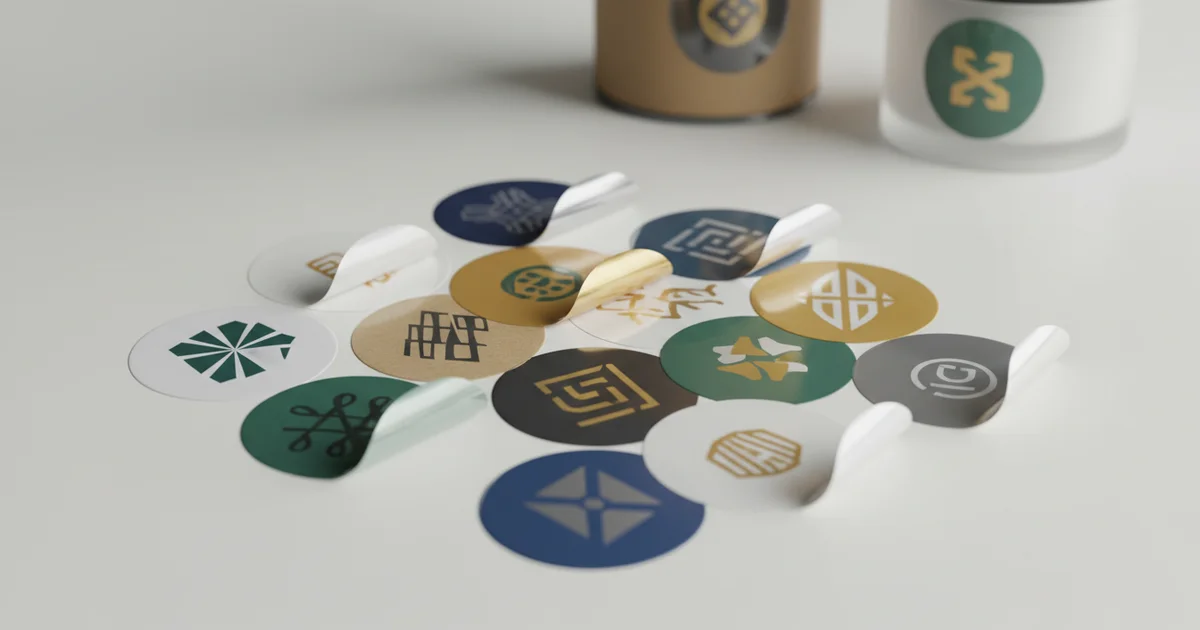
Custom round stickers cost $0.02-$0.15 per label at 10,000-100,000 units. Die tooling adds $200-$500. Scaling from 5,000 to 50,000 units cuts cost 25-35%. Avoid artwork errors causing 80% of reorders.
Are artwork errors quietly doubling your custom round stickers cost in 2026? Most buyers focus on per-unit price but overlook die tooling fees and rework that inflate total spend by 40% or more. Understanding the full cost structure — including art preparation, material selection, die tooling, and volume discounts — helps you avoid surprises. For example, a typical 2-inch round sticker order of 10,000 units with a $250 die costs $0.05 per label in printing alone, and adding the $250 die tooling fee brings the total to $0.075 per label for the first order. Reorders after the die is paid for drop to $0.05 per label. Factor in a 15% error reorder rate, and the effective cost rises to $0.086 per unit. Knowing these numbers helps buyers optimize their custom round stickers cost across multiple runs. This guide breaks down each component so you can budget accurately and reduce overall spend.
What Makes Up the True Custom Round Stickers Cost?
Die tooling is a one-time fixed cost that ranges from $200 to $500 for a custom round shape. Material adds $0.01–$0.03 per label at 10,000 units. Printing and finishing contribute the rest. Larger orders push that number down. Our production team sees the biggest per-unit drop between 5,000 and 50,000 units.
Other cost factors include ink coverage (full-coverage CMYK costs more than spot colors), lamination (matte or gloss adds $0.005–$0.01 per label), and packaging. GSM choice also matters: 80–100 gsm paper works for indoor use, while 200–300 gsm vinyl or polypropylene with FSC certification suits outdoor applications. A simple poly-bag is cheap, but custom retail packaging can add 10–15% to the total. To keep your custom round stickers cost low, choose standard materials like matte paper or gloss vinyl and limit ink coverage to one or two colors if possible.
Color accuracy is another variable. A Delta E value below 2 ensures the printed Pantone 185 C matches the brand red across the whole run. Our press meets ISO 12647 color control standards, which keeps Delta E within spec at 300 dpi. This prevents costly reprints caused by color drift.
Key Cost Components Defined
Die tooling is a precision steel or rotary die that cuts your round sticker shape. It is a one-time fixed cost of $200–$500, separate from printing. The die is reused across reorders. Materials refer to the substrate — paper, vinyl, polyester — each with different durability and cost profiles. Finishing includes lamination, foil stamping, and custom packaging that add to the unit price.
The true cost includes die tooling ($200–$500), materials ($0.01–$0.03 per label at 10k units), printing, finishing, and shipping.
How Does Die Tooling Affect Custom Round Stickers Cost Per Unit?
Die tooling is a one-time fixed cost of $200–$500. A $250 die divided by 5,000 units adds $0.05 per sticker. Divided by 50,000 units, it adds just $0.005. That is the core of the die tooling math. Our custom print production solutions use an automatic self-adhesive label die-cutting machine. It holds tight tolerances of ±0.5 mm, reducing waste and keeping per-unit costs predictable.
Die Cost Breakdown by Volume
For runs under 1,000 units, digital printing avoids die tooling entirely. Offset printing, which we use on our 6-color Heidelberg press, becomes cheaper above 2,000 units. The key is to match the printing method to your volume to minimize total sticker cost per unit. Digital printing on HP Indigo presses produces Delta E less than 2 color accuracy for Pantone matches, while offset on Heidelberg achieves similar accuracy with better consistency across long runs. Both methods target 300 dpi resolution for sharp output.
Die tooling is a fixed cost of $200–$500 that is spread over the order quantity. At 5,000 units the die adds $0.05 per label; at 50,000 units it adds only $0.005 per label. Higher volume drastically reduces the per-unit impact of die tooling.
"Die tooling is the single biggest fixed-cost surprise for first-time buyers. Spreading it over 20,000+ units cuts effective per-label cost by 60–70%." — our production team
According to industry estimates, a 2-inch round die costs $200–$350. A 4-inch die runs $350–$500. Always ask your printer to quote die tooling separately from printing. Our press meets quality management standards, ensuring consistent cuts within ±0.5 mm tolerance. The die cutter uses hardened steel blades that maintain sharpness across runs of 100,000+ labels, so reorders keep the same precision.
When Do Volume Discounts Cut Your Custom Round Stickers Cost?
Scaling from 5,000 to 50,000 units cuts per-unit cost by 25–35% as of 2026 pricing trends. The savings come from spreading setup fees and material waste across more labels. At 5,000 units, round sticker pricing typically sits at $0.12–$0.18 per label. At 50,000 units, it drops to $0.03–$0.08. The sweet spot for most buyers is 10,000–25,000 units.
Volume Tiers and Pricing
Our high-speed full-rotary 6-color multifunctional label printing press handles runs up to 100,000 units efficiently. Setup time is the same for 5,000 or 50,000 labels, so larger orders spread that fixed cost further. Additionally, material waste drops from 15–20% on small runs to 5–8% on large runs. This is why volume discounts are powerful for bulk round label pricing. Our Heidelberg offset press runs stock up to 300 gsm with ±0.5 mm tolerance at 300 dpi, meeting adhesion standards for durable labels. This combination of equipment and quality control ensures consistent results across large volumes.
Volume discounts reduce per-unit cost by 25–35% when scaling from 5,000 to 50,000 units. At 5k units expect $0.12–$0.18 per label; at 50k units it falls to $0.03–$0.08. The best balance of cost and flexibility is 10k–25k units.
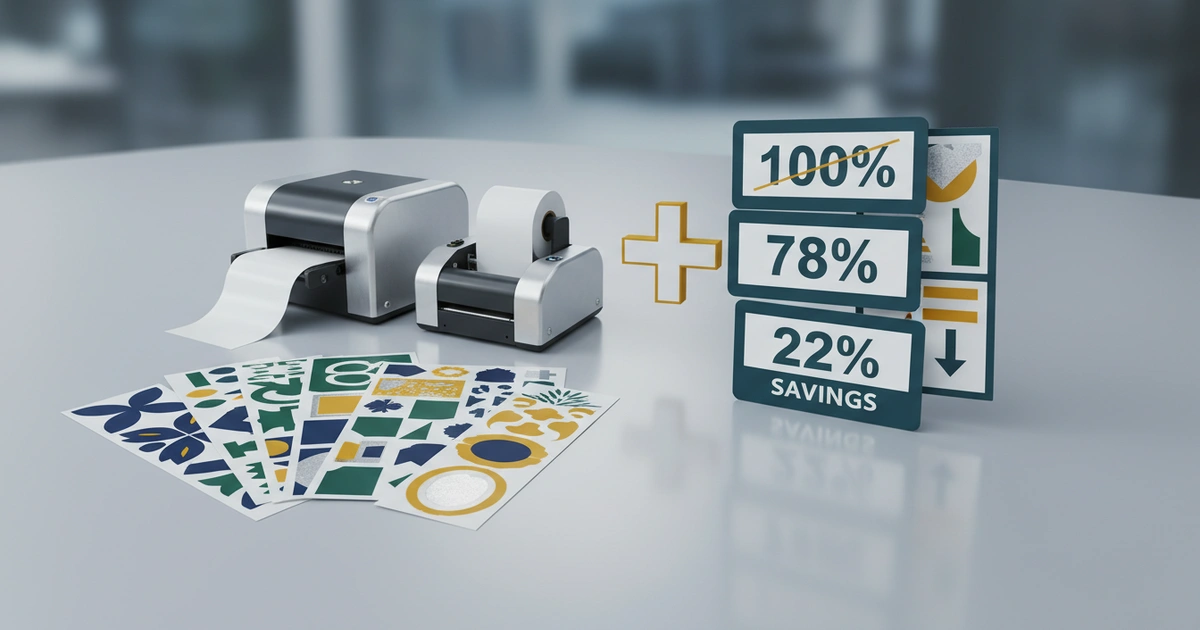
Volume is projected to remain the strongest lever for cost reduction through 2026. As digital printing market share grows, offset still wins on price for bulk orders above 2,000 units. The forecast for sticker demand suggests continued growth in e-commerce, which keeps pressure on printers to offer competitive bulk rates.
The Hidden Cost of Artwork Errors in Custom Stickers
Artwork errors are the most common cause of reorders. Missing bleed, low resolution, and wrong color space are typical mistakes. Each reorder can double your total spend on that batch. A 500-unit reorder at $0.15 per label costs $75 in printing plus $25 in shipping, easily erasing the profit from a 5,000-unit first run.
Common Artwork Mistakes and Their Costs
| Artwork Issue | Cost of Fixing Before Print | Cost of Reorder |
|---|---|---|
| Missing 3 mm bleed | $0 (easy fix) | $75–$150 |
| Low 150 dpi image | $0 (replace file) | $75–$150 |
| Wrong color space (RGB) | $0 (convert to CMYK) | $75–$150 |
| Misspelled text | $0 (edit file) | $75–$150 |
Our fully automatic label optical/visual inspection machine (PULISI) catches these defects before they ship. According to our production team, using a pre-press artwork checklist cuts reorder rates by 60%. Always include 3 mm bleed, 300 dpi resolution, and CMYK color mode. For more guidance, explore our article on how to prepare artwork for sticker printing. Compared to digital proofs, a physical hard proof catches more errors. It costs $15–$30 but prevents $200+ reorders, a 10x return on investment for most runs.
Compliance with FDA 21 CFR for food-contact labels requires substrate certification and ink migration testing. Round stickers used on food packaging must meet these standards to avoid legal risk. Our production team can provide material certifications on request. The Delta E tolerance for color-critical food labels is typically under 2, verified with a spectrophotometer against the Pantone standard. This ensures brand consistency across all printed batches.
Limitations: When Custom Round Stickers Are Not Ideal
Round stickers are not ideal for designs with long text or complex logos. Square stickers can be 10–20% cheaper per unit because they use standard dies. Custom shapes cost more due to bespoke tooling. The main drawback of round stickers is wasted material. A 2-inch circle on a 3-inch sheet leaves 30% unused material. Square layouts pack tighter and waste less. For barcode labels, rectangular formats are clearly better because barcodes need straight edges for reliable scanning.
When Another Approach Works Better
For a run of 500 stickers, digital printing with no die fee is a genuinely better choice. Competitors offer advantages in digital printing using HP Indigo presses, which handle variable data and short runs cost-effectively. This is more suitable for prototypes, small-batch product launches, or personalized stickers. On the other hand, offset printing becomes more economical above 2,000 units, especially when you amortize the die cost across a larger run.
Round stickers may not be ideal when you need maximum brand visibility at minimum cost. Square or rectangle labels allow tighter nesting on sheets, reducing material waste by up to 20%. If your design is a simple logo on a square background, a square sticker will deliver the same visual impact for less money. Consider instead using a standard square die if your artwork does not require a circular cut. The drawback is worth it only when the round shape is essential to your brand identity, such as for product seals or social media badges.
Although round stickers are versatile and feel premium for product seals and social media badges, they are not always the most economical choice. Always compare the per-unit cost of round versus square formats for your specific quantity.
Comparing Printing Methods: Offset vs Digital for Round Stickers
The breakeven point is around 2,000–3,000 units. Digital printing has no die tooling cost, making it ideal for short runs and prototypes. But per-unit cost stays flat regardless of volume. Offset drops per-unit cost as volume increases.
Offset Printing Details
According to industry printing guides, offset delivers sharper detail on fine text and small logos. Our Heidelberg press runs stock up to 300 gsm with ±0.5 mm tolerance at 300 dpi, meeting adhesion standards. It also satisfies ISO 12647 for color reproduction and supports CMYK plus two Pantone spot colors. This combination makes offset ideal for brand-critical labels where Delta E under 2 is required.
Digital Printing Details
Digital handles variable data well but may show slight banding on solid fills. Our FDA medical device labeling compliant offset process meets quality control standards. Digital printing on HP Indigo presses produces Delta E less than 2 color accuracy for Pantone matches, which works well for short-run custom labels.
| Volume | Offset Cost Per Unit | Digital Cost Per Unit |
|---|---|---|
| 500 | Not economical (die + setup) | $0.20–$0.30 |
| 2,000 | $0.12–$0.18 (includes die) | $0.15–$0.25 |
| 10,000 | $0.04–$0.08 | $0.12–$0.20 |
| 50,000 | $0.02–$0.05 | $0.10–$0.15 |
Our recommendation: use digital for the first 2,000 units to test the market. Then switch to offset for larger reorders. This phased approach minimizes risk and maximizes savings on your round sticker cost. The 2023–2026 trend shows digital improving in quality, but offset remains the cost leader for bulk production. As of Q2 2026, the gap is narrowing, but offset still delivers a 30–40% lower per-unit cost at 10,000+ volumes.
Ready to Optimize Your Custom Round Stickers Cost?
Get a free artwork review and volume pricing for your next sticker run. Our team catches errors before they cost you money.
Request a Free QuoteGet Started with Custom Round Stickers Cost Optimization
To lower your custom round stickers cost, start with a clean artwork file. Include 3 mm bleed, 300 dpi resolution, and CMYK color mode. Then ask about die tooling amortization across your first order. Volume discounts kick in at 5,000 units. Scaling to 50,000 units cuts per-unit cost by 25–35%. Our production team offers free artwork reviews to catch errors before they trigger reorders.
As of 2026, offset printing is the most cost-effective method for runs above 2,000 units. Digital printing is projected to grow in market share, but for bulk orders, offset still wins on price. The stickers market is expected to grow steadily through 2026, driven by e-commerce demand. The forecast for the 2024–2026 period anticipates continued expansion in custom packaging labels, which directly supports bulk round sticker orders.
Ready to improve your custom round stickers cost? Contact us today to explore our sticker printing capabilities and get started with a free quote and artwork review.
Frequently Asked Questions
When does offset printing become cheaper than digital for round stickers?
Offset printing becomes more economical above 2,000–3,000 units. At 2,000 units, offset costs $0.12–$0.18 per label including die, while digital is $0.15–$0.25. At 10,000 units, offset drops to $0.04–$0.08, making it significantly cheaper than digital's $0.12–$0.20.
How much does die tooling add to the per-unit cost at different volumes?
A $250 die adds $0.05 per label at 5,000 units, but only $0.005 at 50,000 units. For runs under 1,000 units, digital printing avoids die tooling entirely, though per-unit cost is higher ($0.10–$0.30).
What artwork specifications prevent costly reorders?
Always include 3 mm bleed, 300 dpi resolution, and CMYK color mode. A pre-press checklist can cut reorder rates by 60%. A physical hard proof ($15–$30) catches more errors than digital proofs and prevents $200+ reorders.
Are round stickers always more expensive than square stickers?
Round stickers can be 10–20% more expensive per unit because circular shapes waste up to 30% of sheet material. Square stickers nest tighter, reducing waste. However, round shapes are essential for product seals or social media badges where brand identity demands it.