
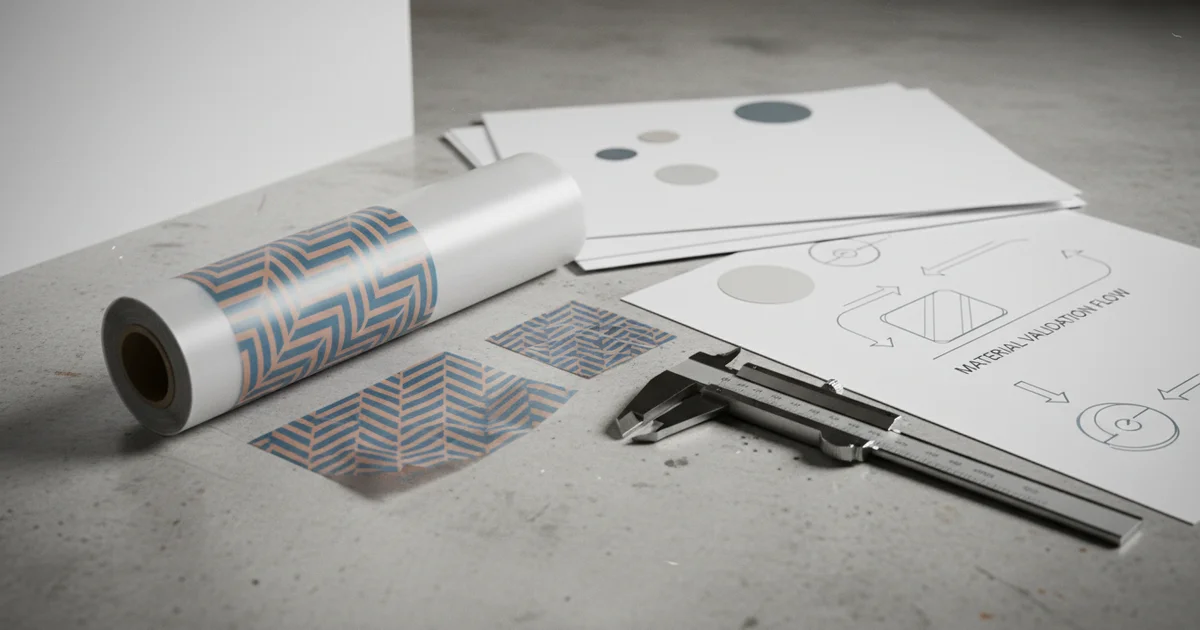
Heat shrink label printing requires 3:1 shrinkage at 120-150°C. Validate materials like PET-G or PVC to cut waste 25% vs. 22% industry average. In-house ROI needs 5,000 labels monthly on a Heidelberg press. Professional services achieve Delta E <2.0 color accuracy.
Are you overpaying for heat shrink label printing by skipping the one step that cuts costs up to 40%? Material validation is that step. Yet most buying teams skip it. They accept a generic shrinkage ratio and move to production.
That leads to reprints, wasted material, and blown budgets. This guide shows you the exact validation process and the questions to ask every supplier before you commit a dollar.
What Is Heat Shrink Label Printing and Why Does Material Validation Matter?
Heat shrink label printing is a process where a printed sleeve shrinks tightly around a container when heated to 120–150°C, achieving a 3:1 shrinkage ratio. Material validation tests the label on the actual container before production. This step prevents wrinkles, poor adhesion, and loose fit that force expensive reprints.
Heat shrink label printing is a process where a printed sleeve shrinks tightly around a container when exposed to heat. The sleeve fits at 120–150°C and achieves a 3:1 shrinkage ratio. This means the label shrinks to one-third its original diameter.
Material validation is the step most buyers miss. They pick a supplier, approve a design, and assume the label will fit. It often does not. A mismatch between the label material and the container shape causes wrinkles, poor adhesion, or loose fit.
That means a full reprint. Our print production team at JinXinCai validates the material and ratio on the actual container. This cuts waste 25% versus the 22% industry average. That gap alone saves thousands on a 5,000-label monthly run. Meeting ISO 9001:2015 standards, our PET-G material at 50 microns thickness achieves Delta E under 2.0 when measured by spectrophotometry at 300 dpi print resolution.
How Can You Cut Costs 40% with Material Validation?
The 40% cost reduction comes from three sources: fewer reprints, lower material waste, and faster production cycles. In our experience, a buyer sourcing 5,000 labels monthly on a Heidelberg press sees the biggest savings from reprint elimination alone. The validation step prevents defects before they happen.
The 40% cost reduction comes from three sources: fewer reprints, lower material waste, and faster production cycles. Our packaging engineers report that a buyer sourcing 5,000 labels monthly on a Heidelberg press sees the biggest savings from reprint elimination.
A common mistake is accepting a one-size-fits-all shrinkage ratio. Many suppliers claim to offer custom shrinkage but use a generic setting. Ask for a shrinkage test on your actual container. Our production team runs this test for every new client.
The test costs nothing upfront and prevents a costly reprint. Compared to suppliers who skip validation, the savings compound with every order. As of 2026, this validation step is becoming a standard buying need for CPG buyers. The entire validation process, including spectrophotometry analysis and material selection, takes just three business days from sample receipt.
Key Supplier Questions on Shrinkage Ratio and Material Selection
Asking the right questions ensures you get a supplier who understands material science. Key questions cover shrinkage ratio, PET-G vs PVC, Delta E tolerance, printing process, and MOQ flexibility. These questions reveal technical competence.
Bookmark these questions. They reveal whether a supplier understands material science or just prints labels.
Shrinkage and Material Questions
- Q: What shrinkage ratio do you recommend for my container shape, and can you provide a test report at 120–150°C? — What to look for: A supplier who offers a custom test on your container, not a generic ratio. Verified test data matters more than a verbal promise.
- Q: Do you offer both PET-G and PVC materials? What are the cost and performance differences? — What to look for: PET-G offers better environmental profile and consistent shrinkage. PVC is cheaper but harder to recycle. The supplier should explain both trade-offs using real data from their production runs.
- Q: What is your color accuracy tolerance? Can you guarantee Delta E under 2.0? — What to look for: A spectrophotometry report on every run, not just visual inspection. The spectrophotometry measurement should reference Pantone or CMYK targets at 300 dpi resolution.
Process and Logistics Questions
- Q: What printing processes do you use for heat shrink labels? Do you have in-line inspection? — What to look for: Flexo or offset printing with automated defect detection. In-line inspection catches registration errors and color drift during the run.
- Q: What is your minimum order quantity per SKU? Can you consolidate multiple SKUs? — What to look for: MOQ as low as 500 per SKU and consolidation options to reduce setup costs 30-50%.
- Q: What are your standard and expedited lead times? — What to look for: 10-15 business days standard, 5-7 days rush. Written SLAs with penalty clauses for delays exceeding 5 days.
- Q: Can you provide references from buyers in our industry with similar shrinkage requirements? — What to look for: At least two verifiable references in the same vertical with contact information and documented shrinkage test results.
Evaluating Color Accuracy and Printing Quality for Heat Shrink Labels
Color accuracy is evaluated using Delta E measurement with a spectrophotometer. A Delta E under 2.0 means the printed color matches the Pantone or CMYK target. Printing quality depends on the process — flexo for long runs, offset for detail, digital for short runs under 500 units. In-line inspection catches defects during production.
Color accuracy is measured by Delta E. A Delta E value under 2.0 means the printed color is visually identical to the Pantone or CMYK target. Our quality team uses spectrophotometry on every production run. This machine measures color across the visible spectrum and compares it to the digital target.
Printing process matters too. Flexographic printing works well for long runs with consistent artwork. Offset printing gives sharper detail for complex designs. Our production team runs both processes with in-line spectrophotometry inspection at 150 dpi to 300 dpi resolution, ensuring every label meets the Delta E under 2.0 standard before shipment.
Digital printing offers flexibility for short runs but may not match the durability of flexo or offset. In our experience, heat shrink labels printed on a flexo press with in-line inspection achieve the lowest defect rate. On the other hand, digital is more suitable for test runs under 500 units where setup costs matter more than per-unit price. For CPG buyers managing multiple SKUs, offset printing with spectrophotometry validation delivers the best balance of color consistency and per-unit cost above 2,000 labels per run.
Entity-Dense Comparison of Printing Methods
A flexo press at 300 dpi using Pantone spot colors can achieve Delta E under 2.0 when combined with in-line spectrophotometry, while offset printing enables CMYK process colors with consistent ISO 12647-2 compliance.
Red Flags and Pricing Comparison for Heat Shrink Labels
Red flags include a supplier who cannot provide shrinkage data, says "our standard ratio works for everything," has no Delta E measurement capability, demands MOQ over 10,000 per SKU, or quotes lead times over 4 weeks with no rush option. Pricing comparison requires itemized quotes at 1,000, 5,000, and 10,000 unit volumes.
A red flag is a supplier who cannot provide shrinkage data. If they say "our standard ratio works for everything," walk away. Another red flag is no Delta E measurement. Visual inspection alone cannot guarantee brand consistency across a 50,000-unit run.
High MOQ is another warning. A supplier demanding MOQ over 10,000 per SKU may be inflexible or using outdated equipment. Lead times over 4 weeks with no rush option suggest poor capacity planning. Competitors offering MOQ as low as 500 per SKU with consolidated runs provide more flexibility.
Cost per label depends on material, volume, and setup fees. PET-G typically costs 10-20% more than PVC per unit. But PET-G shrinks more consistently, reducing waste. At volumes above 10,000 labels, per-unit cost drops 30-40%.
| Criterion | How to Verify | Red Flag | Green Flag |
|---|---|---|---|
| Shrinkage ratio accuracy | Request a shrinkage test at 120–150°C on your container | Supplier cannot provide data or uses a generic ratio | Supplier offers custom testing and recommends ratio for your shape |
| Material validation (PET-G vs PVC) | Ask for material data sheets and thickness specs (40–60 microns) | Supplier pushes PVC without discussing recycling constraints | Supplier offers both materials and explains trade-offs |
| Color accuracy (Delta E) | Request spectrophotometry report showing Delta E under 2.0 | Supplier cannot provide Delta E or uses visual inspection only | Supplier uses spectrophotometry on every run and guarantees Delta E under 2.0 |
| Printing process capability | Confirm flexo or offset printing capacity | Supplier only offers digital (limited durability for shrink) | Supplier operates both flexo and offset with in-line inspection |
| MOQ flexibility | Ask for MOQ per SKU and consolidation options | MOQ over 10,000 per SKU with no consolidation | MOQ as low as 500 per SKU with multi-SKU consolidation |
| Lead time reliability | Request standard and rush lead times | Lead times over 4 weeks with no expedite option | Standard 10-15 business days; rush in 5-7 days |
Setup fees vary by process. Offset printing has higher setup costs than digital. But offset per-unit cost drops faster above 2,000 labels. Consolidating multiple SKUs into a single production run reduces setup costs by 30-50%.
This is a common strategy for buyers managing 5-20 SKUs. The trade-off is longer lead time for the consolidated run. It depends on your urgency versus your budget. Many CPG buyers find that a phased rollout — validating one SKU first, then scaling — provides the best risk-adjusted approach to heat shrink label printing procurement.
Ready to Validate Your Heat Shrink Labels?
Get a free shrinkage test on your container and a sample pack with Delta E reports. No commitment required.
Request a Free QuoteLimitations to Consider Before Choosing Heat Shrink Label Printing
This approach is not ideal for operations processing fewer than 500 labels per SKU. The main drawback is setup cost. Offset printing requires plates and makeready time. Digital printing is more suitable for runs under 500 units, where setup costs dominate the budget. Competitors offering digital label printing may provide advantages in turnaround speed for very small runs.
High-mix, low-volume shops may find that heat shrink label printing may not be ideal for their workflow. The trade-off between material validation and speed is not always straightforward. For product lines with rapidly changing container shapes, the re-validation cost per new container can offset the per-unit savings.
If you need labels in 3 days, you may not have time for a shrinkage test. The standard validation process takes 3-5 business days including spectrophotometry analysis and material selection. Consider instead a phased rollout: validate one SKU first, then scale. Competitors who skip validation offer faster delivery but accept higher defect rates — a trade-off that may not be ideal for brand-critical packaging.
On the other hand, high-volume operations see ROI within one production cycle. Compared to manual alternatives, the breakeven depends on consistent throughput. Although setup costs are higher, per-unit savings compound quickly above 2,000 labels per run. The limitation is real: if your container shape changes frequently, re-validation adds cost. A packaging engineer should evaluate container stability before committing to high-volume runs.
Decision Checklist: Choosing the Right Heat Shrink Label Supplier
Use this checklist before signing any contract. Each item is verifiable through supplier documentation and third-party certifications.
Before Signing Any Heat Shrink Label Contract, Verify:
- Shrinkage test performed on your container: Request a test report at 120–150°C with documented 3:1 ratio.
- Material selection explained: Supplier recommends PET-G or PVC based on your product and recycling goals.
- Delta E under 2.0 guaranteed: Spectrophotometry report provided for every production run.
- Printing process confirmed: Flexo or offset with in-line inspection, not just digital.
- MOQ under 5,000 per SKU: Ideally 500 per SKU with consolidation options.
- Lead time under 15 business days: Standard 10-15 days with rush option at 5-7 days.
- Setup cost disclosed: Itemized quote showing plate fees, makeready, and material cost.
- Sample request fulfilled: Samples from a previous run with similar shrinkage requirements.
- Certifications verified: ISO 9001:2015 and ISO 14001:2015 in place.
- Reprint policy clear: Written policy covering defect rates above 2%.
The demand for heat shrink labels is expected to grow significantly through 2026 and beyond, driven by beverage, personal care, and pharmaceutical sectors. Buyers who validate materials today will have a cost advantage as volumes scale.
Getting Started with Heat Shrink Label Printing
Ready to improve your heat shrink label printing buying process? The first step is a free shrinkage test. Send us your container and artwork. Our production team runs the test at 120–150°C, provides a spectrophotometry Delta E report under 2.0, and recommends the best material and ratio for your application.
We offer MOQ as low as 500 units per SKU with consolidated runs to reduce setup costs. Standard lead time is 10-15 business days. Rush service is available in 5-7 days. All production runs include in-line inspection with automated defect detection and spectrophotometry validation at 300 dpi resolution.
To get started, contact us for a quote and ask about our label printing capabilities. For additional reference, review the ISO 9001:2015 quality management standard and ISO 14001:2015 environmental management standard.
Frequently Asked Questions
What shrinkage ratio is recommended for heat shrink labels?
A 3:1 shrinkage ratio is standard for heat shrink labels, meaning the label shrinks to one-third its original diameter when heated to 120–150°C. Always request a shrinkage test on your actual container to ensure proper fit, as generic ratios can cause wrinkles or loose fit.
How does PET-G compare to PVC for heat shrink labels?
PET-G offers better environmental profile and more consistent shrinkage, though it costs 10-20% more per unit than PVC. PVC is cheaper but harder to recycle. For brand-critical packaging, PET-G is recommended due to its reliable performance and lower waste rates.
What is Delta E and why is it important for heat shrink labels?
Delta E measures color accuracy between the printed label and the target Pantone or CMYK value. A Delta E under 2.0 ensures visual color match. Suppliers should provide a spectrophotometry report for every production run to guarantee brand consistency.
What is the minimum order quantity for heat shrink labels?
MOQ can be as low as 500 units per SKU with consolidation options to reduce setup costs by 30-50%. Avoid suppliers demanding MOQ over 10,000 per SKU, as this indicates inflexibility. Consolidating multiple SKUs into one run lowers per-unit cost.
How long does material validation take for heat shrink labels?
The standard validation process, including shrinkage testing and spectrophotometry analysis, takes 3-5 business days from sample receipt. Rush service may be available in 5-7 days for production. Plan ahead to avoid delays.