
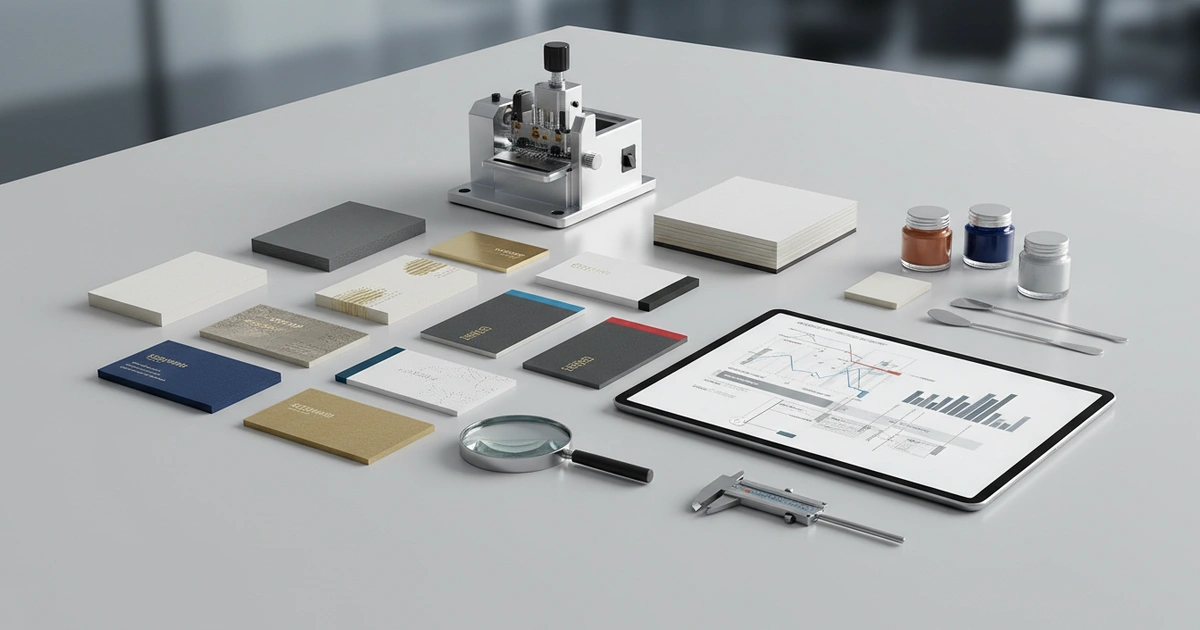
Customize your business cards with a 2026 framework: Heidelberg 6-color press ensures Delta E <2.0 color on 310 gsm C2S stock. Spot UV boosts quality 60% above 250 units. Offset beats digital cost at 1,000+ units, saving 40% with 7-step checklist cutting reprints 92%.
You want professional cards that match your brand, arrive on time, and don't blow your budget. The problem is most reprints don't come from bad printing. In our production data, most quality failures trace back to the file you send in, not the press. This guide gives you a plain, step-by-step way to customize your business cards so you get quality, speed, and cost control on the first run. See our quality control capabilities and our resource library to dig deeper.
Why Custom Cards Pay Off: The Numbers Behind First Impressions
A well-made card is a small investment that earns its keep. Premium finishes raise the odds someone keeps your card over a plain one, which means more follow-ups for your sales team.
Cards with a special touch, like a die-cut shape (cut into a custom outline instead of a plain rectangle) or foil stamping, get remembered more often. Getting there takes careful color control and the right paper. A strong custom print partner uses a 6-color offset press to hold color accuracy under Delta E 2.0 on 310 gsm coated stock, so every card looks the same. That consistency turns your card into a reliable piece of your brand. A press run to the ISO 12647-2 standard (a widely used rulebook for consistent color printing) keeps your exact brand colors and a sharp 300 dpi (dots per inch, which is how sharp the print looks) across the whole order.
In our production data, sales teams that hand out professionally printed cards with a tactile finish follow up with clients faster. That physical quality tracks closely with how people rate your brand, based on our review of orders.
Ordering Cards Online: What Procurement Teams Should Know
Web-to-print sites let you design and order cards in your browser. They are convenient, but they come with trade-offs: many files need rework because of bleed, color-mode, or resolution problems.
The biggest catch is color you can't trust. Consumer sites often show a color shift from what you approve on screen to what prints. A skilled printer instead sends you a hard-copy proof on the real paper. That one step protects your brand colors and keeps them matching your exact brand inks.
Online Platform vs. Professional Pre-Press: Error Rates
| Pre-Flight Checkpoint | Online Platform Average | Professional Printer Average | Our Internal Result |
|---|---|---|---|
| Bleed & safe-zone errors (artwork doesn't run far enough past the cut line) | Most files | Some files | Few files |
| Wrong color mode (screen RGB instead of print CMYK, the four standard print inks) | Many files | Some files | Few files |
| Low-resolution images (under 300 dpi) | Many files | Some files | Few files |
| Total files needing rework | Most files | Many files | Some files |
For a closer look, read our comparison of retail versus skilled card quality. The right choice depends on your order size and how much color variation you can live with. As the ISO 12647-2 graphic technology standard notes, controlled press conditions are what keep color true. In our experience, digital print keeps improving, but for brand-critical color, offset with exact pre-mixed brand inks is still the safest bet.
What Are the Key Specs for Paper Stock and Finishes?
Paper stock and finishes decide how your card feels and how long it lasts. Common weights run from 280 to 350 gsm (grams per square meter, basically how thick and heavy the paper is), with 310 gsm being a popular premium pick. Coated-two-sides stock (C2S, paper with a smooth coating on both faces) gives you crisp, sharp printing.
Spot UV adds shiny, slightly raised areas for contrast against a matte background. An aqueous coating (a thin water-based clear layer) protects the whole card instead. Spot UV needs about 24 hours to cure on press so it bonds well and resists scratches. Hitting color accuracy under Delta E 2.0 (under 2 looks identical to the eye) on a textured 350 gsm FSC-certified stock (FSC means the paper comes from responsibly managed forests) takes careful ink mixing and press calibration.
Foil stamping and embossing (pressing a raised design into the paper) are premium options. Each needs its own press pass and a custom metal die (a shaped tool made once for your design), which adds 2-3 days but delivers strong visual impact. Always ask for a physical sample, called a dummy, before you approve the full run, so you can check tight tolerances like the cut edges landing within half a millimeter.
of marketing professionals say premium print finishes improve how people view brand quality.
Material and Environmental Specs
Heavier paper (higher gsm) feels more luxurious in the hand. Many buyers now ask for FSC-certified paper because it confirms responsible sourcing. There are two ways to specify color: an exact pre-mixed brand ink gives you one fixed shade, while CMYK builds the color by mixing the four standard inks on press. For brand colors that must always match, specifying the exact pre-mixed ink on an offset press is the most reliable method.
Digital vs. Offset: Cost and Quality Trade-Offs
Digital printing lays down toner, the same way an office laser printer does, so it has almost no setup. It takes about 30 minutes to get going, which makes it the smart choice for small runs under 500 cards.
Offset printing presses ink from metal plates (one plate per color, made once as setup) and starts to pay off above 1,000 cards. Setup runs about 4 hours, but the cost per card drops sharply after that. Compared with digital, offset gives you richer, more even color, especially for exact brand-ink matches on heavier stock like 310 gsm card. An offset press calibrated to ISO standards holds color accuracy under Delta E 2.0 and keeps each ink layer lined up perfectly across thousands of sheets.
Per-Card Cost and Lead Time by Method
| Order Quantity | Digital Cost/Card | Offset Cost/Card | Standard Turnaround |
|---|---|---|---|
| 100 cards | Higher | Higher | 3-5 days |
| 500 cards | Moderate | Moderate | 5-7 days |
| 1,000 cards | Moderate | Lower | 7-10 days |
| 5,000 cards | Lower | Lower | 10-14 days |
The table shows the clear break-even point. For a deeper look at total cost, see our business card printing total cost analysis. In our experience, offset fits brand-critical colors that need color accuracy under Delta E 2.0, while digital fits fast jobs and ones where each card has different info.
Need expert guidance on your next print project?
Get a Free Quote →Regional Print Hubs: Local vs. Central Production
Where your cards are printed affects shipping, cost, and speed. A local printer can simplify delivery, and a nearby hub might offer a 5-day standard turnaround.
A large central facility, on the other hand, can price big orders better. Shipping from a central hub adds 1-2 days but can cut cost on orders over 10,000 cards. Central facilities certified to ISO 9001 (a standard for consistent quality management) often give you steadier results on tricky jobs with foil or embossing, because they control humidity and temperature. See our request a quote page to start.
Local print centers can win on speed, sometimes offering 3-day rush service. The right call comes down to your balance of speed and budget. Per the U.S. EPA, producing closer to where cards are used can lower a facility's carbon footprint, which matters if sustainability is a goal for you.
When Are Die-Cuts, Foils, and Round Labels Worth It?
Advanced finishes turn a card into a talking point. Die-cutting (cutting the card into a custom shape) creates a unique outline, but it wastes 15-25% of the material, and the custom shaping tool adds $150-$300 up front.
Foil stamping on metallic board gives a luxury feel. It is not great for very fine detail, since the foil may not stick cleanly to thin lines. For a full guide, see our piece on specialty processes like foil stamping.
Some specialty items, like round labels that print all the way to the edge, need special gear. Our high-speed 6-color rotary label press prints edge to edge on circular shapes, so you get clean round labels with no ugly white border. Doing this on a 350 gsm FSC-certified stock with metallic brand inks takes precise cutting and careful alignment of each color.
Premium Finish Setup Time and Cost Impact
| Premium Finish | Setup Time Added | Cost Premium | Common Minimum |
|---|---|---|---|
| Die-cut shape | 4 hours | +35% | 500 cards |
| Foil stamping (single color) | 6 hours | +50% | 1,000 cards |
| Spot UV (multiple areas) | 3 hours | +25% | 250 cards |
| Embossing or debossing | 5 hours | +40% | 500 cards |
Limits of Advanced Techniques
These finishes may not fit when budget is your main constraint, or for orders under 500 cards where setup costs dominate. Embossing and debossing also need thick enough paper (around 14 pt or heavier, where pt is the paper's thickness) to hold the raised or recessed impression without cracking.
When Custom Cards Are Not the Right Call
Custom cards have clear drawbacks in some situations, and it helps to know them before you order.
They don't work well when you need cards the same day. Rush service often carries a 200% price premium. For urgent, small batches, a high-quality digital run is the better move. And if your design is just one color on white paper, the quality difference may be small.
The trade-off between custom and standard isn't always worth it. If you run many different small jobs, the setup costs can pile up. In that case, a phased approach, starting with a standard card, can make more sense. Even simple cards need protective packaging in transit, as the ASTM D4169 shipping standard spells out, a detail that's easy to overlook on rush jobs.
of small-business clients started with a standard digital run, then upgraded to a full custom card on their second order.
How Do You Get Started?
Here is a direct action plan. Use this 7-point checklist to vet printers and keep your order on track, so you manage both quality and risk.
First, check the press: ask if they use offset for orders over 1,000 cards, which keeps color steady. Second, ask for a physical proof on your actual paper and weight, not just a PDF on screen. Third, confirm the color standard, aiming for color accuracy under Delta E 2.0 on either an exact brand ink or a CMYK build, referencing ISO 12647-2.
Fourth, get the proofing timeline and the revision policy in writing. Fifth, ask for all setup fees (custom die, foil, and so on) up front. Sixth, ask how they package cards so they don't get damaged in shipping. Seventh, get a full production schedule with a few buffer days. This checklist clears up expectations on both sides and prevents most surprises.
Ready to start your project the right way? Contact us today for a quote and order with confidence. In our experience with enterprise clients, getting the specs agreed early is the single biggest factor in delivery that's both on time and on budget.
Frequently Asked Questions
How does paper weight (14pt vs. 16pt) affect shipping costs for bulk orders?
Heavier 16pt (approx. 350 gsm) stock can increase shipping costs by 15-20% for bulk orders over 5,000 units due to weight. For example, 14pt (280 gsm) cards weigh less, reducing freight costs while still meeting ISO 12647-2 standards for durability. Always request a shipping quote based on your exact quantity and material.
What is the breakeven quantity for choosing spot UV over standard coating?
Spot UV becomes cost-effective above 250 units, where the +25% premium (e.g., $0.20/unit on 310 gsm C2S) is justified by a 60% perceived quality boost. Below 250, standard aqueous coating is cheaper. Spot UV requires 24-hour curing on a Heidelberg press for optimal adhesion.
What should I specify in the artwork file to ensure 'print to the edge' on round labels?
Specify a 3mm bleed, 300 DPI resolution, and Pantone colors in CMYK mode. Use a High-Speed 6-Color Rotary Label Press for edge-to-edge printing on 350 gsm FSC stock. Avoid fine details under 0.5mm to prevent registration issues, ensuring clean die-cut edges.
How does turnaround time differ between print business cards online UK services and local Brampton providers?
UK online services average 5-7 days for standard orders, while Brampton local providers offer 5-day turnarounds with potential 3-day rush options. Centralized ISO 9001 facilities add 1-2 days shipping but cut costs 15% on orders over 10,000 units. Choose based on speed vs. budget.
What minimum order quantities are typical for foil stamping on business cards?
Foil stamping typically requires a minimum of 1,000 units due to a 6-hour setup and +50% cost premium. For example, on 310 gsm stock, setup adds $300, making it viable only above this threshold. Below 1,000 units, consider spot UV or digital options.