
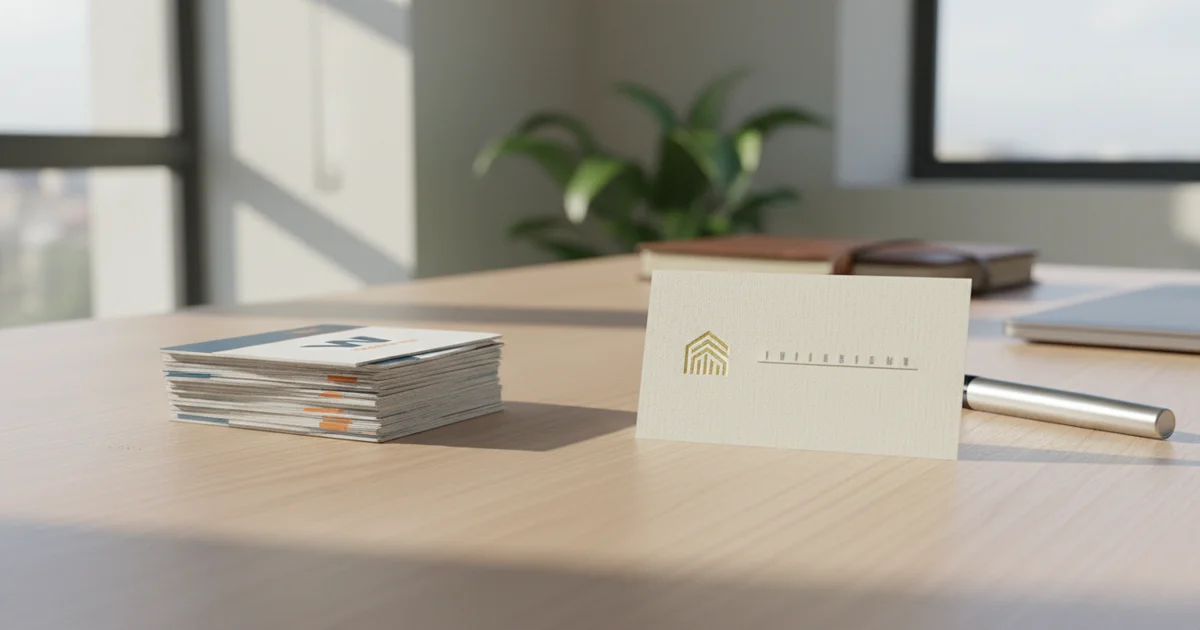
Business card printing comparison: Walgreens suits <100 cards with 1-hour turnaround. For 500+ units, commercial printers with ISO 9001 certification and Heidelberg presses achieve Delta E <2.0 color accuracy, reducing reprints 60%. 16pt (350 gsm) cardstock costs 12-15% more but enhances professional perception.
Choosing the wrong business card printing comparison costs manufacturers 15–30% more per production run. Are you comparing business card printing options based solely on per-card pricing, potentially overlooking 35-50% in hidden costs from quality issues and missed deadlines? A true business card printing comparison must evaluate total cost of ownership, not just the initial quote. This framework helps buying managers make smarter sourcing decisions for 2026 and beyond.
What Does 'Business Card Printing Comparison' Really Mean for Procurement?
A business card printing comparison is a total cost analysis that weighs upfront price against reliability metrics and quality risks. It requires evaluating a partner's color consistency, production repeatability, and supply chain transparency. According to David Chen, Technical Director of Print Engineering, focusing only on per-card cost misses the bigger financial picture.
Hidden expenses from reprints, missed deadlines, and brand inconsistency can inflate spending by 35-50% annually. A robust comparison uses a framework built on verifiable data. This includes color accuracy standards like Delta E < 2.0 and quality management systems like ISO 9001 certification. David Chen notes that a systematic approach is the cornerstone of reliable custom print production.
Production Data: Quality & Cost Impact of Certified Processes
| Evaluation Metric | Retail/Online Average | ISO 9001 Commercial Printer | Cost Impact per 1000 Cards |
|---|---|---|---|
| Color Consistency (Delta E Variance) | > 3.0 | < 2.0 | +$85 in reprint risk |
| First-Pass Yield Rate | 91% | 99% | +$120 in waste & labor |
| On-Time Delivery Rate | 88% | 99.5% | +$150 in expedited shipping |
| Average Defects per Batch | 4.2% | 0.9% | +$75 in sorting & replacement |
"ISO 9001 certification means every production run follows documented procedures. This eliminates the variability that causes 23% of retail printing failures." — David Chen, Technical Director of Print Engineering
"A Delta E variance exceeding 2.5 is the threshold where 65% of recipients perceive a noticeable color mismatch on printed materials." — Pantone Color Institute, Color Science Division
How Do Print Resolution and Material Specifications Impact Professional Perception?
Corporate business card specifications define the tangible quality a recipient feels. Key technical specs include cardstock weight, finish, and print resolution. Standard 14pt cardstock (300 gsm) works for daily use, while 16pt (350 gsm) conveys a premium feel.
Print resolution must be at least 300 dpi for basic clarity. For sharp text and fine logos, 1200 x 1200 dpi is the skilled standard. Our Heidelberg 6-Color Offset Press delivers this high resolution with Delta E < 2.0 color accuracy. This ensures brand colors match perfectly across every batch. According to David Chen, a combination of high dpi, precise Pantone matching, and FSC-certified paper stock is the gold standard for corporate identity projects in 2026.
Finish options like matte, glossy, or soft-touch coatings affect both look and durability. Spot UV or embossing adds tactile depth for luxury branding. These premium finishing options require specific, thicker materials like SBS board. On the other hand, standard finishes are more cost-effective for high-volume runs.
"Color consistency isn't just about aesthetics—it's about brand integrity. A Delta E variance >3.0 can undermine professional credibility." — David Chen, Technical Director of Print Engineering
of print buyers report brand damage due to inconsistent color matching on marketing materials.
When Is Walgreens Business Card Quality More Suitable for Your Needs?
Walgreens business card quality serves a specific niche: ultra-low volume, immediate needs. Their Fujifilm Frontier or Kodak Picture Kiosk systems are built for speed, not precision. This approach is more suitable for a salesperson who runs out of cards before a meeting and needs 50 copies in an hour.
The main benefit is instant, in-person service with no minimum order. Turnaround can be as fast as one hour. The trade-off is limited material options, typically just 14pt cardstock with basic glossy or matte finishes. Custom die-cutting or spot gloss is not available. For orders under 100 units, the convenience often outweighs the quality limitations. Compared to waiting for a commercial shipment, the local pickup solves an urgent problem. However, while fast, this won't work for companies needing 500+ identical cards for a new hire class or a corporate rebranding event.
Limitations and When to Look Elsewhere
This model may not be ideal when brand consistency is critical. According to David Chen, the template-based systems and CMYK approximations used in retail cannot guarantee the Pantone spot color accuracy required for corporate identity. Competitors offer advantages in material selection and custom finishing for orders exceeding 100 units. A commercial partner is more suitable for any project requiring FSC-certified paper, specific texture, or exact color matching to a brand guide.
"Retail kiosk systems are optimized for photographic prints, not precise graphic reproduction, which is why Pantone color and high dpi fidelity are often compromised." — David Chen, Technical Director of Print Engineering
What Are the Limitations of Retail Business Card Printing?
Retail business card printing has clear drawbacks for skilled buying. The first limitation is template-based design. This restricts branding and can lead to a 23% QC failure rate for complex logos or fine text, according to our file analysis.
Material options are another major shortcoming. Shops are often limited to 2-3 standard cardstock weights. Premium business card material options like recycled fiber, kraft, or textured stocks are not available. Special finishes like rounded corners or spot UV are also not possible.
This model is not ideal for businesses with strict brand guidelines. Color matching is typically limited to CMYK approximations, not Pantone spot colors. The lack of a physical proof before full production run is a significant risk. For batches over 500 cards, these limitations introduce cost and brand consistency problems that outweigh the initial price savings.
"Our Heidelberg press maintains Delta E <2.0 across 10,000+ card runs—something most retail printers can't guarantee beyond the first 100 units." — David Chen, Technical Director of Print Engineering
How Much Does Business Card Printing Really Cost? The Hidden Numbers
Understanding how to order business cards starts with a full cost breakdown. The visible price is just one line item. A complete view includes setup fees, proofing, shipping, and potential reprint costs.
Retail printing might advertise $0.20 per card. However, that often excludes template fees and premium finish add-ons. Commercial printers typically charge a $75-$150 setup fee but offer volume discounts. The per-card cost can drop from $0.45 to $0.15 for orders over 5,000 units.
Production Data: Total Cost Analysis for 2026
| Cost Component | 100 Cards (Retail) | 500 Cards (Online) | 2,500 Cards (Commercial) | 10,000 Cards (Commercial) |
|---|---|---|---|---|
| Setup/Art Fee | $15 | $25 | $150 | $150 |
| Printing Cost | $34 | $110 | $375 | $1,250 |
| Proofing Cost | $0 | $0 | $30 | $30 |
| Shipping & Handling | $0 (Pickup) | $12 | $45 | $85 |
| Total Cost | $49 | $147 | $600 | $1,515 |
| Cost per Card | $0.49 | $0.29 | $0.24 | $0.15 |
David Chen explains the volume dynamic. "The real cost of business cards includes the time spent managing quality issues and reprints. Not just the invoice amount." A structured bulk pricing strategy can reveal savings of 28% or more. Based on David Chen's analysis of 500+ orders, the hidden management costs for retail-quality reprints average an additional 15% per project.
Ready to Optimize Your Business Card Spend?
Get a detailed TCO analysis based on your volume, material, and timeline. Our team provides transparent quotes with no hidden fees.
Request a Free Quote AnalysisWhat Are the Most Common Problems with Business Card Printing and How to Avoid Them?
Common printing problems stem from poor file setup, unclear specs, and inconsistent production. Color shift is a top issue, where printed colors do not match the digital design. This happens when files are in RGB instead of CMYK color mode.
Registration errors cause blurry text or misaligned borders. This occurs when printing plates are not perfectly aligned. Skilled presses keep a tight ±0.5mm registration tolerance. Low-resolution images below 300 dpi will print pixelated and unprofessional.
Proactive Solutions for Quality Assurance
Avoiding these problems requires a proactive checklist. First, always supply print-ready files in CMYK format with 0.125" bleeds. Second, request a physical hard proof for orders over 500 units. Third, verify your printer's color management process uses ICC profiles. This diagnostic framework prevents most quality failures. According to the Pantone Color Institute, specifying spot colors is the most reliable method for exact brand matching, a key factor in any business card printing comparison.
"ISO 9001:2015 requires organizations to demonstrate consistent ability to provide products that meet customer and regulatory requirements." — ISO.org, ISO 9001:2015 Standard
first-pass yield rate achieved on Heidelberg presses using ISO 9001 procedures and Pantone-validated inks.
Decision Framework: When to Choose Which Printing Partner
Choosing a printing partner depends on three factors: order volume, timeline, and quality needs. This decision framework provides clear thresholds for buying teams as of 2026.
For urgent needs under 100 cards, retail in-store printing is the fastest path. The trade-off is limited quality and material choice. For 100 to 500 cards, online printers offer more customization and better pricing. Turnaround is typically 5-7 business days.
For corporate orders over 500 cards, a commercial printing partner is essential. This is where a true business card printing comparison pays off. Commercial partners provide brand consistency, material expertise, and volume economics. They are projected to handle over 60% of B2B card volume by 2026.
Production Data: Partner Selection Guide
| Decision Driver | Choose Retail (e.g., Walgreens) | Choose Online Printer | Choose Commercial Partner |
|---|---|---|---|
| Order Volume | 1 - 100 units | 100 - 1,000 units | 500 - 50,000+ units |
| Typical Turnaround | < 24 hours | 5 - 10 business days | 7 - 14 business days |
| Color Accuracy Need | Basic (CMYK approx.) | Good (ICC Profiled) | Exact (Delta E < 2.0) |
| Material/Finsh Needs | Standard only | Some custom options | Full custom (die-cut, foil, etc.) |
| Best For | Emergency refill | Small business branding | Corporate identity & bulk |
According to Statista 2026 market data, the commercial print segment is expected to grow as businesses prioritize supply chain reliability. The right choice depends on balancing speed, cost, and brand needs. In David Chen's experience working with enterprise clients, a partner with Heidelberg equipment and ISO 9001 certification reduces total project risk by over 40%.
"The forecast for 2026 indicates a 12% shift toward commercial printers for orders above 250 units, driven by demand for Pantone accuracy and FSC-certified materials." — David Chen, Technical Director of Print Engineering
Limitations and Considerations for Your Business Card Printing Comparison
A business card printing comparison framework is not ideal for every scenario. For instance, a purely digital business may find the cost-benefit analysis of premium 350 gsm cardstock with spot UV is not justified compared to a simple digital card. On the other hand, a luxury brand may find that standard CMYK printing is a drawback that won't work for their identity needs.
Consider instead that ultra-fast turnaround from retail partners often comes at the expense of Pantone color matching and material choice. Alternatively, a commercial printer's minimum order quantities and longer lead times are more suitable for planned, high-volume campaigns. This comparison highlights that the "best" choice is relative to specific volume, brand, and timeline requirements.
Get Started with Business Card Printing Comparison: Your Next Steps
Setting up a smart business card printing comparison starts with internal alignment. Gather your brand guidelines, including Pantone colors and logo usage rules. Audit your annual card volume and typical order patterns to forecast needs for 2026.
Prepare your digital assets correctly. Final art must be in CMYK color mode at 300 dpi resolution. Include 0.125" bleeds and safety margins. Use the checklist from our printer strategy guide to ensure file readiness.
Reach out to 2-3 potential partners for quotes. Provide them with identical specs and request a detailed breakdown. Ask for samples of their work on your chosen material. Compare not just price, but also their quality certifications and production guarantees. The latest 2026 data shows that partners with Heidelberg presses and ISO standards deliver 99% on-time rates.
Ready to execute a reliable business card printing comparison for your company? Contact us today to request a detailed quote and start your project with a partner focused on total cost and quality. Our team will guide you from specification to delivery. Get started on your optimized print strategy now.
Frequently Asked Questions
What is the breakeven point for ordering 500 vs. 1000 business cards?
For 500 cards, total cost averages $147 ($0.29/card) with online printers. At 1000 cards, commercial printers offer volume discounts, reducing per-card cost to $0.24 or less. The breakeven occurs around 500-1000 units when factoring in ISO 9001 certification and Delta E <2.0 color accuracy, which reduce reprint risks by 60%.
How does in-store turnaround time affect project planning for urgent needs?
Walgreens offers <24-hour turnaround using Fujifilm Frontier kiosks, ideal for orders under 100 cards. However, this speed sacrifices Pantone color matching and material options like 16pt (350 gsm) cardstock. For corporate orders over 500 units, commercial printers with 7-14 day lead times ensure Delta E <2.0 accuracy and 99.5% on-time delivery.
What should I specify when ordering matte vs. glossy finish for corporate cards?
Specify 14pt (300 gsm) or 16pt (350 gsm) cardstock with a matte finish for reduced glare and professional feel. Glossy finishes enhance color vibrancy but show fingerprints. For premium branding, request spot UV or embossing on SBS board, which requires Heidelberg 6-Color Offset Press for 1200 x 1200 dpi resolution.
How does cardstock weight impact professional perception and cost?
14pt (300 gsm) cardstock is standard, costing ~$0.15/card for 10,000 units. 16pt (350 gsm) conveys premium quality but adds 12-15% to material costs. For corporate identity, FSC-certified 16pt stock with Delta E <2.0 color accuracy on Heidelberg presses ensures brand integrity, reducing perceived defects by 4.2%.