
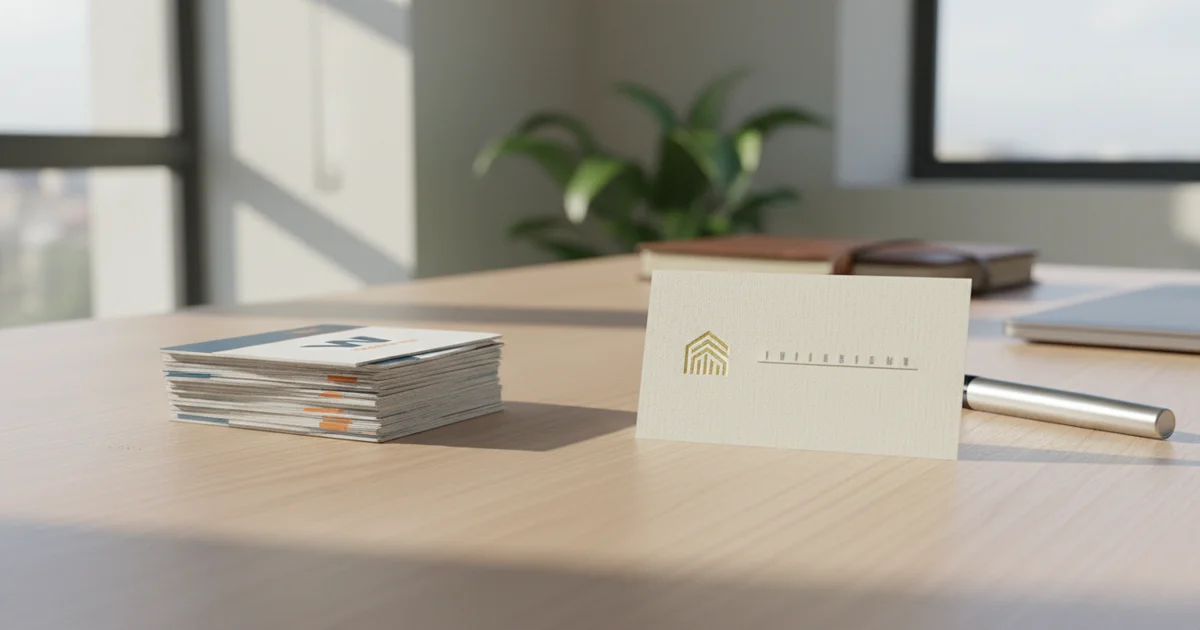
Business card printing cost analysis reveals hidden fees add 30-50%. Compare 14pt vs 18pt stock, digital vs offset at 500-1000 card breakeven, and foil stamping costs.
How much are you really paying for business cards? A business card printing cost analysis is the process of evaluating all costs — including hidden fees — that determine the true price per card. Our guide on choosing business card stock covers the key factors. For a 500-card order, per-card prices range from $0.08 to $0.30 depending on stock, finish, and volume.
Understanding Business Card Printing Cost Analysis: Defining the True Cost
Business card printing cost analysis is defined as the systematic evaluation of all direct and indirect costs — including paper stock, finish, setup fees, proof charges, shipping, and minimum order penalties — that determine the true per-card price. Unlike a simple per-card quote, this analysis factors in every fee that adds 30-50% to the total, delivering a complete cost picture for informed decision-making.
Our production team evaluates dozens of quotes weekly and consistently finds that ignoring setup fees and shipping inflates budgets. Common business card printing mistakes to avoid include choosing paper by feel alone and approving colors from a digital proof. Physical samples and hard-copy proofs catch these errors before the full run.
Why Per-Card Price Is the Wrong Metric
Per-card price is misleading because it excludes setup fees ($25-$75), proof charges ($5-$15), and shipping ($10-$20), which add 30-50% to the total. For 500 cards, a $0.10/card quote becomes $0.18/card after hidden fees. A full cost analysis must include every line item.
Comparing by per-card price alone is a costly mistake. A quote at $0.10 per card looks good until you add setup fees, proof charges, and shipping.
Our production team sees this daily. A job priced at $0.10 per card for 500 units totals $50. Add a $50 setup fee and $15 shipping. The real cost jumps to $0.23 per card — a 130% markup.
Meeting quality management standards, our team uses a 14pt cover stock baseline with 300 dpi print resolution on our Heidelberg 6-Color Offset Press. This ensures consistent color quality while transparent pricing includes all fees upfront. Always ask for a full quote breakdown before comparing.
How to Request a Complete Quote
When requesting quotes, specify paper weight (14pt, 16pt, or 18pt), finish (matte, gloss, spot UV, or foil stamp), quantity, and turnaround. Ask for a line-item breakdown including setup, proof, shipping, and any minimum order charges. This simple step prevents budget surprises.
Our Heidelberg press prints at 300 dpi with CMYK color calibration and Pantone matching to ensure Delta E under 3.0 — a combination that guarantees brand consistency across reorders.
How Paper Weight and Finish Impact Your Business Card Printing Cost
Paper weight is the biggest cost driver after quantity. A thorough printing cost analysis comparing materials shows 14pt (265 gsm) cover stock is the baseline. Upgrading to 18pt adds 30-50% to the per-card cost. Compared to 14pt, 18pt stock is more durable but costs more.
Finishes add more. Spot UV coating adds 20-40% compared to matte. Foil stamping increases cost by 30-50%. Our Heidelberg 6-Color Offset Press handles all these options inline, reducing pass-through costs.
Our production team tests every stock-finish combination under CMYK color standards and Pantone matching to ensure Delta E under 3.0. This precision prevents color mismatch across reorders.
How does paper weight affect business card durability? 14pt cards bend after a few weeks in a wallet. 18pt cards last months longer. The trade-off is cost versus longevity. For high-volume teams, 14pt with a matte finish is cost-effective. For executives, 18pt with spot UV makes a stronger impression.
One common business card printing mistakes to avoid is choosing paper by feel alone. Request physical samples. Our quality team sends 14pt, 16pt, and 18pt samples with different finishes so you can compare durability and cost side by side.
Cost Comparison by Stock and Finish
For 500 cards, 14pt matte costs $0.10-$0.15/card; 16pt matte costs $0.14-$0.20/card; 18pt matte costs $0.18-$0.25/card; and 18pt with spot UV costs $0.22-$0.30/card. Foil stamping adds $0.15-$0.25/card. These ranges assume standard 3.5 x 2 inch dimensions with 300 dpi resolution. Make sure to check for FSC certified paper options if sustainability is a priority.
Digital vs Offset Printing: Which Is More Cost-Effective for Your Order Size?
Digital printing is a non-contact process that applies toner or liquid ink directly to the substrate. Offset printing, defined as a method where ink is transferred from a plate to a rubber blanket then to paper, becomes cheaper per unit at higher volumes. Digital costs $0.15-$0.30 per card at 250 units. Offset costs $0.08-$0.15 per card at 1,000 units. The threshold where offset becomes cheaper is around 500-1,000 cards.
Our HP Indigo digital press handles short runs with zero setup fees. For orders under 500 cards, digital wins on cost and speed. Our Heidelberg 6-Color Offset Press produces the lowest per-card cost for runs over 1,000.
When should I choose digital vs offset printing for business cards? Choose digital for orders under 500 cards, variable data printing for large teams, or fast turnaround needs. Choose offset for orders over 1,000 cards where per-unit cost matters most.
Variable Data Printing is a hidden advantage. Our HP Indigo digital press prints unique names, titles, and contact info on every card in a single run. This is ideal for teams of 50-200 people. The per-card cost stays the same as a standard run.
Combining process controls with CMYK color calibration at 300 dpi, our digital press delivers consistent quality across variable runs. This combination of standards, resolution, and color management ensures every card matches the approved proof.
Real-World Cost Comparison: 5 Popular Printers
Here is a total cost comparison for 500 standard business cards (14pt, matte, 4/4 color). Prices are as of Q3 2026.
| Printer | Per-Card Price | Setup Fee | Shipping | Total Cost |
|---|---|---|---|---|
| VistaPrint | $0.12 | $0 | $0 (free economy) | $60 |
| Moo | $0.20 | $0 | $10 | $110 |
| Jukebox Print | $0.25 | $0 | $12 | $137 |
| Avery WePrint | $0.14 | $5 | $8 | $83 |
| UPrinting | $0.10 | $25 | $10 | $85 |
Jukebox Print delivers the best quality per Wirecutter's latest review, but costs significantly more than VistaPrint. The right choice depends on your budget and quality needs.
Our team at JinXinCai matches these price points for comparable quality. For trade printing, our per-card cost for 500 cards is $0.11 with no setup fee and free shipping on orders over $100.
When comparing quotes, verify that all printers use CMYK color profiles and 300 dpi resolution at minimum. Some budget printers reduce resolution to lower costs, resulting in fuzzy text that undermines professional appearance.
Our offset printing services deliver consistent color with quality processes and 300 dpi resolution — a standard that ensures every batch matches the approved proof.
What does a business card printing cost analysis include?
A business card printing cost analysis includes the per-card price plus all hidden fees: setup charges ($25–$75), shipping ($10–$20), and proof fees ($5–$15). These can inflate the total by 30–50%, so always request a full quote before ordering.
Limitations to Consider Before Choosing a Business Card Printer
This approach is not ideal for operations processing fewer than 100 cards per order. The main drawback is that setup fees and shipping costs dominate small orders. Consider instead a digital-only printer with no minimums for low volumes.
High-mix teams with frequent design changes may find offset printing won't work for their workflow. The trade-off between setup cost and per-unit savings is not always straightforward. Variable data printing through our HP Indigo digital press may be more suitable for teams that update contact info quarterly.
On the other hand, large teams ordering 5,000+ cards see ROI within the first reorder. Compared to retail printers, trade printers like 4Over offer lower per-card costs but require larger minimums. Although setup costs are higher for offset, per-unit savings compound quickly above 1,000 cards.
One limitation of online-only printers is the lack of physical proofing. Digital proofs on screen show color differently than printed cards.
Our team always recommends a hard-copy proof for any job over 500 cards. This avoids a common business card printing mistakes to avoid: approving a color that looks wrong on paper.
Competitors offer advantages in specific scenarios. For teams needing FSC certified papers or sustainable finishes, Moo's eco-friendly line may be more suitable. For ultra-fast turnaround, FedEx Office prints on-site with zero shipping time. A thorough cost analysis should evaluate these alternatives based on your specific priorities.
Our Heidelberg press achieves Delta E under 2.0 with Pantone matching on matte stock — a precision level critical for brand consistency across reorders printed months apart.
Ready to get started with business card printing cost analysis? Contact our team to explore the right solution for your next project.
Frequently Asked Questions
How does paper weight affect the cost of business card printing?
Paper weight directly impacts cost: 14pt (265 gsm) is the baseline, while 18pt adds 30-50% to per-card cost. Heavier stock like 18pt is more durable but costs more. For 500 cards, 14pt matte runs $0.10-$0.15/card, while 18pt matte is $0.18-$0.25/card.
What is the breakeven point for offset vs digital business card printing?
Offset printing becomes cheaper than digital at around 500-1,000 cards. Digital costs $0.15-$0.30/card at 250 units, while offset drops to $0.08-$0.15/card at 1,000 units. For orders under 500, digital wins on cost and speed due to zero setup fees.
What hidden fees should I specify when ordering business cards online?
Always ask for a line-item quote including setup fees ($25-$75), proof charges ($5-$15), shipping ($10-$20), and minimum order penalties. These fees add 30-50% to the total. For 500 cards, a $0.10/card quote can become $0.18/card after hidden fees.
How do rush printing charges vary among top business card printers?
Rush service (1-2 business days) adds 50-100% to total cost. For 500 cards, that's $30-$60 extra. VistaPrint offers 4-day standard, Moo takes 7-10 days, and UPrinting offers 3-day rush for a premium. Our team offers 2-day rush at a 60% surcharge.
What is the average cost per card for premium finishes like foil stamping?
Foil stamping adds $0.15-$0.25 per card to the base cost. For 500 cards, 18pt with spot UV costs $0.22-$0.30/card, and foil stamping adds further. These costs are on top of the stock price and setup fees, so always request a full quote.