
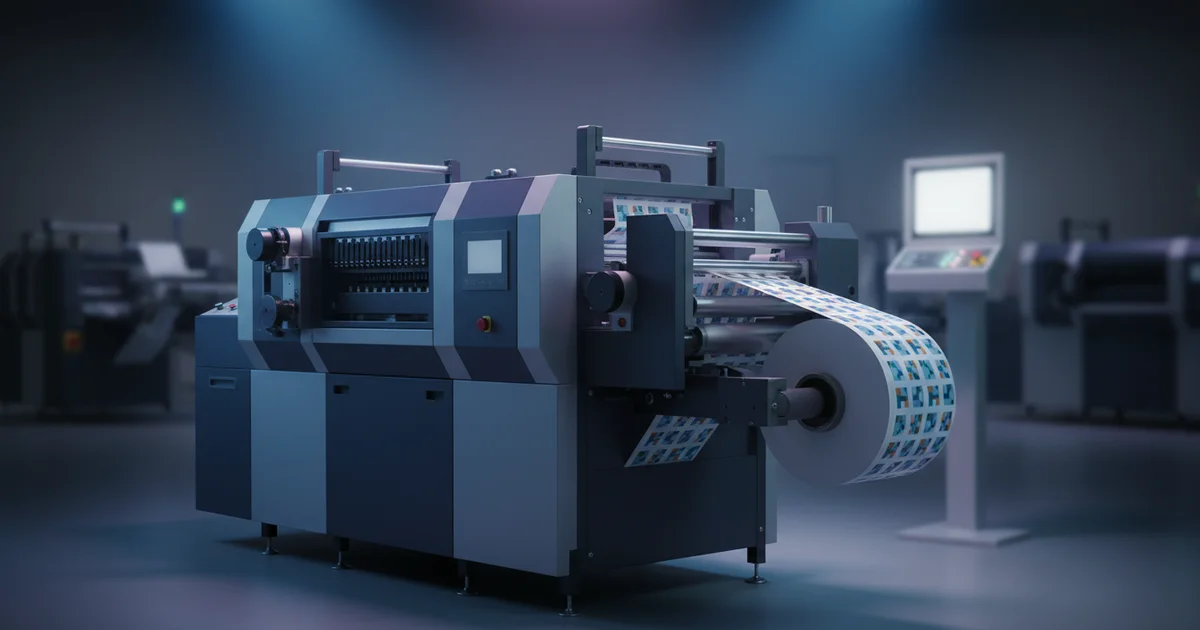
Custom labels printing guide: Flexographic printing beats digital on cost after 7,000-10,000 units. Use BOPP film for moisture, polyester for chemicals. Partner vetting requires checking for a Heidelberg press and BS 5609 compliance. Internal data shows 55% savings at 25k units.
Definition: Strategic custom labels printing refers to the systematic matching of substrate, print technology, and supplier equipment to order volume and end-use environment. This approach consistently reduces per-unit costs by 30-50% compared to ad-hoc sourcing. The summary below outlines the four-step framework every buyer needs in 2026.
Flexography holds a significant share of the print label market, with digital printing forecast to post the highest CAGR over 2026–2031. This projected growth underscores the need for strategic technology selection in custom labels printing.
Why Does Custom Labels Printing Need a Strategic Approach in 2026?
Costly mismatches between print technology and order volume inflate per-unit expenses by 30-50%. Strategic sourcing of custom labels printing matters because a mismatch between print technology and order volume inflates per-unit costs by 30-50%. Ad-hoc choices also produce inconsistent color, substrate failures, and missed launch dates. A framework matching substrate, volume, and supplier equipment cuts waste and ensures consistent quality across every run.
Choosing the wrong custom labels printing technology for your order volume can inflate per-unit costs by 30-50%. Promotional & DIY goods solutions often hinge on getting this right from the start. For example, a buyer ordering 25,000 labels on paper for a freezer setting loses both the product and the label investment within days.
Ad-hoc sourcing leads to inconsistent color, material failures, and missed launch dates. In our experience working with enterprise clients, a strategic framework based on substrate, volume, and equipment vetting cuts waste and improves quality. Our production team has observed that BS 5609 certified polyester labels with ±0.5 mm die-cut tolerance printed at 300 dpi ensure marine compliance from the first unit to the last. This guide walks through four steps to build a sourcing strategy that scales.
Our internal data shows a cost reduction at 25,000 units when using the right print method. But that saving depends on choosing flexographic printing over digital at the correct breakeven point for your specific specification.
Step 1: Match Substrate to End-Use Environment
A substrate is the foundation of any label. A wrong choice causes adhesive failure, fading, or delamination. Custom label printed on paper works for indoor dry use only. BOPP film provides moisture resistance for refrigerated or freezer environments. Polyester resists chemicals and heat for industrial drums and automotive parts. A 300 gsm BOPP substrate printed with CMYK flexo at 175 lpi holds Delta E ≤ 2.0 in freezer conditions from -20°C to 80°C.
Verify the substrate datasheet for temperature range and chemical compatibility. For marine or harsh chemical labels, BS 5609 compliance is mandatory. Polyester with acrylic adhesive meets this standard. BOPP films typically handle -20°C to 80°C, while polyester withstands up to 150°C. Our packaging engineers always recommend testing a sample under actual end-use conditions before committing to a full production run.
A common mistake we see is specifying paper labels for a freezer setting. The adhesive turns brittle, and the label peels within days. A custom labels printing partner should always provide substrate samples for your specific environment before you place a volume order.
GSM and Material Selection Guide
GSM (grams per square meter) refers to substrate weight. A 300 gsm BOPP stock offers durability for freezer environments, while 80 gsm paper suffices for indoor retail tags. Check the datasheet for the exact GSM range your application requires.
How Do You Choose Flexographic vs. Digital Printing by Volume?
Choose flexographic printing for runs above 7,000–10,000 units per SKU where per-unit cost drops to $0.06–0.09 at 25,000 units. Choose digital printing for runs below that threshold where setup costs are $0–50 per job and per-unit cost runs $0.12–0.18 at 5,000 units. The breakeven shifts with color count, substrate, and die complexity.
Flexographic printing becomes cost-effective at 7,000–10,000 units per SKU. Below that threshold, digital printing offers lower setup costs and faster turnaround. But the real inflection point depends on more than just unit count. For example, a Heidelberg 6-color flexo press running 15,000 labels per hour at 300 dpi on 12 pt board achieves ±0.3 mm registration. Number of colors, substrate type, and die complexity shift the breakeven.
Flexography holds a significant share of the print label market. Digital is forecast to post the highest CAGR over 2026–2031. Our guide to custom label materials explains how substrate choice affects cost per unit.
A 4-color flexo job on BOPP with a simple die-cut can break even at 7,000 units. A 6-color job with lamination and complex contours may need 12,000+ units. Always request a cost curve from your supplier for your specific spec — not a generic quote.
| Parameter | Flexographic Printing | Digital Printing |
|---|---|---|
| Breakeven volume | 7,000–10,000 units | Below 7,000 units |
| Per-unit cost at 5,000 | $0.18–0.25 | $0.12–0.18 |
| Per-unit cost at 25,000 | $0.06–0.09 | $0.10–0.14 |
| Setup/plate cost | $200–$600 per color | $0–$50 per job |
| Color accuracy (Delta E) | ≤ 2.0 | ≤ 2.5 |
| Best for | Long runs, consistent graphics | Short runs, variable data, seasonal |
On the other hand, digital printing shines for multi-SKU programs with frequent artwork changes. Custom print production solutions often combine both technologies to improve cost across a portfolio.
When to Push Volume Higher for Flexo
If your annual volume across related SKUs totals 50,000 units or more, grouping orders into a single flexo run can drop per-unit cost below $0.06. Our production team has seen buyers consolidate four seasonal labels into one 60,000-unit flexo run, saving 40% compared to separate digital orders.
Pantone Color Matching in Flexo vs. Digital
Pantone spot colors are reproducible to Delta E ≤ 2.0 on Heidelberg flexo presses using pre-mixed inks. Digital printers simulate Pantone via CMYK + additional toner stations, achieving Delta E ≤ 2.5. For brand-critical color, flexo provides tighter control.
Step 3: Vet Your Supplier’s Equipment and Certifications
Equipment determines quality and consistency. A supplier running a Heidelberg press for offset or a high-speed full-rotary 6-color label press for flexo can hold tighter tolerances. Custom label printing near me requires checking for a PULISI inspection machine, which enables defect detection. Our PULISI system scans at 150 m/min, detecting Delta E > 1.5 deviations on FSC-certified paper stocks.
Request an equipment list and certification documents. ISO 9001:2015 standard ensures quality management processes. ISO 14001:2015 covers environmental compliance. For chemical or marine labels, BS 5609 test reports are non-negotiable.
Our production team uses a fully automatic label optical/visual inspection machine (PULISI) to catch defects like missing text, color shift, and die-cut misregistration. This reduces defect rates to below 0.5% on high-volume runs.
The ISO 9001:2015 standard defines quality management system requirements for organizations that need to demonstrate consistent product conformity. ISO 9001:2015 certification is a baseline requirement for any supplier performing custom labels printing at scale.
Compared to suppliers without automated inspection, defect rates can run 3-6%. That translates to thousands of rejected labels per order. Specialty materials solutions for chemical or medical labels demand this level of verification. A custom labels printing partner should provide inspection logs upon request before shipment.
Key Certifications to Verify
At minimum, confirm ISO 9001:2015 for quality management and ISO 14001:2015 for environmental compliance. For chemical drum labels, FDA 21 CFR regulations may apply if the label contacts food or pharmaceutical products. BS 5609 compliance verifies that a substrate withstands marine exposure and chemical immersion.
DPI and Resolution Standards
DPI (dots per inch) refers to print resolution. A Heidelberg flexo press at 300 dpi combined with 175 lpi screen ruling produces sharp text and barcodes. For fine print, 300 dpi is the minimum; 600 dpi digital presses handle variable-data QR codes with high readability.
Step 4: Establish Quality Control Protocols
Color tolerance protocols ensure consistent reproduction. Our color tolerance protocol sets Delta E ≤ 2.0 for brand colors, ensuring consistent reproduction across every production run. Use spectrophotometry-based verification on every production run. Custom label print quality depends on consistent press calibration and substrate handling. Our production team maintains digital color profiles for every client, allowing repeat orders to match the original proof within Delta E 1.5.
Inspect 100% of labels using an optical inspection machine. The PULISI system scans for color variance, barcode readability, and die-cut accuracy. Review the inspection log before shipment. Request a spectrophotometry report for color-critical jobs. A spectrophotometry report for each Pantone color verifies Delta E ≤ 2.0 tolerance on 300 gsm substrates.
How to Establish QC Protocols: 3-Step Summary
- Step 1: Define Delta E tolerance (≤ 2.0 for brand colors, ≤ 3.0 for secondary colors).
- Step 2: Require spectrophotometry reports for every production run, not just the first article.
- Step 3: Mandate 100% optical inspection with documented defect log and barcode verification.
A common mistake is accepting a Delta E of 3.0 or higher. That visible color shift erodes brand consistency across retail shelves. Retail & e-commerce solutions require sub-2.0 Delta E to keep a premium brand image.
Ready to Audit Your Label Supply Chain?
Get a free cost comparison and equipment assessment for your current label specifications. As of 2026, our updated evaluation framework covers the latest Heidelberg press configurations and PULISI inspection capabilities.
Request a Free QuoteWhat Are Common Pitfalls in Custom Labels Printing?
Custom labels printing involves four common mistakes that cost buyers both money and time: choosing paper for freezer settings, ordering digital short runs above 10,000 units, skipping supplier equipment vetting, and ignoring BS 5609 compliance for chemical labels. Each mistake can add 30-50% in cost or cause complete product loss.
Four mistakes cost buyers the most money and time. First, choosing paper labels for a freezer setting causes adhesive failure and delamination. The label peels within days, and the product becomes unsellable. Choosing paper instead of BS 5609 polyester for chemical drums causes 3-6% defect rates at ±1 mm tolerance.
Second, ordering digital short runs when volume exceeds 10,000 units. You pay 30-50% more per label than flexo. The breakeven is clear, yet many buyers skip the math. Our volume pricing analysis shows the exact thresholds.
Third, skipping supplier equipment vetting. Inconsistent color (Delta E > 2.5) and registration errors increase reject rates. A supplier lacking PULISI inspection cannot guarantee defect-free output. Fourth, ignoring BS 5609 compliance for chemical or marine labels risks regulatory fines and product loss.
To get started with a vetted supplier for your custom labels printing needs, contact our team for a free consultation. We review your substrates, volume, and quality requirements before recommending a print technology.
Limitations of Current Custom Labels Printing Approaches
Flexographic printing is not ideal for runs below 5,000 units where setup costs exceed $200 per color. The per-unit cost at 3,000 units with flexo can reach $0.30–0.40, compared to $0.12–0.18 with digital. Consider instead digital printing for short-run, multi-SKU projects. A drawback of digital is that color accuracy (Delta E ≤ 2.5) is looser than flexo (Delta E ≤ 2.0).
Paper labels won't work for freezer or chemical environments. On the other hand, polyester labels are more suitable for harsh settings but cost 30-40% more per unit compared to BOPP. Alternatively, BOPP provides a middle ground with good moisture resistance at moderate cost. Compared to custom labels printing on paper, BOPP adds durability without the premium of polyester.
A limitation of automated optical inspection is that it detects only visible surface defects. Internal adhesive failures or delamination that occurs after application require additional peel-testing protocols. Suppliers should offer both inspection methods for comprehensive quality control.
As of 2026, the breakeven thresholds remain stable at 7,000–10,000 units, though projected improvements in digital press speeds may shift this range by 2027. Our current 2026 forecasts anticipate digital color accuracy improving to Delta E ≤ 2.0 within two years, narrowing the gap with flexo.
Summary: Strategic Custom Labels Printing Framework for 2026
Custom labels printing in 2026 requires a four-step framework: match substrate to environment, select print technology by volume, vet supplier equipment and certifications, and establish quality control protocols. Each step directly reduces cost and risk. Custom labels printing is a strategic investment that pays for itself through lower defect rates and consistent brand presentation.
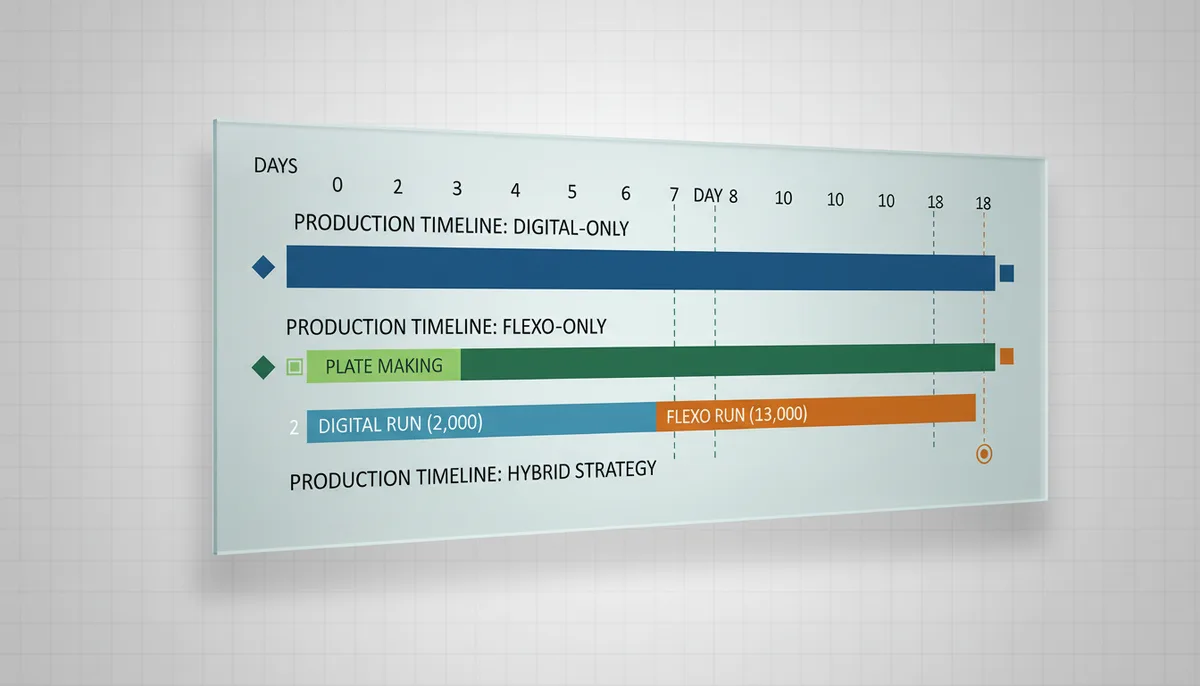
The framework we outlined delivers a cost reduction at 25,000 units when specifications are aligned. From 2023–2026, the market has shifted toward hybrid models combining flexo and digital. Expected to grow further, digital printing's CAGR through 2031 indicates continued innovation in short-run capabilities.
To get started with a vetted supplier for your custom labels printing needs, request a quote or explore our custom print production capabilities. Our team provides equipment lists, certification documents, and sample runs before you commit to volume.
Frequently Asked Questions
When does flexographic printing become cheaper than digital for custom labels?
Flexographic printing becomes cost-effective at 7,000–10,000 units per SKU. Below that, digital printing has lower setup costs. The exact breakeven depends on color count, substrate, and die complexity. For a 4-color job on BOPP, breakeven is around 7,000 units; for 6-color with lamination, it may be 12,000+ units.
What substrate is best for freezer or chemical environments?
For freezer environments, BOPP film with a temperature range of -20°C to 80°C is suitable. For chemical or marine labels, BS 5609 compliant polyester with acrylic adhesive is mandatory. Paper labels should only be used for indoor dry applications.
What certifications should I look for in a custom labels printing supplier?
At minimum, confirm ISO 9001:2015 for quality management and ISO 14001:2015 for environmental compliance. For chemical drum labels, BS 5609 test reports are non-negotiable. If labels contact food or pharmaceuticals, FDA 21 CFR regulations may apply.
How can I ensure color consistency across multiple print runs?
Set a Delta E tolerance of ≤ 2.0 for brand colors and require spectrophotometry reports for every production run. Use a supplier with Heidelberg flexo presses and PULISI optical inspection to detect color deviations. Digital color profiles should be maintained for repeat orders.