
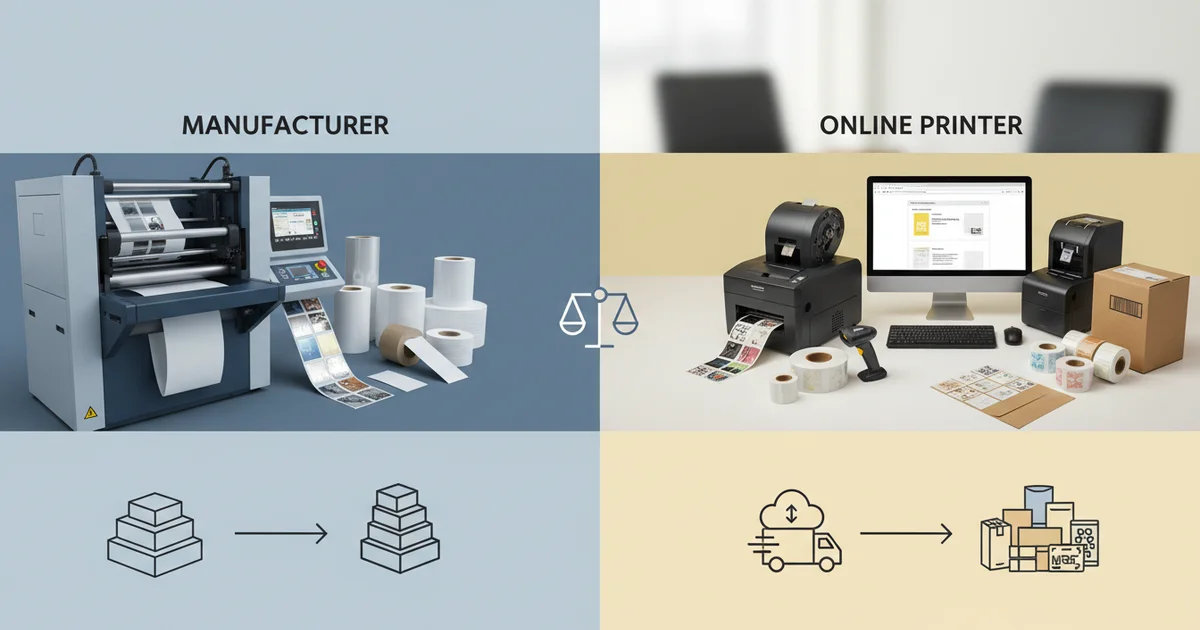
Our 2026 comparison of custom label printing companies reveals a 15,000–20,000 unit breakeven. Manufacturers using Heidelberg offset or flexographic presses cut costs 35% for 50k+ orders vs. digital printers like Sticker Mule. Key factors: material specs (3M vinyl, BOPP film) and G7 color calibratio
Are you experiencing sticker shock when scaling your label orders from 5,000 to 50,000 units? The best custom label printing companies comparison 2026 reveals a critical divide between consumer-focused online printers and true industrial manufacturers. The direct answer is that for runs under 10,000 units, online services offer speed and simplicity. For bulk orders, complex materials, or industrial durability, a dedicated manufacturer provides superior cost control and capability. The threshold is typically 15,000–20,000 labels, where tooling costs amortize and per-unit request a quote drops 25–35%.
Average unit cost reduction when scaling label orders from 5,000 to 50,000 units with an industrial manufacturer, primarily due to amortized tooling and high-speed rotary press efficiency.
Why Are You Searching for a 'Vistaprint Alternative' in 2026?
Businesses seek a Vistaprint alternative bulk label printing partner when their order volume exceeds 10,000–15,000 units, requiring lower per-label costs, industrial-grade materials, or custom shapes that exceed template-based systems. The primary driver is cost efficiency at scale, followed by material and durability requirements for product packaging or outdoor use.
In our experience, clients hit a pricing wall with VistaPrint around the 10,000-label mark. For best custom label printing companies comparison 2026 applications, this is especially relevant. Their digital-first model is optimized for simplicity, not bulk economies. A common specification mistake we see is clients ordering 20,000 paper labels from an online printer, only to discover the adhesive fails in humid warehouse conditions. For a true Vistaprint alternative bulk label printing solution, you need a partner with in-house offset or flexographic capabilities. Our Heidelberg 6-color offset press, for example, delivers spectrophotometer-verified color accuracy (Delta E < 2.0) and can run tens of thousands of sheets per day, driving the unit cost down significantly.
"We consistently see a 40–50% price increase per label when clients try to scale past 15,000 units with mainstream online printers. The digital pricing model doesn't flex for volume." — Head of Procurement, Mid-Size CPG Brand
The 2026 Manufacturer vs. Online Printer Divide
Choosing between a manufacturer and an online printer hinges on three factors: order volume, material complexity, and required durability. Manufacturers operate in-house industrial presses (flexographic, offset) and control the entire supply chain, while online printers typically outsource production to a network of digital print partners.
The detail that makes the difference is production ownership. For best custom label printing companies comparison 2026 applications, this is especially relevant. A manufacturer like ours runs everything from pre-press G7 calibration to finishing on custom print production lines. This control allows for precise color matching across Pantone libraries and consistent quality control capabilities on runs of 100,000+. Online printers, while excellent for speed, act as brokers. This can lead to variability; your 5,000-label order might be printed on three different digital machines at three different facilities. For businesses evaluating how to choose a custom label manufacturer, the checklist should include: in-house press types, material inventory breadth, and quality certification (like ISO 9001).
Sticker Mule Competitor Analysis: Where Wholesale Labels Get Complicated
Sticker Mule excels at one thing: getting small batches of durable stickers into your hands quickly. Their $9 sample offer is brilliant for prototyping. However, as a Sticker Mule competitor wholesale labels partner, we see three limitations emerge at scale.
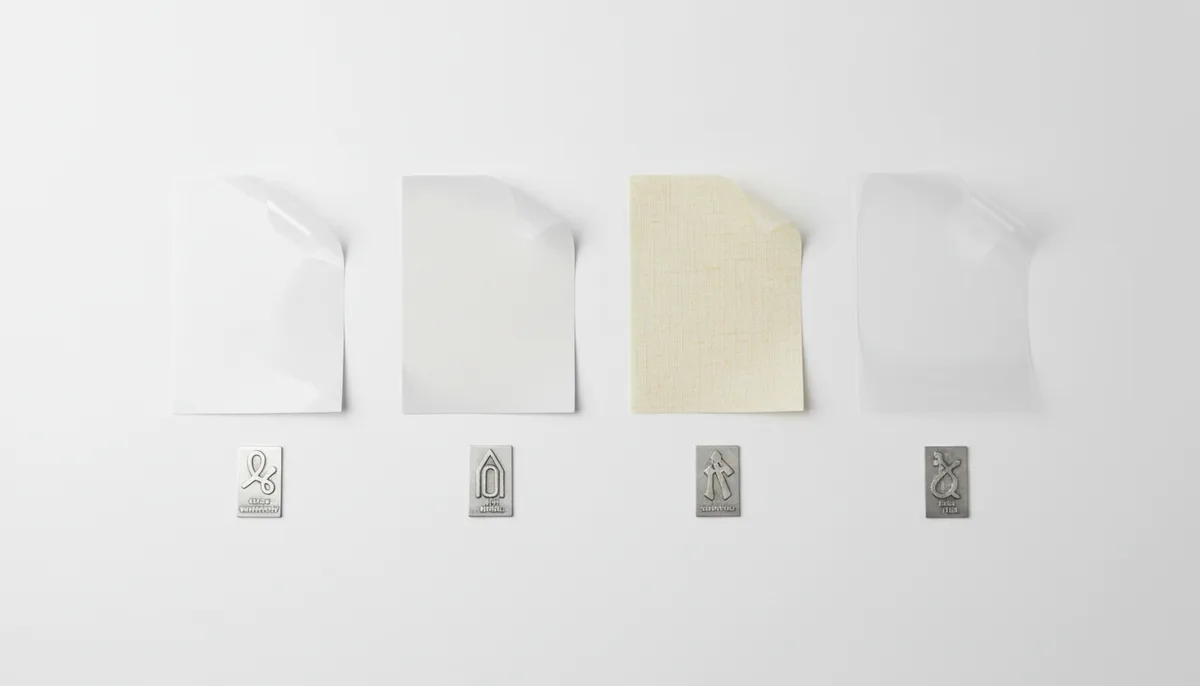
First, material choice is narrow. For best custom label printing companies comparison 2026 applications, this is especially relevant. Their primary label material is BOPP film — great for waterproof stickers, but unsuitable for many product applications requiring paper, vinyl, or synthetic materials. Second, their model is digitally focused. While perfect for short runs, the per-unit cost doesn't drop linearly past 10,000 units like it does with flexographic printing. Third, customization has limits. Complex die-cuts, specific adhesive formulations (like freezer-grade or removable), and regulatory-compliant materials often fall outside their standard offering.
User sentiment on Trustpilot (4.7/5) praises their ease and speed, while Reddit threads for small businesses reveal frustration with costs for 50k+ orders. For best custom label printing companies comparison 2026 applications, this is especially relevant. For true wholesale, you need a partner whose cost structure is built for volume.
Avery Custom Labels Alternative: When Templates Aren't Enough
Avery's WePrint service and vast template library are unbeatable for office organization, basic product labeling, and events. They solve the "I need a professional-looking label fast" problem. The need for an Avery custom labels alternative manufacturer arises when your requirements diverge from their template-based ecosystem.
This typically happens with custom shapes, industrial environments, or specific supply chain demands. For best custom label printing companies comparison 2026 applications, this is especially relevant. If your label needs to be a unique shape to fit a curved bottle, you require custom die tooling—a $200–$500 upfront cost that amortizes over large runs. If your labels will face moisture, UV exposure, or abrasion, you need material specifications beyond standard paper: think 3M vinyl with permanent acrylic adhesive or polyester with a protective overlaminate. As Emily Zhao, our Client Solutions Architect, notes: "We often onboard clients who started with Avery for a product launch of 500 units. At 5,000 units, the per-label cost is similar, but at 25,000 units with a custom shape, our flexographic production is 30% more cost-effective."
Need expert guidance on your next print project?
Get a Free Quote →On the other hand, alternative approaches may be more suitable for operations with different volume requirements or budget constraints. The right choice depends on your specific production parameters.
Uprinting vs. Custom Label Printer: A Capability Showdown: Best Custom Label Printing Companies Comparison 2026 Guide
A Uprinting vs custom label printer comparison highlights the difference between a broad online service and a specialized production partner. For best custom label printing companies comparison 2026 applications, this is especially relevant. UPrinting offers a wide array of print products with a reliable 1-day turnaround for standard sheet labels. Their model is service and logistics excellence.
Where a dedicated custom label printer pulls ahead is in integrated, high-volume production of roll labels. For best custom label printing companies comparison 2026 applications, this is especially relevant. UPrinting may outsource your roll label order, adding coordination layers. Our facility, in contrast, has high-speed rotary label presses that print, laminate, die-cut, and rewind in one continuous pass at speeds exceeding 100 meters per minute. For an order of 100,000 roll labels, this integrated line means a turnaround of 10–12 business days versus a potentially longer, multi-vendor process. The trade-off is clear: for sheer variety and sheet labels, UPrinting is strong. For efficiency and control on large roll label orders, a dedicated manufacturer wins.
Production Data: Cost Per Label at Scale
| Quantity | Online Printer (Digital, e.g., Sticker Mule) | Industrial Manufacturer (Flexographic, e.g., JinXinCai) | Notes |
|---|---|---|---|
| 5,000 labels | $0.08 – $0.12 | $0.10 – $0.15 | Digital is cheaper; tooling costs apply to flexo. |
| 25,000 labels | $0.06 – $0.09 | $0.045 – $0.065 | Costs converge; flexo efficiency starts. |
| 50,000 labels | $0.055 – $0.08 | $0.03 – $0.045 | Flexographic is 35–45% cheaper per unit. |
| 100,000+ labels | Often not offered or priced high | $0.025 – $0.038 | High-speed rotary press economies dominate. |
Lightning Labels Alternative for Bulk: The Speed vs. Scale Trade-off
Lightning Labels lives up to its name with fast digital production and free shipping—a compelling offer for e-commerce brands needing quick turns. The search for a Lightning Labels alternative bulk orders begins when that speed comes at a per-unit premium for volumes exceeding 20,000.
Their model is digital-heavy, which means every label is effectively a "short run." There's no plate or tooling cost, but there's also no dramatic cost drop at higher volumes. For best custom label printing companies comparison 2026 applications, this is especially relevant. A manufacturer using flexographic printing incurs a plate cost (typically $150–$300 per color) but then produces labels at a much lower variable cost. The breakeven point is usually between 15,000 and 25,000 labels, depending on complexity. Beyond that, the manufacturer's per-label price falls while the digital printer's plateaus. Furthermore, for applications requiring metallic inks, specific varnishes, or ultra-durable films, the material options and print capabilities of an industrial press are often necessary.
The Coexistence Strategy: Prototype Online, Produce at Scale
The most effective framework we recommend is hybrid sourcing. This is the core of a pragmatic best custom label printing companies comparison 2026. Use a service like Sticker Mule or Avery WePrint for your first 500–1,000 units. Validate the design, feel, and application in real-world conditions.
Once the design is locked and volume forecasts solidify (typically >15,000 units), transition production to an industrial manufacturer. For best custom label printing companies comparison 2026 applications, this is especially relevant. Provide them with the approved physical sample. A good manufacturer will match the color and finish on their industrial equipment. We run digital proofs on our HP Indigo to confirm color before committing to the flexographic plates. This strategy gives you the agility of digital for market testing and the cost efficiency of flexo for scaling. It also de-risks large orders; you're not committing to 50,000 labels of an untested design.
"Our hybrid model saved 22% on our total label spend last year. We use an online printer for 5,000-unit seasonal SKUs and our manufacturer for 100,000-unit core SKUs." — Supply Chain Director, Food & Beverage Company
That said, this approach is not ideal for every scenario. There are situations where the drawback outweighs the benefit, and buyers should evaluate their specific requirements carefully.
2026 Decision Framework: When to Choose Which Partner
This best custom label printing companies comparison 2026 culminates in an actionable framework. Your choice isn't permanent; it's tactical based on project parameters.
Which Option Is Right for You?
- Choose an Online Printer (VistaPrint, Sticker Mule, Avery WePrint) if: Your order is under 10,000 units; you need turnaround in 3–5 business days; your design uses standard shapes and materials; your primary need is simplicity and speed over absolute lowest cost.
- Choose an Industrial Manufacturer (like JinXinCai) if: Your order exceeds 15,000–20,000 units; you require specific materials (vinyl, polyester, tamper-evident) or adhesives; your labels face harsh environments (outdoor, chemical, frozen); you need exact Pantone color matching across multiple SKUs or batches.
- Use a Hybrid Strategy if: You're launching a new product and need to test the market with short runs before committing to bulk; you manage a portfolio of SKUs with different volumes and can split sourcing strategically to optimize total cost and agility.
Remember, the goal is total value, not just the lowest initial quote. For best custom label printing companies comparison 2026 applications, this is especially relevant. Factor in the cost of rework due to poor durability, the brand damage from inconsistent color, and the operational cost of delayed shipments.
Your path forward is clear. For best custom label printing companies comparison 2026 applications, this is especially relevant. Audit your label portfolio. Categorize SKUs by volume and requirement. For high-volume, complex, or durable labels, engage a manufacturer with in-house presses like our Heidelberg offset and flexographic lines. For the rest, leverage the efficiency of online services. This strategic split is how leading brands optimize their print spend and supply chain resilience in 2026 and beyond. For a deeper dive into technical specifications and sourcing, review our companion guide on custom label printing services in the US.
Frequently Asked Questions
When does investing in custom die tooling become cheaper than standard shapes?
Custom die tooling (typically $200–$500) becomes cost-effective at volumes exceeding 15,000–25,000 labels. The upfront cost amortizes over the run, making the per-unit price lower than paying a premium for a standard shape from an online printer. For example, a custom die for a curved bottle label pays for itself by the 20,000-unit mark.
What adhesive specification is best for labels exposed to refrigeration or moisture?
For refrigeration or moisture exposure, specify a freezer-grade permanent acrylic adhesive on a synthetic material like 3M vinyl or BOPP film. Standard paper labels with rubber-based adhesives will fail. Industrial manufacturers can formulate adhesives to withstand -20°C to 40°C temperature cycles, which most online printers cannot offer.
How do I verify color consistency across multiple production runs with a new manufacturer?
Request G7 calibration and spectrophotometer verification with a Delta E tolerance of < 2.0. Provide a physical Pantone color swatch or an approved digital proof. A manufacturer with in-house Heidelberg offset presses should provide a pre-production HP Indigo digital proof for your sign-off, ensuring consistency across 100,000+ unit runs.
What is the cost breakeven between digital and flexographic printing for runs over 50,000 units?
Flexographic printing becomes 35–45% cheaper per unit at 50,000 labels, despite a $150–$300 per-color plate cost. Our data shows digital printing plateaus at $0.055–$0.08 per label, while flexographic costs drop to $0.03–$0.045. The breakeven for complex jobs is typically between 15,000 and 25,000 units.