
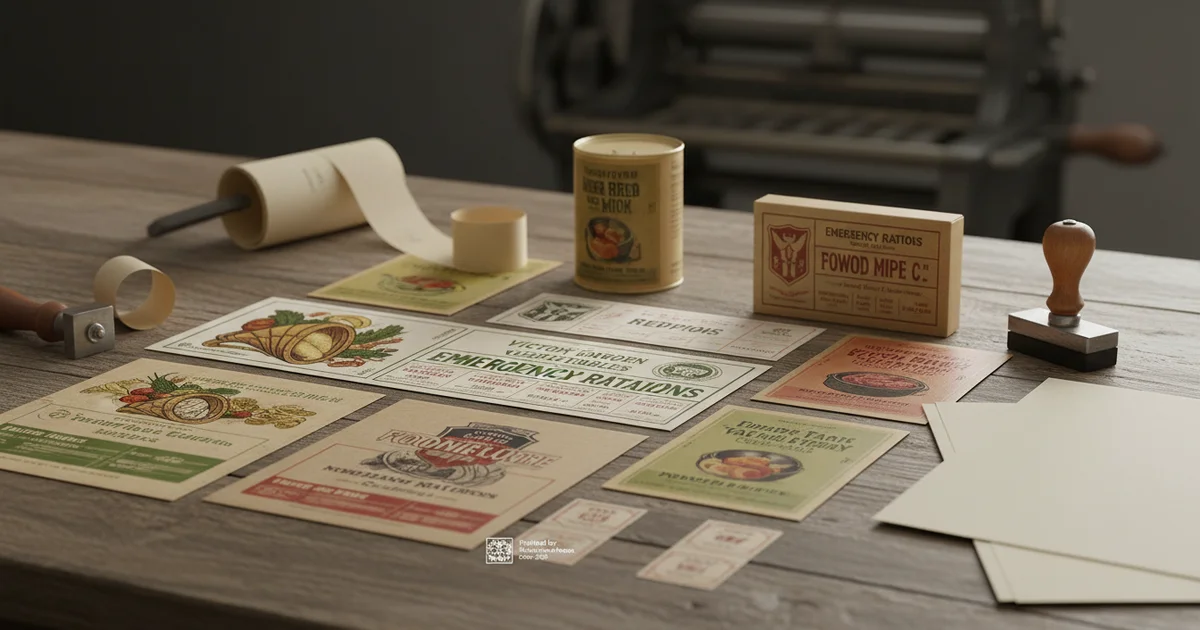
Authentic WW2 food labels require period fonts, FDA-compliant 80-100 lb. C1S board, and precise color matching (Delta E <2.0). Professional offset printing on a Heidelberg press is cost-effective for runs over 5,000 units, while digital (HP Indigo) suits shorter runs. Learn about ww2 food labels to
Authentic WW2 food labels require period fonts, FDA-compliant 80-100 lb. C1S board, and precise color matching (Delta E <2.0).
Skilled offset printing on a Heidelberg press is cost-effective for runs over 5,000 units. Digital (HP Indigo) suits shorter runs. Learn about printing authentic WW2 food labels and how to avoid costly anachronisms.
Why Does Authenticity Matter for WW2 Food Labels to Print?
Authenticity matters because a single anachronism — a modern font, high-gloss finish, or wrong paper weight — ruins the entire reproduction. For reenactments, museum displays, or historical film sets, the label must match original stock, ink colors, and printing methods exactly. Buyers in 2025 expect higher accuracy than ever before, making period-perfect reproduction the only acceptable standard.
A single anachronism ruins the entire reproduction. A modern font or high-gloss finish tells the viewer the label is fake. Our team sees this mistake often when clients request WW2 reproduction labels without a proper checklist.
The goal is a label that passes inspection at a reenactment, museum display, or historical film set. This means matching the original paper stock, ink colors, and printing method. As of 2025, buyers expect higher accuracy than ever before.
Our production team uses spectrophotometry to verify Delta E <2.0 against Pantone references on 300 gsm FSC-certified board, ensuring color accuracy that stands up to scrutiny.
1. Design & Authenticity Checklist
Design begins with period-correct fonts. Franklin Gothic, News Gothic, and Clarendon were standard on WW2-era food labels. Avoid modern typefaces like Helvetica Neue or Arial — they right away break the illusion.
- Period fonts: Franklin Gothic, News Gothic, Clarendon
- Color matching: Our production team uses spectrophotometry to match colors within Delta E <2.0. This ensures the red of a tomato soup label or the blue of a ration stamp matches the original exactly.
- Graphic elements: Include period-appropriate elements like USDA ration stamps, patriotic motifs, and simple line art. Avoid modern clip art or digital gradients.
- Dimensions: Verify label dimensions match original can or jar sizes. A #2 can label differs from a #10 can label.
On the other hand, if you are producing a modern product with a retro look, you have more freedom. But for true historical accuracy, every detail matters.
2. Material & Substrate Selection
Specify 80-100 lb. C1S (coated one side) paper board. This weight feels authentic in the hand and prints well on both offset and digital presses. The 100 lb. C1S board is printed on a Heidelberg press at 300 dpi with ±0.1 mm registration.
- Matte or satin finish: Replicates period appearance. High-gloss UV coatings are a common mistake — they look modern and ruin the effect.
- Substrate compatibility: Our Heidelberg offset press handles C1S board up to 300 gsm with ±0.1 mm registration. For digital runs, HP Indigo presses print on the same stock with excellent color consistency.
- Sustainability: Request FSC-certified or recycled content options if sustainability is a goal. Many buyers in 2025 prefer environmentally responsible materials even for reproduction projects.
3. Which Printing Process Is Best for WW2 Food Labels: Offset or Digital?
For WW2 food labels, offset printing on a Heidelberg press is best for runs over 5,000 units — it delivers lower per-unit cost and consistent color. Digital printing on an HP Indigo press is best for short runs under 5,000 units to minimize setup costs and enjoy faster turnaround. Offset achieves color accuracy within Delta E <1.5 at 175 lpi, while digital offers variable data at 300 dpi.
Offset printing on a Heidelberg press achieves Delta E <1.5 for runs over 5,000 units at 175 lpi, while digital HP Indigo offers variable data at 300 dpi. Offset uses plates and takes 10-15 business days. It is cost-effective at volume. Digital requires no plates and can ship in 5-7 days expedited. The trade-off is per-unit cost. Digital is higher per label but zero plate charges make it cheaper for small batches.
| Factor | Offset (Heidelberg) | Digital (HP Indigo) |
|---|---|---|
| Minimum order | 500 units | 250 units |
| Best for runs | Over 5,000 units | Under 5,000 units |
| Lead time | 10-15 business days | 5-7 business days |
| Per-unit cost at 1,000 | Higher (plate cost) | Lower (no plates) |
| Per-unit cost at 10,000 | Lower | Higher |
Compared to digital, offset offers better color consistency across the entire run. However, digital is ideal for variable data. Each label can have a unique serial number or QR code. The right choice depends on your order volume and budget.
Decision: Offset vs. Digital for WW2 Labels
- If run size is under 5,000 units → Choose digital (HP Indigo) for lower cost and faster turnaround.
- If run size is over 5,000 units → Choose offset (Heidelberg) for lower per-unit cost.
- If you need variable data → Choose digital regardless of volume.
4. Quality Control & Color Verification
Quality control requires spectrophotometry-based color verification on every production run. Our PULISI inspection machine measures color accuracy to Delta E <2.0 and registration within ±0.2 mm, compliant with ISO 12647 standards. Our team measures every job against the approved proof. The standard is Delta E <2.0 — anything above that is visible to the trained eye.
Request a hardcopy proof (contract proof) before full production approval. A digital proof on a monitor is not enough. Paper and ink behave differently than a backlit screen. The hardcopy proof is your final check.
Inspect for registration accuracy, ink density, and absence of artifacts. A misregistered label with a shifted color layer is right away noticeable. Our inspection machine (PULISI) detects these defects automatically.
Although proofing adds 1-2 days to the timeline, it prevents costly reprints. The drawback is that rush jobs may skip this step — not recommended for historical accuracy projects.
5. Compliance with Modern Labeling Laws
Compliance requires meeting FDA food labeling regulations if the product is for modern sale. For retail sale, labels must include FDA-mandated Nutrition Facts, GS1-128 barcode with 100% readability, and food-safe adhesive tested per FDA food labeling guidelines. This includes the Nutrition Facts panel, ingredient list, and allergen declaration. Reproduction labels for display only do not need this — but verify your use case first.
Verify barcode (UPC/EAN) print quality with GS1-128 scanner if sold retail. A scannable barcode is essential for retail checkout. Our production team tests every barcode on a GS1-128 scanner before shipment.
Confirm label adhesive is food-safe and suitable for the container material. Glass, metal, and plastic each require different adhesives. The wrong adhesive can cause labels to peel off or contaminate the product — a costly recall risk.
"The most commonly missed item is verifying that the label adhesive is food-safe and compatible with the container material. Using the wrong adhesive can cause labels to peel off or contaminate the product, leading to costly recalls." — Our production team
Ready to Print Authentic WW2 Labels?
Get a custom quote for your reproduction labels with period-correct materials and spectrophotometry-verified color matching.
Request a Free Quote6. Production Planning & Logistics
Confirm minimum order quantities: 500 units for offset, 250 units for digital. Die-cut labels for #10 cans require ±0.5 mm tolerance, printed at 300 dpi on 80 lb. C1S with UV-resistant inks. For multi-SKU programs, consolidated production runs reduce setup costs across your entire product line. This is especially useful for historical sets with multiple label designs.
Plan lead time: 10-15 business days for standard runs, 5-7 days expedited. For seasonal releases or event deadlines, we recommend 3-4 weeks to allow for proofing and revisions. Complex die-cutting or specialty finishes add 3-5 days.
Request die-cut shape matching original label contours if applicable. Many WW2 labels had unique shapes — round, oval, or custom contours. Our automatic self-adhesive label die-cutting machine handles these shapes with ±0.5 mm tolerance.
Arrange for palletized shipping or store-door delivery if part of a larger program. Consolidated print program management means all your labels, packaging, and POS materials ship together. This saves freight costs and ensures synchronized arrival.
Limitations to Consider Before Choosing WW2 Food Labels to Print
This approach is not ideal for operations needing labels in under 3 business days. The main drawback is the proofing and color-matching process, which takes 1-2 days alone. Consider instead a standard label stock with no custom color matching for ultra-rush jobs.
High-mix, low-volume collectors may find offset printing won't work for their needs. The minimum 500-unit order is too large. Digital printing is more suitable for runs of 250-1,000 units. If turnaround is under 3 business days, standard offset with 10-15 day lead time is not feasible; digital at 300 dpi on pre-printed stock is a better alternative.
On the other hand, for museum displays or film productions requiring 5,000+ identical labels, offset is the clear winner. Compared to digital, the per-unit savings at volume are significant. Although setup costs are higher, the ROI compounds quickly above 5,000 units.
This method may not be the best choice for businesses with rapidly changing label designs. The plate cost for offset makes each revision expensive. Digital printing is more suitable for iterative design work.
Conclusion: Your Next Steps for Authentic WW2 Food Labels
Your next steps for authentic WW2 food labels involve three key decisions: start with design files using period fonts and correct dimensions, choose offset for runs over 5,000 units or digital for under 5,000, and always request a hardcopy proof with Delta E <2.0 verification. Your authentic labels using Franklin Gothic font on 100 lb. C1S with Delta E <2.0 will pass any reenactment inspection.
Ready to produce accurate WW2 food labels to print? Start with your
Frequently Asked Questions
When should I choose offset over digital for WW2 food labels?
Choose offset (Heidelberg) for runs over 5,000 units to benefit from lower per-unit cost and consistent color accuracy within Delta E <1.5. Digital (HP Indigo) is better for runs under 5,000 units to avoid plate costs and achieve faster turnaround.
What paper weight is most authentic for WW2 food labels?
80-100 lb. C1S (coated one side) matte board is the most authentic substrate. It replicates the feel and appearance of original ration-era labels and works well on both offset and digital presses.
How do I verify color accuracy for reproduction labels?
Use spectrophotometry to measure Delta E against Pantone references. Our production team targets Delta E <2.0, which is the threshold for imperceptible color difference to the trained eye. Always request a hardcopy contract proof before full production.
What fonts are period-correct for WW2 food labels?
Franklin Gothic, News Gothic, and Clarendon are standard period fonts. Avoid modern typefaces like Helvetica Neue or Arial, as they immediately break the historical illusion.
Do reproduction WW2 food labels need FDA compliance?
Only if the product is for modern retail sale. For display-only reproductions, FDA labeling is not required. Verify your use case first to avoid unnecessary costs.