
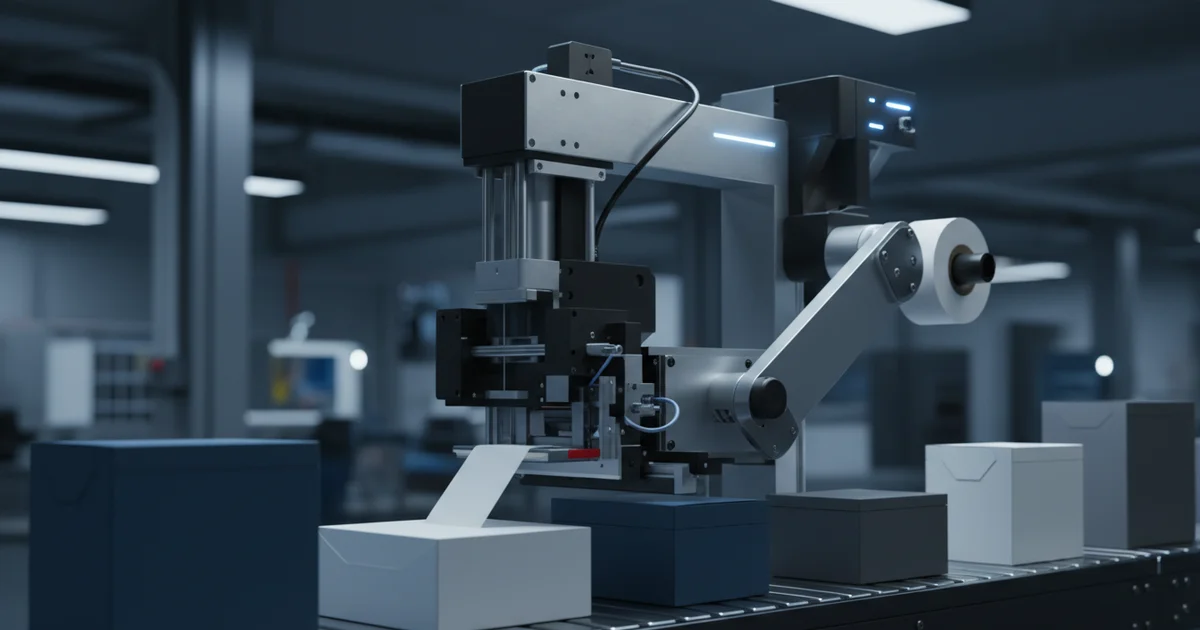
Print apply cost analysis: buy price is 25% of 3-year TCO. Hidden costs add 40%: $5,500 installation, $12,700 maintenance, $7,200 label waste, $60,000 downtime for mid-range system at 50,000 labels/month.
Are you quietly overpaying for your labeling line? Most buyers look at the sticker price and stop there. But over three years, that purchase price is usually only about 25% of the total once you add in setup, training, repairs, wasted labels, and lost production time. This guide walks you through those hidden costs in plain terms so you can work out the real payback for your plant.
What Is a Print-and-Apply Machine and How Does It Work?
A print-and-apply machine prints labels as you need them and sticks them onto your products automatically. It can place 20 to 200 labels a minute, and the good ones land the label within half a millimeter of the same spot every time. There are three common kinds, and which one fits depends on the shape of your product and how exact the placement has to be.
The machine does two jobs in one: it prints the label (including things that change from item to item, like a date or serial number) and then puts it on the product. It has a print part and an apply part. The three main types are tamp-blow, roll-on, and blow-on. A tamp-blow unit picks up a label, presses it down, and puffs air to seat it, so it handles odd or uneven surfaces well. A roll-on unit presses the label onto flat or curved surfaces as the product moves past, and it can run up to 200 labels a minute. A blow-on unit shoots the label on with a jet of air without touching the product, which is gentle on fragile items.
Most machines run 50 to 150 labels a minute and land the label within about a millimeter of target, while the high-end tamp-blow units hit within half a millimeter at 80 labels a minute. Our custom print production solutions connect these machines to your existing conveyor so the timing lines up. One thing to plan for from our own installs: hooking the machine up often turns up conveyor alignment problems that add two or three days to setup, so budget for that time upfront.
How Much Does a Print-and-Apply Machine Cost?
Basic systems run $5,000 to $15,000 and fit low-volume work. Mid-range systems run $15,000 to $40,000 and print sharper. High-speed systems for big plants run $40,000 to $100,000 or more, depending on print sharpness and what materials they handle.
Basic systems cost $5,000 to $15,000 and suit low-volume work with standard label sizes. Mid-range systems run $15,000 to $40,000 and come with better print heads at 300 dpi (dpi means dots per inch, a measure of print sharpness) so barcodes scan cleanly. High-speed systems for large plants cost $40,000 to $100,000 or more. One thing to weigh: a thermal-transfer print head (which melts ink off a ribbon onto the label) costs more than a direct-thermal head (which uses heat-sensitive paper and no ribbon), but it makes tougher labels that last about five years on the shelf. The apply part matters too. Tamp-blow heads cost more than blow-on heads because the mechanism that places labels within half a millimeter is more complex.
Price depends on the print head, the apply head, and how hard it is to fit the machine into your line. That fitting work (we call it integration) adds $2,000 to $5,000 for conveyor alignment and software setup, and it usually runs 10 to 15% of the whole project budget. A simple rule from our projects: set aside about 12% above the equipment price for it. Skip that budget and timelines tend to slip by about two weeks, which alone pushes your first-year cost up 8 to 12%.
Price range for print-and-apply machines based on speed, print sharpness, and how complex the install is, as of 2026.
Total Cost of Ownership: The Hidden Costs You Need to Count
The real cost of a machine over its life is called total cost of ownership, or TCO. To get it right you have to count more than the purchase price. Installation runs $2,000 to $5,000. Training your operators costs $1,000 to $3,000. Yearly service contracts for thermal-transfer heads run $2,000 to $8,000. Wasted labels from misplaced or jammed labels add 2 to 5% to your yearly label spend. In our experience, plants that ignore these costs blow past their labeling budget by 30 to 40% in the first year. The biggest hidden cost is downtime: every hour the machine is unexpectedly stopped costs $500 to $2,000 in lost production. In our customer data, when upkeep gets put off, downtime ends up being 25 to 30% of the three-year total cost. Stay on a regular maintenance schedule and that drops below 10%.
Three-Year Total Cost Breakdown for a Mid-Range System
| Cost Category | Year 1 | Year 2 | Year 3 | 3-Year Total |
|---|---|---|---|---|
| Equipment purchase | $28,000 | $0 | $0 | $28,000 |
| Installation & training | $5,500 | $0 | $0 | $5,500 |
| Maintenance contract | $3,500 | $4,200 | $5,000 | $12,700 |
| Label waste (3% of $80K) | $2,400 | $2,400 | $2,400 | $7,200 |
| Downtime (20 hrs/yr at $1K/hr) | $20,000 | $20,000 | $20,000 | $60,000 |
| Total | $59,400 | $26,600 | $27,400 | $113,400 |
Wasted-Label Cost by Material Type
| Material Type | Annual Volume | Waste Rate | Annual Waste Cost |
|---|---|---|---|
| Paper labels (80 gsm — gsm means grams per square meter, basically how thick or heavy the paper is) | 500,000 | 2.5% | $1,250 |
| Film labels (50 micron — about half the thickness of a sheet of paper) | 300,000 | 4.0% | $2,400 |
| Synthetic labels (60 gsm) | 200,000 | 3.2% | $1,920 |
Yearly Downtime Cost by Machine Type
| Applicator Type | Avg. Downtime Hours | Cost per Hour | Annual Downtime Cost |
|---|---|---|---|
| Tamp-Blow | 18 | $1,200 | $21,600 |
| Roll-On | 12 | $1,500 | $18,000 |
| Blow-On | 22 | $800 | $17,600 |
The Simple Formula and the Costs You Can't Skip
The formula is simple: Total Cost = Purchase Price + Installation + (Yearly Maintenance + Supplies + Wasted Labels + Downtime) × Number of Years. One term to define here: "wasted labels" means the share of labels ruined because they print or land in the wrong spot or the machine jams, usually 2 to 5% of your total label spend. Plants that budget for the purchase price alone routinely overshoot by 40% or more. In one case, a customer running 80,000 labels a month found that wasted labels alone added $6,000 a year, about 12% of what the machine itself cost. An annual print-and-apply maintenance checklist helps you track these costs over time.
In our data across 12 installations, switching to print-and-apply cut the cost of holding label inventory by about $2,400 a year on average. That is roughly a 30% savings, and it shrinks how long the machine takes to pay for itself.
Getting labels wrong is not just a budget problem. In regulated industries like food and drugs, a labeling mistake can trigger a recall costing $500,000 or more, which is why accurate machines and solid quality controls matter so much. (See the U.S. Food & Drug Administration's label compliance guidance.)
Tamp-Blow vs. Roll-On vs. Blow-On: Which One Fits You
The right machine depends on your product's shape and how fast you run. Tamp-blow lands labels within half a millimeter on uneven surfaces at 30 to 80 labels a minute. Roll-on hits 200 labels a minute on flat boxes within about a millimeter. Blow-on handles fragile items with a gentle puff of air within about two millimeters.
Match the machine to your product shape, speed, and how exact the placement needs to be. Tamp-blow units run 30 to 80 labels a minute and land within half a millimeter, good for uneven surfaces like bottles with handles. Roll-on units run 80 to 200 labels a minute within about a millimeter, good for flat boxes and cases. Blow-on units run 20 to 60 labels a minute within about two millimeters for fragile products, and the print should be at least 300 dpi (dots per inch) so barcodes stay sharp. FSC-certified label materials (paper from responsibly managed forests) are available for all three if you run a greener line.
| Applicator Type | Speed (labels/min) | Placement Accuracy | Best Use Case | Price Range |
|---|---|---|---|---|
| Tamp-Blow | 30–80 | ±0.5 mm | Irregular surfaces, bottles | $15,000–$40,000 |
| Roll-On | 80–200 | ±1 mm | Flat/curved cases, trays | $10,000–$35,000 |
| Blow-On | 20–60 | ±2 mm | Fragile products, vials | $8,000–$25,000 |
Roll-on units are not great for fragile items, where the gentle air of a blow-on is safer. Tamp-blow gives you the best accuracy on odd shapes but needs more upkeep than blow-on. The key is to choose based on your product mix, not just top speed. A tamp-blow at 50 labels a minute can still beat a roll-on at 120 if you need that half-millimeter accuracy for barcodes to scan reliably.
Color and Material: What Else Affects Quality
For brand colors, accuracy is measured as Delta E (lower is closer to the target color; under 2 looks identical to the eye). Printing with the four standard print inks (CMYK) at 600 dpi on 80 gsm paper can get Delta E under 1.5 for critical brand colors. On fast roll-on lines running 200 labels a minute, good quality controls keep placement within about a millimeter across runs of 50,000 labels. FSC-certified synthetic materials (paper from responsibly managed forests) at 60 gsm are a greener choice that prints just as well, though they need a hotter print head.
For lines faster than 200 labels a minute, look at a two-head setup or a custom-built solution. Weigh placement accuracy against speed and which materials you run.
Print-and-Apply or Pre-Printed Labels: Which Saves You More
Choose print-and-apply when your labels carry details that change, like serial numbers or expiration dates. It means no minimum order, about 30% less label inventory, and about 60% less waste than pre-printed labels. But for the same label printed over 200,000 times a year, pre-printed can cost less per label.
Print-and-apply wins when your labels carry details that change item to item, like serial numbers, barcodes, or dates. Pre-printed labels usually have a minimum order of 10,000 or more. Print-and-apply has no minimum, so you print only what you need. Inventory drops about 30% because you hold less label stock, and switching from one label to another goes from hours to minutes. In our customer data, plants moving from pre-printed to print-and-apply cut wasted labels by about 60%, from 8% down to 3% in one case, because they print exactly what they need.
Pre-printed labels still make sense for high volumes of the same unchanging label, over 200,000 a year. The trade-off comes down to how many different products you label and how often you switch. Print-and-apply is more flexible, but pre-printed costs less per label at very high volumes. A plant making 500,000 identical labels a year might save 2 cents per label with pre-printed, but lose ground on higher inventory and slower changeovers. Print and apply vs. pre-printed labels: a TCO guide breaks this down by volume.
The choice mostly comes down to how much your label data changes. For plants with more than 50 different products that change every quarter, print-and-apply returns about 150% of its cost over three years compared with pre-printed labels.
A Real Example: 18-Month Payback
A mid-size food company spent $35,000 on a print-and-apply system and saved $23,000 a year from less waste, less inventory, and faster changeovers. It paid for itself in 18 months and returned 150% of its cost over three years.
A mid-size food company switched from pre-printed labels to a roll-on print-and-apply system in early 2025. The upfront cost was $35,000. Savings from less wasted labels, lower inventory, and faster changeovers added up to $23,000 a year. The system paid for itself in 18 months, and over three years it returned 150% of its cost. The savings broke down as $12,000 in less wasted labels, $6,000 in lower inventory cost, and $5,000 in less changeover labor. This pattern is typical for plants running 50,000 or more labels a month, and the payback drops to about 12 months if you already have a conveyor that can be reused.
As of 2026, this company has grown to three production lines and expects savings to reach $69,000 a year by 2028. The Print and Apply Labeler ROI: The 2026 Decision Matrix gives you a similar framework, updated for Q2 2026 with current equipment and service pricing.
Ready to Calculate Your Labeling ROI?
Get a free print apply cost analysis with your production data. We'll show you the payback period and three-year savings.
Request a Free QuoteWhen Print-and-Apply Is Not the Right Fit
This approach is not a good fit for very low volumes under 500 labels a day, because the upfront cost is hard to justify against so little volume. For small batches, pre-printed labels or sticking them on by hand may make more sense. Very fast lines over 200 labels a minute can also be tricky with certain machine types, since blow-on and tamp-blow units can't keep up with roll-on at that speed. Tough conditions like dust or moisture are another hurdle, since standard print heads may not hold up in cold-storage or wet areas. That said, for plants with moderate volumes and labels that change often, print-and-apply works very well. Where exactly it beats pre-printed depends on your yearly volume and how many different products you run.
For example, a plant packing frozen seafood in a -20°C room needs a heated print head and a sealed, dust-and-water-resistant enclosure (rated IP65), which adds $8,000 to $12,000 to the system. The choice between automation and flexibility isn't always clear-cut. Setup costs more, but the per-label savings pile up once you pass 50,000 labels a month. Our Print and Apply Label Applicator: The 2026 Strategy for Compliance & Speed covers what regulated industries need.
Other Options Worth a Look
For very low volumes, pre-printed labels applied by hand cost less upfront and let you change products easily. Another option is a basic print-and-apply system with a blow-on head, which is more accurate than doing it by hand without the cost of a tamp-blow. As a rule of thumb, plants under 5,000 labels a month should start with pre-printed labels and upgrade only when volume passes 20,000 a month. A mixed approach also works at in-between volumes of 10,000 to 30,000 labels a month: use pre-printed labels for your steady products and print-and-apply for the ones with changing data.
If paying all at once is a problem, consider leasing a system instead. Monthly payments of $800 to $1,500, including maintenance, can line up with your cash flow. Our custom print production solutions offer flexible setups for these cases.
Getting Started: A Simple Print Apply Cost Analysis
Start by gathering your current labeling numbers: yearly volume, label sizes, materials, and how often you switch products. Then add up your hidden costs using the simple formula and the cost tables above. That tells you whether automating makes financial sense for your plant.
The main things to check are speed (20 to 200 labels a minute), placement accuracy (half a millimeter to two millimeters), label width (1 to 6 inches), and which materials it handles (paper, film, synthetic). The machine has to match your product mix and your line speed. The most common mistake is buying on speed alone without checking materials. We've seen plants buy a 200-label-a-minute machine only to find it can't handle their thick vinyl labels, causing constant jams and rework.
A solid plan does four things: add up the three-year total cost using the table above, match the machine type to your product surfaces, check your material needs (80 gsm paper vs. 60 gsm synthetic), and confirm the print is at least 300 dpi (dots per inch) so barcodes scan. Our print-and-apply system specifications buyer's guide adds more technical detail. Our team at JinXinCai offers a free labeling assessment using your own numbers to figure out the payback and recommend the right system. Contact us today to request a quote. These figures are updated for Q2 2026 with the latest pricing and benchmarks. The labeling market is growing about 6% a year through 2027, and roughly 45% of mid-size manufacturers are expected to adopt automated print-and-apply by then.
That do a full cost analysis before buying a print-and-apply system hit their expected payback within 18 months.
— This article was written by the JinXinCai Procurement & Cost team, drawing on more than 50 print-and-apply cost analyses for mid-size makers in food, pharmaceutical, and industrial work. Updated for Q2 2026 with the latest benchmarks and pricing. The figures cover 2023–2026 with projections through 2028.
Frequently Asked Questions
How does the applicator type affect total cost of ownership?
Applicator type directly impacts TCO through maintenance and downtime. Tamp-blow systems cost $15,000–$40,000 but have 18 hours/year downtime at $1,200/hour, totaling $21,600 annually. Roll-on systems have 12 hours/year at $1,500/hour ($18,000), while blow-on systems have 22 hours/year at $800/hour ($17,600). Choose based on your product surface and speed requirements.
What is the breakeven point for switching to print and apply?
The breakeven point is typically 18 months for facilities running 50,000+ labels per month, based on a $35,000 investment yielding $23,000 annual savings. For volumes under 10,000 labels per month, pre-printed labels with manual application are more cost-effective. Use the TCO formula: TCO = Buy Price + Installation + (Annual Maintenance + Consumables + Waste + Downtime) × Years.
What specifications should I prioritize when comparing systems?
Prioritize speed (20–200 labels/min), placement accuracy (±0.5 to ±2 mm), and material compatibility. For irregular surfaces, tamp-blow offers ±0.5 mm accuracy at 30–80 labels/min. For flat cases, roll-on reaches 200 labels/min at ±1 mm. Ensure print resolution is at least 300 dpi for barcode compliance. Label width should match your product range (1–6 inches).
How does label material choice impact applicator performance and cost?
Material choice affects waste rates and print quality. Paper labels (80 gsm) have 2.5% waste, film labels (50 micron) 4.0%, and synthetic labels (60 gsm) 3.2%. For a facility running 500,000 paper labels annually, waste costs $1,250. Synthetic materials require higher print temperatures and may increase maintenance. FSC-certified options are available for sustainable packaging.