
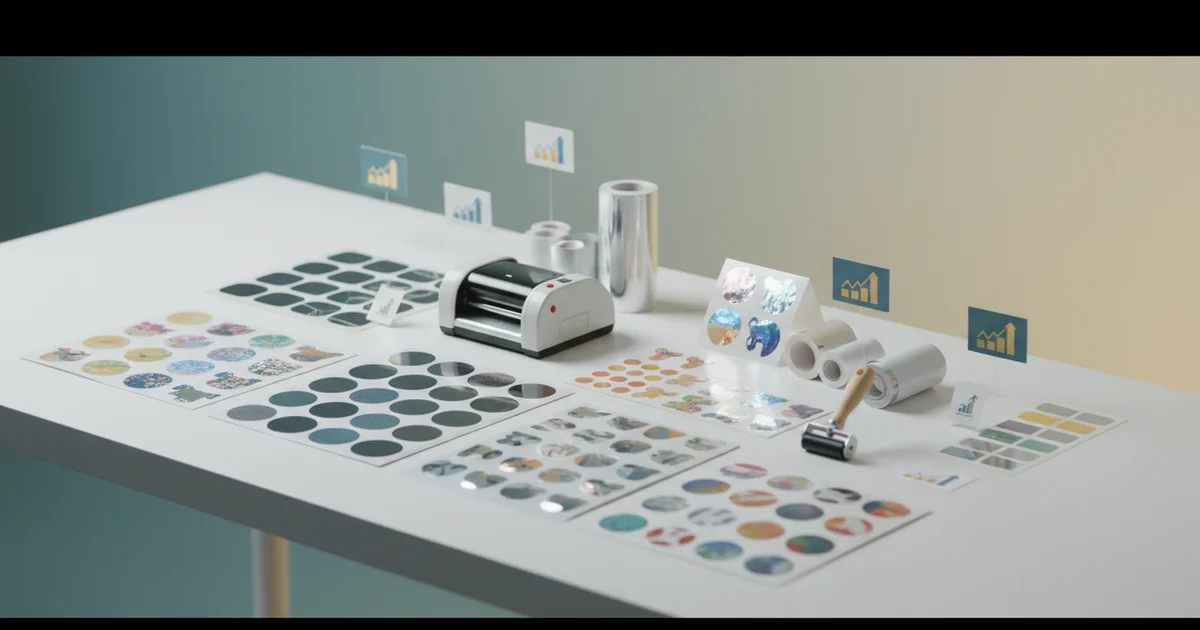
To make custom stickers, specify 3.5 mil vinyl for 5-7 year outdoor durability or clear polyester for glass. Offset printing on a Heidelberg press delivers Delta E < 2.0 color accuracy for runs over 5,000 units at $0.02–$0.15 per sticker.
Are you spending 30% of your labeling budget on reprints due to material failure, adhesive issues, or non-compliance? The core mistake is treating custom stickers as a simple commodity rather than engineered solutions. To make custom stickers that perform, you must align specifications with the end-use environment from day one. This guide provides the decision frameworks and production parameters we use with enterprise clients to eliminate waste and ensure reliability.
Are You Buying Stickers or Solving a Business Problem?
Define the sticker's job first. Promotional giveaways require visual impact and low cost, while industrial asset labels demand durability and permanent adhesion. Misalignment here is the root cause of most budget waste.
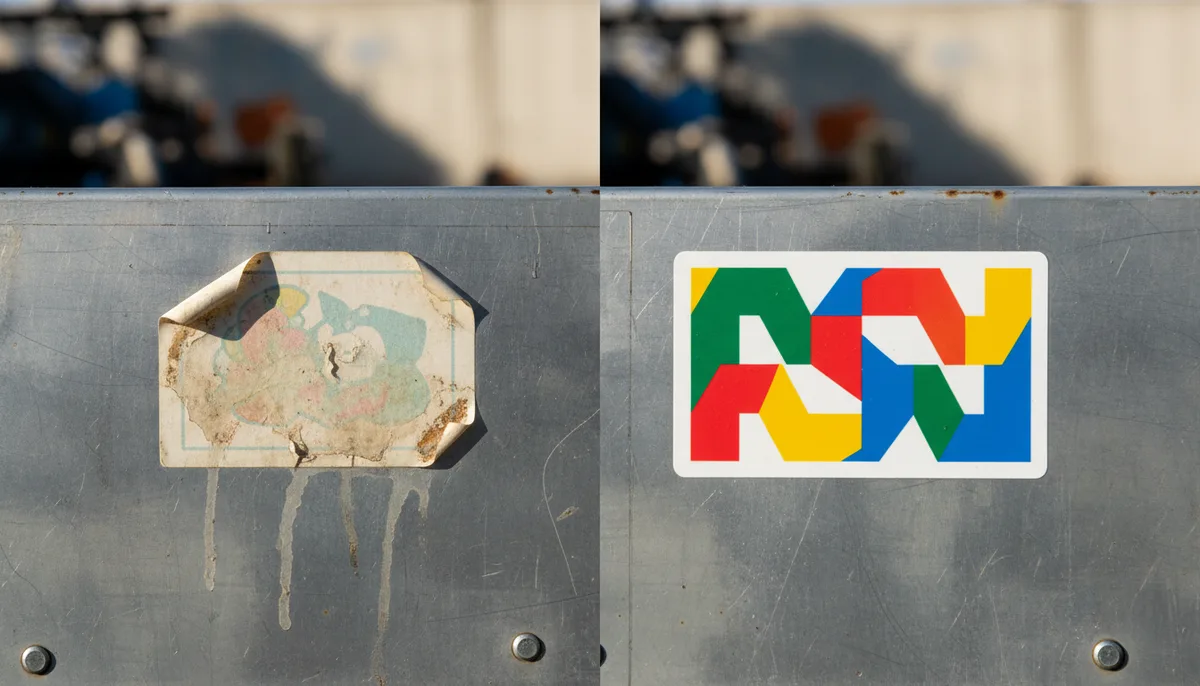
In our experience, the most common and costly error is using a promotional-grade paper sticker for a product that will face moisture or abrasion. We've analyzed over 500 client jobs and found that nearly 30% of reprint costs stem from this fundamental mismatch. A promotional sticker might have a functional lifespan of 3–6 months outdoors, while an industrial label on a tool or machine must last 3–5 years.
"We see clients default to a standard 70# gloss paper for everything because it's familiar. When that label fails on a warehouse shelf or a hard hat, the reprint cost isn't just the unit price—it's the labor to re-apply thousands of labels and the risk of non-compliance." — David Chen, Technical Director, Print Engineering
The first question in our custom print production consultation is always: "What is the sticker's environment and required lifespan?" This dictates every subsequent specification.
How to Make Custom Stickers: The 5-Step Production Blueprint
The professional process to make custom stickers involves five critical stages: 1) Design & Prepress, 2) Plate Making, 3) Printing, 4) Die-Cutting, and 5) Finishing & Packaging. Handoff points between these stages are where most quality errors occur if files and specs are not locked.
Let's break down the blueprint we use for commercial runs, which differs significantly from DIY or small-batch digital printing.
How to Make Custom Stickers: 5-Step Commercial Production
- Design & Prepress: Supply print-ready PDF/X-1a files with 1/8" bleed and CMYK+Pantone spot colors. Our pre-press team runs G7-calibrated proofing on every job. The detail most get wrong? Not embedding fonts or outlining text, which causes font substitution and layout shifts.
- Plate Making: For offset printing, aluminum plates are created for each color. This step adds $200–$500 in setup but is amortized over the entire run, making it cost-effective for quantities above 5,000.
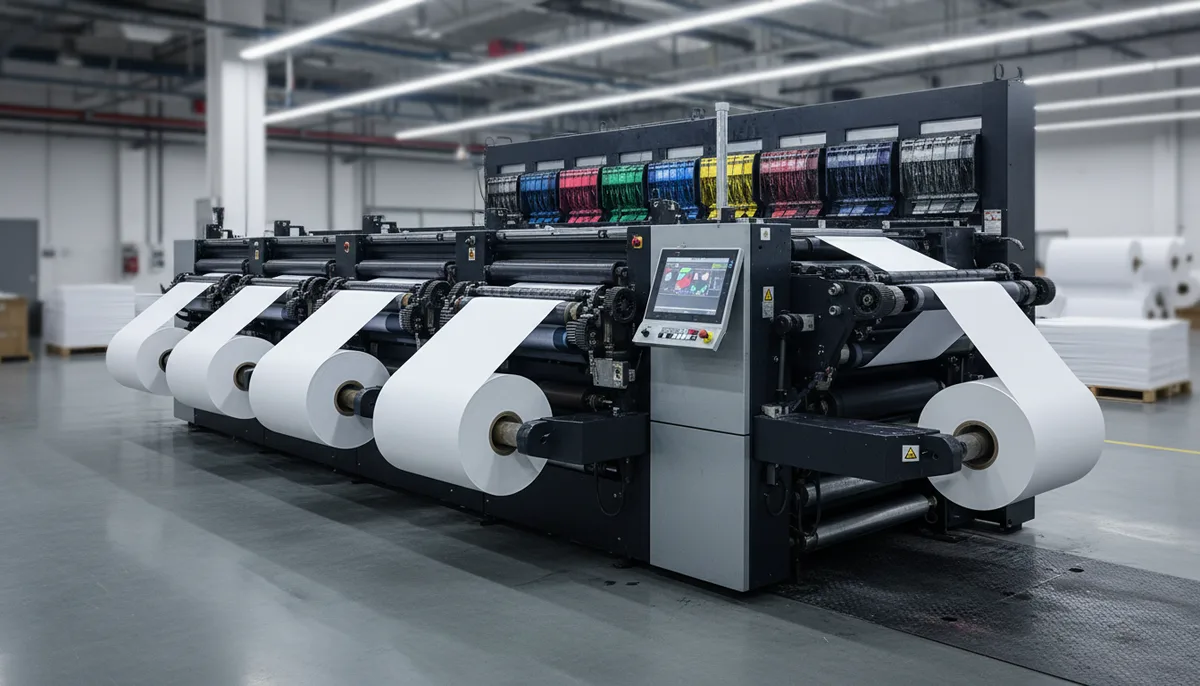
- Printing: For volume runs, we use our Heidelberg 6-Color Offset Press. This industrial press delivers spectrophotometer-verified color accuracy with a Delta E < 2.0 tolerance, ensuring brand colors match perfectly across all custom label stickers. Inline coating can be applied for protection.
- Die-Cutting: The printed sheets are fed into our Automatic Self-Adhesive Label Die-Cutting Machine. A custom steel rule die, costing $200–$500, is used for precision kiss-cutting—cutting through the sticker layer but leaving the backing paper intact.
- Finishing & Packaging: Labels are inspected, slit, and rewound onto cores for roll format or guillotine-cut into sheets. They are then packed in shrink-wrapped boxes to prevent moisture damage during shipping.
This process, from approved proof to shipped product, typically takes 10–15 business days for a first run. Understanding this timeline is crucial for planning promotional launches or product rollouts, a topic we explore further in our guide on strategic sourcing for labels.
Material Selection: When Do You Need Vinyl vs. Custom Clear Stickers?
Your choice between white vinyl, custom clear stickers, or paper is the single biggest determinant of performance and cost. This isn't an aesthetic choice—it's an engineering decision.
of material-related failures we analyze are due to using paper in a wet or abrasive environment.
Vinyl (Oracal 651 or 3M Calendered): This is your workhorse for durability. A 3.5 mil white vinyl with a permanent acrylic adhesive is the standard for outdoor use, product labeling, or asset tags. It offers 5–7 years of outdoor durability. The waterproof adhesive forms a permanent bond with most clean, smooth surfaces.
Custom Clear Stickers (Polyester or BOPP Film): Use these when you want the surface texture or color to show through the label, like on glass or dark-colored products. The key detail is adhesive choice. A permanent adhesive can cause "ghosting" or residue on glass. For temporary promotions or window decals, a removable adhesive is mandatory. Clarity is measured in haze percentage — look for less than 3% for premium clarity.
Paper (70#–80# Gloss or Matte): Reserved for indoor, short-term promotional items, event handouts, or product packaging where cost is the primary driver. It is not waterproof and will degrade quickly outdoors.
Production Data: Sticker Material Performance
| Material | Best For | Outdoor Lifespan | Cost per 10K (4"x3") | Critical Limitation |
|---|---|---|---|---|
| 80# Gloss Paper | Indoor promotions, event giveaways | 3–6 months | $180–$250 | Not waterproof, low abrasion resistance |
| 3.5 mil White Vinyl | Product labels, outdoor asset tags, hard hats | 5–7 years | $450–$600 | Higher cost, not suitable for textured surfaces |
| 2 mil Clear Polyester | Window decals, glass product labeling | 2–3 years (UV laminated) | $550–$750 | Adhesive can ghost on glass if not specified correctly |
| Synthetic Polypropylene | Chemical or oil exposure, freezer labels | 3–5 years | $500–$700 | Requires specific aggressive adhesive |
The Real Math Behind Inexpensive Stickers Custom Orders
"Inexpensive" is a function of volume and smart specification. The unit cost to make custom stickers drops dramatically not just with quantity, but by avoiding over-engineering for the application.
The biggest cost drivers are 1) material, 2) custom die tooling, and 3) print process. For truly inexpensive stickers custom runs, you must optimize all three. A promotional paper sticker run of 50,000 units can cost as little as $0.02–$0.03 each. The same quantity in durable vinyl might be $0.04–$0.06. The key is that the die tooling cost ($200–$500) is amortized over the entire run.
"The breakeven between digital and offset printing for stickers is typically around 3,000–5,000 units. Below that, digital's lack of setup charges wins. Above that, offset's lower per-unit cost dominates, especially for custom label stickers requiring precise brand colors." — Head of Operations
Our internal pricing data shows a 25–35% unit cost reduction when scaling from 5,000 to 50,000 units of the same SKU. This economy of scale is why consolidating multiple label needs into a single production run is one of the most effective strategies for procurement teams. For a deeper dive on print procurement strategies that apply to stickers, business cards, and more, see our business card printing procurement guide.
Need expert guidance on your next print project?
Get a Free Quote →Application Engineering: Roll, Sheet, or Precision Die-Cut?
How will the stickers be applied? Manual application by staff favors sheets. High-speed automated applicators require rolls. This decision impacts material orientation, waste, and total applied cost.
Sheets: Ideal for manual distribution or application. They are familiar to end-users but generate more waste (the matrix around the stickers) and are slower to apply. Sheets are the default for most personalized labels stickers used in retail or as handouts.
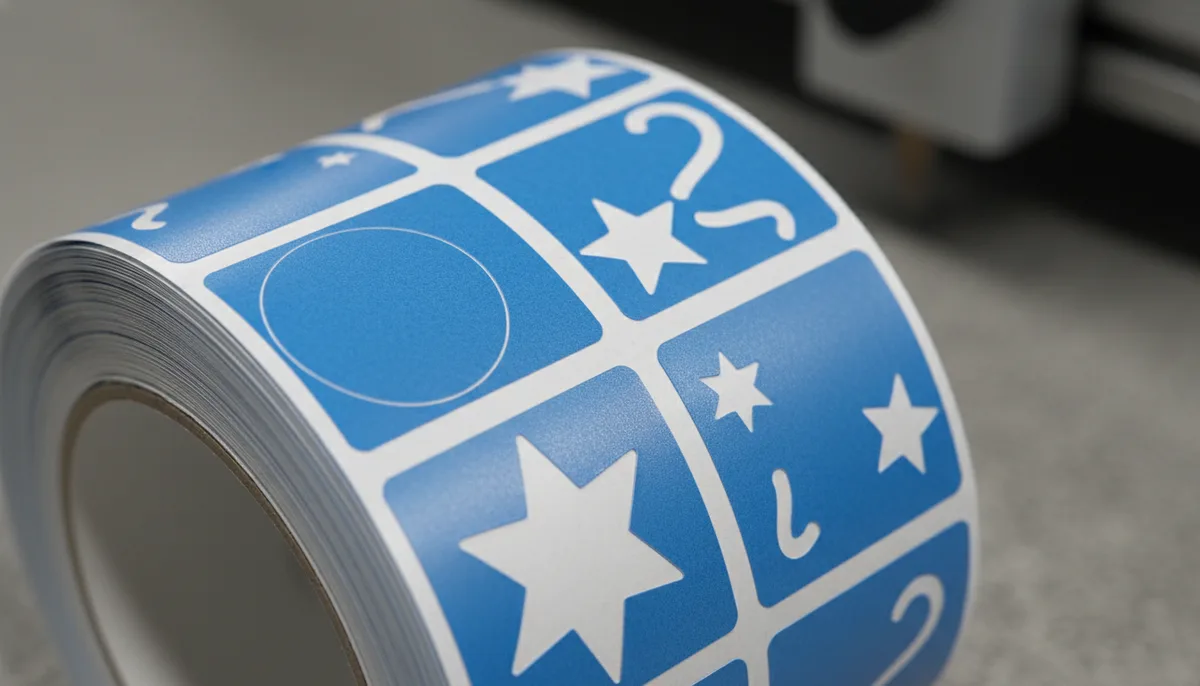
Rolls: The format for efficiency. Used with automated dispensers in manufacturing, logistics, or warehousing, they enable rapid, consistent application. Our Automatic Self-Adhesive Label Die-Cutting Machine produces rolls with precision registration (±0.5 mm), which is critical for automated lines. The waste matrix is removed inline and recycled.
Precision Die-Cut (Kiss-Cut): This is the standard for most custom shapes. The sticker is cut through but remains on its backing paper for easy "peel and apply." The alternative, "butt-cutting," (cutting through both sticker and backing) is only for very simple shapes and creates loose stickers that are hard to handle.
Case Study: Specifying Compliant Hard Hat Labels Custom
This is where specification becomes non-negotiable. Hard hat labels custom are safety-critical and must meet ANSI/ISEA Z89.1 standards for legibility and durability. A generic sticker is a compliance failure waiting to happen.
From our work with industrial safety clients, here are the mandatory specs most generic suppliers miss:
- Material: Minimum 3.5 mil thick vinyl. Paper or thinner films will peel or degrade.
- Adhesive: Permanent, aggressive acrylic adhesive rated for high-temperature (up to 150°F/65°C) and UV exposure. It must bond to curved, textured polycarbonate.
- Printing: High-contrast colors (often black on OSHA yellow or red) that remain legible after abrasion and chemical exposure. Inks must be fade-resistant.
- Finishing: A protective over-laminate is often required to meet ASTM D1000 peel adhesion tests after environmental aging.
The label must remain permanently attached and legible for the service life of the hard hat. This is a perfect example of why you must make custom stickers with the end-use environment dictating the specification, not the other way around. For more on integrating durable labeling into operations, our guide on supply chain labeling strategy offers related insights.
Vendor Selection: The 4 Criteria Beyond Unit Price
Choosing a supplier on unit price alone is the fastest path to the 30% reprint penalty. Evaluate these four capabilities, which we prioritize in our own custom print production solutions.
- Technical Consultation & Specification Review: Does the vendor ask detailed questions about environment, surface, and lifespan? Or do they just quote a price? A good partner will challenge underspecified or over-engineered requests.
- Color Management & Proofing: For brand consistency, ensure they use spectrophotometers and provide G7-calibrated hard proofs. Our Heidelberg press's Delta E < 2.0 color accuracy is a benchmark for brand work.
- Precision Die-Cutting Capability: Can they handle complex shapes reliably? Ask about their machine tolerance (ours is ±0.5 mm) and if they design dies in-house.
- Scalability & Lead Time Consistency: Can they handle a 50,000-unit reorder with the same color match and deliver in the same 10–15 day window? Check references for production scalability.
A vendor's ability to guide you to the right specification is often more valuable than a 5% lower unit cost. This is true whether you're producing inexpensive stickers custom for a promotion or mission-critical hard hat labels custom for a worksite.
Your Implementation Timeline for 2026
To execute a flawless sticker project this quarter, follow this timeline. The goal is to make custom stickers that perform without budget waste.
Decision: Offset vs. Digital for Your Custom Stickers
- If your run is under 3,000 units AND you don't need precise Pantone color matching → Choose Digital Printing. Faster setup, cost-effective for small batches.
- If your run is over 5,000 units AND/OR you require brand color accuracy (Delta E < 2.0) → Choose Offset Printing on a Heidelberg press. Lower per-unit cost and superior color consistency.
- If your run is between 3,000–5,000 units → Request quotes for both processes. The breakeven is fluid based on color count and material.
Weeks 1-2: Finalize design with bleed and correct color mode. Conduct a use-case analysis to lock in material and adhesive specs. Obtain and approve a hard proof from your vendor.
Weeks 3-5: Production. This includes plate/die creation, printing, cutting, and finishing. For a 20,000-unit run of vinyl labels, this is a standard lead time.
Week 6: Receive shipment. Conduct a quality audit on the first box: check color against proof, adhesion test, and die-cut accuracy. Apply a sample to the intended surface for a 48-hour bond test.
By treating custom stickers as engineered components, you transform a cost center into a reliable brand and operational asset. The process to make custom stickers is a blend of art and precise engineering — getting it right the first time is the only path to true value.
Frequently Asked Questions
When does offset printing become cheaper than digital for custom label stickers?
Offset printing on a Heidelberg press becomes cost-effective for runs over 5,000 units, with a typical breakeven point of 3,000–5,000 units. For orders under 3,000 units, digital printing avoids the $200–$500 plate-making setup charge, making it more economical for small batches.
What adhesive specification is required for personalized labels stickers used in cold storage?
For cold storage applications, specify a permanent, aggressive acrylic adhesive rated for temperatures as low as -20°F. This adhesive must be paired with a synthetic polypropylene face material, which costs $500–$700 per 10,000 units, to prevent brittleness and adhesive failure in freezing conditions.
What is the production timeline for a complex die-cut custom label stickers order of 20,000 units?
A complex die-cut order of 20,000 vinyl labels typically takes 10–15 business days from approved proof to shipment. This timeline includes plate/die creation ($200–$500), printing on a Heidelberg 6-Color Press, and precision kiss-cutting on an Automatic Self-Adhesive Label Die-Cutting Machine.
How does order volume affect the per-unit cost of inexpensive stickers custom?
Scale economies reduce unit costs by 25–35% when scaling from 5,000 to 50,000 units. For example, a promotional paper sticker can drop from approximately $0.03 to $0.02 per unit. The fixed cost of a custom steel rule die ($200–$500) is amortized over the larger run.