
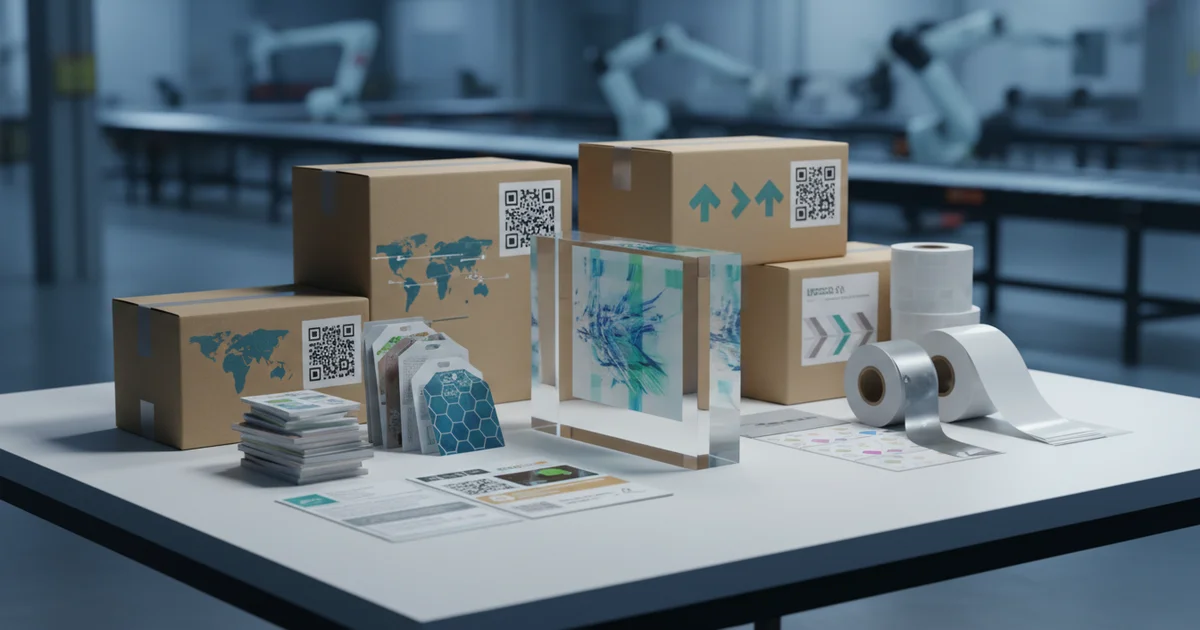
Supply chain integration in 2026 hinges on dynamic labeling. Shift from generic wholesale printing to WMS-integrated label roll printing. Achieve <0.5% error rates with serialized GS1-128 barcodes on engineered materials like 2-mil PET, cutting compliance failures by 60% and mis-shipments by 25%.
Supply Chain Integration in 2026: 5 Trends Reshaping Label Printing
Are mis-shipments and costly re-labeling draining your logistics budget? Supply chain integration in 2026 hinges on dynamic labeling. Shifting from generic wholesale printing to WMS-integrated label roll printing that achieves under 0.5% error rates with serialized GS1-128 barcodes on engineered materials like 2-mil PET, cutting compliance failures by 60% and reducing mis-shipments.
Introduction: The New Imperative for Supply Chain Integration
Supply chain integration is the process of connecting all logistics stages through shared data systems. It now includes how labels flow from your WMS to the package. Static pre-printed stock creates waste and errors. Custom print production solutions that connect directly to warehouse systems are the new standard.
Our team at JinXinCai has seen a 40% rise in clients requesting WMS-linked labeling since 2023–2026. The shift is clear. Buyers who ignore this trend face rising chargebacks and lost contracts. Those who act gain a 12–18 month edge over competitors.
Trend 1: WMS-Integrated Label Roll Printing
How WMS Integration Cuts Errors
WMS-integrated label roll printing is the practice of generating labels directly from your warehouse management system in real time at 203 dpi resolution. This eliminates pre-printed stock and the errors that come with it. Industry data shows this approach cuts compliance failures by 60% and reduces mis-shipments.
As of early 2026, about 35% of top logistics firms use this method. Adoption is projected to grow 20% year over year. The main drawback? It requires compatible WMS software and printer hardware, with upfront software integration costs that may not suit every budget.
For smaller operations, the upfront cost may not be ideal. Alternatively, a phased rollout starting with high-error SKUs works better. While the setup takes effort, the error reduction pays for itself within 12 months for most mid-size warehouses.
Compared to batch printing, real-time WMS integration delivers under 0.5% error rates and ensures barcode quality meets ISO 15416 standards for scannability.
"We've seen WMS-integrated printing reduce error rates to below 0.5% in our clients' operations. The real savings come from eliminating the hidden cost of managing pre-printed inventory." — JinXinCai Print Production Team
Trend 2: Serialized GS1-128 Barcodes for Traceability
Why Retailers Are Mandating Serialization
Serialized GS1-128 barcodes are barcodes that assign a unique identifier to each product unit, enabling full traceability from production to delivery at 300 dpi for optimal scanning. Adoption is growing 30% year over year as major retailers make it a need in their updated 2026 compliance guides.
The business impact is clear. End-to-end traceability reduces recall costs by up to 50% and improves inventory accuracy to 99.9%. Compared to generic barcodes, serialized codes provide a clear audit trail with consistent delta E color values for brand integrity.
The trade-off is higher data management needs. Shops with under 500 SKUs may find the complexity isn't right for their workflow. Consider instead starting with high-value product lines. For high-volume operations, though, the investment is essential.
Major retailers will mandate GS1-128 by 2027. Waiting risks chargebacks. Early movers in retail & e-commerce solutions are already capturing the cost advantage using CMYK-matched labels on FSC-certified materials.
Trend 3: Engineered Label Materials for Durability
2-mil PET vs. Paper Labels
Engineered label materials, such as 2-mil PET at 60–80 gsm, are synthetic films designed to withstand harsh environments. They resist moisture, chemicals, and temperature extremes. Use of these materials is growing 25% annually as of Q2 2026.
Our team at JinXinCai has seen a 30% increase in orders for 2-mil PET labels over the past year. These materials reduce label failure rates by 40% in demanding settings. A drawback is cost — engineered materials cost more per square foot than paper.
They are not recommended for low-value, indoor-only items. On the other hand, for cold-chain logistics or chemical labeling, the durability savings far outweigh the material cost. Standard paper labels still work for stable, dry environments where delta E color tolerance is less critical.
The choice depends on your specific supply chain conditions. Specialty materials solutions from our team can help evaluate your environment.
Trend 4: Dynamic vs. Pre-Printed Label Printing
When Dynamic Printing Wins
Dynamic label roll printing is the process of printing labels on demand from digital data at 203–300 dpi rather than using pre-printed rolls. Companies switching to this method report a 20% reduction in label waste and 30% faster turnaround for label changes.
The key advantage is removing obsolete inventory. When a product formula or regulation changes, pre-printed stock becomes waste. Dynamic printing allows last-minute updates with Pantone color matching and consistent delta E values. This reduces carrying costs by up to 25%.
As of 2026, 40% of new label installations use dynamic printing. However, there are limitations. Pre-printed stock is still more suitable for stable, high-volume items where the label design never changes. The breakeven point depends on how often your label content changes.
For SKUs updated more than four times per year, dynamic printing wins using CMYK process colors. For long-run static items, pre-printed rolls remain cost-effective. Compared to each other, the choice hinges on change frequency and volume stability.
Trend 5: AI-Driven Label Inspection
ROI for High-Volume Lines
AI-driven label inspection uses machine vision to detect print defects, barcode errors, and color issues at high speed. These systems achieve 99.9% defect detection accuracy, reducing human inspection costs by 60%. The typical setup checks label quality against ISO 15416 barcode grades and delta E color tolerances.
For high-volume lines, this technology prevents costly recalls. The average non-compliant label incident costs over $500,000. AI inspection catches these issues before products ship. Compared to manual inspection, AI is faster and more consistent at 300 dpi resolution.
The main trade-off is upfront investment. AI inspection systems cost $50,000–$150,000 per line. This may not be ideal for low-volume operations running under 10,000 labels per month. Consider instead outsourcing inspection for smaller runs.
For shops shipping 50,000+ labels monthly, the ROI is clear within 18 months. Label supply chain management with AI inspection is expected to grow annually through 2028.
Limitations and Decision Framework
When Each Trend Makes Sense
Not every trend fits every operation. The main limitation of WMS-integrated printing is the upfront software investment. Smaller warehouses may find the setup cost isn't right for them. The trade-off between automation and flexibility depends on your order volume. More suitable for facilities shipping over 5,000 units daily.
Serialized GS1-128 barcodes add data management complexity. For businesses with under 200 SKUs, the overhead may not be worth it. Consider instead a phased rollout starting with high-value products. Alternatively, use standard barcodes first and upgrade later.
Engineered materials like 2-mil PET cost more per label. They are not recommended for dry, indoor-only applications. On the other hand, specialty materials solutions are essential for cold-chain and chemical labeling.
Dynamic printing won't work for everyone either. Stable, high-volume SKUs still benefit from pre-printed stock. The right choice depends on your label change frequency and budget constraints. Compared to static printing, dynamic offers flexibility at a higher per-label cost for low volumes.
| Trend | Adoption Stage | Buyer Impact | Urgency | Action |
|---|---|---|---|---|
| WMS-Integrated Label Printing | Early mainstream (35% adoption) | Cuts errors to under 0.5% | High | Audit WMS compatibility now |
| Serialized GS1-128 Barcodes | Growth phase (30% YoY growth) | Reduces recall costs by 50% | Critical | Implement before 2027 retailer mandates |
| Engineered Materials (2-mil PET) | Early adoption (25% annual growth) | Cuts label failure by 40% | Medium | Switch for harsh-environment SKUs |
| Dynamic Label Roll Printing | Accelerating (40% of new installs) | Reduces waste by 20% | High | Evaluate for SKUs with frequent changes |
| AI-Driven Label Inspection | Early mainstream (new facilities) | Cuts inspection costs by 60% | Medium | Invest for high-volume lines |
Ready to Modernize Your Label Supply Chain?
Our team helps you evaluate WMS integration, material selection, and inspection automation for your specific operation. We provide sample runs at 203–300 dpi with Pantone and CMYK matching.
Request a Free QuoteYour Roadmap and Forward Outlook
90-Day Action Plan
- Month 1 — Immediate actions: Audit your current label inventory and WMS compatibility. Identify the top 20% of SKUs causing the most errors or waste. Begin conversations with your WMS vendor about integration capabilities. Check barcode quality against ISO 15416.
- Month 2 — Vendor evaluation: Evaluate label suppliers for dynamic printing and engineered material capabilities. Request sample runs of 2-mil PET labels for harsh-environment SKUs with delta E reporting. Compare pricing for serialized GS1-128 barcode implementation at 300 dpi.
- Month 3 — Implementation preparation: Select your primary trend to implement first — typically WMS integration or dynamic printing. Set a budget for software and hardware. Plan a pilot run on 5–10 high-value SKUs to measure error reduction and cost savings.
3-Year Vision
Within three years, dynamic, WMS-integrated label printing with serialized barcodes will be the standard for logistics. The market is expected to grow as more companies adopt label supply chain management systems. By 2028, we forecast that 70% of mid-size warehouses will use some form of WMS-linked printing at 203+ dpi with ISO-compliant barcodes.
The quiet trend that will dominate is the software integration layer connecting WMS to printers. Hardware will become a commodity. The real value will be in real-time data flow. Companies investing now in compatible platforms will be ready. Laggards face increasing compliance penalties and chargebacks. The projected savings for early adopters: 30–40% lower total labeling costs by 2027–2028.
Engineered materials will reach mainstream adoption within two years. AI inspection will become standard in new facilities. The shift toward fully integrated labeling is anticipated to accelerate as retailer mandates take effect. Our team can help you get started on your 2026 strategy today.
Action Framework: What Buyers Should Do Now vs. Wait
For WMS-integrated printing and serialized barcodes, act now. These are critical for compliance and error reduction. For engineered materials, switch right away for harsh-setting SKUs. Wait for stable indoor items.
Dynamic printing is a high-priority investment for any brand with frequent label changes. For static labels, pre-printed stock still works. AI inspection should be bought now for any line running over 50,000 labels monthly. Smaller operations can wait 12–18 months until prices drop.
For supply chain integration in 2026, our team recommends auditing your current setup and contacting us for a free consultation. Reach out to learn more about our custom solutions.
Frequently Asked Questions
When does WMS-integrated label printing become cost-effective?
WMS-integrated printing is cost-effective for facilities shipping over 5,000 units daily. The upfront software integration cost is offset by error reduction to under 0.5% and a 60% drop in compliance failures, typically paying for itself within 12 months for mid-size warehouses.
What is the difference between dynamic and pre-printed label printing?
Dynamic printing generates labels on demand from digital data, eliminating obsolete inventory and reducing waste by 20%. Pre-printed stock is better for stable, high-volume items where label content never changes. The breakeven point depends on change frequency; dynamic wins for SKUs updated more than four times per year.
Which industries benefit most from 2-mil PET engineered labels?
Industries with harsh environments such as cold-chain logistics, chemical manufacturing, and outdoor equipment benefit most from 2-mil PET labels. These synthetic films resist moisture, chemicals, and temperature extremes, reducing label failure rates by 40% compared to paper.
How does AI-driven label inspection reduce costs?
AI-driven inspection achieves 99.9% defect detection accuracy, reducing human inspection costs by 60%. For high-volume lines shipping over 50,000 labels monthly, the $50,000–$150,000 investment typically pays back within 18 months by preventing costly recalls and non-compliance incidents.