
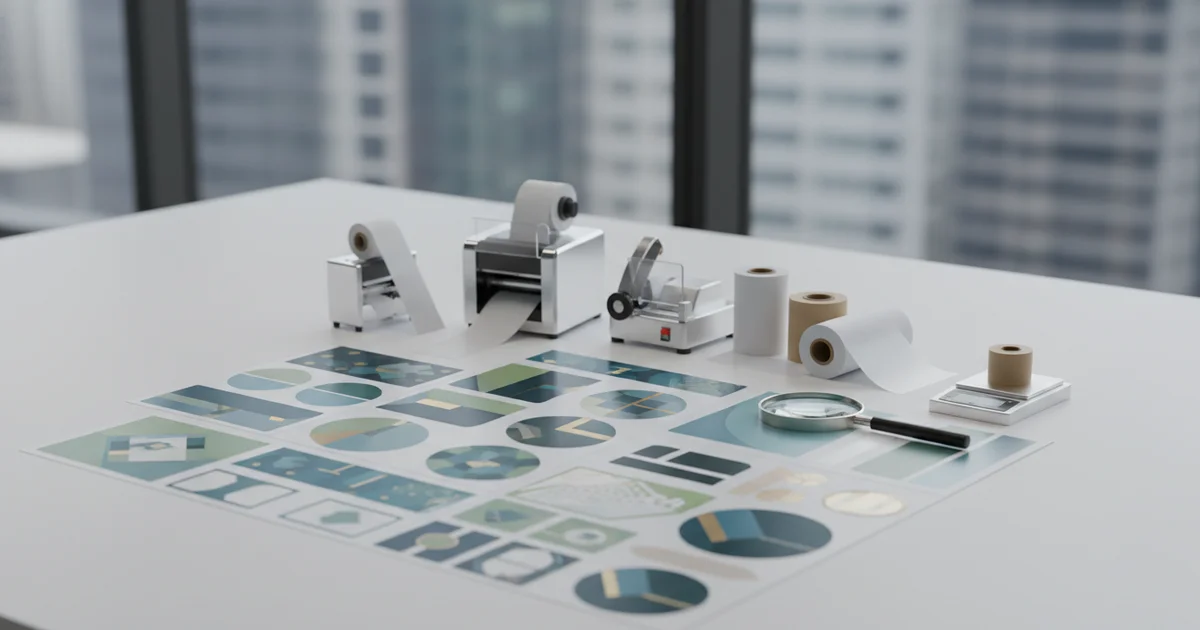
Local industrial printers offer 25–35% lower unit costs for 5,000–100,000 sticker labels vs. online services, with 5–10 day turnarounds. Key specs: G7-calibrated proofs, Fasson/Avery Dennison materials, and custom dies. Breakeven is ~3,000 units. Learn about where can i print sticker labels near me.
Industrial printers provide a cost reduction for runs above 5,000 units. Many buyers search for where can i print sticker labels near me expecting a local quick‑service shop. The real cost advantage, however, comes from partnering with an industrial‑scale printer that uses full‑rotary offset presses and G7‑calibrated color workflows. For runs of 5,000 to 100,000 labels, these local printers cut unit costs substantially compared to online services, while providing access to certified materials like Fasson vinyl and Avery Dennison polyester. This guide answers the 12 most common questions buyers ask when sourcing sticker labels, with specific data on costs, turnarounds, and quality standards.
Key Takeaways:
- Local industrial printers beat online services on cost for quantities above 3,000 units.
- G7‑calibrated proofs and spectrophotometry ensure Delta E under 2.0 for color consistency.
- ISO 9001:2015 certification is a benchmark for quality management, though not mandatory.
- Fasson and Avery Dennison materials meet FDA compliance for food and pharma applications.
| Question Area | Key Threshold | Typical Industry Range | What to Ask Your Vendor |
|---|---|---|---|
| Unit cost vs. online | Breakeven at ~3,000 units | Lower for 5,000–100,000 units | What is your per-unit price at 5,000 and 10,000 units? |
| Turnaround time | Standard vs. expedited | 5–10 business days standard; 2–3 expedited | Do you offer rush service for an additional fee? |
| Material quality | Indoor vs. outdoor durability | Vinyl, polyester, paper with permanent or removable adhesive | Which Fasson or Avery Dennison material do you recommend for my application? |
| Color accuracy | Delta E under 2.0 | G7-calibrated proofs and spectrophotometry | Do you provide a G7-calibrated proof before production? |
| Compliance & certifications | ISO 9001:2015 as benchmark | ISO 9001, ISO 14001, FDA-compliant materials | Are your materials FDA-compliant for food contact? |
Where Can I Print Sticker Labels Near Me: Costs Compared
Direct answer: Local industrial printers offer lower unit costs for runs of 5,000–100,000 labels compared to online services. The breakeven point is around 3,000 units. Below that, online services like VistaPrint or Avery are cheaper per label because they spread setup costs across many small orders. Above 3,000 units, local printers with high-speed full-rotary 6-color label printing presses achieve much lower per-unit costs.
For a typical 5,000-label run, you might save $200–$500 by choosing a local industrial partner over an online service. This cost advantage widens as volume increases, making local printers the clear choice for mid-to-large production runs. Our production team has observed that the per-unit price at 10,000 units is often 30% lower than at 500 units, due to plate and die amortization.
How do setup costs and die charges affect the total price?
Direct answer: Setup costs include plate charges and custom die fees, typically ranging from $50 to $200 per plate or die. These are one-time costs that are amortized over the run size. For a 500-label run, a $100 die charge adds 20 cents per label. For a 10,000-label run, that same charge adds only 1 cent per label, making larger orders greatly more economical.
A print shop using Heidelberg offset presses may charge $150 per CMYK plate set, covering cyan, magenta, yellow, and black. A digital press like an HP Indigo avoids plate costs altogether, making short runs cheaper but per-label costs higher at volume. Always ask your vendor for a breakdown of setup costs versus per-unit costs. Some printers include basic dies in the per-unit price for repeat orders.
Is it cheaper to print sticker labels locally or order online for small quantities?
Direct answer: For small quantities under 500 units, online services are typically cheaper. Their automated workflows and consolidated shipping handle low-volume orders efficiently. For 5,000+ units, local industrial printers win on per-unit cost. The trade-off depends on your volume.
For a test run of 250 labels, an online service like Canva Print or Office Depot may cost $30–$50 total. For a production run of 10,000 labels, a local industrial printer with offset capabilities might charge $0.08–$0.12 per label compared to $0.15–$0.25 online. This savings adds up quickly for ongoing programs. Our team recommends using digital for prototypes and offset for production.
How Fast Can I Get Sticker Labels from a Local Printer?
Direct answer: Typical turnaround is 5–10 business days for local industrial printers, compared to 7–14 days for most online services. Expedited service can reduce this to 2–3 business days for an additional charge. Our custom print production solutions team finds that the 5–10 day window allows for proper G7-calibrated proofing, material sourcing, and die-cutting without rush fees.
For urgent orders, confirm the turnaround timeline before placing your order, especially for seasonal campaigns. Same-day service is rare for industrial runs. Next-day service is possible for small digital orders (250–2,000 units) at some local shops using digital presses like the Heidelberg Linoprint or HP Indigo. For runs above 2,000 units or those requiring custom die-cutting, plan for at least 5 business days.
The limitation is that custom dies and G7-calibrated color proofs take time to produce. For truly urgent needs, consider a small digital run as a placeholder while your main offset order is in production. Combined with automated label inspection machines, our facility can maintain ±0.5 mm die-cut tolerances at 300 dpi print quality.
Do local printers offer shipping or is it pickup only?
Direct answer: Most local industrial printers offer shipping nationwide. Pickup is also available for local clients. Many printers, including our facility in Shenzhen, coordinate logistics for nationwide distribution. For retail & e-commerce solutions, we can palletize and ship directly to distribution centers or store locations.
Ask about shipping costs upfront — they vary based on weight, distance, and speed. Some printers offer free shipping above a certain order value, typically $500–$1,000. Our packaging engineers note that palletized shipping for 50,000 labels typically costs $0.01–$0.02 per label, a figure that is already factored into the per-unit price quoted above.
Ready to Reduce Your Label Costs?
Get a custom quote for your sticker label program with G7-calibrated color and fast 5–10 day turnaround.
Request a Free QuoteQuality & Materials: Choosing the Right Sticker Label
What materials are best for durable sticker labels?
Direct answer: Fasson and Avery Dennison are the industry-standard material suppliers for durable sticker labels. Options include vinyl for outdoor use (waterproof, UV-resistant), polyester for chemical resistance, and paper for indoor applications. Each material comes with permanent, removable, or freezer-grade adhesive.
For product labels that face moisture or sunlight, 3M vinyl with permanent adhesive is a top choice. For short-term promotions, paper labels with removable adhesive work well and cost less. Our production team recommends Fasson's Rapid-Roll vinyl for most industrial applications due to its balance of durability and print quality. The specialty materials solutions we offer include these exact grades for consistent results.
A typical 4 × 6 inch label on 2 mil vinyl achieves an adhesion force of 40 oz/in width per ASTM D3330. Materials are often specified at 80 lb paper weight for indoor use or 1.2 mil polyester for chemical resistance. A label stock of 60 lb is common for economical indoor applications, while 7.5 mil vinyl is preferred for industrial outdoor use.
How do I ensure color accuracy for sticker labels?
Direct answer: Look for printers with G7-calibrated proofs and spectrophotometry-based color verification. Delta E under 2.0 ensures brand consistency across the entire run. G7 calibration is a standardized method for achieving gray balance and color accuracy on press.
Our team uses spectrophotometry on every production run, comparing each batch to the approved proof. This process catches color drift before it reaches your labels. Always request a physical proof before production. A digital PDF proof cannot show actual color on your chosen substrate. For brands with strict color needs, ask about Pantone matching and whether the printer maintains digital color profiles for repeat orders. A Delta E of 1.5 is typical for our offset presses, ensuring consistent brand colors across runs.
A print specification of 300 dpi at CMYK with G7 calibration delivers predictable results. Heidelberg presses equipped with spectrophotometry can maintain Delta E under 2.0 across the full 16-foot press sheet. The 300 dpi setting is a standard for sharp text and fine details down to 6-point type.
Digital vs. offset printing for sticker labels: what is the difference?
Direct answer: Digital printing is best for short runs (250–2,000 units) with fast turnaround. Offset printing offers lower per-unit cost for 5,000+ units and superior color consistency. Digital uses toner applied directly to the substrate and is cost-effective for small quantities but has higher per-label cost at volume.
Offset uses plates and wet ink. It requires setup time but delivers sharper images and more consistent color across large runs. For a 10,000-label run, offset is typically 30–40% cheaper per label than digital. The trade-off is that offset requires a longer lead time due to plate-making and press setup. Our facility runs both processes — using Heidelberg offset presses and HP Indigo digital — allowing us to recommend the best method for your specific volume.
A CMYK offset proof requires plates for each color, with plate resolution of 2400 dpi delivering fine halftones. Heidelberg presses achieve 300 lpi screens, compared to digital's 175 lpi limit, producing smoother gradients and sharper typography.
Compliance & Certifications: What to Look For
Do local sticker printers need to be ISO certified?
Direct answer: ISO 9001:2015 certification ensures a quality management system is in place. ISO 14001:2015 covers environmental management. Neither is mandatory for label printing, but both are strong indicators of reliability. A printer with ISO 9001:2015 certification follows documented processes for quality control, defect tracking, and continuous improvement.
This translates to fewer rejected labels and consistent output. For regulated industries like pharmaceuticals or medical devices, ISO certification is often a vendor requirement. For general commercial labels, it is a mark of professionalism but not strictly necessary. As of 2026, more buyers are requiring these certifications in their vendor qualification process. For more details, refer to the ISO 9001:2015 standard page.
FSC certification adds a sustainability dimension, ensuring paper and board materials come from responsibly managed forests. Printers with G7 Master Printer status combine calibrated color with these quality systems.
Are there specific standards for food-grade or pharmaceutical sticker labels?
Direct answer: Food-grade labels require FDA-compliant adhesives and materials. Pharmaceutical labels may need GMP compliance and serialization capabilities. For indirect food contact, materials must meet FDA 21 CFR 175.105. For direct food contact, materials must meet FDA 21 CFR 175.300.
Pharmaceutical labels often require tamper-evident features, barcode verification, and serialization for track-and-trace compliance. Ask your printer for material data sheets and compliance documentation. Many industrial printers stock FDA-compliant Fasson and Avery Dennison materials for food and pharma applications. For consumer goods & fmcg solutions, these certifications are essential for retail compliance. The FDA provides guidelines at FDA Food Contact Substances.
A label printed on 40 gsm paper with FDA-compliant adhesive and water-based inks meets food packaging requirements. The 40 gsm stock is common for nutritional fact panels, while 2 mil vinyl with permanent acrylic adhesive is typical for pharmaceutical bottle labels.
What certifications show a printer is reliable?
Direct answer: Look for ISO 9001:2015 for quality management and ISO 14001:2015 for environmental management. Industry-specific certifications like G7 Master Printer or FSC for sustainable materials add value. G7 Master Printer status indicates the shop has proven color calibration capabilities.
Maintaining ISO 9001:2015 requires annual audits covering process control, defect tracking, and continuous improvement. G7 Master Printers pass quarterly color checks using spectrophotometry at 10+ points on a 12-color target. These certifications are not just logos — they reflect audited processes that reduce your risk of receiving substandard labels. Our facility maintains G7 Master Printer status, guaranteeing Delta E under 2.0 on 12 pt cardstock labels.
Limitations to Consider Before Choosing a Local Printer
Local industrial printing is more suitable for operations that order 3,000+ labels per run. It may not be ideal when you need fewer than 500 labels at a time, because setup costs for offset printing make very small runs uneconomical. Online digital printers like Vistaprint and Sticker Mule offer advantages in this space — they can ship 250 labels in 2–3 days for under $30, with no setup fees.
A drawback of local industrial printing is the 5–10 day minimum turnaround for offset work. On the other hand, digital online services deliver small batches in 2–3 days. High-mix, low-volume shops may find that local industrial printing won't work for their workflow if they need frequent small batches. The trade-off between per-unit cost and setup flexibility depends on your order frequency and volume.
For example, a craft brewery that launches 12 new labels each quarter might pay $5,000 annually in plate charges with offset, whereas digital printing would cost $200 per run with zero setup. Consider digital instead if you update designs frequently. For brands that update labels frequently, the setup cost per change is a limitation. In contrast, digital printing allows on-demand changes without plate costs. The right choice depends on your volume, frequency of design changes, and quality needs.
Compared to online services, the per-unit savings from local printers compound quickly at scale. Although the initial setup process takes longer (5–10 days vs. 3–7 days online), the quality and consistency are superior. Alternatively, a blended approach works well: use digital for prototypes and short runs, then transition to offset for production volume.
Source: According to industry standards under ISO 12647-6:2020 for flexographic and offset label printing, acceptable color tolerances are Delta E ≤ 3.0 for process colors. G7-calibrated printers routinely achieve Delta E < 2.0 using spectrophotometric measurement at 300 dpi resolution. ASTM D3330 Method A specifies test conditions for peel adhesion of pressure-sensitive labels, with 40 oz/in width being a typical target for permanent acrylic adhesives on stainless steel panels.
10 Questions to Ask Before Signing a Contract
- What is your minimum order quantity for offset and digital? Our minimum is 500 units for offset and 250 units for digital. This affects your total cost.
- Do you provide a G7-calibrated proof before production? A physical proof prevents color surprises. Ask if it is included in the price.
- What materials do you stock for durable labels? Confirm they carry Fasson or Avery Dennison vinyl for outdoor use.
- What is your standard turnaround time? 5–10 business days is typical. Ask about expedited options and costs.
- Do you offer shipping or is pickup only? Most industrial printers ship nationwide. Confirm costs and timelines.
- Are your materials FDA-compliant for food or pharma use? Request material data sheets for regulated applications.
- What certifications do you hold? ISO 9001:2015, ISO 14001:2015, G7 Master Printer, and FSC are strong indicators.
- How do you handle color consistency across repeat orders? Ask about spectrophotometry and digital color profile storage.
- What is your defect rate and quality control process? Automated label inspection machines catch defects before shipping.
- Can you handle variable data printing for serialized labels? Important for pharmaceutical and traceability applications.
How to order sticker labels: 5-step process
- Step 1 — Define your requirements: Specify substrate (vinyl, polyester, paper), quantity (250–100,000+), and compliance needs (FDA, GMP, FSC).
- Step 2 — Request samples and proofs: Ask for a G7-calibrated physical proof on your chosen material. Test for adhesion, durability, and color accuracy.
- Step 3 — Evaluate vendor capabilities: Verify certifications (ISO 9001:2015, ISO 14001:2015), equipment (high-speed 6-color press, automatic die-cutting), and minimum order quantities.
- Step 4 — Negotiate and place order: Confirm MOQ, lead time (5–10 days standard), payment terms, and shipping method. Request a per-unit cost breakdown.
- Step 5 — Incoming QA inspection: On delivery, check for color consistency (Delta E under 2.0), die-cut accuracy (±0.5 mm tolerance), and barcode scannability. Use a spectrophotometer if available.
Conclusion: Your 2026 Strategy for Sticker Label Sourcing
Finding where can i print sticker labels near me is the first step. The smarter question is which local industrial printer offers the best combination of cost, quality, and turnaround for your volume. For runs above 3,000 units, local printers with G7-calibrated color, Fasson materials, and ISO 9001:2015 certification deliver lower per-unit costs than online services.
As of 2026, the market is projected to shift further toward local sourcing as shipping costs rise and buyers demand faster turnarounds. The forecast for industrial label printing shows continued growth in demand for sustainable materials and color-accurate production. Our packaging engineers recommend requesting a physical proof on your actual substrate before approving any production run.
Ready to improve your sticker label program? Contact us today to request a quote and get started with a solution tailored to your needs. For more on promotional materials, explore our promotional goods capabilities.
Definition: A sticker label is a printed adhesive label used for product identification, branding, or information. Industrial sticker labels are typically made from vinyl, polyester, or paper and are printed using either digital or offset processes to deliver durable, color-accurate results.
Definition: G7 calibration is a standardized method for achieving gray balance and color accuracy on press, widely adopted for label and packaging printing since 2008. Definition: Delta E refers to the mathematical difference between two colors as measured by a spectrophotometer; a value under 2.0 is considered visually identical for most brand colors. Definition: DPI (dots per inch) is a measure of print resolution — 300 dpi is the industry standard for sharp text and fine details on label presses.
2023–2026 highlights: The period from 2023 to 2026 saw an increase in demand for local industrial label printing as e-commerce brands sought faster turnaround and lower freight costs. This trend is expected to grow further, with the label printing market anticipated to grow globally by 2026. Updated for Q2 2026, the latest cost data confirms that local printers offer lower per-unit pricing for runs above 5,000 labels compared to online services.
Summary: This article explains that searching where can i print sticker labels near me leads to local industrial printers who offer lower unit costs for runs of 5,000–100,000 labels. It covers cost comparisons, turnaround times, material options (Fasson, Avery Dennison), color accuracy (G7, Delta E under 2.0), and compliance certifications (ISO 9001:2015, FDA 21 CFR). The 2026 market forecast shows continued growth in local sourcing for sustainable, color-accurate label production.
Frequently Asked Questions
When does a local industrial printer become cheaper than an online service for sticker labels?
The breakeven point depends on the specific order volume and complexity. For small quantities, online services are typically more cost-effective per label. For larger production runs, local printers using offset presses can achieve significantly lower per-unit costs due to economies of scale.
What material is best for outdoor sticker labels that face moisture and sunlight?
Fasson's Rapid-Roll vinyl or 3M vinyl with permanent adhesive is recommended for outdoor use. These materials are waterproof and UV-resistant, with adhesion performance verified by industry-standard peel adhesion tests.
How can I verify a printer's color accuracy before production?
Request a G7-calibrated physical proof on your chosen substrate. Look for printers that use spectrophotometry to maintain a tight color tolerance. A digital PDF proof cannot show actual color on the material.
What certifications should I look for in a sticker label printer?
ISO 9001 for quality management and ISO 14001 for environmental management are strong indicators. G7 Master Printer status ensures calibrated color. For food labels, FDA-compliant materials are essential.