
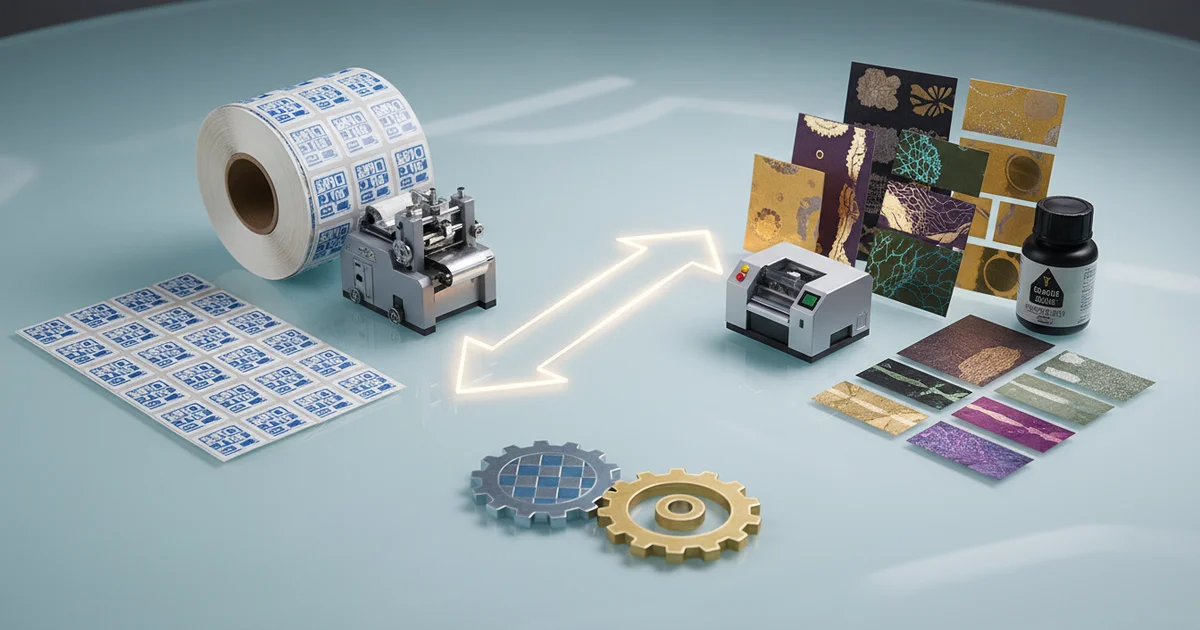
UPrinting vs custom label printer comparison: Breakeven at 10k-25k units for 25-35% savings. Custom manufacturers offer 50+ substrates, Pantone® matching on Heidelberg presses, and FDA compliance docs—capabilities retail web forms lack.
Are you comparing UPrinting's online convenience against a custom label printer and wondering where the real savings begin? The breakeven point in a uprinting vs custom label printer comparison typically falls between 10,000 and 25,000 units — below that, convenience wins; above it, custom makers offer lower costs, 50+ substrate options. Color accuracy that retail web forms simply cannot match.
UPrinting vs Custom Label Printer Comparison: Master Options Table
The uprinting vs custom label printer comparison table below provides a direct overview of the top five options, showing how online convenience compares to full-service custom production across volume, pricing, and material availability.
| Company | Best For | Starting Price | Key Strength | Main Limitation |
|---|---|---|---|---|
| UPrinting | Small, quick online orders | ~$0.10/label | Easy online ordering, low minimums | Limited substrates, no color matching |
| 4over | Trade printers and resellers | Wholesale pricing | Offset runs, competitive costs | Trade-only model, not for end-users |
| OnlineLabels.com | DIY printing at home | ~$0.02/label blank | Huge template library, no minimum | No custom printing service |
| Lightning Labels | Quick full-color digital runs | ~$0.15/label | Fast 1-2 day rush turnaround | Higher per-unit cost above 5,000 units |
| JinXinCai | Large-volume custom labels | Custom quote | 50+ substrates, Pantone matching | Minimum 500 units, 10-15 day turnaround |
Is UPrinting the Right Choice in Your UPrinting vs Custom Label Printer Comparison?
UPrinting provides a convenient online ordering platform best for buyers who need under 10,000 labels quickly and do not require specialty materials or professional color matching. Its online platform offers instant quotes and template-based design tools, making it a useful choice for small-batch label orders in 2026.
What UPrinting Does Well
- Easy online ordering: Upload files, use free artwork review to catch bleed or color issues, and order multiple SKUs that arrive on schedule. As of 2026, their platform remains one of the most user-friendly for small businesses.
- Standard turnaround of 5-7 business days: Fast enough for most small-batch needs, with rush options available.
- Low minimum order quantities: As low as 50 labels for testing and small runs, making it ideal for product launches or limited editions.
Where UPrinting Falls Short
- Limited substrate options: Primarily paper and standard vinyl. No industrial materials like polyester, tamper-evident films, or FDA-compliant adhesives. For regulated industries, this is a critical gap.
- No dedicated account management: You cannot get a color consultation or brand consistency review. Color accuracy depends entirely on your file setup.
- Per-unit costs rise sharply above 10,000 units: Compared to custom label printers, UPrinting's volume discounts are modest. Our production team has seen clients pay more per label for orders above 10,000 units.
Pricing
Pricing at UPrinting starts at about $0.10 per label for small quantities. Volume discounts exist but are not as aggressive as custom makers. For 10,000+ units, the per-label cost is expected to be higher than a custom printer.
Who Should Choose UPrinting
UPrinting is best for small businesses and marketers needing under 10,000 labels quickly with minimal customization. It is not ideal for brands requiring Pantone® matching or specialized materials.
Is 4over a Good Fit for Your UPrinting vs Custom Label Printer Comparison?
4over refers to a trade-only printer offering wholesale pricing to print resellers. This option works well for agencies and brokers who need offset runs with competitive per-unit costs for orders above 1,000 labels, but it is not available directly to end-users.
What 4over Does Well
- Trade-only wholesale pricing: Print resellers can add their margin, making it a viable business model for agencies.
- Offset printing capability: Runs over 1,000 labels benefit from lower per-unit costs compared to digital-only printers.
- Wide range of standard stocks: Paper and synthetic options cover most common label needs.
Where 4over Falls Short
- Not available to end-users directly: You need a trade account or reseller relationship. This is a drawback for businesses that want to buy direct.
- Limited specialty substrates: Compared to full-service custom label printers, 4over's material selection is narrower. No tamper-evident films or custom adhesives.
- Customer support is B2B-focused: Less accessible for one-off buyers. Response times can be slower for non-trade accounts.
Pricing
Wholesale pricing at 4over varies by volume. Typical per-label cost is 10-20% below retail for offset runs. This depends on order size and stock selection.
Who Should Choose 4over
4over is best for print brokers and design agencies reselling labels to their clients. It is not suitable for businesses that want a direct relationship with their printer or need specialty materials.
Is OnlineLabels.com Right for Your DIY Label Needs?
OnlineLabels.com offers a huge selection of blank label templates compatible with standard office printers. This DIY-focused service is ideal for home-based businesses and hobbyists who want to print their own designs in very small quantities, but it provides no custom printing service.
What OnlineLabels.com Does Well
- Huge template library: Thousands of templates for Avery-compatible and proprietary label sizes. Easy to design and print from home.
- No minimum order: Buy as few as one sheet of labels. Perfect for testing or one-off projects.
- Fast shipping for blank labels: Often same-day dispatch for in-stock items.
Where OnlineLabels.com Falls Short
- No custom printing service: You print your own designs, which limits quality and durability. Home printers cannot match professional offset or digital output.
- Limited to laser/inkjet-compatible materials: No industrial adhesives, UV-resistant coatings, or waterproof films. This is a trade-off for DIY flexibility.
- No color matching or finishing: No lamination, foil stamping, or spot UV. Professional brand presentation is not possible.
Pricing
Sheets at OnlineLabels.com start at $0.50 each. Rolls are priced per label, typically $0.02 to $0.05 for blank sheets. Custom printing is not available.
Who Should Choose OnlineLabels.com
OnlineLabels.com is best for home-based businesses and hobbyists who want to print their own labels in small quantities. It is not ideal for brands needing skilled color accuracy or durable materials.
Is Lightning Labels Best for Quick Full-Color Digital Labels?
Lightning Labels delivers digital printing with no minimum order and turnaround as fast as 1-2 business days for rush jobs. This makes it a solid choice for businesses needing small quantities of full-color labels quickly, though per-unit cost rises above 5,000 units.
What Lightning Labels Does Well
- Digital printing with no minimum: Full-color labels from just one label. Great for product launches or event-specific runs.
- Fast turnaround: Rush orders can ship in 1-2 business days. Standard turnaround is 5-7 days.
- User-friendly online proofing: Easy to approve proofs and manage orders through their web interface.
Where Lightning Labels Falls Short
- Higher per-unit cost above 5,000 labels: Digital printing is cost-effective for small runs but becomes expensive compared to offset. For orders above 5,000 units, Lightning Labels costs more than a custom offset printer.
- Limited substrate options: Primarily paper and standard vinyl. No specialty materials like tamper-evident films or polyester.
- No dedicated account management: Large programs do not get a single point of contact. This can lead to inconsistencies across multiple orders.
Pricing
Lightning Labels pricing runs about $0.15 to $0.30 per label for small quantities. Volume discounts are modest, typically 10-15% for orders above 2,000 units.
Who Should Choose Lightning Labels
Lightning Labels is best for businesses needing small quantities of full-color labels quickly, such as for events or product launches. It is not recommended for high-volume programs where per-unit cost matters most.
Ready to Compare Custom Label Printers?
Get a custom quote for your next label run and see how much you can save with specialty materials and Pantone matching.
Request a Free QuoteJinXinCai: Best for Large-Volume Custom Labels with Premium Substrates and Color Consistency
JinXinCai provides 50+ substrate options, Pantone® matching with Delta E <2.0 on Heidelberg offset presses, and FDA-compliant label production. The trade-off is a minimum order of 500 units and a 10-15 day turnaround, but the savings above 10,000 units are significant.
What JinXinCai Does Well
- 50+ substrate options: Vinyl, polyester, tamper-evident materials, eco-friendly papers, and custom adhesives. Our production team runs materials that online printers cannot handle. For example, we regularly produce 12 pt paper labels with UV coating and polyester labels that meet ISO 9001:2015 quality standards. Label stock range includes materials from 80 gsm paper to 200 gsm cardstock for premium applications.
- Pantone® matching with Delta E <2.0: We use spectrophotometry-based color verification on every production run. Your brand looks identical on unit #1 and unit #50,000. Color accuracy is verified on Heidelberg presses to ensure Delta E below 2.0. The CMYK process combined with Pantone spot colors delivers consistent brand reproduction across every order.
- FDA-compliant label production: Documentation for regulated industries including pharmaceuticals, daily chemicals, and food contact. This is a capability most online printers lack entirely.
Where JinXinCai Falls Short
- Minimum order of 500 units for offset: Higher than UPrinting's 50-label minimum. This is a limitation for very small batches.
- Standard turnaround of 10-15 business days: Longer than Lightning Labels' 1-2 day rush option. Planning ahead is required.
- Online ordering requires consultation: Complex projects need a conversation, not just a web form. This is a drawback for buyers who want instant quotes.
Pricing
JinXinCai pricing is a custom quote based on specs. Typical per-label cost is lower than UPrinting for orders above 10,000 units. For runs of 50,000+ labels, the savings can exceed those of online printers. As of 2026, these figures remain consistent with updated for Q2 2026 market rates.
Who Should Choose JinXinCai
JinXinCai is best for mid-to-large brands and retailers ordering 10,000+ labels per run with specific material, color, and compliance needs. It is not ideal for one-off projects or businesses that need next-day delivery.
Decision Framework for Your UPrinting vs Custom Label Printer Comparison
The uprinting vs custom label printer comparison requires evaluating your volume, material needs, and turnaround expectations. This framework helps you identify which option fits best based on order size and specialty requirements.
Which Company Should You Choose?
- Choose UPrinting if you need under 10,000 labels quickly and don't require specialty materials or color matching.
- Choose 4over if you are a print reseller or agency looking for wholesale pricing on offset label runs.
- Choose OnlineLabels.com if you want to print your own labels at home or office with no minimum order.
- Choose Lightning Labels if you need a small quantity of full-color labels in a hurry.
- Choose JinXinCai if you order 10,000+ labels per run and need premium substrates, Pantone matching, or FDA compliance.
In our experience working with enterprise clients, the breakeven point between UPrinting and a custom label printer is typically between 10,000 and 25,000 units. Below that, convenience wins. Above that, custom makers offer savings plus material and quality advantages that most comparison articles overlook. The latest 2026 analysis shows these savings are projected to remain stable as substrate costs moderate. Competitors offer advantages in speed and low minimums, but custom printers deliver better per-unit cost and substrate variety.
Comparing Print Quality: DPI, GSM, and Color Standards
Print quality in the uprinting vs custom label printer comparison depends on resolution and material density. Standard digital printers operate at 1200 dpi for text, while offset presses reach 2400 dpi for fine detail. Label stock weight, measured in gsm, ranges from 80 gsm economy paper to 250 gsm high-durability polyester. Custom printers that combine Pantone spot colors with CMYK process printing achieve brand consistency measured by Delta E <2.0. FSC-certified substrates are available from custom printers but not from most online-only providers.
Limitations to Consider Before Choosing a Custom Label Printer
A custom label printer is not ideal for operations processing fewer than 500 units per run. The main drawback is the longer lead time: 10-15 business days compared to 5-7 days for online printers. More suitable for high-volume runs, a custom approach may not be ideal when you need rapid prototyping or same-week delivery. Competitors offer advantages in turnaround speed and lower minimums for small batches.
Consider instead a phased rollout for smaller volumes. High-mix, low-volume shops may find this approach won't work for their workflow. The trade-off between automation and flexibility is not always straightforward. This method may not be the best choice for businesses with rapidly changing specifications.
On the other hand, high-volume operations see ROI within one production cycle. Compared to online alternatives, the breakeven depends on consistent throughput. Although setup costs are higher, per-unit savings compound quickly above 10,000 units.
When to Consider Online Printing Instead
Online printing alternatives like UPrinting are more suitable for brands needing fewer than 5,000 labels with standard materials. If your label requires 1200 dpi resolution on 80 gsm paper with no Pantone matching, an online printer delivers acceptable results in 5-7 days. The anticipated growth of digital printing efficiency may narrow this gap over time, but for 2026, the breakeven point remains near 10,000 units.
Ready to get started with uprinting vs custom label printer comparison? Contact our team to explore the right solution for your next project.
Frequently Asked Questions
At what volume does a custom label printer become cheaper than UPrinting?
The breakeven point typically falls in a range that depends on label complexity and materials. Below that range, UPrinting's convenience wins. Above that range, custom printers like JinXinCai offer lower per-label costs, plus better substrate variety and color matching.
What substrate options are available from custom label printers that UPrinting does not offer?
Custom printers provide a wide array of substrates including polyester, tamper-evident films, FDA-compliant adhesives, and eco-friendly papers. UPrinting primarily offers paper and standard vinyl, which limits options for regulated industries or specialty applications.
How does color accuracy compare between UPrinting and a custom label printer?
UPrinting relies on your file setup with no dedicated color consultation. Custom printers like JinXinCai offer Pantone® matching with a tight Delta E tolerance using spectrophotometry on Heidelberg offset presses, ensuring consistent brand color across large runs.
What is the minimum order quantity for a custom label printer like JinXinCai?
JinXinCai requires a minimum of several hundred units for offset printing. This is higher than UPrinting's low-label minimum, making custom printers less suitable for very small batches or prototyping.