Tape and label graphics reprints start with vague specs. Lock anilox volume, a physical label sticker mockup, and a 5-stage audit to stop color drift.
Nearly 1 in 3 label reprints starts with a screen proof that looked perfect and a press run that did not — a costly waste of stock and press time. Tape and label graphics are a specifiable production input. Four gates decide whether your program ships on time: substrate, print process, application method, and proofing standard. See our full range of printing capabilities for more details.
Tape and Label Graphics: What Procurement Teams Must Specify Up Front
Tape and label graphics are printed pressure-sensitive labels, tapes, and related graphics made on a converting press. A clear brief covers four gates: substrate, print process, application method, and proofing standard.
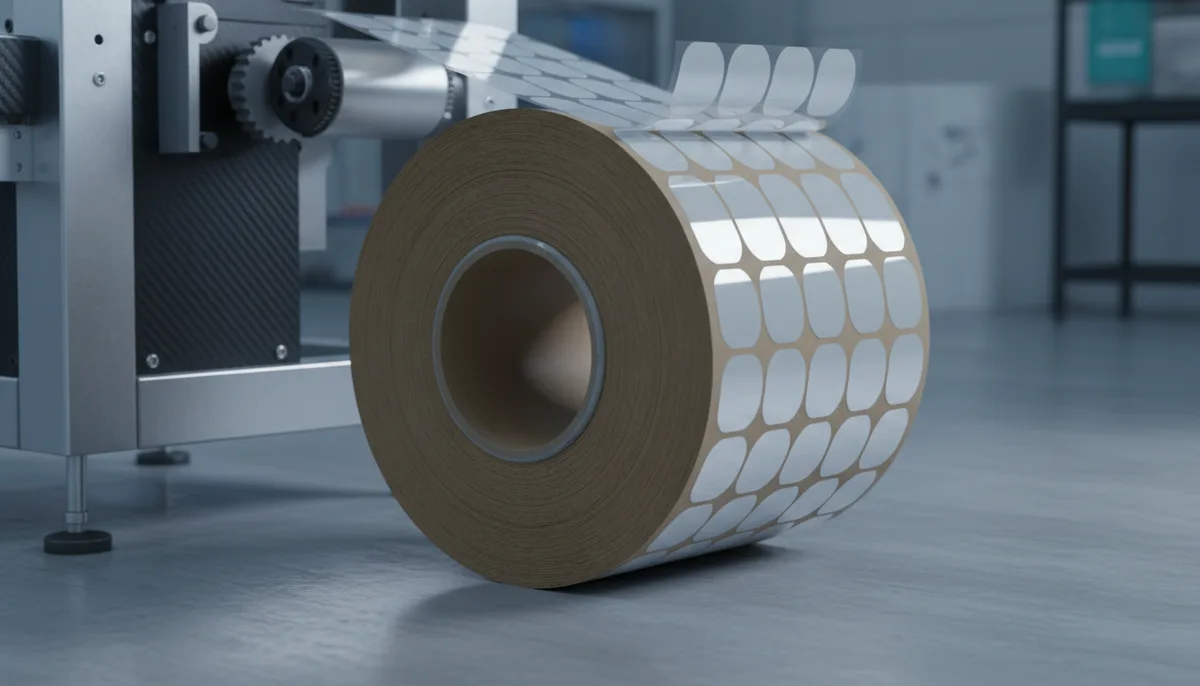
Our custom print production team runs rotary label presses for continuous roll-to-roll work. Those presses handle self-adhesive stock on multiple substrates with tight registration.
Vague briefs are the top cause of rework we see. A buyer who writes "red label, glossy" gets a different red on every run. A buyer who names a Pantone reference and an approved drawdown gets the same red.
Specifying well means writing down what the job must achieve, not just how it should look. Note the application surface, the expected service life, and any compliance needs such as FDA food-contact rules for indirect additives. Those details drive substrate and adhesive choice before a single plate is cut.
How Does Anilox Roll Volume Impact Print Color Consistency?
Anilox roll volume is the ink a flexographic press delivers per unit area, measured in cm³/m². A higher cell volume lays down more ink and prints darker. A mismatch between the specified and actual roll volume is a leading cause of brand-color drift across runs.
This is the anilox roll volume impact on print color in plain terms. The roll is the ink meter, and the meter must match the job. Our production team verifies each job against an approved drawdown before the run starts.
Flexographic printing depends on that transfer. Compared to digital, flexo holds color better on long runs but needs the roll set right first. A worn or wrong roll shows up as a muddy or weak brand color.

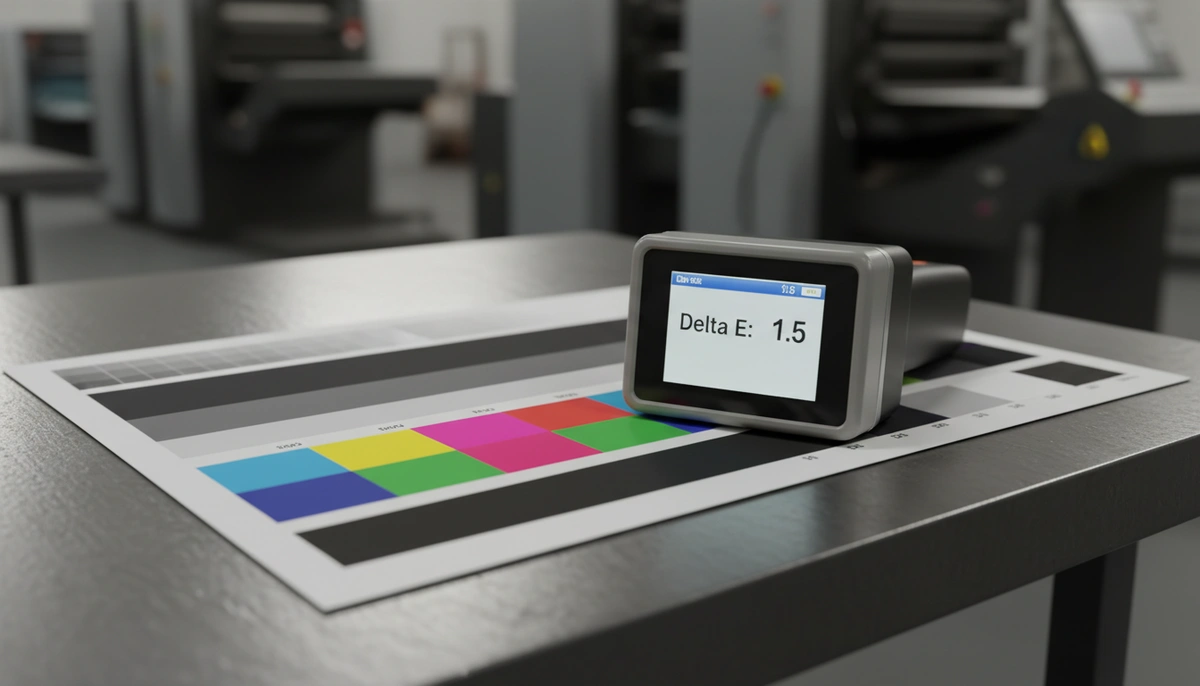
Color control is measurable, not just visual. A press proof checked with a spectrophotometer against a Delta E tolerance catches drift before it reaches the roll. Our packaging engineers pair that check with a documented anilox volume for each ink station, so a reprint starts from the same known baseline rather than a guess. As of 2026, that Delta E check remains the most reliable early-warning signal on a rotary run.
Label Sticker Mockup and Trade Show Graphics: Proofing Before You Print
A label sticker mockup is a physical proof printed on the actual production substrate. It shows true color, true finish, and true die geometry, which a screen PDF cannot.
Every die has three parts: a bleed line, a cut line, and a clear space. If artwork ignores any of the three, the die-cut finishing step trims into your design.
Trade show graphics fail for a related reason. Fine lines and small type proofed only on screen look sharp, then blur at booth viewing distance. Our team proofs these at full size on the final stock.
- Bleed: extend art past the cut line so trim drift never shows white
- Cut line: keep all type and logos inside the clear space
- Substrate match: proof on the exact facestock, not a stand-in
A practical mockup pairs a named Pantone reference with a CMYK build, so the proof shows both spot color and process detail. Buyers sourcing bottle work should also read our guide to durable labels for shampoo bottles before locking a finish.
Print and Apply Label Applicators vs. Manual Labeling: What Changes at Volume?
Print and apply label applicators combine a printer and an applicator in one unit. They print and place each label in a single pass. Cuts the hand-placement errors that build at volume.
Manual labeling puts a person in the loop for every unit. Small angle and position errors add up fast, and label error reduction becomes a daily fight.
If you are asking "show me companies that offer print and apply label applicators," qualify on integration, not just hardware. The applicator must talk to your line controls and your label data.
On the other hand, manual labeling still suits low volume and odd shapes. Compared to automation, it needs far less setup and no line integration.
An automated line holds placement within a stated tolerance, often ±1 mm on a flat panel, and keeps that repeatable across a shift. A manual station cannot promise the same consistency at speed. That gap is why high-volume programs treat the applicator and its data feed as one system, not two purchases.
Need expert guidance on your next print project?
Get a Free Quote →Label Error Reduction: Building a Print Manufacturing Audit Checklist
A print manufacturing audit checklist is a five-stage inspection tool that turns label error reduction into a repeatable process. It should be a contract annex, not an internal nicety.
How to build the five-stage audit: summary
- Stage 1: Check incoming artwork for bleed, cut line, and clear space.
- Stage 2: Verify anilox volume and ink against the approved drawdown.
- Stage 3: Confirm six-color registration at press start.
- Stage 4: Inspect die-cut edges and matrix strip on the first roll.
- Stage 5: Log label error reduction results per run.
Print quality assurance lives in stages two and three. That is where color consistency is won or lost on a rotary press.
In-House vs. Outsourced Tape and Label Graphics: A Comparative View
In-house printing is more suitable for fast iteration and tight control on small batches. Outsourcing is more suitable for volume, six-color complexity, and die-cut finishing that needs a rotary press.
Compared to an in-house digital unit, a 6-color rotary press delivers consistent registration on long runs. That matters most when your brand color must match across thousands of pressure-sensitive labels.
In practice, on the other hand, in-house wins when you change art weekly. Although outsourcing cuts per-unit cost at volume, it adds a lead time you must plan around. The right call depends on order volume and how often your artwork changes.
For a full cost picture, see our print-on-demand cost analysis.
| Method | Main Error Source | Best Volume Fit | Color Control | Proofing Need |
|---|---|---|---|---|
| Manual labeling | Hand placement angle and drift | Low volume, odd shapes | Pre-printed only | Physical mockup |
| Print and apply applicators | Data and line integration | High volume, repeat SKUs | Printer-managed | Data and placement test |
| Outsourced rotary | Anilox and ink mismatch | Long runs, multi-color | Approved drawdown | Full substrate proof |
When Tape and Label Graphics Are Not Ideal — and What to Consider Instead
Notably, tape and label graphics on a flexo press are not ideal for very short runs. The main drawback of a flexo setup is the make-ready time before the first good label. Consider instead digital label printing for prototypes and tiny batches.
From a practical standpoint, trade show graphics may not be the best fit for a rotary label press at all. Large-format vendors are often more suitable for oversized booth panels. That trade-off is honest, and we route that work so.
One-off test labels also won't work for a full rotary run on cost. Although the print quality is excellent, the setup does not pay back below a modest quantity. The limitation is volume, not capability.
Competitors offer advantages in specialty finishes such as foil or emboss that sit outside a standard flexo run. Where a project needs those effects, a dedicated finishing house may be the better partner. We say so plainly rather than force a job onto the wrong press.
Get Started with Tape and Label Graphics: A Vendor Qualification Path
Along the same lines, tape and label graphics reward buyers who qualify the vendor's process, not just its price list. Five questions separate a reliable partner from a risky one.
- How do you control anilox volume and color consistency run to run?
- What proofing standard do you agree before the first run?
- Can you integrate print and apply label applicators with our line?
- Will you sign our print manufacturing audit checklist as an annex?
- What die-cut finishing and substrate options do you run in house?
Our team answers all five in writing before a job starts. We also print to the Pantone Matching System for brand color.
Ready to move? Contact us to request a quote and get started with tape and label graphics built to a written spec.
Frequently Asked Questions
How does anilox roll volume affect color consistency in flexographic label printing?
Anilox roll volume is the ink a flexo press delivers per unit area, measured in cm³/m². A higher cell volume prints darker, so a mismatch between the specified and actual roll volume is a leading cause of brand-color drift. Verify each ink station against an approved drawdown and a spectrophotometer Delta E check before the run.
What is the breakeven point for investing in print and apply label applicators?
There is no universal unit count; the crossover depends on your line speed, SKU count, and labor cost. Print and apply label applicators usually pay back when hand-placement errors and rework dominate your cost per unit. Qualify on integration with your line controls and label data, not just hardware price, before committing.
What should be included in a print manufacturing audit checklist for label production?
A five-stage checklist should cover artwork bleed, cut line, and clear space; anilox volume and ink against the approved drawdown; six-color registration at press start; die-cut edges and matrix strip on the first roll; and a logged label error reduction result per run. Make it a contract annex, not an internal nicety.
How can label sticker mockups reduce errors in trade show graphics?
A label sticker mockup is a physical proof on the actual production substrate, so it shows true color, finish, and die geometry that a screen PDF cannot. For trade show graphics, proof at full size on final stock to catch fine lines and small type that blur at booth viewing distance. Pair a named Pantone reference with a CMYK build checked at 300 dpi.
When are tape and label graphics not worth it for small businesses?
Flexo tape and label graphics are not ideal for very short runs because make-ready time before the first good label does not pay back below a modest quantity. Consider digital label printing for prototypes and tiny batches instead. Specialty finishes such as foil or emboss may also need a dedicated finishing house outside a standard flexo run.