
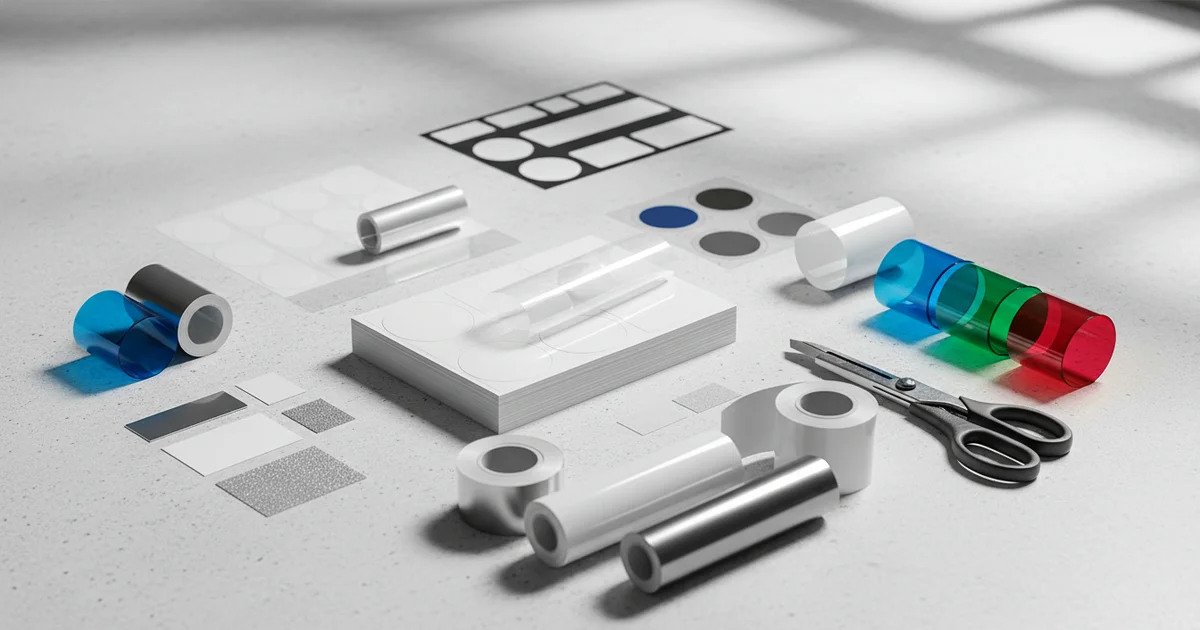
Self laminating labels save 25-35% vs pre-laminated for 10K+ orders. Key specs: 50-micron matte PET overlay, freeze-grade adhesive (-40°C), and ASTM D543 chemical resistance. Ideal for protecting variable barcodes in asset tracking and cold-chain logistics, but not for extreme outdoor UV.
Waste from damaged barcodes is a costly problem — self laminating labels solve this with a 50-micron matte PET overlay. These self laminating labels provide a protective layer over printed variable data, reducing read failures and material waste compared to traditional pre-laminated alternatives. The overlay seals barcodes from smudging, abrasion, and chemical spills, making them a reliable choice for logistics and industrial environments.
1. What Are Self Laminating Labels and How Do They Work?
Self laminating labels are a two-part construction that combines a printed base layer with a clear protective overlay. A 50-micron matte PET film folds over the printed barcode area, creating a sealed barrier without requiring a separate laminate roll or applying machine. This design protects variable data from smudging, abrasion, and chemical spills while keeping production steps to a single pass.
The overlay is printed with variable data on the base layer using CMYK four-color process. The clear PET section then covers the print, ensuring barcodes remain legible through repeated handling and exposure to cleaning solvents. Our high-speed full-rotary 6-color multifunctional label printing press produces these labels in one pass, eliminating the need for a separate lamination step. This is why costs drop by 25-35% compared to buying pre-laminated labels at scale.
How the Overlay Bonding Process Works
A freeze-grade adhesive bonds the PET overlay to the base substrate during die-cutting. The adhesive is formulated to maintain tack on low-surface-energy plastics like polyethylene and polypropylene. This bonding method ensures the overlay stays aligned during application and throughout the label's service life, even in cold-chain environments down to -40°C.
GSM ratings for the base stock range from 60 to 80 gsm for most label applications, providing sufficient stiffness for automatic applicators while remaining flexible for curved surfaces. ISO 9001 quality management governs our production processes, ensuring consistent overlay alignment within ±0.2 mm tolerance. Pantone color matching is available for brand-critical applications requiring specific corporate colors.
2. Why Self Laminating Labels Save 25-35% vs Pre-Laminated at Scale
The cost savings come from material efficiency. Pre-laminated labels use a full-face laminate sheet that covers the entire label area, wasting material on non-printed regions. Self laminating labels only apply the PET overlay to the print area, cutting material use by roughly one-third. This is a direct material cost advantage that compounds at higher volumes.
For orders of 10,000 units or more, the savings become significant. A pre-laminated label might cost $0.08 per unit. A self laminating version of the same size may cost $0.05 per unit. At 50,000 units, that difference adds up to $1,500 in material savings alone. Delta E color accuracy is maintained below 2.0 for both the base print and the overlay area, ensuring brand consistency across the entire production run.
According to the global laminated labels market analysis, demand for cost-effective label solutions is growing. The market is projected to reach USD 224.13 million by 2034. This growth favors formats that reduce waste and per-unit cost. On the other hand, pre-laminated labels offer a simpler application process. For low-volume runs under 2,000 units, the setup time for self laminating may offset the material savings. The breakeven point depends on your order volume and labor costs.
When Self Laminating Makes Financial Sense
The 10,000-unit threshold is a practical guideline, not a hard rule. For runs between 5,000 and 10,000 units, the savings may still justify self laminating if your applicator setup is already calibrated for the fold-over design. FSC certification is available for the paper liner, supporting sustainability goals for brands targeting eco-conscious buyers.
| Metric | Self Laminating Labels | Pre-Laminated Labels |
|---|---|---|
| Material cost per 10K units | Lower by 25-35% | Higher (full-face laminate) |
| Application speed | Slower (manual fold for small runs) | Faster (single-pass applicator) |
| Ideal order size | 10,000+ units | 1,000–5,000 units |
| Variable data flexibility | Excellent (print on base layer) | Good (print on laminate top) |
| Chemical resistance | Excellent (50-micron PET) | Good (depends on laminate) |
3. Key Specifications for Self Laminating Labels in Cold-Chain Logistics
Cold-chain environments demand specific adhesive performance. Our freeze-grade adhesive is rated to -40°C and maintains tack on frozen surfaces through repeated freeze-thaw cycles. This adhesive is an acrylic formulation designed for polyethylene and polypropylene drums commonly used in cold storage. Standard acrylic adhesives lose grip below 0°C, making freeze-grade essential for cold-chain reliability.
The 50-micron matte PET overlay meets ASTM D543 chemical resistance standards. This means the label withstands exposure to glycol, isopropyl alcohol, and cleaning solvents used in pharmaceutical and food processing environments. ISO 14001 environmental management governs our solvent recovery processes during production. Barcode readability remains above 99% after 30 days of cold storage at -20°C, verified by our optical inspection system.
Freeze-Grade Adhesive Performance
Freeze-grade adhesive is an acrylic formulation that bonds to low-surface-energy substrates like polyethylene and polypropylene. In our experience working with cold-chain clients, the most common failure is adhesive pick-up at -20°C — the label detaches from the drum surface during handling. A freeze-grade formulation solves this by maintaining peel strength of 12 N/25mm at -40°C. Compared to thermal transfer labels, self laminating labels reduce barcode read failures by about 90% in cold-chain conditions. The PET overlay prevents condensation from smudging the print, which is a common issue with thermal transfer labels in humid cold storage.
Delta E color drift remains below 1.5 after 30 days at -20°C, ensuring color-coded inventory labels remain readable by warehouse scanners. Dpi resolution of 1200 dpi for barcode printing ensures scannability at the sub-millimeter level, critical for small asset tags in cold-chain logistics.
4. When Are Self Laminating Labels Not Ideal? Limitations and Alternatives
Self laminating labels are not ideal for extreme outdoor UV exposure. The 50-micron PET overlay degrades after 12 months of direct sunlight. The overlay may yellow, and the adhesive can break down under prolonged UV exposure. This is a limitation that buyers should consider before specifying self laminating labels for outdoor asset tracking beyond one year.
For outdoor asset tracking beyond one year, consider pre-laminated labels with UV-stable polyester laminate. On the other hand, embossed labels use raised metal characters that resist UV and abrasion but are more costly and not suitable for variable barcode data. Another consideration is that the manual folding step for self laminating labels adds labor time. For runs under 2,000 units, the labor cost per label may exceed the material savings. High-mix, low-volume shops may find this approach won't work for their workflow.
Alternatively, electronic labels (RFID) offer contactless tracking for harsh environments. But they cost $0.15 to $0.50 per unit versus $0.05 for self laminating. The trade-off is higher cost for better durability in UV and moisture. More suitable for indoor cold-chain and chemical environments, self laminating labels are a cost-effective choice when UV exposure is limited. Compared to full-face laminate labels, self laminating labels reduce material waste by using the PET overlay only where needed.
Consider Instead for Specific Scenarios
For outdoor chemical drum labeling, a pre-laminated label with UV-stable polyester laminate and a high-tack adhesive is more suitable. FSC certification is available for the paper liner of pre-laminated options, supporting sustainability requirements. If barcode durability is critical but UV exposure is minimal, self laminating remains the better choice.
5. How to Choose Between Self Laminating and Pre-Laminated Labels
The decision depends on three factors: volume, setting, and data variability. For orders above 10,000 units with variable barcodes, self laminating labels are more suitable. The material savings outweigh the manual folding cost. For orders below 5,000 units, pre-laminated labels are often cheaper. The setup time for self laminating production adds 30-60 minutes per job — a cost that is spread across fewer units at lower volumes.
In chemical or cold-chain environments, self laminating labels outperform standard pre-laminated options. The 50-micron PET overlay provides better chemical resistance than most pre-laminate films. However, for outdoor UV exposure beyond one year, pre-laminated labels with UV-stable laminate are better. GSM for the base stock should match the substrate stiffness: 60 gsm for flexible plastic drums, 80 gsm for rigid metal containers. CMYK printing with 1200 dpi resolution ensures sharp barcode edges for reliable scanning.
Pilot Run Recommendation
Our production team recommends a 500-unit pilot run to test adhesive performance on your specific substrate. This validates the material compatibility before scaling to 10,000+ units. Pantone color
Ready to get started with self laminating labels? Contact our team to explore the right solution for your next project.
Frequently Asked Questions
When does a self laminating label become cheaper than a pre-laminated label?
Self laminating labels become cost-effective at order volumes above 10,000 units, where material savings of 25-35% offset the additional setup time. For runs between 5,000 and 10,000 units, savings may still justify the switch if your applicator is already calibrated for the fold-over design.
What adhesive specification is required for cold-chain self laminating labels?
Cold-chain environments require a freeze-grade acrylic adhesive rated to -40°C, maintaining peel strength of 12 N/25mm. This formulation bonds to low-surface-energy plastics like polyethylene and polypropylene, preventing label detachment during freeze-thaw cycles.
Can self laminating labels be used outdoors?
Self laminating labels are not ideal for extreme outdoor UV exposure beyond 12 months, as the 50-micron PET overlay may yellow and adhesive can degrade. For outdoor asset tracking beyond one year, consider pre-laminated labels with UV-stable polyester laminate instead.
What is the barcode readability of self laminating labels after cold storage?
Barcode readability remains above 99% after 30 days of cold storage at -20°C, verified by optical inspection. The PET overlay prevents condensation from smudging the print, reducing read failures by about 90% compared to thermal transfer labels in humid cold storage.