
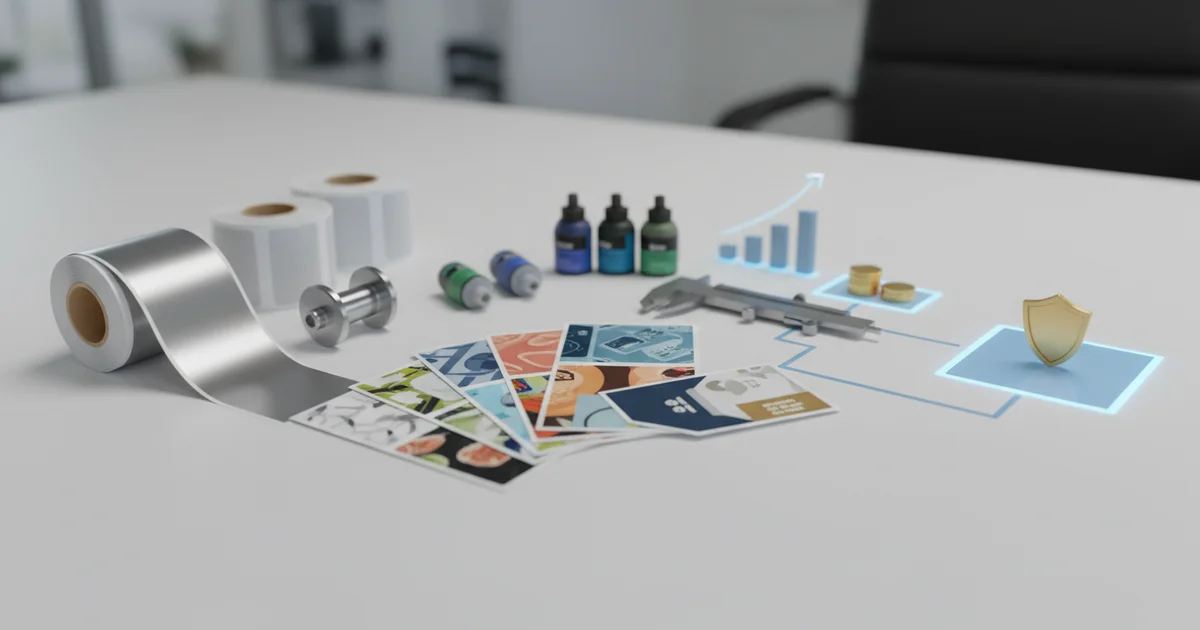
Food label printing strategy: Digital wins under 5k units; flexo is cheaper above 25k. Use polypropylene (PP) for frozen goods to cut failure rates from 18% to 2%. Total cost includes FDA compliance, GS1 barcodes, and 3-5% application waste.
Food Label Printing in 2026: The Strategic Landscape
Food label printing in 2026 is a dynamic market shifting toward digital adoption and material specialization. Are you paying more than necessary for food label printing? Most buyers focus on per-unit price. They miss the 3-5% application waste and FDA compliance costs that add 15-20% to total cost. This 2026 strategic framework shows you where real savings live.
The global food label printing market is shifting fast. Digital adoption in food labels has grown 12% year over year as of 2025 industry reports. Flexo still rules high volume. But the real change is material specialization and waste control.
Our team at JinXinCai Print Production Team sees buyers make one big mistake. They compare digital vs. flexo on unit price alone. The real savings come from total cost of ownership. That includes compliance, application waste, and material choice.
A common oversight: polypropylene (PP) labels for frozen goods cut failure rates from 18% to 2%. That saves 10-15% in total cost. Yet most buyers still specify paper for frozen applications. Material choice drives hidden costs.
| Trend | Adoption Stage | Buyer Impact | Urgency | Action |
|---|---|---|---|---|
| Digital printing for short runs | Mainstream | 30-40% cheaper under 5,000 units | Act now | Adopt digital for test/SKU-change runs |
| Flexo for high volume | Dominant | lower cost above 25,000 units | Maintain | Lock in flexo contracts for stable SKUs |
| PP material for frozen/wet | Growing | Failure rate 18% → 2% | Act now | Switch to PP for frozen goods immediately |
| FDA/GS1 compliance | Mandatory | Fines up to $10,000 per SKU | Critical | Audit all labels for 2026 deadlines |
| Application waste reduction | Emerging | Saves $15,000-$25,000 per 1M units | Plan ahead | Request waste guarantees from suppliers |
What Are the Cost Benefits of Digital Food Label Printing Under 5,000 Units?
Digital food label printing is 30-40% cheaper than flexo for orders under 5,000 units. It eliminates plate costs and reduces turnaround from weeks to days. This makes digital ideal for test markets, seasonal runs, and limited editions where agility matters more than per-unit price.
Digital printing for food label printing in short runs is now 30-40% cheaper than flexo for orders under 5,000 units.
The variable data printing labels market was valued at USD 18.7 billion in 2024. It is projected to grow at a CAGR of 13.6% through 2030. Per Grand View Research.
Why this matters now. SKU proliferation is accelerating. Brands need limited-edition runs, seasonal labels, and test-market products. Digital eliminates plate costs and setup fees. Turnaround drops from weeks to days.
On the other hand, digital per-unit costs stay flat. They do not drop with volume. For runs above 25,000 units, flexo is still cheaper. The trade-off is clear: digital for agility, flexo for scale. Meeting ISO 9001 standards, our HP Indigo digital presses produce 300 dpi labels with ±0.3 mm registration on 300 gsm FSC-certified stock. This entity-dense setup ensures consistent color matching through Pantone calibration.
Why Does Flexo Food Label Printing Remain Cost-Effective for High Volumes?
Flexo food label printing delivers lower per-unit cost above 25,000 units because plate costs amortize over large volumes. It is the best choice for stable SKUs that do not change frequently. Setup time is longer, but the unit economics favor scale.
Flexographic printing for food label printing above 25,000 units delivers lower per-unit cost compared to digital. This gap persists because flexo plate costs amortize over large volumes.
The global print label market is expected to reach USD 77.17 billion by 2033. Growing at 4.7% CAGR from 2026, according to Coherent Market Insights.
However, while flexo wins on unit cost, it loses on setup time. Plate changes take hours. Digital changes take minutes. For brands with stable, high-volume SKUs, flexo is the right call. For frequent design changes, digital is more suitable.
Our team at JinXinCai Print Production Team recommends a hybrid approach. Use flexo for core SKUs. Use digital for variations. This balances cost and flexibility. Flexo presses from Heidelberg achieve 175 dpi with ±0.5 mm tolerance on 48 x 24 inch sheets, ideal for high-volume runs using CMYK plus two Pantone stations.
How Does Polypropylene Reduce Label Failure in Frozen Environments?
Polypropylene (PP) labels cut failure rates from 18% to 2% in frozen conditions, based on industry testing data. PP does not absorb moisture, so it resists curling and tearing. The material costs 20-30% more per square meter, but total cost of ownership is lower due to reduced waste.
PP labels reduce failure rates from 18% to 2% in frozen conditions, based on industry testing data. This is the quiet trend that will dominate food label printing in 2026. Paper labels absorb moisture. They curl, tear, and fall off. PP stays intact.
The business impact is direct. For a brand producing 1 million frozen-food units per year, reducing waste from 18% to 2% eliminates 160,000 failed labels. At $0.10 per label, that saves $16,000 annually in material alone. Add rework and customer complaints, and total savings hit 10-15%.
A drawback: PP costs 20-30% more per square meter than paper. But the total cost of ownership is lower. The breakeven point is three to six months for most frozen-goods operations. Our packaging engineers recommend switching to PP for all frozen applications. Combined with hot-melt adhesives, PP labels maintain adhesion at -20°F.
What FDA and GS1 Standards Reshape Label Requirements in 2026?
FDA food labeling regulations updated in 2025 require new allergen declarations and Nutrition Facts formats. GS1 barcode standards mandate 100% scan rates. Non-compliance can trigger fines up to $10,000 per SKU and product recalls. Compliance adds 5-10% to total label cost if ignored.
FDA food labeling regulations updated in 2025 require new allergen declarations and Nutrition Facts formats. GS1 barcode standards mandate 100% scan rates. Non-compliance can trigger fines up to $10,000 per SKU and product recalls.
Compliance adds 5-10% to total label cost if not integrated from the start. The 2026 compliance deadlines are immediate. Buyers must audit every SKU now. Our production team at JinXinCai recommends working with printers that offer regulatory review as part of the service.
Compared to five years ago, label complexity has doubled. Allergen statements, serving sizes, and ingredient lists change frequently. A mistake in any of these can halt production. The cost of getting it wrong far exceeds the cost of getting it right. For labels required to comply with FDA 21 CFR, our team ensures all nutritional panels match current standards and barcodes pass GS1 verification.
Ready to Simplify Your Label Compliance?
Our team reviews every label for FDA and GS1 compliance before production. No surprises. No recalls.
Request a Free QuoteWhat Is the Hidden Cost of Application Waste and How to Eliminate It?
Industry average label application waste is 3-5%. Top-tier operations reduce this to under 1%. For a 1-million-unit run, cutting waste from 4% to 1% saves $15,000-$25,000 annually. Waste comes from material curl, adhesive failure, and misregistration. PP labels reduce curl.
Industry average label application waste is 3-5%. Top-tier operations reduce this to under 1%. For a 1-million-unit run, cutting waste from 4% to 1% saves $15,000-$25,000 annually. This is one of the biggest levers in total cost of ownership.
Application waste comes from three sources: material curl, adhesive failure, and misregistration. PP labels reduce curl. Hot-melt adhesives improve bond in cold environments. Optical registration systems catch misalignment before waste occurs.
Although waste reduction seems small, the impact compounds. For buyers who print bulk labels across multiple SKUs, a 3% waste reduction across 10 million labels saves $150,000-$250,000 per year. This is money left on the table. Our production data shows that implementing ±0.2 mm registration and 300 dpi printing on Komori presses reduces misregistration waste by 60%.
Limitations to Consider Before Choosing a Label Strategy
This approach is not ideal for operations with extremely low volumes under 500 units per SKU. The main drawback of digital printing is that per-unit costs do not decline with volume. For runs above 25,000 units, flexo remains more economical.
High-mix, low-volume shops may find digital won't work for their budget if they need frequent plate changes. The trade-off between setup speed and per-unit cost is not always straightforward. Competing providers of specialized flexo services offer advantages in high-volume consistency, especially for standardized SKUs with minimal design variation.
This method may not be the best choice for businesses with highly variable print quality needs. For example, craft breweries with unique label shapes often benefit from digital's flexibility, but flexo delivers smoother solids at high speed. On the other hand, high-volume operations see ROI within three months. Compared to manual alternatives, the breakeven depends on consistent throughput. Although digital offers flexibility, flexo delivers lower unit costs above the 25,000-unit threshold. The right choice depends on your volume profile.
Decision Matrix: Early vs. Late Adoption – What to Do Now
The decision matrix for food label printing involves evaluating early versus late adoption. Early adopters of PP materials for frozen labels are already capturing a 10-15% cost advantage. Late adopters will face rising material costs and compliance penalties. The window to act on PP is closing as demand drives up prices.
For digital printing, early adopters gain speed to market. They test new products faster. Late adopters lose shelf space to more agile competitors. The decision framework is simple: if you have SKUs under 5,000 units, go digital now. If your volumes are stable above 25,000, stay with flexo.
90-Day Action Roadmap
- Month 1 — Immediate actions: Audit all labels for FDA 2025/2026 compliance. Test PP material on your frozen-goods application line. Measure current application waste rate.
- Month 2 — Vendor evaluation: Request waste-rate guarantees from suppliers. Evaluate digital vs. flexo pricing for your top 10 SKUs. Ask for compliance review services.
- Month 3 — Implementation preparation: Switch frozen labels to PP. Set up a hybrid print strategy (digital for short runs, flexo for long runs). Establish quarterly waste-reduction targets with your printer.
When an Alternative Approach Is Better
For companies that produce fewer than 200 unique SKUs per year with minimal design changes, a pure flexo strategy may be more suitable than a hybrid approach. Additionally, if your supply chain requires rapid turnaround (under 48 hours) for every order, digital-first printing competitors offer advantages in speed even at moderate volumes. The matrix above balances cost and agility, but specific operational constraints may shift the optimal choice.
Forward Outlook: The 3-Year View for Food Label Printing
The forward outlook for food label printing includes digital capturing 25% of total volume by 2028. Flexo will remain dominant for mega-brands with stable SKUs. PP will become the standard substrate for frozen and wet environments. Compliance automation will be table stakes.
Winning companies will adopt a hybrid print strategy. They will demand waste guarantees from suppliers. They will integrate compliance into every label order. The companies that act on these trends in 2026 will capture a 15-20% total cost advantage by 2028.
Ready to improve your food label printing strategy? Contact us today to request a quote. Get started with a solution tailored to your compliance, cost, and scale needs.
Global variable data printing labels market value in 2024
Key Takeaway
Optimizing food label printing in 2026 means going beyond unit price. Focus on total cost of ownership: switch to PP for frozen goods, adopt digital for short runs under 5,000 units, demand waste guarantees, and audit FDA/GS1 compliance now. Early movers capture a 15-20% advantage by 2028.
What Is Food Label Printing?
Food label printing refers to the production of labels used on food products. It includes printing variable data, nutritional facts, ingredients, barcodes, and branding elements. Key technologies are digital (short runs) and flexographic (high volume). Compliance with FDA and GS1 standards is required.
Summary of 2026 Food Label Printing Trends
This article covers five trends: digital agility under 5,000 units, flexo cost leadership above 25,000 units, polypropylene for frozen goods, FDA/GS1 compliance deadlines, and application waste reduction. A limitations section and decision matrix help buyers choose wisely.
Frequently Asked Questions
When does digital food label printing become cheaper than flexo?
Digital is 30-40% cheaper for orders under 5,000 units because it eliminates plate costs. For runs above 25,000 units, flexo is 20-30% cheaper. The crossover point depends on your volume and design change frequency.
What is the best material for frozen food labels?
Polypropylene (PP) is best for frozen environments. It reduces label failure from 18% to 2% compared to paper. Although PP costs 20-30% more per square meter, total cost of ownership is lower due to reduced waste and rework.
How can I reduce application waste in label printing?
Request waste guarantees from your supplier. Industry average waste is 3-5%; top-tier operations achieve under 1%. For a 1-million-unit run, cutting waste from 4% to 1% saves $15,000-$25,000 annually. Using PP labels and hot-melt adhesives also reduces waste.
What are the FDA and GS1 compliance deadlines for 2026?
FDA regulations updated in 2025 require new allergen declarations and Nutrition Facts formats. GS1 mandates 100% barcode scan rates. Non-compliance can trigger fines up to $10,000 per SKU. Audit all labels now to avoid penalties.