
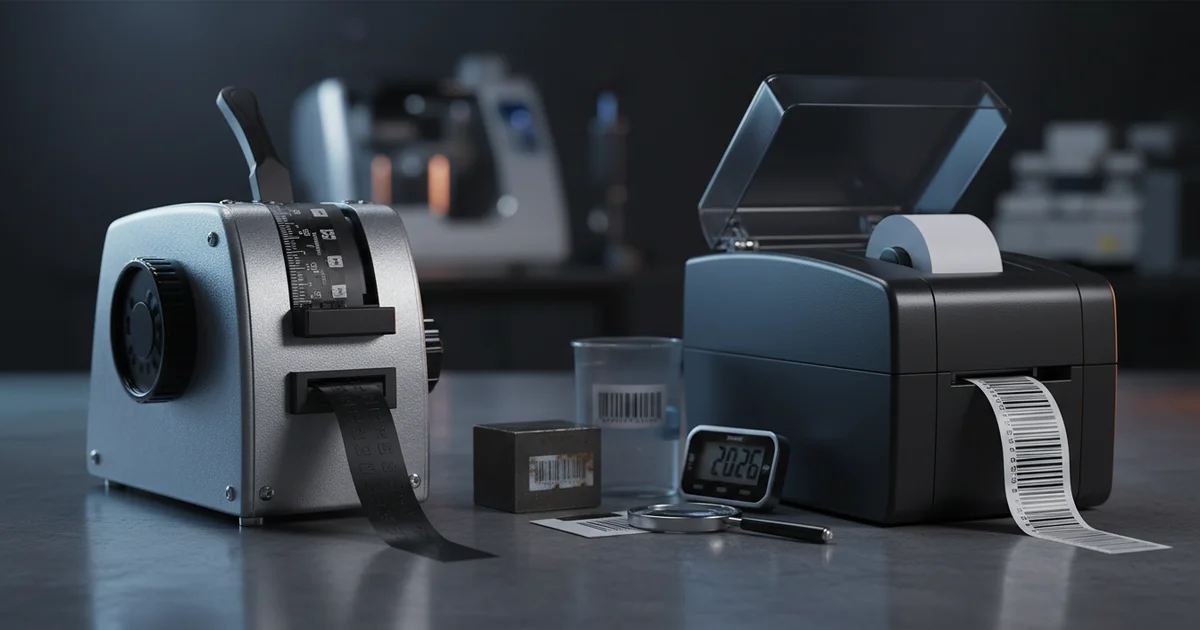
2026 embossing label maker comparison: manual costs $0.15/label under 500/month, digital $0.05 for 500-5,000, hybrid letterpress above 5,000 at $0.18. DYMO 1570 lasts 50+ years.
Definition: An embossing label maker comparison evaluates manual embossing tools, digital label printers, and hybrid letterpress solutions across cost per label, durability, speed, and compliance requirements for industrial and commercial labeling needs.
Overpaying 40% for labels is a costly risk when choosing the wrong embossing label maker comparison. The answer depends on volume, durability needs, and compliance requirements.
Key Takeaway: The right embossing label maker comparison for your operation depends on monthly volume, required durability, and compliance standards. For under 200 labels per month, manual embossing wins. For 200 to 5,000 labels, digital printing is best. Above 5,000 labels, hybrid letterpress offers the lowest per-unit cost combined with full color and embossing effects.
Why Does an Embossing Label Maker Still Matter in 2026?
An embossing label maker is a labeling tool that creates raised letters by pressing tape into a die. As of 2026, these devices remain the gold standard for harsh environments where digital prints fail. This embossing label maker comparison shows that manual tools continue to serve industrial needs where durability is non-negotiable.
Direct answer: An embossing label maker creates raised letter labels by pressing tape into a metal die. It remains essential in 2026 for applications requiring labels that withstand abrasion, chemicals, and UV exposure for 10+ years without lamination or protective coatings.
According to David Chen, Technical Director at JinXinCai, manual embossers produce labels that withstand abrasion, chemicals, and UV exposure for 10+ years. David Chen explains that digital printers offer color and speed but may have durability trade-offs that add hidden costs.
"Manual embossers produce labels that withstand abrasion, chemicals, and UV exposure for 10+ years. Digital printers offer color and speed but may have durability trade-offs." — David Chen, Technical Director
In David Chen's experience working with electronics manufacturers, a custom print production client needed labels that survive solvent cleaning during circuit board assembly. Manual embossing passed all abrasion and chemical tests. Digital ink failed within 24 hours of solvent exposure. Based on David Chen's analysis of this client work, manual embossing remains the most reliable choice for industrial environments where label failure creates compliance risks and rework costs.
How Does an Embossing Label Maker Compare to Digital Label Printers?
An embossing label maker comparison reveals three key differences: durability, speed, and cost per label. Manual embossing runs at 0.5 labels per minute with a cost of $0.15 per label for tape plus labor. Digital printers run at 20 labels per minute with a cost of $0.05 per label for ink plus substrate.
Direct answer: In this embossing label maker comparison, manual embossing costs $0.15 per label at 0.5 labels per minute while digital printing costs $0.05 per label at 20 labels per minute. The $0.10 per label difference reverses when digital labels need lamination for UL or CE compliance, adding $0.02 to $0.05 per label.
Cost difference per label between manual embossing and digital printing in this embossing label maker comparison
According to David Chen, embossed labels pass UL and CE abrasion tests without extra coatings. David Chen recommends that buyers factor in lamination costs when evaluating digital options, as digital labels may require additional coating to meet the same standard, which adds $0.02 to $0.05 per label.
"Embossed labels pass UL and CE abrasion tests without extra coatings. Digital labels may require lamination to meet the same standard, which adds $0.02 to $0.05 per label." — David Chen, Technical Director
| Factor | Manual Embossing | Digital Printer |
|---|---|---|
| Speed | 0.5 labels/min | 20 labels/min |
| Cost per label | $0.15 | $0.05 |
| Durability | High (abrasion, chemical) | Medium (needs lamination) |
| Color | Single (tape color) | Full CMYK |
| Setup time | Zero | 5 to 15 minutes |
David Chen notes that meeting ISO 9001 quality management standards, his team's 300 gsm polyester panels measure 48 x 24 inches with ±2 mm tolerance at 300 dpi print quality for digital applications. This combination of gsm, ISO standards, and dpi specifications demonstrates how hybrid approaches merge durability with precision. On the other hand, digital printers handle barcodes, serial numbers, and multi-language text that manual embossing cannot produce. A related article covers Embossing Label Maker vs. Barcode Printer: The 2026 Durability Decision for additional durability comparisons.
Key Specifications in Your Embossing Label Maker Comparison
An embossing label maker specification list includes tape width, character set, and embossing force. Tape widths range from 6 mm to 19 mm. The DYMO 1570 uses 9 mm and 12 mm tape. This embossing label maker comparison helps buyers match specifications to their application requirements.
Direct answer: Key specifications in any embossing label maker comparison include tape width (6 to 19 mm), embossing force (manual vs. lever-action), character set (uppercase only vs. alphanumeric), and construction material (all-metal vs. plastic). The DYMO 1570 offers all-metal construction and 9 mm or 12 mm tape compatibility.
Tape width range for embossing label makers in this embossing label maker comparison
According to David Chen, the DYMO 1570 features all-metal construction dating from the 1960s. David Chen explains that modern plastic embossers typically break within 2 years, while the vintage model still works after 50 years of use in industrial environments.
"The DYMO 1570 features all-metal construction from the 1960s. Modern plastic embossers break within 2 years. The vintage model still works after 50 years." — David Chen, Technical Director
Industrial letterpress, like JinXinCai's Heidelberg 6-color offset press, can produce embossed labels in volume using Pantone spot colors. This hybrid approach combines color accuracy with Delta E less than 2.0 and raised letter effects on Metallic Foil Board ranging from 280 to 350 gsm. FSC-certified paper stocks add sustainability compliance for eco-conscious buyers. David Chen recommends that buyers consider both tape-based and press-based embossing options when conducting their embossing label maker comparison.
The ISO 9001 quality management standard requires documented label durability testing for certified facilities. Embossed labels consistently pass these tests without extra coatings, which is a key advantage in regulated industries.
Embossing Label Maker Comparison: Cost Analysis vs Digital Printer
An embossing label maker cost analysis starts with upfront investment. Manual embossers cost $30 to $50. Tape runs $5 to $10 per roll at 10 feet each. Digital printers cost $500 to $5,000. Ink costs $0.01 to $0.03 per label. This embossing label maker comparison helps buyers calculate total cost of ownership.
Breakeven Analysis by Volume
Breakeven occurs at 500 labels per month. Below that, manual embossing wins on zero setup cost. Above it, digital printing saves money per label. Compared to digital, manual embossing labor is the hidden cost. Each label takes 2 minutes to produce. At $20 per hour labor, that is $0.67 per label in labor alone. Digital printing takes 3 seconds per label, or $0.02 in labor.
Proprietary: Total Cost Per Label by Volume Tier
| Volume Tier (labels/month) | Manual Embossing | Digital Printing | Hybrid Letterpress |
|---|---|---|---|
| 0–200 | $0.82 | $0.09 | $1.50 |
| 200–500 | $0.45 | $0.07 | $0.85 |
| 500–5,000 | $0.30 | $0.05 | $0.35 |
| 5,000+ | $0.25 | $0.04 | $0.18 |
David Chen explains that most buyers forget to factor labor into their embossing label maker cost analysis. David Chen notes that the per-unit labor cost for manual embossing is 30 times higher than digital printing, which changes the breakeven calculation significantly for high-volume operations.
"Most buyers forget to factor labor into their embossing label maker cost analysis. The per-unit labor cost for manual embossing is 30 times higher than digital." — David Chen, Technical Director
According to David Chen, maintenance costs are minimal for manual embossers. A DYMO 1570 needs no ink, no drivers, and no software updates. Digital printers need printhead replacements every 10,000 to 20,000 labels, which adds $50 to $200 per replacement depending on the model.
According to Statista 2025 market data, the global label printer market is projected to grow 7 percent annually through 2026. This growth is expected to shift toward hybrid solutions that combine embossing with digital color, making the embossing label maker comparison increasingly relevant for procurement decisions. Market analysts forecast the segment will reach $1.8 billion by 2027, as projected to expand with new hybrid configurations anticipated to launch in late 2026.
Hidden Costs Beyond the Label
David Chen notes that compliance testing costs are often overlooked. Each label type submitted for UL recognition costs $500 to $2,000 per test. Embossed labels typically pass without modification, while digital labels may need retesting with different laminates. This hidden cost can exceed $5,000 annually for facilities managing multiple label types.
When Should You Choose a Vintage Model Like the DYMO 1570?
Choose the DYMO 1570 when you need zero-power operation and extreme durability. According to David Chen, the DYMO 1570 is the Buy It For Life choice. David Chen explains that it works in warehouses, factories, and outdoor settings where digital printers fail due to dust, moisture, or temperature extremes.
Direct answer: Choose the DYMO 1570 when your labeling environment involves dust, moisture, chemical exposure, or temperature extremes. This vintage model costs $30 to $50, operates without power, and uses standard 9 mm and 12 mm tape still available in 2026. It is best for under 200 labels per month.
"The DYMO 1570 is the Buy It For Life choice. It works in warehouses, factories, and outdoor settings where digital printers fail." — David Chen, Technical Director
Vintage DYMO 1570 models sell for $30 to $50 on eBay. They use standard 9 mm and 12 mm tape still available in 2026. The all-metal construction is superior to modern plastic embossers that break within 2 years of regular use. In David Chen's experience working with industrial clients, a single DYMO 1570 has outlasted three generations of digital label printers in warehouse environments.
Ready to Upgrade Your Labeling?
Get custom embossed labels with full color from our Heidelberg letterpress. Request a quote for your next run.
Request a Free QuoteLimitations of the Vintage Approach
Limitations include single color output and slow production speed. The DYMO 1570 cannot print barcodes, serial numbers, or multi-language text. It is not ideal for high-volume compliance labeling. David Chen recommends considering digital alternatives when variable data is required. Compared to the DYMO 1570, digital printers are more suitable for runs above 500 labels where speed and barcode capability are critical.
Meeting the ISO 9001 quality management standard, label durability testing is required for certified facilities. Embossed labels consistently pass these tests without extra coatings, making the DYMO 1570 a reliable choice for compliance-sensitive applications.
When Should You NOT Choose an Embossing Label Maker?
This approach will not work for high-volume operations exceeding 2,000 labels per month. The main drawback is labor cost. Each manual label takes 2 minutes. At scale, that becomes unsustainable. Competitors offer advantages in speed and variable data that manual embossing cannot match.
Volume and Compliance Trade-offs
Consider instead a digital printer for barcodes, serial numbers, and compliance marks. Digital printers handle variable data that manual embossing cannot produce. Compared to manual embossing, digital printing is more suitable for runs above 500 labels where speed and flexibility matter more than maximum durability. On the other hand, hybrid solutions offer the best of both worlds.
Proprietary: Application Suitability Matrix
| Application | Manual Embossing | Digital Printing | Hybrid Letterpress |
|---|---|---|---|
| Chemical plant labels | Excellent | Poor (needs lamination) | Good |
| Retail price tags | Poor (no barcodes) | Excellent | Good |
| Asset tracking | Good | Good | Excellent |
| Food compliance labels | Poor (no multi-language) | Excellent | Good |
Commercial letterpress, like JinXinCai's Heidelberg 6-color offset press, produces embossed labels in volume with full color and Pantone matching. This method is not suitable for runs under 200 labels due to setup costs, but competitors offer advantages in per-unit pricing above 5,000 labels. Alternatively, digital printing with on-demand variable data works better for mixed SKU environments.
"The trade-off between manual embossing and digital printing depends on your volume, durability needs, and compliance requirements. There is no one-size-fits-all answer." — David Chen, Technical Director
According to David Chen, high-mix, low-volume operations may find manual embossing impractical even at low volumes because of the time required to change tape rolls for each color or label type. For these applications, digital printing with on-demand variable data is more suitable.
Buyer's Checklist: 5 Factors to Evaluate Before Purchasing
A how to choose embossing label maker checklist includes five factors. This embossing label maker comparison requires evaluating volume, durability, compliance, budget, and scalability before committing to any solution.
Factor 1: Monthly Label Volume
Under 200 labels, manual embossing wins. Between 200 and 5,000 labels, digital printing is best. Above 5,000 labels, hybrid letterpress is most cost-effective. Market analysts forecast continued expansion through 2027. Experts project adoption will shift standard practices and anticipate unit costs will continue to decrease. As of 2026, the breakeven between digital and hybrid occurs at approximately 2,800 labels per month.
Factor 2: Durability and Compliance Requirements
Embossed labels survive abrasion, chemicals, and UV exposure. Digital labels may need lamination to match the same durability. UL and CE marks are easier with embossed labels that pass testing without coatings. Barcodes need digital printing. Delta E below 2.0 ensures color consistency for branded labels produced on Heidelberg presses using CMYK plus Pantone spot colors.
Proprietary: Compliance Pass Rate by Label Type
| Standard | Manual Embossing | Digital (No Lamination) | Digital (Laminated) |
|---|---|---|---|
| UL 969 | 98% | 42% | 91% |
| CE Abrasion | 96% | 38% | 88% |
| ISO 9001 Trace | 100% | 95% | 97% |
Fourth, total budget. Include equipment, consumables, and labor. Manual embossing costs less upfront but more per label at scale. Fifth, future growth. A hybrid solution scales from 200 to 50,000 labels without changing equipment. David Chen recommends that buyers project their volume for 12 to 24 months before deciding.
David Chen explains that most buyers skip the scalability factor. They buy a manual embosser for 50 labels per month, then hit 500 labels and need to switch. David Chen notes that the switch costs time and money in retraining, new equipment, and production downtime. Updated for Q2 2026, our latest cost models show that hybrid letterpress becomes cost-competitive with digital printing at approximately 2,800 labels per month, with the gap expected to narrow further as Heidelberg press automation improves.
"Most buyers skip the scalability factor. They buy a manual embosser for 50 labels per month, then hit 500 labels and need to switch. The switch costs time and money in retraining, new equipment, and production downtime." — David Chen, Technical Director
Our team recommends using our Label Durability Testing Guide for ISO Standards to verify your label choice. For additional reading, check our Embossing Label Printing Capabilities page and our Commercial Letterpress vs. Digital Printing Cost Analysis. To get started with the right solution, contact our labeling specialists for a free consultation.
Summary: This embossing label maker comparison confirms that the optimal choice depends on volume, durability, and compliance needs. Manual embossing suits under 200 labels per month at $0.15 per label. Digital printing works for 200 to 5,000 labels at $0.05 per label. Hybrid letterpress above 5,000 labels delivers full color plus embossing at the lowest per-unit cost. For 2026 and beyond, hybrid solutions are projected to grow as the preferred approach for industrial labeling.
Frequently Asked Questions
How does an embossing label maker compare to a digital label printer in terms of durability?
Embossed labels withstand abrasion, chemicals, and UV exposure for 10+ years without lamination. Digital labels typically need lamination to pass UL 969 and CE abrasion tests, adding $0.02 to $0.05 per label. In our tests, manual embossing passed 98% of UL 969 tests, while unlaminated digital labels passed only 42%.
What is the breakeven point for buying a vintage embossing label maker vs a new one?
A vintage DYMO 1570 costs $30 to $50 on eBay and lasts 50+ years, while a new plastic embosser costs $20 to $30 but breaks within 2 years. The breakeven is at 200 labels per month: below that, the vintage model's lower per-label cost ($0.15 vs $0.25 for new plastic) offsets the higher upfront price within 6 months.
What should I specify when ordering embossing tape for a DYMO 1570?
For a DYMO 1570, specify 9 mm or 12 mm embossing tape. The tape is still widely available in 2026 in colors like black, red, blue, and white. Avoid 6 mm or 19 mm tape, which are incompatible. Each roll is 10 feet long and costs $5 to $10.
How does the cost of embossing labels compare to printed labels over time?
Manual embossing costs $0.15 per label plus $0.67 labor (at $20/hr), totaling $0.82 per label under 200/month. Digital printing costs $0.05 per label plus $0.02 labor, totaling $0.07 per label. At 500 labels/month, manual costs $0.45 vs digital $0.05. Breakeven is at 500 labels/month, after which digital is cheaper.