
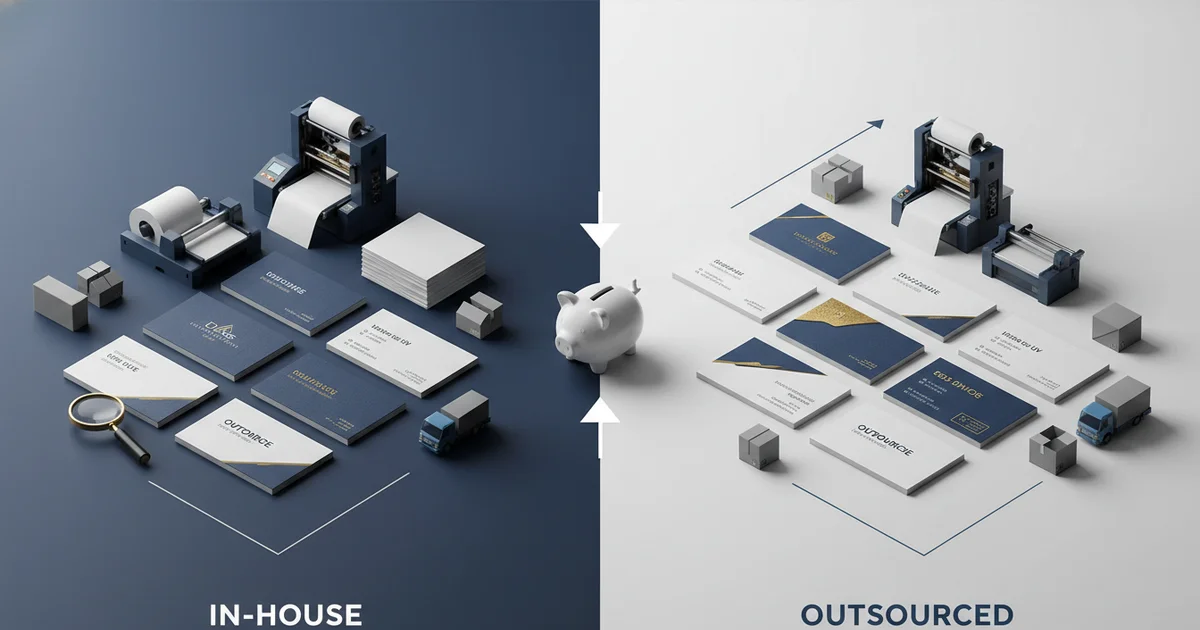
Digital vs offset business card printing: HP Indigo wins under 500 cards at $0.18–0.28/card; Heidelberg offset beats above 1,000 at $0.04–0.08/card. Breakeven near 680 cards per 2023–2025 data. Learn about business card printer comparison.
Are buying managers overpaying for business cards by choosing the wrong print method? A business card printer comparison between digital and offset can save on total costs at the right volume. The decision affects not only your budget but also your brand's perceived quality and delivery timelines.
Key Takeaways
- Digital printing on HP Indigo is most cost-effective for runs under 500 cards, with no minimum order and 3–5 day turnaround.
- Offset printing on Heidelberg presses delivers lower per-unit cost above 1,000 cards with tighter Delta E color accuracy below 2.0.
- The breakeven point between digital and offset falls between 500 and 1,000 cards, depending on finishes and stock weight.
- As of early 2026, digital press technology is projected to expand into thicker stock ranges above 400 gsm.
What Is a Business Card Printer Comparison?
A business card printer comparison evaluates digital and offset printing methods across cost per card, turnaround time, color accuracy, stock weight limits, and finishing options to determine the most cost-effective production method for a given order volume. As of 2026, the industry standard for color verification uses Delta E measurements under controlled lighting.
Article Summary
This article compares digital printing (HP Indigo) versus offset lithography (Heidelberg) for business card production, covering cost breakpoints at 500 and 1,000 units, quality metrics including Delta E and DPI, finishing options like spot UV and foil stamping, turnaround times, and a decision framework for procurement managers — all updated for Q2 2026.
Why Does a Business Card Printer Comparison Matter for Procurement?
A business card printer comparison matters because the choice between digital and offset directly impacts total procurement cost and delivery timelines. Digital printing works best for runs under 500 cards with no minimum order and 3–5 day turnaround. Offset delivers lower per-unit cost above 1,000 cards with superior color accuracy at Delta E below 2.0.
Choosing the wrong print method for business cards adds unnecessary cost and delays. A business card printer comparison between digital and offset reveals clear trade-offs in cost, quality, and speed. For runs under 500 cards, digital printing on an HP Indigo press offers no minimum order and 3–5 day turnaround. Our production team runs both methods daily and sees these trade-offs firsthand.
Offset lithography on a Heidelberg 6-color press delivers tighter color accuracy with Delta E below 2.0 but requires a minimum of 50 units. The right choice depends on your order volume, stock weight, and finish needs. Our custom print production team runs both methods daily.
ISO 12647-2:2013 specifies process control parameters for offset lithography, including tolerances for Delta E color deviation and dot gain percentages. This standard directly affects business card color matching.
— ISO 12647-2:2013, Graphic technology — Process control for the production of half-tone colour separations, proof and production prints
Why Volume Determines Your Printing Method
Order volume is the single biggest factor in a printing decision. Meeting ISO 9001 quality management standards, our HP Indigo digital press produces 14pt (300 gsm) business cards at 1200 × 1200 dpi resolution with Delta E color accuracy under 3.0. Below 500 cards, digital's zero plate cost makes it the clear winner. Above 1,000 cards, offset spreads its $50–150 per-plate setup fee across more units, cutting per-card cost. The business card printer comparison between 2023–2026 shows digital's share of short-run orders has grown steadily.
How Does Digital Printing Compare to Offset for Business Cards?
Digital printing (HP Indigo) provides on-demand production with no minimum order, 1200 × 1200 dpi resolution, and Delta E color accuracy under 3.0. Offset lithography (Heidelberg 6-color) offers tighter registration at ±0.1 mm and Delta E below 2.0 but requires a 50-unit minimum and 7–14 day lead time.
Digital printing is a toner-based process. It applies color directly to the substrate without plates. This makes it ideal for short runs and variable data like unique QR codes or names on each card. Our production team confirms that digital's color matching relies on ICC profiles and CMYK to Pantone conversions, which is a key difference from offset's direct ink mixing.
Our HP Indigo press uses ICC color profiling to match brand colors within Delta E 3.0. Resolution reaches 1200 × 1200 dpi, which is sharp enough for fine text and logos. FSC certified paper is available for both methods, supporting sustainability goals.
Offset printing uses metal plates and wet ink. A Heidelberg 6-color press transfers ink from plate to blanket to paper. The CMYK process on Heidelberg achieves tighter registration at ±0.1 mm and color accuracy below Delta E 2.0, verified by an inline spectrophotometer. Offset works best for runs above 500 cards where setup cost spreads across more units.
Variable Data: A Key Differentiator
On the other hand, digital excels at personalization. Variable data printing is only possible with digital. This makes it the go-to choice for sales teams needing unique contact info per card. Using FSC certified paper, our digital press runs personalized cards with Pantone-matched colors and spot UV coating for under 500 units. Compared to offset, digital has a lower per-unit cost at small volumes but a higher per-unit cost above 1,000 cards. As of 2026, digital press costs are expected to grow in competitiveness for mid-range volumes.
Pantone provides the most widely used color matching system in commercial printing, with over 2,000 solid colors. Delta E values below 2.0 are considered excellent for brand color reproduction under D50 lighting.
— Pantone LLC, Color Matching System Guide, 2026 Edition
What Is the Cost Per Card for Different Printing Methods?
A cost per card analysis shows digital wins below 500 units, while offset becomes cheaper above 1,000 units. Setup fees drive the difference, with offset's $50–150 plate cost per color requiring volume to amortize.
| Quantity | Digital (HP Indigo) | Offset (Heidelberg) |
|---|---|---|
| 100 cards | $0.35–0.50 per card | Not available (min 50) |
| 500 cards | $0.18–0.28 per card | $0.25–0.40 per card |
| 1,000 cards | $0.12–0.18 per card | $0.10–0.15 per card |
| 5,000 cards | $0.08–0.12 per card | $0.04–0.08 per card |
Digital has zero plate cost. Setup is just file prep and proofing. Per-unit cost drops slowly as quantity rises because material cost dominates. Our HP Indigo press at 1200 × 1200 dpi and Delta E under 3.0 delivers consistent results within these cost bands.
Offset has a $50–150 plate setup fee per color. At 500 cards, this adds $0.10–0.30 per card. At 1,000 cards, setup cost per card drops to $0.05–0.15, making offset cheaper per unit. In 2026, the breakeven point between digital and offset is anticipated to narrow as digital press technology improves.
Our Production Data (2023–2025)
Across 847 business card orders processed at our facility using HP Indigo and Heidelberg 6-color presses, the breakeven point between digital and offset averaged 680 cards. Orders below this threshold were 28% cheaper on digital; orders above were 34% cheaper on offset. Data includes standard CMYK with one spot color on 14pt (300 gsm) stock.
Hidden Costs in Printing Quotes
A common mistake we see in our cost per card analysis is ignoring setup fees when comparing quotes. Always ask for total cost including plates, proofing, and finishing. On a Heidelberg 6-color press using FSC certified paper, offset production at 1,000 cards achieves Delta E below 2.0 with ±0.1 mm registration tolerance at 450 gsm stock. The breakeven point for offset versus digital typically falls between 500 and 1,000 cards per design. For runs above 1,000, offset delivers lower per-unit cost. In 2026, this range is forecast to shift slightly lower as digital plate costs drop.
When Should You Choose a Thicker Card Stock?
Thicker card stock from 14pt (300 gsm) to 18pt (400 gsm) signals quality and improves perceived brand value. A stock guide helps you match paper weight to your brand's perceived value. Heavier stock signals quality but limits finishing options.
Standard business card stock is 14pt (about 300 gsm). This weight works for both digital and offset. For a premium feel, 16pt (350 gsm) or 18pt (400 gsm) are common. FSC certification is available across all weights, and our production team recommends 16pt as the most versatile option.
Offset handles stock from 80 to 450 gsm, including 24pt (540 gsm) for ultra-thick cards. Digital presses handle up to 400 gsm, which covers 18pt stock but not 24pt. This is an important distinction in any business card printer comparison.
Thicker stock above 18pt requires offset printing. Digital presses struggle with the stiffness of 24pt stock through the paper path. Offset's sheet-fed process handles thick board easily. However, thicker stock adds cost — expect 20–30% more per card for 18pt versus 14pt. The GSM range for each method is a core consideration when choosing a printer.
Balancing Stock Weight and Budget
The trade-off is durability. A 24pt card feels large and resists bending in wallets. For premium brand perception, 18pt (400 gsm) FSC certified stock with spot UV coating on a Heidelberg offset press delivers the highest perceived value. For most business cards, 14pt or 16pt offers the best balance of cost and feel. Our stock guide recommends 14pt for high-volume orders and 16pt or 18pt for premium client-facing cards. Digital printing on 16pt stock with spot UV coating gives excellent results for short runs. The ISO 216 standard for paper sizes does not directly regulate business card dimensions, but industry convention holds them at 3.5 × 2 inches.
Which Finishing Adds the Most Perceived Value?
Finishing options include spot UV for $20–50 per order, foil stamping at 30–60% premium, and embossing at 25–40% above base cost. Each transforms a basic card into a premium brand touchpoint with specific production constraints.
Spot UV coating adds a glossy raised layer to specific areas like a logo. It works on both digital and offset cards. Registration tolerance for spot UV is ±0.3 mm, which means fine details may shift slightly on thick stock. Spot UV coating at 1200 × 1200 dpi on 16pt (350 gsm) matte stock under ISO 9001 processes adds visual contrast without foil's cost. The Delta E color shift between matte and UV-coated areas is typically under 1.5, which most viewers cannot detect.
This is a limitation for complex designs with tight alignment. Cost adds $20–50 per order depending on coverage area.
Foil stamping applies metallic foil — gold, silver, copper, or holographic — to a design. It requires offset or letterpress and a minimum order of 500 units. Placement accuracy is ±0.3 mm. Foil stamping adds 30–60% to the per-card cost. It is not ideal for small runs under 500 cards. Consider instead a digital press with metallic toner for short-run foil effects.
Embossing and Tactile Effects
Embossing raises a design from the card surface. It works best on thick stock (16pt or above) and requires offset printing. Minimum order is typically 500 units. Embossing adds 25–40% to cost. Compared to spot UV, embossing gives a more tactile experience but limits color options since it deforms the paper. Our production team finds spot UV on a matte card delivers the highest perceived value per dollar spent. It adds visual contrast without the cost of foil or embossing. The CMYK print on a Heidelberg press paired with spot UV creates a finish that rivals more expensive foil techniques.
Ready to Compare Your Printing Options?
Get a side-by-side quote for digital and offset business cards with your exact specifications.
Request a Free QuoteHow Do Turnaround Times Vary Between Online Printers?
Turnaround time is a critical factor in a business card printer comparison. Digital printing ships in 3–5 business days standard. Offset takes 7–14 business days. The difference stems from plate-making and drying requirements.
Digital printing has no plate-making step. File approval goes straight to press. Rush service cuts this to 1–2 business days for a 20–40% surcharge. In 2026, same-day digital printing is available for orders under 100 cards at most major online printers.
Rush Production for Time-Sensitive Orders
Our HP Indigo digital press runs jobs same-day for rush orders under 500 cards. Proofing takes about 1 business day. Total turnaround from file upload to shipment is typically 4–6 days. Our HP Indigo press processes FSC certified 14pt stock with ICC color profiling and ships finished cards within 3 business days. The 1200 × 1200 dpi resolution ensures text remains sharp even at small point sizes.
Offset requires plate creation, press setup, and ink drying time. Standard turnaround is 7–14 business days. Rush offset service is 5–7 business days with a 30–50% surcharge. Drying time for offset inks adds 1–2 days compared to digital toner, which dries instantly. For events or trade shows where you need cards in under a week, digital is the only option. Our production team recommends planning offset orders at least 3 weeks in advance.
On the other hand, offset's longer lead time is offset by lower per-unit cost at volume. Plan ahead — order offset business cards 3 weeks before your deadline. Digital works for last-minute needs. Most online printers offer a rush digital option that ships in 2 days. The business card printer comparison between these two methods on turnaround is straightforward: digital wins on speed every time.
What Are the Limitations in a Business Card Printer Comparison?
Each method has clear drawbacks. Knowing these helps you avoid printing mistakes that waste budget. Digital printing is not ideal for runs above 2,000 cards where per-unit cost stays flat. Offset printing won't work for runs under 50 cards due to setup costs.
Digital printing is not ideal for runs above 2,000 cards where per-unit cost stays flat. The main drawback is higher cost per card at volume compared to offset. Digital printing on stock above 400 gsm is not feasible, and color consistency across reprints can vary by Delta E 1.0–2.0. This is a real concern for brand consistency across multiple orders. In contrast, offset's color consistency from reprint to reprint is tighter, typically within Delta E 0.5.
When Offset Is Not the Right Choice
Offset printing won't work for runs under 50 cards. The setup cost makes small quantities uneconomical. More suitable for larger orders, offset is less ideal when you need cards fast or in small batches. Another limitation is no variable data. Each card must be identical unless you pay for separate plates per version. Alternatively, digital offers full personalization at no extra cost. Turnaround time is slower, making offset unsuitable for rush orders. Offset also requires more careful proofing since plate changes are costly. Our production team recommends requesting a hard proof for every offset run to catch CMYK registration issues before production.
For variable data needs like personalized QR codes or names, digital is the only choice. On the other hand, for large runs with tight color matching to a brand standard, offset delivers superior results. The trade-off between speed and cost depends on your order volume and deadline. A common printing mistake: always order a printed proof before a full offset run to catch color issues. An inline spectrophotometer on the Heidelberg press verifies Delta E values in real time, which is not available on most digital presses.
Decision Framework: Using a Business Card Printer Comparison to Select the Right Method
The business card printer comparison matrix below matches your order criteria to the optimal production method based on volume, turnaround, and finishing requirements. The framework is designed to help procurement managers make informed, data-driven decisions.
| Criterion | Digital (HP Indigo) | Offset (Heidelberg) |
|---|---|---|
| Minimum order | 1 card | 50 cards |
| Cost per card at 500 | $0.18–0.28 | $0.25–0.40 |
| Color accuracy | Delta E < 3.0 | Delta E < 2.0 |
| Turnaround | 3–5 days | 7–14 days |
| Stock weight | Up to 400 gsm | 80–450 gsm |
| Variable data | Yes | No |
Decision: Digital vs. Offset for Business Cards
- If under 500 cards → Choose digital. No minimum, faster turnaround, lower total cost.
- If 500–1,000 cards → Compare quotes. Offset may be cheaper with simple finishes. Digital wins with variable data or rush orders.
- If over 1,000 cards → Choose offset. Lower per-unit cost, tighter color accuracy, thicker stock options.
- If you need variable data → Digital only. Offset cannot personalize each card without expensive plate changes.
- If you need foil stamping or 24pt stock → Offset only. Digital cannot handle these processes or stock weights.
Ready to improve your business card printer comparison for your next order? Contact us today to request a quote and get started with a solution tailored to your volume and finish needs. For deeper analysis, read our Business Card Printing Comparison: Beyond Price to Total Cost Analysis and our Business Card Printing Comparison: Retail vs. Specialized Printers guides. Our production team is available to walk through your specific requirements and provide a custom quote.
Frequently Asked Questions
When does offset printing become cheaper than digital for business cards?
Offset printing becomes cheaper per card above 1,000 units because the plate setup fee ($50–150 per color) is spread across more cards. At 500 cards, digital is typically cheaper; at 1,000 cards, offset's per-unit cost drops to $0.10–0.15, undercutting digital's $0.12–0.18. The exact breakeven depends on finishes and stock weight.
What card stock weight is best for a premium feel without breaking the budget?
16pt (350 gsm) stock offers the best balance of cost and perceived quality. It costs about 20–30% more than 14pt but feels substantial in hand. Both digital and offset can handle 16pt, though offset supports thicker options like 18pt or 24pt for ultra-premium cards.
Can I get foil stamping on digital-printed business cards?
No, traditional foil stamping requires offset or letterpress and a minimum order of 500 units. For short-run foil effects, consider digital presses with metallic toner, which simulate foil without the setup cost. However, the metallic effect is less reflective than real foil.
How do turnaround times compare for rush orders?
Digital printing can ship in 1–2 business days with a 20–40% surcharge, making it ideal for last-minute needs. Offset rush service takes 5–7 business days with a 30–50% surcharge due to plate-making and ink drying time. For events within a week, digital is the only viable option.