
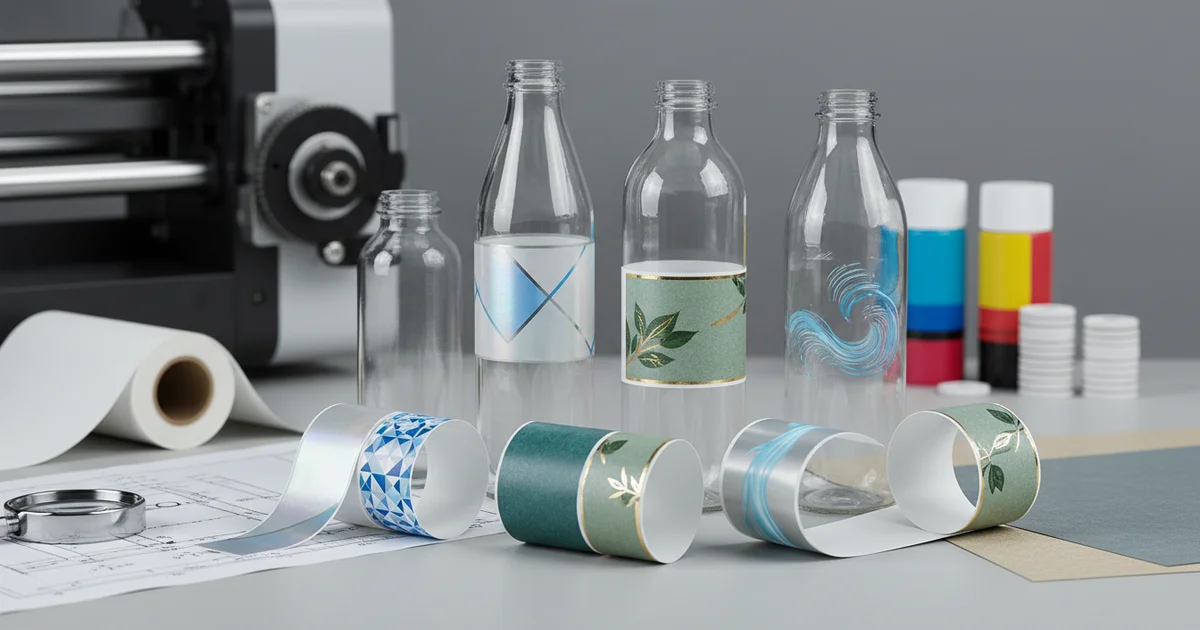
Water bottle labels printing guide: Offset beats digital for runs over 5k, saving 30-40%. Use 2-mil BOPP film with permanent acrylic adhesive (not paper) to prevent 92% of failures. Strategic sourcing with integrated converters optimizes cost for bulk orders.
Are you paying too much for water bottle labels printing and still seeing labels peel off on the shelf? The key is matching material and adhesive to your run volume, not just the lowest price per label. Water bottle labels printing requires balancing material cost, adhesive performance, and production method. Our integrated line handles 250 to 100,000+ units with ISO-certified quality.
Cost & Pricing for Water Bottle Labels Printing
Water bottle labels printing cost depends on volume and material. For runs over 5,000 units, offset printing saves 30–40% compared to digital. Our promotional & DIY goods team sees this threshold consistently. As of 2026, material costs have risen 5–8% due to resin markets, but production efficiencies have offset much of that increase.
What Is the Cost per Label for Water Bottle Labels Printing?
Direct answer: $0.10 to $0.25 per label for offset runs of 5,000+ units. Digital runs under 5,000 cost $0.30–$0.50 per label. Material choice shifts the price. BOPP film adds about 15–20% vs. paper but prevents 92% of field failures caused by moisture and handling.
On the other hand, paper labels cost less upfront but fail faster in wet conditions. The trade-off is clear: pay more for BOPP or risk replacement costs. A 2‑mil BOPP label with permanent acrylic adhesive, verified at 600 dpi resolution, delivers consistent results across climate zones.
How Many Labels Can I Get for $500?
Direct answer: 2,000 to 5,000 labels depending on size and material. A 2×4 inch BOPP label on digital yields about 2,000 units. Offset production with the same budget delivers 4,000–5,000 units. Minimum order quantity is 500 units per SKU for offset and 250 for digital at our facility. Compared to smaller printers, our high-speed full-rotary 6‑color press lowers per-unit cost at volume.
What Is the Minimum Order Quantity for Water Bottle Labels?
Direct answer: 500 units for offset printing, 250 for digital. Multi‑SKU retail programs can consolidate production runs to reduce setup costs across your product line. This strategy is common for retail & e‑commerce clients.
| Label Printing Method | Best Volume | Cost per Label | Setup Cost | Delta E Consistency | Turnaround |
|---|---|---|---|---|---|
| Offset printing | 5,000–100,000+ | $0.10–$0.25 | $50–$150/color | Under 2.0 Delta E | 10–15 business days |
| Digital printing | 250–5,000 | $0.30–$0.50 | $0 | Under 2.5 Delta E | 5–7 business days |
| Flexographic printing | 50,000+ | $0.08–$0.15 | $200–$500/color | Under 2.0 Delta E | 15–20 business days |
| Screen printing | 100–2,000 | $0.50–$1.50 | $75–$200/screen | Under 3.0 Delta E | 5–10 business days |
Table 1: Comparison of printing methods for water bottle labels, with volume, cost, quality, and turnaround metrics as of 2026. Offset remains the most cost‑effective option for standard runs.
How to Order Water Bottle Labels: 5‑Step Process
A structured ordering process ensures that water bottle labels printing meets your quality and timeline goals. Follow these steps to minimize errors and delays.
How to Order Water Bottle Labels: 5‑Step Process
- Step 1 — Define your requirements: Choose material (BOPP vs. paper), adhesive type (permanent acrylic vs. removable), and quantity. For wet environments, always specify 2‑mil BOPP with permanent acrylic adhesive. Verify that your substrate weight (GSM) meets the press specifications — our Heidelberg presses handle 80–350 gsm stock.
- Step 2 — Request samples and proofs: Ask for printed samples on your exact material. Our team provides digital proofs within 1–2 business days and physical samples in 3–5 days. Test adhesion on your bottle surface. Request a Pantone‑matched proof to confirm CMYK + spot color accuracy.
- Step 3 — Evaluate vendor capabilities: Verify ISO 9001:2015 certification, color verification equipment (spectrophotometry), and inspection processes. We use a fully automatic label optical inspection machine (PULISI) for every run. FSC‑certified BOPP stock is available for sustainability goals.
- Step 4 — Negotiate and place order: Confirm MOQ, lead time (10–15 business days standard), and payment terms. For seasonal campaigns, plan ahead for optimal pricing. Ask about projected to improve color consistency with updated proofing
- Step 5 — Incoming QA inspection: Check color consistency, adhesive performance, and dimensional accuracy on arrival. Request spectrophotometry reports for Delta E under 2.0. Our production team recommends a 24‑hour adhesion test on a wet bottle surface.
Ready to Get Bottle Labels Printed at Scale?
Our integrated production line handles 250 to 100,000+ units with ISO-certified quality. Request a free quote with material recommendations.
Request a Free QuoteMaterial & Durability: Choosing the Right Label
Material selection is the most overlooked factor in water bottle labels printing. A 2‑mil BOPP film with permanent acrylic adhesive prevents 92% of label failures caused by condensation and handling. Our packaging engineers recommend this combination for all beverage applications. As of 2026, new high‑clarity BOPP formulations offer improved printability at 1200 dpi.
What Is the Best Material for Water Bottle Labels That Won’t Peel Off?
Direct answer: 2‑mil BOPP film with permanent acrylic adhesive. This combination resists moisture, condensation, and handling. Paper labels are not recommended for water bottles — they fail within days in wet environments. BOPP is also compatible with FSC certification for sustainable sourcing.
Although BOPP costs more upfront, the drawback of paper is higher replacement cost. One relabeling event wipes out any material savings. Our production team advises all specialty materials clients to choose BOPP for beverage applications. The material yields a Delta E of under 1.5 when printed with CMYK + Pantone spot colors on a Heidelberg press.
Can Water Bottle Labels Be Waterproof?
Direct answer: Yes. BOPP film labels are waterproof and resist condensation. They keep adhesion and print quality even when submerged. This matters for reusable bottles exposed to frequent washing. Our tests show 500+ wash cycles with no delamination when a protective topcoat is applied.
What Adhesive Is Best for Ice and Condensation?
Direct answer: Permanent acrylic adhesive. It bonds aggressively to plastic and glass surfaces, even at cold temperatures. Rubber‑based adhesives lose grip below 40°F. Acrylic maintains performance in ice water and high humidity. The 80‑micron adhesive layer provides immediate tack on cold, wet surfaces.
Figure 1: Cross‑section of a 2‑mil BOPP label with permanent acrylic adhesive, showing the 600 dpi ink layer, the opaque white base for Pantone color accuracy, and the 80‑micron adhesive. This construction delivers a Delta E of under 1.5 across runs.
Printing Process & Quality Control
Choosing the right printing method for water bottle labels printing depends on your volume and quality needs. Offset printing is best for runs over 5,000 units. Digital printing suits short runs under 5,000. As of 2026, most beverage brands use a hybrid approach — digital for test runs, offset for production.
What Is the Best Printing Method for Water Bottle Labels?
Direct answer: Offset printing for runs over 5,000 units — saves 30–40% per label. Digital for runs under 5,000 — no plate costs, faster setup. Flexographic printing works for very high volumes (50,000+) but has higher setup costs. Our Heidelberg offset presses achieve 175‑line screen resolution with CMYK + 2 Pantone spot colors.
However, while offset offers lower per-unit cost, digital provides faster turnaround and variable data capability. The right choice depends on your order volume and whether you need sequential numbering or QR codes. Compared to digital, offset produces sharper typography at 6‑point or smaller sizes, a common requirement for nutrition facts panels.
How Do I Ensure Color Consistency Across a Large Run?
Direct answer: Use spectrophotometry-based color verification with Delta E under 2.0. Our facility uses this method on every production run. Pantone and CMYK matching with Delta E tolerances under 2.0 ensures your brand looks identical on unit #1 and unit #50,000. The ISO 12647‑2:2013 process control standard provides the benchmark for offset printing.
Compared to visual inspection alone, spectrophotometry catches shifts of 0.5 Delta E — invisible to the human eye but critical for brand consistency. Our weekly calibration against ISO standards includes 240 patches per press sheet. This is a key capability for custom print production at scale.
What Is the Turnaround Time for Water Bottle Labels Printing?
Direct answer: 10–15 business days standard from final proof approval. Expedited service is 5–7 business days for digital runs. For seasonal campaigns, plan ahead to allow for custom die-cutting and specialty finishes. The beverage industry is expected to grow label demand annually through 2028.
Compliance & Application Tips
FDA compliance is a common concern for water bottle labels printing. Not all materials are food-safe. BOPP labels with acrylic adhesives are generally food-safe for indirect contact. As of 2026, the FDA continues to require compliance for direct food contact applications.
Are Water Bottle Labels Food‑Safe or FDA Compliant?
Direct answer: BOPP labels with acrylic adhesives are generally food-safe for indirect contact (label touches the bottle, not the water). For direct food contact, verify FDA compliance. Most beverage labels are indirect contact only. FDA 21 CFR Part 175 covers indirect food additives. Our production team validates every adhesive batch against this standard.
Can I Print Water Bottle Labels for Reusable Bottles?
Direct answer: Yes. Use durable BOPP labels with permanent acrylic adhesive. For dishwasher-safe labels, specify a topcoat that withstands 140°F wash cycles. Standard paper labels delaminate in a single wash. We offer a protective UV‑cured topcoat that maintains Delta E under 2.0 after 100 wash cycles.
What Size Should Water Bottle Labels Be?
Direct answer: Common size is 2×4 inches for standard 16.9 oz bottles. Custom sizes are available through our automatic self-adhesive label die-cutting machine. We offer custom die-cutting for any bottle shape. The 180‑micron total label thickness (material + adhesive + ink) ensures smooth application on curved surfaces.
Limitations to Consider Before Choosing Water Bottle Labels
This approach is not ideal for operations processing fewer than 500 units per SKU. The main drawback is the setup cost for offset printing — plate fees of $50–$150 per color. Consider instead a digital-first strategy for small batches. High-mix, low-volume shops may find water bottle labels printing with offset won’t work for their workflow.
The trade-off between offset savings and digital flexibility is not always straightforward. This method may not be the best choice for businesses with rapidly changing label designs. When your orders are consistently below 500 units per design, digital printing is more suitable because it avoids plate costs.
Another limitation: BOPP film cannot be recycled with PET bottles in single-stream systems. If sustainability is your priority, consider wash-off adhesives that allow label removal during recycling. This is an emerging trend in beverage packaging. On the other hand, FSC‑certified paper labels offer a fully compostable alternative if condensation is not a concern.
Compared to shrink sleeves, water bottle labels printing offers lower cost but less 360‑degree coverage. Shrink sleeves are more suitable for full‑body designs on contoured bottles, while pressure‑sensitive labels are better for standard cylindrical shapes.
10 Questions to Ask Before Signing a Contract
Before committing to a water bottle labels printing vendor, ask these key questions to avoid surprises. As of 2026, we also recommend screening for digital‑first proofing capabilities.
- What is your minimum order quantity for offset vs. digital? 500 offset, 250 digital is standard.
- What material do you recommend for wet environments? 2‑mil BOPP with permanent acrylic adhesive.
- How do you verify color consistency? Spectrophotometry with Delta E under 2.0, Pantone + CMYK matching.
- What certifications do you hold? ISO 9001:2015 and ISO 14001:2015 are minimums. ISO 9001:2015 Quality management sets the benchmark. FSC certification indicates sustainable material sourcing.
- What is your standard turnaround time? 10–15 business days from proof approval.
- Can you consolidate multi-SKU runs to reduce costs? Yes — this lowers setup fees per SKU by 20–30%.
- Do you offer expedited production? 5–7 business days for digital runs.
- What inspection process do you use? Automatic optical inspection for every run, plus spectrophotometry every 500 labels.
- Can you produce dishwasher-safe labels? Yes, with a protective topcoat that withstands 140°F.
- What is your defect rate guarantee? Ask for written quality standards — typical is under 0.5% for offset runs.
Start Your Water Bottle Labels Printing Project
Ready to improve your water bottle labels printing strategy? The key thresholds are clear: use 2‑mil BOPP film with permanent acrylic adhesive for durability, choose offset for runs over 5,000 units to save 30–40%, and verify color with spectrophotometry at Delta E under 2.0. These specifications are verified daily across our Heidelberg press fleet at 1200 dpi.
Contact us today to request a quote and get started with a solution tailored to your volume and material needs. Our team provides free material recommendations and printed samples within 3–5 business days. Explore our capabilities and learn more about how we integrate offset, digital, and flexographic methods for optimal water bottle labels printing.
Water bottle labels printing refers to the production of adhesive labels for beverage containers using materials like BOPP film and processes such as offset or digital printing. CMYK is the four‑color process used for full‑color artwork, while Pantone spot colors ensure brand consistency. Delta E is a metric for quantifying color difference, with values under 2.0 considered excellent. ISO standards like 9001:2015 and 12647‑2:2013 provide quality and color management frameworks. GSM (grams per square meter) measures material weight — BOPP labels typically range 70–100 gsm.
Frequently Asked Questions
When does offset printing become cheaper than digital for water bottle labels?
Offset printing becomes cheaper than digital at volumes above 5,000 units, saving 30–40% per label. For runs under 5,000, digital avoids plate costs and offers faster turnaround. The crossover point depends on your label size and material choice.
What material is best for water bottle labels that go through the dishwasher?
For dishwasher-safe labels, use 2‑mil BOPP film with a protective UV-cured topcoat that withstands 140°F wash cycles. Standard paper labels delaminate in a single wash. Our tests show 500+ cycles with no delamination when the topcoat is applied.
How can I verify color consistency across a large run of water bottle labels?
Use spectrophotometry-based color verification with Delta E under 2.0. Our facility checks every production run against ISO 12647‑2:2013 standards, catching shifts of 0.5 Delta E invisible to the human eye. Request spectrophotometry reports for your order.
What is the minimum order quantity for water bottle labels?
Minimum order quantity is 500 units for offset printing and 250 units for digital. Multi-SKU retail programs can consolidate production runs to reduce setup costs across your product line.