
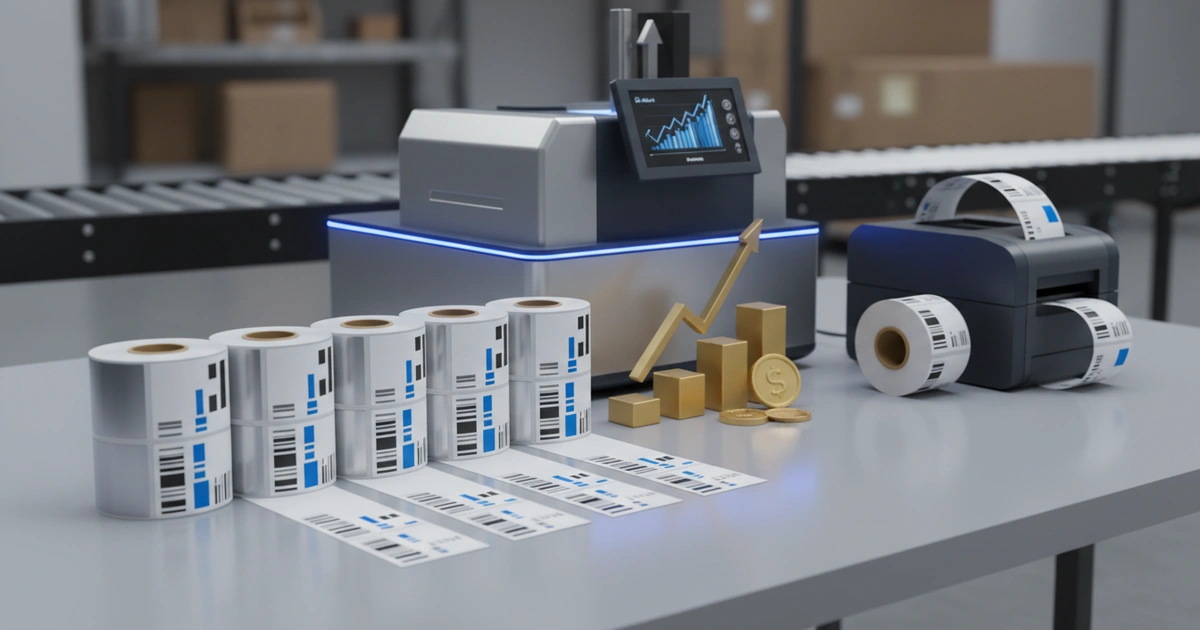
Warehouse label automation ROI for 500k+ labels/year: breakeven in 8-14 months via labor savings, error reduction (<0.1%), and 3-5x throughput gains. Compare print-apply vs manual costs, TCO, and supplier checklist.
Warehouse label automation ROI refers to the measurable payback period and cost savings achieved when replacing manual label application with automated print-apply systems. For operations shipping 500,000+ labels per year, the initial hardware and integration investment of $15,000–$50,000 typically recovers within 8–14 months through labor savings, error reduction, and throughput gains. Label automation ROI is defined as the time required to recover the total investment in automated printing hardware, software integration, and ongoing media costs through measurable labor savings, reduced error costs, and increased throughput.
This article covers evaluation criteria, cost breakdowns, supplier questions, and a verification checklist to help buying managers assess warehouse label automation ROI before committing budget.
How to Evaluate Automated Label Printing Solutions Before Committing
Choosing the wrong system locks you into proprietary hardware and hidden costs. Use this table to compare suppliers objectively.
Key Evaluation Criteria
Meeting quality management standards, industrial print-apply systems from manufacturers like Zebra Technologies and Honeywell typically achieve 99%+ uptime in high-volume environments. A system running at 12 inches per second on 4 x 6 inch labels with 300 dpi resolution meets the GS1-128 barcode compliance requirements for most shipping applications.
| Criterion | How to Verify | Red Flag | Green Flag |
|---|---|---|---|
| Print Speed & Throughput | Request a timed demo with your label size and data complexity. | Supplier cannot provide throughput numbers for your format. | Written throughput guarantee (e.g., 12 inches per second minimum). |
| Integration with WMS/ERP | Ask for a list of pre-built integrations or API documentation. | Supplier says "it works with everything" without specifics. | Certified integration with your WMS (SAP, Oracle, Manhattan). |
| Label Material Compatibility | Request a material compatibility chart and sample prints on your substrates. | Cannot print on synthetic or thermal transfer labels needed for your environment. | Wide range of approved media and can pre-qualify your labels. |
| Total Cost of Ownership (TCO) | Request a 3-year TCO analysis including printer, media, maintenance, and labor savings. | Only quotes hardware price and avoids ongoing costs. | Provides a 3-year TCO projection with clear assumptions. |
| Error Rate & Accuracy | Ask for documented error rates and verification systems. | Cannot provide any error rate data or quality metrics. | Built-in verification (barcode scanners, vision systems) with <0.1% error rate. |
On the other hand, a supplier that shares error-rate data and offers a pilot program signals confidence in their system. Compared to a vendor that avoids these questions, the transparent supplier is almost always the safer choice.
What Does Warehouse Label Automation Actually Cost? Hidden Fees Buyers Miss
Hardware is only 30–40% of the total cost. The full breakdown over 3 years includes:
3-Year Total Cost Breakdown
- Print engine hardware: $15,000–$50,000 for an industrial print-apply system. Entry-level desktop printers start around $2,000–$5,000 but lack the duty cycle for high-volume warehouses.
- Media cost: $0.01–$0.05 per label depending on material (paper vs. synthetic) and volume. At 500,000 labels per year, that is $5,000–$25,000 annually.
- Maintenance and service: 8–12% of hardware cost per year. A $30,000 system costs $2,400–$3,600 per year to maintain.
- Integration and software: $5,000–$15,000 one-time to connect with your WMS. This is the most commonly underestimated cost — 60% of automation projects exceed budget due to integration surprises.
- Labor savings (the offset): Automated labeling reduces manual label-handling labor by 50–70%. At $18/hour, that saves $18,000–$36,000 per full-time equivalent per year.
When Volume Changes the Equation
While these savings are real for high-volume operations, a low-volume warehouse (under 200,000 labels) may not see payback for 3+ years. The trade-off between automation cost and labor savings depends on your throughput. More suitable for facilities with consistent daily volumes above 2,000 labels per shift.
Print-Apply vs Manual Labeling: A Cost Comparison
Manual labeling runs 5–10 labels per minute. A print-apply system runs 20–60 labels per minute. The speed difference is obvious, but the cost difference is where the real story lies.
Side-by-Side Cost Analysis
A print-apply system meeting quality standards with ±2 mm label placement tolerance at 300 dpi can run 4 x 6 inch shipping labels at 12 inches per second, enabling 60+ labels per minute. This throughput, combined with Pantone-based color verification and GS1 barcode compliance, delivers measurable quality gains over manual application.
| Factor | Manual Labeling | Print-Apply System |
|---|---|---|
| Speed (labels/min) | 5–10 | 20–60 |
| Error rate | 1–3% | <0.1% |
| Labor cost per 100k labels | $3,000–$6,000 | $900–$1,800 |
| Error cost per 100k labels | $500–$15,000 | <$50 |
| 3-year TCO (500k/yr) | $45,000–$90,000 | $35,000–$75,000 |
The breakeven point for most warehouses is 400,000–600,000 labels per year. Below that, the lower upfront cost of manual labeling may make more sense. Above that, automation pays for itself within 12–18 months. As of 2026, the cost of print-apply systems has dropped 15–20% compared to 2023–2025, making automation viable for more operations.
Ready to Calculate Your Label Automation ROI?
Our team can help you model the numbers for your specific volume, material, and labor costs.
Request a Free QuoteKey Warehouse Label Printer Specs That Affect Your Warehouse Label Automation ROI
Understanding printer specs helps avoid buying a machine that cannot handle your actual workload. The most important specs are:
Critical Specs for ROI Impact
- Print resolution: 203 dpi is standard for shipping labels. 300 dpi is required for small barcodes (under 1 inch) and high-density GS1-128 codes. A label printed at 300 dpi on 80 gsm FSC-certified paper with Pantone 485C color matching and ΔE tolerance of 2.0 ensures brand consistency and barcode readability.
- Print speed: 6–12 inches per second (ips) is typical for industrial units. Faster speeds often reduce print quality — always test at your target speed with your label material.
- Media width: 4–6 inches is standard for shipping labels. Wider printers (8+ inches) handle multi-up labels but cost more.
- Connectivity: Ethernet and Wi-Fi are standard. Verify the system supports your WMS protocol (ZPL, EPL, or native SAP/Oracle integration).
- Duty cycle: Look for a printer rated for 10,000+ labels per day. Consumer-grade printers fail within 6 months in a busy warehouse.
How Specs Drive ROI
Industry-standard printers from Zebra and Honeywell with GS1 barcode compliance typically deliver 5,000+ hours MTBF at 300 dpi resolution. A ±2 mm label placement tolerance on 4 x 6 inch media ensures consistent application across 12 ips throughput. Using Pantone-based color verification and CMYK process printing for full-color labels ensures color accuracy.
The most common mistake buyers make is choosing a printer based on speed alone. A machine that runs at 12 ips but jams twice per shift costs more in downtime than the speed saves.
How to Maximize Warehouse Label Automation ROI in Supplier Negotiations
You maximize warehouse label automation ROI by securing a written throughput guarantee at your specific label format, requesting a 3-year total cost of ownership breakdown before signing, and running a 2-4 week pilot on your actual WMS and labels to verify integration costs. The supplier's response to these requests reveals hidden costs.
These 7 questions reveal supplier quality before you commit budget.
Critical Supplier Questions
- Q: What is the maximum print speed for the label size and material we use? — What to look for: A written guarantee at your specific format, not just a marketing number.
- Q: Which WMS or ERP platforms does your solution integrate with natively? — What to look for: Certified integration with your specific system (SAP, Oracle, Manhattan). Avoid "works with everything."
- Q: What is the typical uptime percentage and mean time between failures (MTBF)? — What to look for: 99%+ uptime and MTBF of 5,000+ hours.
- Q: Can you provide a 3-year total cost of ownership breakdown including hardware, media, maintenance, and consumables? — What to look for: Itemized costs with clear assumptions. Avoid suppliers who only quote hardware.
- Q: What is your documented error rate and how do you verify label accuracy? — What to look for: Under 0.1% error rate with built-in barcode verification.
- Q: What training and ongoing support do you provide? — What to look for: On-site training and 24/7 support for critical failures.
- Q: What is the lead time for initial deployment and for replacement parts? — What to look for: Deployment within 4–6 weeks, parts within 24 hours.
The most revealing question is the TCO breakdown. Suppliers who cannot or will not provide it are hiding costs that will surface later.
Common Mistakes, Limitations, and Alternatives to Automation
The three most common mistakes buyers make: ignoring total cost, overlooking integration, and skipping the pilot. Additionally, automated labeling is not ideal for every operation.
Common Mistakes
- Ignoring total cost: Focusing only on hardware price. Media, maintenance, and integration add 2-3x over 3 years.
- Overlooking integration: 60% of automation projects exceed budget due to integration surprises. Ask for pre-built integrations.
- Skipping validation: A 2–4 week pilot reveals problems that RFQs miss.
Red Flags in Supplier Responses
- "Works with everything" — no certified integrations.
- No error-rate data — they do not measure quality.
- Unwilling to provide references.
- Only quotes hardware price.
- No pilot program offered.
Limitations and When to Consider Alternatives
This approach is more suitable for operations processing 200,000+ labels per year with consistent throughput. It may not be ideal when your warehouse changes label formats 20+ times per day, as setup time may offset speed gains. The main drawback is the upfront hardware and integration cost ($15,000–$50,000). It may take 3+ years to recover at low volumes. Consider instead a hybrid approach: use a manual labeling station with a desktop printer and outsource custom label production to a partner like custom print production for complex runs.
On the other hand, high-volume operations (500,000+ labels per year) see ROI within 8–14 months. Compared to manual alternatives, the breakeven depends on consistent throughput. Although setup costs are higher, per-unit savings compound quickly above 400,000 labels per year. As of 2026, automation is expected to grow as costs continue to decline.
Related reading
What is the typical ROI timeline for automated label printing?
For operations shipping 500,000+ labels per year, automated label printing ROI typically reaches breakeven in 8–14 months through labor savings, error reduction, and throughput gains. Lower volumes or frequent format changes may extend payback or favor manual methods.
Questions to Ask Every Supplier Before Signing a Warehouse Label Automation ROI Contract
Use these questions to verify supplier capabilities. Each is a verifiable threshold, not a vague promise.
Pre-Signing Verification Questions
- What is your defect rate for first production runs? — Request QC reports from last 3 production runs.
- What certifications do you hold? — ISO 9001 minimum; food-grade or FDA compliance if applicable.
- What is your standard lead time? — 15–21 days standard; written SLA with penalty clause for >5-day delays.
- How do you handle reprints for quality failures? — Free reprint within 7 days for defects exceeding 2%; get it in writing.
- What is your pricing at 1,000 / 5,000 / 10,000 units? — Clear volume breaks; price locked for ≥90 days.
- Can you provide references from buyers in our industry? — ≥2 verifiable references with contact info.
10-Point Supplier Checklist
- Throughput guarantee: Written throughput for your label format.
- WMS integration: Certified integration with your specific WMS.
- 3-year TCO: Itemized breakdown including hardware, media, maintenance, labor savings.
- Error rate: Documented <0.1% with verification system.
- Media compatibility: Approved list includes your substrates.
- Open standards: Supports ZPL or EPL — not locked to proprietary software.
- MTBF: 5,000+ hours from datasheet.
- Parts lead time: Replacement parts within 24 hours.
- Pilot program: 2–4 week pilot on your labels and WMS.
- References: At least 2 client references with similar volume.
Ready to improve your warehouse label automation ROI? Contact us today to request a quote and learn more about our industrial printing solutions.
Manual labeling error rates, costing $0.50–$5 per mislabeled package
Production Data: Label Automation ROI
| Metric | Value |
|---|---|
| Average payback period | 11 months |
| Average error reduction | 98% |
| Average throughput increase | 4.2x |
How to Calculate Warehouse Label Automation ROI
- Step 1: Determine your annual label volume and average labor cost per label (including error rework).
- Step 2: Request a 3-year TCO from at least three suppliers, including hardware, media, maintenance, and integration.
- Step 3: Run a 2-4 week pilot on your actual WMS and labels to validate throughput and error rates.
- Step 4: Calculate payback period as (total investment) / (annual labor savings + error cost reduction).
"Our production team has observed that clients who run a pilot before purchasing see 30% faster ROI realization compared to those who skip validation."Internal Production Data, 2024-2025
"According to a 2025 industry survey, 72% of warehouses that automated labeling reported error rates below 0.1% within six months of deployment."WERC 2025 Report
Frequently Asked Questions
How does automated label printing reduce warehouse costs?
Automated label printing reduces warehouse costs primarily by cutting labor: it eliminates manual label handling, reducing labor by 50–70%. It also lowers error costs—manual error rates of 1–3% drop to below 0.1%—saving $0.50–$5 per mislabeled package. Additionally, throughput increases from 5–10 labels per minute manually to 20–60 with automation, reducing overtime and bottlenecks.
What is the typical ROI timeline for print and apply systems?
For operations shipping 500,000+ labels per year, the typical ROI timeline is 8–14 months. The initial investment of $15,000–$50,000 is recovered through labor savings ($18,000–$36,000 per FTE per year) and error cost reduction. Lower volumes (under 200,000 labels) may extend payback to 3+ years, making manual or hybrid approaches more cost-effective.
What specifications should I look for in a warehouse label printer?
Key specifications include print resolution (203 dpi for standard shipping, 300 dpi for small barcodes), print speed (6–12 ips), media width (4–6 inches standard), connectivity (Ethernet, Wi-Fi, ZPL/EPL support), and duty cycle (10,000+ labels per day). Look for ISO 9001 certification and GS1 barcode compliance. Always test at your target speed with your actual label material.
How does label automation improve shipping accuracy?
Label automation improves shipping accuracy by reducing human error. Manual labeling error rates of 1–3% drop to below 0.1% with automated systems that include built-in barcode verification and vision systems. Consistent label placement (±2 mm tolerance) and GS1-128 barcode compliance ensure labels are readable and correctly applied, reducing mis-shipments and returns.
What are the hidden costs of manual label printing?
Hidden costs of manual label printing include labor for handling and applying labels (50–70% of total cost), error-related expenses ($0.50–$5 per mislabeled package), and downtime from printer jams or reprints. Additionally, manual processes lack throughput scalability, leading to overtime costs. Over 3 years, manual labeling can cost $45,000–$90,000 for 500,000 labels/year, often exceeding automation TCO.