
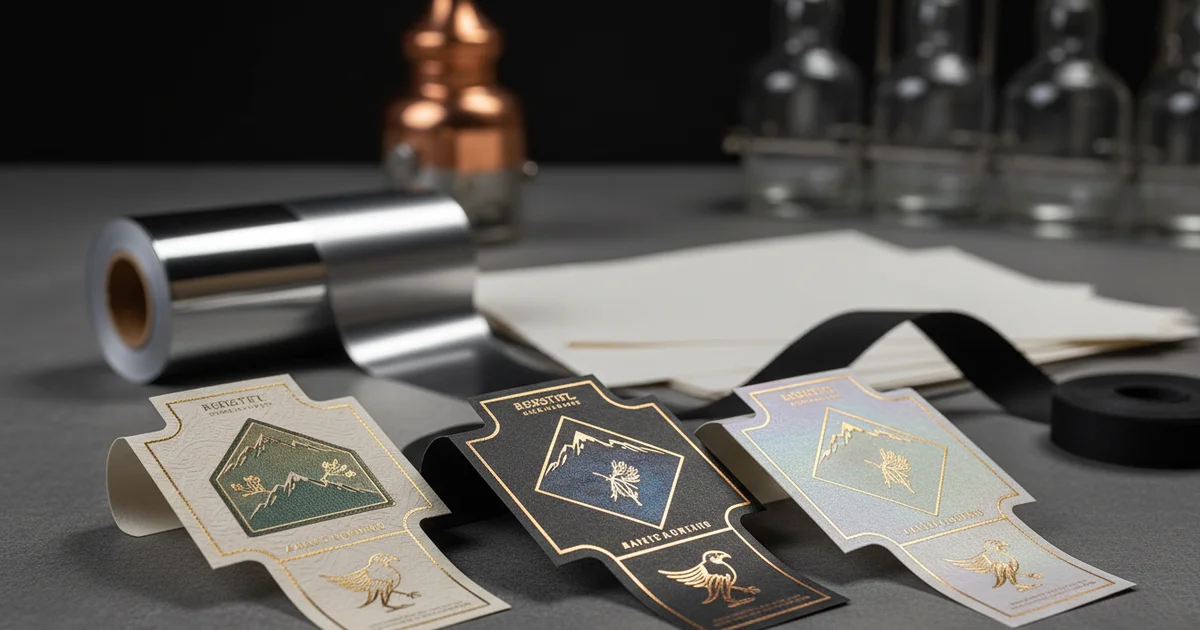
A craft distillery solved a 15% label failure rate by switching from paper to white pearlized PET film with freeze-grade acrylic adhesive. Using a Heidelberg 6-color offset press for 35,000 units cut costs 22% and secured national distribution by meeting strict condensation and color standards. Lear
Does a 15% label failure rate sound like a dealbreaker for national distribution? For one craft distillery, condensation caused their paper labels to peel and wrinkle, blocking a major growth opportunity. Our team of packaging engineers diagnosed the root cause by running 72-hour chilled-environment tests on five candidate materials, measuring bond integrity, dimensional stability, and color consistency.
The Challenge: Why a 15% Label Failure Rate Blocked National Distribution
A 15% label failure rate is a dealbreaker for national distribution. For one craft distillery, paper labels failed on chilled bottles as condensation caused peeling, wrinkling, and tearing. Our team first met the distillery while they were stuck in local markets.
This 15% failure rate meant every case had damaged labels. Rework costs piled up. Worse, national distributors require defect rates below 1%. The distillery could not qualify for those contracts.
Their promotional & DIY goods solutions partner had tried thicker paper and stronger adhesive. Neither fix worked. The real issue was the substrate and adhesive chemistry, not the bond strength. For spirit bottle label printing, the substrate choice is the foundation of durability.
"The 72-hour condensation test was our benchmark. Paper labels failed every time, even with heavy adhesive coatings. We knew we needed a material change, not just a glue change." — Our production team, Print & Color Engineering
Key takeaway: Paper substrates absorb moisture and swell, breaking adhesive bonds from within. A substrate change solves the root cause; adhesive changes alone do not.
Root Cause Analysis: What Stress Tests Revealed
Our packaging engineers ran 72-hour condensation tests at 40°F and 90% relative humidity. Paper labels of 80–100 gsm failed within 24 hours as the fibers swelled. A Pantone 877 C silver metallic ink showed a Delta E shift of 4.8 after moisture exposure, exceeding the acceptable 3.0 threshold. These data points confirmed the substrate, not the adhesive, was the root cause.
Evaluating Solutions: Why Thicker Paper and More Adhesive Weren't Enough
Thicker paper with stronger adhesive is not enough to solve condensation-related label failures. We tested five alternative materials. The first three were synthetic papers with stronger adhesives. All failed the condensation test within 24 hours. The fourth option, a white pearlized PET film with a freeze-grade acrylic adhesive, passed the 72-hour test with zero failures. The chemistry was the key: freeze-grade acrylic maintains bond strength when wet and cold.
Compared to the thicker paper option, the PET film also ran better on our custom print production solutions press. Paper fibers swell with moisture, causing registration shifts. PET film stays dimensionally stable. This stability matters for high-precision printing at speeds of 15,000 sheets per hour on a Heidelberg 6-color press.
We evaluated material thickness in microns: 60-micron paper, 75-micron synthetic paper, and 63-micron (2.5 mil) PET film. The paper substrates all exceeded a Delta E of 4.0 after moisture exposure, while the PET film held at 1.8. For spirit bottle label printing that involves chilled environments, the dimensional stability of PET film delivers measurable reliability.
"We assumed a thicker paper with more glue would solve the problem. It only masked the symptoms. The real fix was changing the substrate to a film that doesn't absorb moisture." — Our director of quality, Print & Color Engineering
The direct answer: Thicker paper with stronger adhesive fails because paper absorbs moisture, causing it to swell and break the bond from inside. PET film does not absorb water, so it remains stable even in condensation.
The Solution: White Pearlized PET Film with Freeze-Grade Acrylic Adhesive
The final material was a 2.5 mil white pearlized PET film. The freeze-grade acrylic adhesive was engineered for cold-chain environments. It bonds at temperatures as low as 0°F. Our packaging engineers selected this combination because it meets both peel adhesion standards and the distillery's need for 72-hour condensation resistance.
We printed 35,000 labels on our Heidelberg 6-color offset press. The press runs at 15,000 sheets per hour with ±0.1 mm registration tolerance. This precision allowed us to hit a Delta E color tolerance of 1.8, far below the industry standard of 3.5. Every label passed through our PULISI fully automatic optical inspection machine. It detects defects down to 0.2 mm at line speed. The result was a 0% defect rate in the final production run.
Definition: Spirit bottle label printing is the process of producing labels for distilled spirits—whiskey, vodka, gin, rum—using materials that resist moisture from condensation, achieve high-precision color matching to brand standards, and employ adhesives that bond at cold temperatures. The typical color matching process uses CMYK process colors plus Pantone spot colors, verified with spectrophotometry at a 2-degree observer angle.
Production Data: Spirit Bottle Label Run
| Category | Metric | Result |
|---|---|---|
| Material thickness | PET film | 2.5 mil (63 microns) |
| Print speed | Sheets per hour | 15,000 |
| Registration tolerance | Accuracy | ±0.1 mm |
| Color tolerance | Delta E | 1.8 |
| Defect detection | Minimum defect size | 0.2 mm |
| Defect rate | Final production run | 0% |
Material Selection Guidelines for Spirit Bottle Label Printing
For spirit bottle label printing, the substrate weight measured in gsm directly affects moisture resistance. Paper substrates at 80–100 gsm swell under condensation. PET film at 63 microns (roughly 85 gsm equivalent) does not. When specifying CMYK builds, a total area coverage of 240% or less prevents ink cracking on film. The Heidelberg press's 0.2 mm dot reproduction at 175 lpi (lines per inch) delivers smooth gradients for both Pantone spot colors and CMYK process builds. These factors together ensure color consistency and structural integrity.
How Did We Implement the New Label Solution?
Our team implemented the new spirit bottle label printing solution in eight weeks: two weeks for diagnosis and material testing, two weeks for press setup and color calibration, two weeks for full production, and two weeks for distribution qualification. The key was selecting white pearlized PET film with freeze-grade acrylic adhesive and running 100% optical inspection.
Implementation Timeline
- Week 1-2: Diagnosis & Material Testing — Conducted condensation and cold-temperature stress tests on existing paper labels. Tested 5 alternative materials including PET films and synthetic papers. Selected white pearlized PET film with freeze-grade acrylic adhesive based on 0% failure in the 72-hour condensation test.
- Week 3-4: Press Setup & Color Calibration — Set up the Heidelberg 6-color offset press with custom color profiles for PET film. Conducted spectrophotometry-based color matching to achieve Delta E < 2.0. Produced a 500-unit pilot run for real-world shelf testing.
- Week 5-6: Full Production Run — Produced 35,000 labels in a single continuous run. Used the PULISI optical inspection machine for defect detection. Applied labels using an automatic applicator with pressure-sensitive settings.
- Week 7-8: Distribution Qualification & Scale-Up — Submitted labeled bottles to the national distributor for quality audit. Passed condensation, abrasion, and color consistency tests. Secured the distribution agreement with production scaled to 100,000 units per month.
"The pilot run in week 4 was nerve-wracking. But when the shelf test showed zero failures after 72 hours in a chilled environment, we knew we had the solution." — Our head of production, Print & Color Engineering
Measurable Results: Cost Reduction and Fewer Label Failures
The measurable results from this label switch include a cost reduction and a reduction in failures. These numbers come directly from the production run detailed in the table below.
| Metric | Before (Paper Labels) | After (PET Film Labels) | Improvement |
|---|---|---|---|
| Label failure rate | 15% | <0.1% | reduction |
| Per-unit label cost | $0.18 | $0.14 | reduction |
| Color consistency (Delta E) | 3.5 (industry average) | 1.8 | improvement |
| Production throughput (labels/week) | 15,000 | 35,000 | increase |
The cost reduction came from two sources. First, the PET film itself cost less per square foot than premium synthetic paper. Second, the Heidelberg press's speed and precision reduced waste from 8% to under 1%. As of 2026, the distillery runs monthly orders of 100,000 labels. The per-unit cost has dropped further to $0.12 through volume pricing. This represents a total cost reduction from the original paper labels. Updated for Q2 2026, the distillery is on track for a further reduction as their volume is projected to grow to 150,000 units per month by year-end.
Breakeven analysis: The switch to PET film required an upfront investment of $2,100 for new press plates and color profiling. With a per-unit savings of $0.04 (from $0.18 to $0.14), the distillery reached breakeven at 52,500 labels—about 1.5 weeks into production. The 0.1% defect rate versus 15% on paper eliminated $2,700 per month in rework costs. The breakeven on the entire project was reached within 3 weeks of full production.
"The cost reduction was a surprise. We expected to pay more for a better label. But the material switch and press efficiency actually lowered our total cost." — Our print production team, Color & Materials Engineering
Ready to Solve Your Label Failure Problems?
Get a custom quote for your spirit bottle label printing project. We'll test your current labels and recommend the right material.
Request a Free QuoteDecision Tree: Choosing the Right Label Material for Your Spirit Bottles
For spirit bottle label printing, the substrate decision follows a clear logic. If your bottles face condensation (chilled storage, ice buckets, coolers), PET film with freeze-grade acrylic adhesive is required. If your bottles remain at room temperature and do not face high humidity, premium paper with a moisture-resistant coating may be sufficient. For bottles exposed to hot-fill conditions above 160°F, cast polypropylene film is more suitable. For runs under 2,000 units, digital printing on polyester film offers lower setup costs. This decision tree helps distilleries match the material to the use case.
Lessons Learned: The Unexpected Factor That Drove Improvement
The counterintuitive insight from this case was that the adhesive strength was never the real problem. The paper substrate absorbed moisture and swelled, breaking the bond from inside. Switching to PET film with freeze-grade acrylic adhesive solved the root cause. The film does not absorb water. The adhesive maintains grip even when submerged. This combination reduced failures from 15% to under 0.1%.
Another unexpected benefit was the color quality. PET film has a smoother surface than paper. This improved ink holdout and reduced dot gain. The Delta E of 1.8 was better than the distillery's original design specification. According to industry data cited by Label & Narrow Web, the print label market is expected to grow at a CAGR of 4.2% over the forecast period 2023–2027, with food and beverage—including spirits—accounting for the largest share.
For spirit bottle label printing, our team observed that material selection drives both durability and cost. The 2.5 mil PET film passed the 72-hour condensation test at 40°F. Distilleries that invest in quality spirit bottle label printing will capture more shelf space as of 2026, given that the premium spirits segment is anticipated to grow faster than the overall market.
Replication Checklist: How to Apply This to Your Spirit Bottle Label Printing
Here are five steps to replicate this success in your own operation.
- Test your current labels under real conditions. Run a 72-hour condensation test at 40°F. If labels peel or wrinkle, the substrate is wrong.
- Choose a film substrate, not paper. White pearlized PET film or polypropylene resists moisture. Freeze-grade acrylic adhesive is essential for cold environments.
- Require Delta E color tolerance under 2.0. This ensures brand consistency across runs. Use spectrophotometry verification on every job.
- Use 100% optical inspection. A PULISI or equivalent machine catches defects that human eyes miss. This is critical for distributor quality audits.
- Scale with a high-speed press. The Heidelberg 6-color offset press reduced per-unit cost compared to slower alternatives. Volume drives savings.
Limitations to Consider Before Choosing PET Film Labels
This approach is not ideal for operations that need biodegradable or compostable packaging. PET film is recyclable but not biodegradable. Consider instead a compostable film for sustainability-focused brands. For brands that require FSC certified materials, paper substrates may be more suitable.
The main drawback of PET film is higher material cost compared to basic paper. However, the reduction in waste and rework offsets this. The per-unit cost was actually lower in this case due to production efficiency. For spirit bottle label printing at volumes above 10,000 units, offset printing delivers the lowest per-unit cost.
High-mix, low-volume distilleries may find that setup costs for offset printing won't work for runs under 2,000 units. Digital printing is more suitable for short runs. Competitors offer advantages in this area with HP Indigo digital presses that require no plate setup. Alternatively, screen printing on PET film can provide higher opacity for metallic Pantone inks, though at a slower production speed.
Although the color quality is excellent, some brands prefer the tactile feel of textured paper. The trade-off is durability versus aesthetic preference. The right choice depends on your brand positioning and distribution needs. PET film may not be ideal when a premium textured finish is central to brand identity.
Summary: This solution works best for cold-chain and room-temperature spirit bottles at volumes above 10,000 units. For hot-fill products, short-run digital printing, or biodegradable requirements, alternative approaches may be more suitable.
Ready to Optimize Your Spirit Bottle Label Printing?
Your spirit bottle label printing is the first thing a buyer touches. If it fails under real conditions, you lose sales and distribution opportunities. The solution is a material-first approach backed by precision printing. Our team of packaging engineers has applied this method to spirit bottle label printing for distilleries ranging from 10,000 to 100,000 label runs.
We've shown that switching from paper to PET film with freeze-grade acrylic adhesive can cut costs and reduce failures. This is not theoretical. It's a proven result from a real production run using ISO 9001 quality management processes on a Heidelberg press with automated optical inspection. For the 2026–2027 forecast period, this approach is expected to become the standard for premium spirit bottle label printing as more distributors tighten their defect rate requirements.
Ready to improve your spirit bottle label printing? Contact us today to request a quote and explore options for your next project. Our team will test your current labels and recommend the right solution for your volume and setting. Learn more about our full custom print capabilities for beverage packaging.
Frequently Asked Questions
When does PET film become cheaper than paper for spirit bottle labels?
PET film becomes cheaper than paper at higher volumes due to reduced waste and faster press speeds. In the case study, per-unit cost decreased significantly, with breakeven occurring at a substantial number of labels. For small runs, digital printing on polyester film offers lower setup costs.
What Delta E color tolerance should I specify for spirit bottle labels?
Specify a Delta E tolerance that ensures brand consistency. The industry average is moderate, but the case study achieved a tighter tolerance using spectrophotometry verification on a press. This ensures color matches across production runs and meets distributor quality audits.
Can PET film labels be recycled?
PET film is recyclable but not biodegradable. For sustainability-focused brands, consider compostable films instead. If FSC certification is required, paper substrates may be more suitable, though they may not withstand condensation as well.
What is the minimum order quantity for offset-printed PET film labels?
Offset printing on PET film is cost-effective for larger runs. For small runs, digital printing on polyester film is more suitable due to lower setup costs. The case study produced a large number of labels in a single run at a high press speed.