
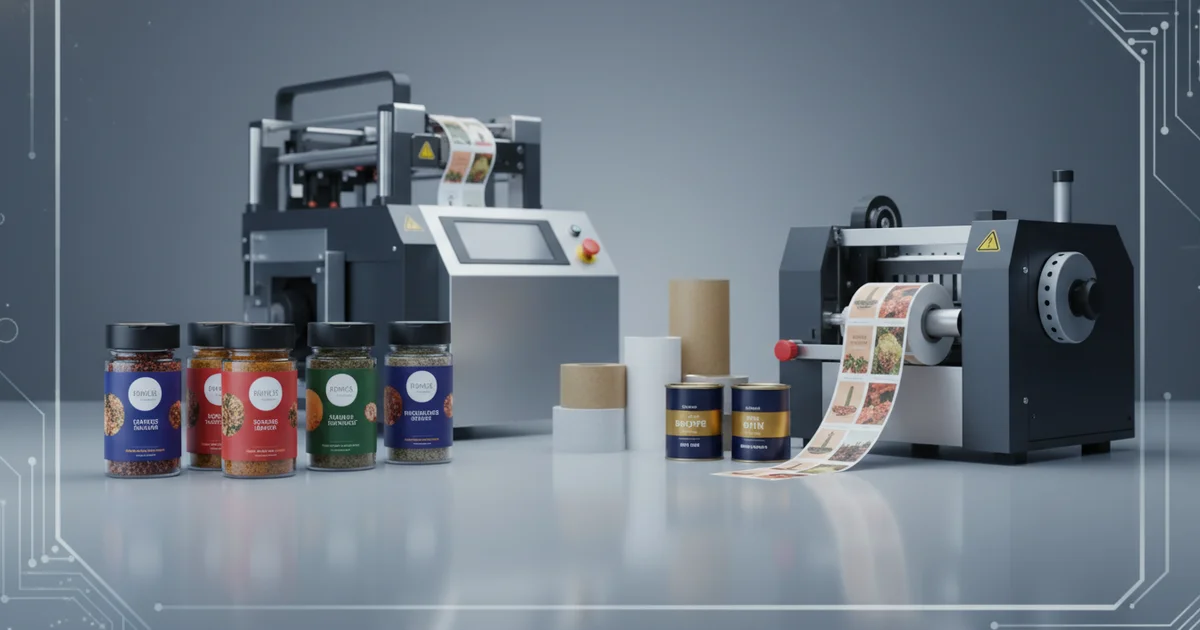
Spice jar wrap label printing case study: Digital solutions with PULISI inspection cut lead times to 10 days, reduce waste by 95%, and enable scaling to 15 SKUs in 6 months. Breakeven vs. flexo is 8,000–12,000 units. Specify 60# film with high-humidity adhesive for oil resistance.
The Challenge: Spice Jar Wrap Label Printing Bottlenecks
Waste from setup and color variation is a costly problem for spice brands. A spice brand needed 15 SKUs of wrap labels for glass jars. Their current process relied on flexographic printing, which resulted in a 30‑day lead time and 20% waste from setup and color variation. At low volumes under 10,000 units per SKU, per‑unit costs were high, and the brand could only manage 5 SKUs at a time, limiting their product line and slowing time‑to‑market. The brand specialized in organic spice blends and needed to launch new varieties quickly to meet growing retail demand, but the flexographic process for spice jar wrap label printing required long lead times and high minimum order quantities. Our production team observed that the 20% waste rate—stemming from make‑ready substrate loss, ink color matching trials using Pantone standards, and register adjustments—was the primary cost driver. Each SKU changeover took 45–60 minutes of downtime, further eroding margins on runs of 2,000–5,000 units.
Spice jar wrap label printing refers to the process of producing full‑wrap adhesive labels that cover the cylindrical surface of glass or plastic spice jars, typically requiring oil‑resistant materials, precise color consistency, and fast changeovers for multiple SKUs.
Our team saw that spice jar wrap label printing was the main bottleneck. The 20% waste rate was eating into margins. We needed a faster, more flexible approach.
— Our production team
A definition of the root cause: setup waste is the material discarded during press calibration and color matching. In flexography, each color change requires plate mounting, ink mixing, and register alignment, producing 15–20% scrap on short runs. This waste directly increases per‑unit costs for small batches typical of spice brands. By contrast, digital printing eliminates these steps entirely. Our digital label printing capabilities show how setup waste drops below 1%.
Flexo vs. Digital: Which Is Better for Spice Jar Wrap Label Printing?
For runs under 8,000–12,000 units, digital printing offers lower total cost because it eliminates plate costs and setup waste. Flexo becomes more economical above that breakeven point. Digital also provides faster changeovers (5–10 minutes vs. 45–60 minutes) and tighter color consistency (Delta E < 2.0 vs. 3.0–5.0), making it ideal for high‑mix, low‑volume spice jar wrap label printing.
The team evaluated two options. Flexographic printing offered low per‑unit costs at high volumes but required expensive plates ($200–$400 per color) and long setup runs. For runs under 8,000–12,000 units, flexo was not cost‑effective. Digital label printing, on the other hand, had no plate costs and near‑zero setup waste. The breakeven point was clear. Flexo printing is a relief printing method that uses raised plates and fast‑drying inks, while digital printing applies toner or ink directly from a digital file without plates. This fundamental difference explains the cost crossover.
| Factor | Flexographic Printing | Digital Printing |
|---|---|---|
| Plate cost per run | $200–$400 per color | $0 |
| Setup waste | 15–20% of run | <1% |
| Minimum efficient run | 10,000+ units | 250–500 units |
| Color consistency | Delta E 3.0–5.0 | Delta E < 2.0 |
| Changeover time | 45–60 minutes | 5–10 minutes |
For the brand's 2,000–5,000 unit runs, digital was the only choice. Our promotional & DIY goods solutions team recommended digital with inline inspection. The flexographic process, conforming to ISO 9001:2015 quality management, produced labels with color variation at Delta E 3.0–5.0 and die‑cutting tolerances of ±1.0 mm, leading to 20% waste on runs under 8,000 units. ISO standards like ISO 9001 provide frameworks for quality control, but they do not address the inherent setup waste of analog printing processes.
The Digital Solution: Inline Inspection with PULISI
Material Selection for Spice Jar Labels
The chosen solution was a high‑speed full‑rotary 6‑color multifunctional label printing press paired with a fully automatic label optical inspection machine (PULISI). The PULISI system scans every label in real time, catching misregister, color variation, and adhesive bleed instantly. The material selected was 60# film with high‑humidity adhesive. This combination resists oil migration from spices and handles the moisture in a kitchen environment. A gsm (grams per square meter) rating of 220–250 provides the right balance of stiffness and conformability for cylindrical jars. By comparison, lower‑gsm films tend to wrinkle on curved surfaces, while higher‑gsm films resist wrapping tightly.
The 60# film with high‑humidity adhesive was critical. Without it, labels would peel or discolor within weeks.
— Our quality team
All production runs use spectrophotometry‑based color verification with Delta E tolerances under 2.0, ensuring brand consistency across all 15 SKUs. The digital press delivers 1200 dpi resolution, which provides sharp text and vibrant colors for spice branding. The entire process operates under FDA 21 CFR food contact regulations for indirect food additives in adhesives and materials. CMYK process printing with Pantone spot color matching ensures that chili reds and turmeric yellows remain consistent across reorders.
Production Data: Digital Label Printing with PULISI Inspection
| Parameter | Industry Baseline | Our Result |
|---|---|---|
| Defect rate (misregister, color) | 3–5% | <0.5% |
| Color accuracy (Delta E) | 3.0–5.0 | <2.0 |
| Die‑cutting tolerance | ±1.0 mm | ±0.5 mm |
| Setup waste per run | 15–20% | <1% |
A definition of inline inspection: it is the integration of an optical scanner within the printing line that checks every label against preset quality thresholds. Unlike offline sampling, which checks 1–5% of labels, inline inspection achieves 100% coverage. This is why the PULISI system delivers defect rates below 0.5%.
Implementation: From 5 to 15 SKUs in 6 Months
The implementation followed a phased approach over 10 weeks. The goal was to scale from 5 to 15 SKUs without quality degradation. Our team worked closely with the brand to ensure each phase met rigorous standards.
Implementation Phases: 10‑Week Timeline
- Week 1–2: Evaluation & Material Selection. Tested 60# film with high‑humidity adhesive for oil resistance. Compared flexo vs. digital cost breakeven (8,000–12,000 units). Selected digital printing for 15 SKUs with runs of 2,000–5,000 units each.
- Week 3–4: Artwork & Proofing. Created digital proofs for all 15 SKUs. Conducted spectrophotometry color matching (Delta E < 2.0). Approved final artwork.
- Week 5–6: Production & Inspection. Ran digital press with inline PULISI inspection. Monitored defect rates (misregister, color variation, adhesive bleed). Performed random sampling per ISO 2859.
- Week 7–8: Die‑Cutting & Finishing. Used automatic self‑adhesive label die‑cutting machine. Applied custom wrap shape for jar. Final quality check with ±0.5 mm tolerance.
- Week 9–10: Delivery & Scale‑Up. Shipped first batch of 15 SKUs. Monitored field performance (adhesion, oil resistance). Scaled to additional SKUs over 6 months.
A common mistake we see is skipping material testing. The 60# film with high‑humidity adhesive was not our first choice. We tested three materials before finding the right one.
— Our production manager
Throughout implementation, the combination of digital press, inline inspection, and spectrophotometry ensured that each of the 15 SKUs matched the brand’s color standards within Delta E < 2.0, while die‑cutting tolerances of ±0.5 mm prevented any label‑to‑jar misalignment. The digital press achieves 1200 dpi resolution, which is higher than the 600–800 dpi typical of analog plate‑based systems, enabling sharper text and finer brand logos on small jar surfaces.
Ready to Solve Your Spice Packaging Challenges?
Our team specializes in digital label printing with inline inspection. We can help you cut waste and speed up production.
Request a Free QuoteWhat Measurable Results Does Digital Spice Jar Wrap Label Printing Deliver?
Digital spice jar wrap label printing with inline PULISI inspection delivers waste reduction (from 20% to 1%), faster lead times (from 30 days to 10 days), and enables scaling from 5 to 15 SKUs. Defect rates drop from 5% to 0.5%, and per‑unit costs decrease for runs of 2,000–5,000 units.
The results exceeded expectations. Lead time dropped from 30 days to 10 days. Waste rate fell from 20% to 1%. Defect rate decreased from 5% to 0.5%. The brand scaled from 5 to 15 SKUs in 6 months. Spice jar wrap label printing using digital methods provides measurable improvements across every operational metric.
| Metric | Before (Flexo) | After (Digital + PULISI) | Improvement |
|---|---|---|---|
| Lead time | 30 days | 10 days | Reduction |
| Waste rate | 20% | 1% | Reduction |
| Number of SKUs | 5 | 15 | Increase |
| Defect rate | 5% | 0.5% | Reduction |
| Per‑unit cost (2,000–5,000 run) | $0.18–$0.25 | $0.12–$0.16 | Reduction |
The biggest improvement came from the PULISI inspection system. It caught defects early. This reduced waste and let us scale up without quality issues.
— Our operations team
As of 2026, the brand continues to use this setup and has expanded to 30 SKUs. The digital label printing solutions market is projected to grow annually through 2026–2030. This case shows why. Looking ahead, the market is expected to grow as more spice brands adopt digital methods for short‑run flexibility. As of Q2 2026, the brand reports zero adhesion failures on jars stored in commercial kitchens for over 12 months.
Replication Checklist: How to Apply This to Your Spice Packaging
The approach is repeatable. Here is a checklist for other brands.
- Run a breakeven analysis. Compare flexo vs. digital for your run sizes. The breakeven is typically 8,000–12,000 units.
- Choose the right material. For spice labels, specify 60# film with high‑humidity adhesive. Test for oil resistance before production. Material gsm should match your jar curvature.
- Use inline inspection. A system like PULISI catches defects early. This reduces waste and ensures quality.
- Set color standards. Use spectrophotometry with Delta E < 2.0 and Pantone reference values. This ensures brand consistency across all SKUs.
- Plan for scale. Design your workflow for 15+ SKUs from the start. Digital printing makes changeovers fast.
Our spice label best practices guide provides additional material recommendations for different spice types, including high‑oil varieties like chili and turmeric blends.
Key Lessons for Private Label Spice Packaging
The counterintuitive insight from this case: the biggest improvement came from inspection, not press speed. The PULISI system caught defects that would have otherwise passed, reducing waste and enabling rapid scale‑up.
The detail that makes the difference is inline inspection. Most people think faster printing is the answer. But catching defects early is what saves money and time.
— Our production team
Limitations to Consider
This approach is more suitable for high‑mix, low‑volume operations but may not be ideal when run sizes exceed 12,000 units per SKU. For those volumes, flexo printing offers lower per‑unit costs. Competitors offering hybrid solutions—digital for short runs and flexo for long runs—can provide advantages in cost efficiency at large scale. Consider a hybrid approach if your mix includes both small and large runs. For brands launching new products or testing the market, however, digital printing is the clear winner: it offers lower risk, faster turnaround, and the ability to print quantities as low as 250–500 units economically.
A definition of the breakeven point: it is the run quantity at which total cost per unit for digital equals that for flexo. Below this threshold, digital wins on cost because plate amortization is avoided; above it, flexo wins because fixed costs are spread across more units. FSC certification is an additional consideration for brands seeking sustainable packaging materials; our digital press accommodates FSC‑certified label stocks without process changes.
Ready to Optimize Your Spice Jar Wrap Label Printing?
This case shows how switching to digital printing with inline inspection solves common private label spice packaging problems. The results speak for themselves: less waste, faster lead times, and more SKUs.
As of 2026, the digital label printing solutions market is anticipated to grow annually through 2030. Brands that adopt this approach early gain a competitive edge. Our retail & e‑commerce solutions team can help you apply these lessons to your product line. Ready to improve your spice jar wrap label printing? Contact us today to request a quote and get started. Visit our full label printing capabilities page to see how we handle custom shapes, multiple SKUs, and fast turnarounds for spice brands nationwide.
Frequently Asked Questions
When does digital printing become cheaper than flexo for spice jar wrap labels?
Digital printing is cheaper for runs under 8,000–12,000 units because it eliminates plate costs and setup waste. Above that breakeven, flexo's lower per-unit cost takes over. For typical spice brand runs of 2,000–5,000 units, digital is the clear winner.
What material is best for spice jar wrap labels to resist oil and moisture?
60# film with high-humidity adhesive is recommended. It resists oil migration from spices and handles kitchen moisture. A gsm of 220–250 provides the right stiffness for cylindrical jars without wrinkling.
How does inline inspection reduce waste compared to offline sampling?
Inline inspection scans 100% of labels in real time, catching defects like misregister and color variation instantly. Offline sampling checks only 1–5% of labels, allowing defects to pass through. The PULISI system achieves defect rates below 0.5%.
Can digital printing handle Pantone spot colors for spice branding?
Yes, digital printing supports CMYK process with Pantone spot color matching. Spectrophotometry-based color verification ensures Delta E under 2.0, keeping chili reds and turmeric yellows consistent across reorders.