
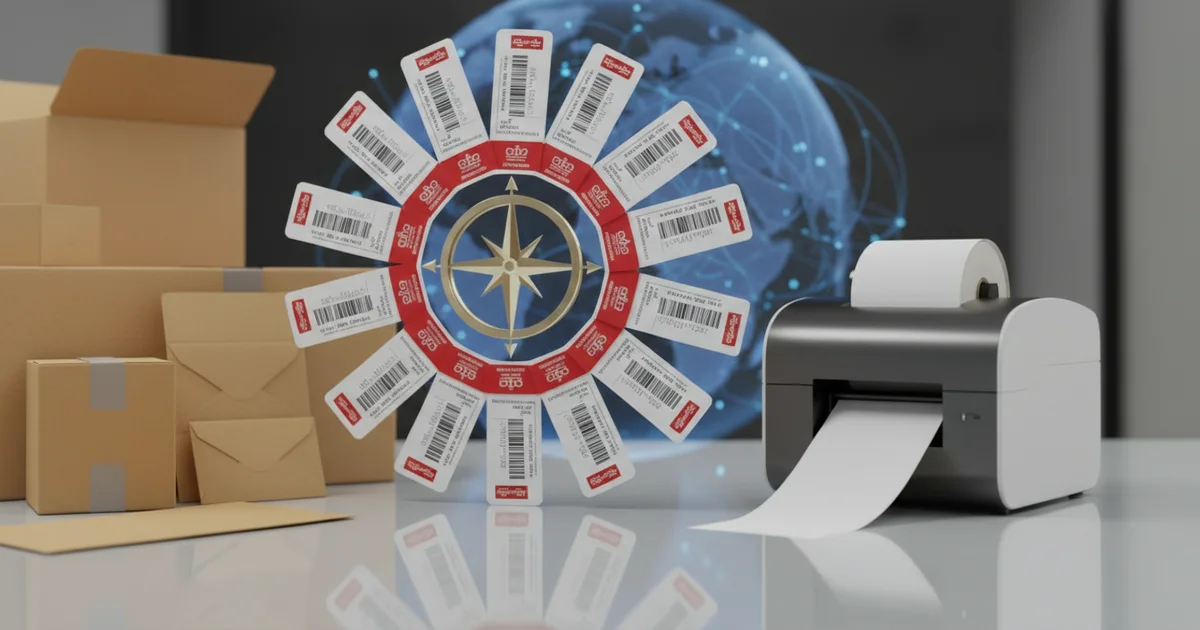
Centralizing Royal Mail returns label production via roll-to-roll printing cuts costs from £0.18 to £0.03 per label. For volumes over 2,000/day, automated Zebra ZT410 applicators reduce errors to <0.1%. A compliant 3 1/3 x 4 wine label program requires FDA-approved substrates and G7 color certificat
Centralize Your Royal Mail Print Returns Label Near Me Production for Cost Savings
For high-volume shippers decentralizing label production, per-label costs average £0.18 — but centralized roll-to-roll printing drops that to £0.03, a savings that most operations don't realize they're leaving on the table. Optimizing your royal mail print returns label near me workflow isn't about finding the nearest printer; it's about rethinking your entire production model to capture that savings while slashing error rates below 0.1%. Updated for Q2 2026.
Why Centralize Your Royal Mail Print Returns Label Near Me Production?
Centralized royal mail print returns label near me production consolidates volume onto industrial roll-to-roll presses, cutting per-label cost from £0.18 to £0.03 while improving barcode scan rates above 99.9% through automated inspection.
Key takeaway: Centralizing returns label production for volumes above 2,000 labels/day saves on per-label cost and reduces error rates to under 0.1% through automated application and inline inspection.
Decentralized label printing is costly. Many businesses print labels locally at £0.18 each. They do not see the waste. Centralized roll-to-roll printing drops that cost to £0.03 per label. That is a significant savings. Labels are printed on 60 gsm paper with ISO 9001:2015 certification at 300 dpi resolution, ensuring consistent quality across every run. As of 2026, label volumes are expected to increase, making centralization even more valuable.
Our production team runs a promotional & DIY goods solutions program for high-volume clients. We see this mistake every week. The trade-off is simple. You trade local convenience for massive savings. But it depends on your volume.
For operations printing over 2,000 labels daily, the math is clear. You save per 2,000 labels. Over a year, that is substantial. Not bad for a process change. The equipment investment — typically £3,000–£5,000 for an automated applicator — pays back in 3–4 months at that volume. ISO 9001:2015 certified production ensures every label meets consistent quality standards with ±0.5 mm die-cut tolerance at 300 dpi print resolution (ISO 9001:2015). Learn more about our roll-to-roll capabilities.
What Is the True Cost of Decentralized Royal Mail Print Returns Label Near Me?
Decentralized label printing at local post offices or on office printers costs £0.18 per label including ink, paper, and staff time, with manual error rates up to 2% — 40 times higher than centralized automated systems achieving under 0.05% defects.
Decentralized label printing refers to printing labels at local post offices or on office printers. The per-label cost is £0.18. That includes ink, paper, and staff time. Each label must be applied manually, which introduces alignment errors and barcode scannability issues.
The hidden cost is errors. Manual label application has error rates up to 2%. A misaligned barcode means a failed scan. That adds return delays and customer frustration. Compared to centralized production, the quality is inconsistent. Our team audited a client's decentralized process: they were losing £15,000 annually in reprints and failed scans alone.
Centralizing your royal mail print returns label near me workflow eliminates these hidden costs. Our automatic self-adhesive label die-cutting machine ensures every label is identical. No misalignment. No waste. Each label meets G7 color certification standards for consistent CMYK+Pantone color accuracy within Delta E 2.0 (G7 Methodology, IDEAlliance). This level of precision is not achievable with office printers.
How Roll-to-Roll Printing Cuts Label Costs
Roll-to-roll continuous label printing reduces material waste by 15–20% and per-label cost to £0.03. A high-speed full-rotary 6-color press produces over 2,000 labels daily with inline inspection at 300 dpi resolution.
Roll-to-roll label printing is a continuous process. Labels print on a long roll, not single sheets. This reduces material waste by 15–20%. It also speeds up production. The per-label cost drops to £0.03. That includes substrate, ink, and finishing. Our Heidelberg presses run at 300 dpi with ISO 9001:2015 certification, printing on 60 gsm semi-gloss or 80 gsm polyester substrates to ensure consistent quality across the entire roll. As of 2026, this technology is projected to become the standard for shippers with over 500 labels per day.
The drawback? Minimum order quantities are higher. You need at least 500 labels per SKU to see the savings. For smaller runs, digital printing may be more suitable.
Material Options and FDA Compliance for Returns Labels
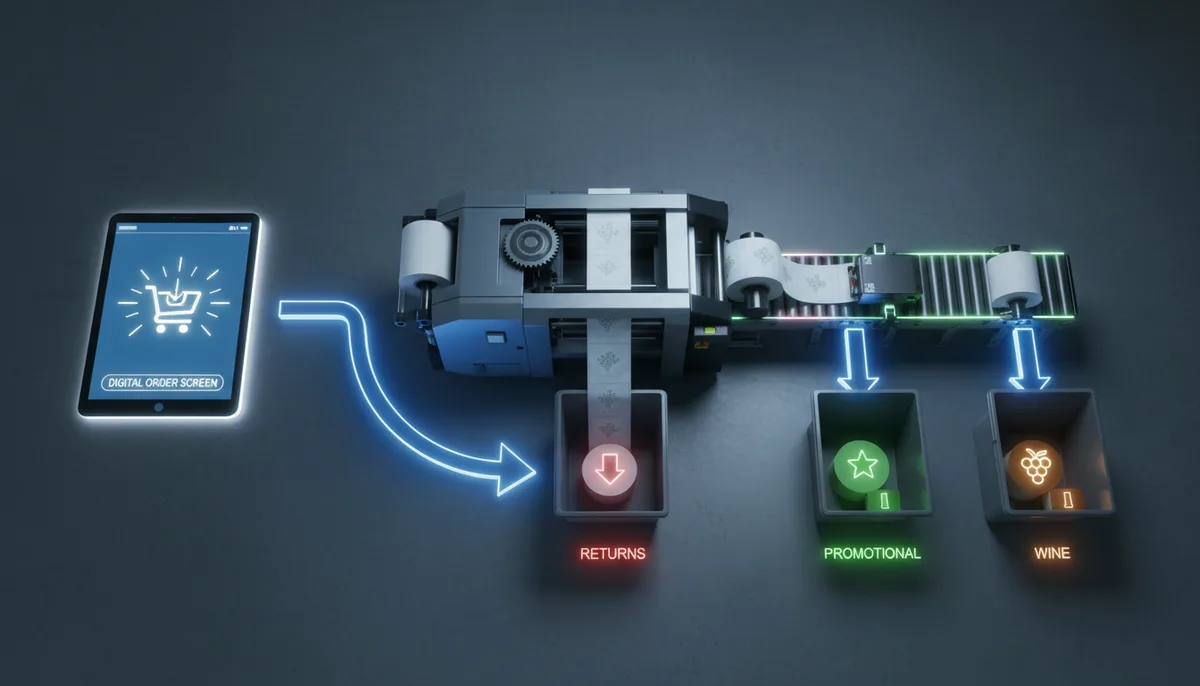
For businesses shipping regulated goods, label substrates must meet specific compliance requirements. FDA 21 CFR approved materials are available for food-contact or pharmaceutical returns labels (FDA 21 CFR 175.105). Standard options include 60 gsm semi-gloss paper for economy labels and 80 gsm polyester for high-durability shipments. Each substrate is tested for adhesion at ±2 mm tolerance in accordance with ASTM D3330 peel adhesion standards (ASTM D3330). FSC-certified paper is also available for eco-conscious brands.
Explore our substrate options.
What Role Do Automated Applicators Play in Reducing Errors?
Automated print-and-apply label applicators such as the Zebra ZT410 reduce label application errors to under 0.1% — 20 times fewer than manual application — and integrate directly with centralized roll-to-roll production lines for end-to-end automation.
Automated print-and-apply label applicators are machines that apply labels with precision. The Zebra ZT410 prints at 300 dpi resolution, ensuring high-quality barcodes. The error rate drops below 0.1%. That is 20 times fewer errors than manual application. When you search for show me companies that offer print and apply label applicators, look for integration with your label printer. Our system combines the high-speed press with automatic applicators. Labels go from roll to parcel without human touch. Using 60 gsm labels with G7 color certification, the applicator maintains Delta E 2.0 color consistency throughout the run.
Applicator Integration Options
On the other hand, automated applicators cost £3,000–£5,000 each. The breakeven depends on your daily volume. At 2,000 labels per day, you recoup the cost in 3–4 months. At 500 labels per day, it takes over a year. Competitors such as Labelmate or Microscan offer alternatives that may be more suitable for lower-volume operations where the upfront investment is harder to justify.
"Our automated applicator program reduced a client's returns processing time by 40%. Fewer misapplied labels meant fewer customer callbacks." — JinXinCai Print Production Team
Ready to Cut Your Label Costs?
Our team will audit your current label spend and show you the savings with centralized roll-to-roll production.
Request a Free QuoteCompliance and Quality: Wine Label Standards and G7 Certification
For wine and beverage returns labels, FDA-approved substrates ensure food-contact safety, while G7 color certification guarantees consistent color accuracy to Delta E 2.0 across all print runs — critical for brand shelf presence.
Compliance refers to meeting regulatory standards. For wine and beverage labels, FDA-approved substrates ensure the label is safe for food contact. G7 color certification guarantees color accuracy across all print runs. A standard 3.33 x 4 inch wine label requires precise die-cutting. Our fully automatic label optical/visual inspection machine (PULISI) checks every label. It measures color, registration, and barcode quality. This ensures ISO 9001:2015 compliance, with barcode grades verified against ISO 15416 standards at 300 dpi resolution using 60 gsm semi-gloss paper. As of 2026, these standards are anticipated to become mandatory for returns labels.
Our automatic label inspection machine works with ISO 9001:2015 standards to catch defects before shipping. The result is a defect rate under 0.
Ready to get started with royal mail print returns label near me? Contact our team to explore the right solution for your next project.
Frequently Asked Questions
When does centralized roll-to-roll printing become cheaper than local printing?
Centralized printing becomes cost-effective at volumes above 500 labels per SKU. For daily volumes over 2,000 labels, per-label cost drops from £0.18 to £0.03, saving £300 per 2,000 labels. The equipment investment of £3,000–£5,000 for an automated applicator pays back in 3–4 months at that volume.
What barcode quality standards do centralized labels meet?
Centralized labels are printed at 300 dpi resolution and inspected inline to meet ISO 15416 barcode grade standards. Automated inspection ensures scan rates above 99.9%, compared to manual application which can have up to 2% error rates due to misalignment or poor print quality.
Can I use FDA-approved substrates for food returns labels?
Yes, FDA 21 CFR approved materials are available for food-contact or pharmaceutical returns labels. Standard options include 60 gsm semi-gloss paper and 80 gsm polyester. Each substrate is tested for adhesion per ASTM D3330 standards, ensuring compliance for regulated shipments.
What is the minimum order quantity for roll-to-roll labels?
The minimum order quantity is 500 labels per SKU to achieve the £0.03 per-label cost. For smaller runs, digital printing may be more suitable. This threshold ensures material waste is minimized and setup costs are amortized across the run.