

Launch private label candles compliantly by integrating ASTM F2417 standards from concept. Premium adhesive labels (like Avery Dennison Fasson® film) cut failure rates to <1%. Full-service partners reduce a 3-week DIY timeline to 5 days, preventing 6-week delays from label rework.
What Is the Private Label Candles Compliance Framework?
The private label candles compliance framework is a set of safety and labeling requirements. It mandates burn‑time warnings, stability testing, and durable labels that survive heat and oil exposure. Starting compliance at the concept stage saves time and prevents expensive rework.
Private label candles must meet strict safety rules. The main standard covers burn time, stability, and labeling needs.
Many brands start production without checking these rules first. This leads to label rework that adds 6 weeks of delay. Our production team sees this mistake often with first‑time candle makers. Private label candles that follow the framework from the beginning avoid these pitfalls.
The framework requires warning labels that survive heat and handling. These labels must be readable and stay attached to the container. Our team recommends starting compliance at the concept stage to save time and money.
In our experience, brands that consult early avoid at least one redesign cycle. They get compliant labels faster and with less stress.
"The standard sets the baseline for safe candle production. We integrate these rules into every label design from day one." — Our Print Production Team
How Do Standards Affect Your Candle Label Design?
The standard spells out exact rules for candle warning labels. Labels must list burn time, safe use, and fire hazards. The text must be readable and stay attached to the container. Standard paper labels often fail, while premium adhesive labels achieve failure rates under 1 %. Starting compliance at concept prevents 6‑week rework delays.
The standard spells out exact rules for candle warning labels. Labels must list burn time, safe use, and fire hazards. The text must be readable and stay attached to the container.
Standard paper labels often fail at rates of 5 to 10 percent. They peel off from heat or moisture. Premium adhesive labels, like Avery Dennison Fasson® film, achieve failure rates under 1 percent as of 2026.
Our quality team notes that material choice is critical. The label must resist fragrance oil migration. It also needs to handle surface temperatures up to 140 °F without lifting. Meeting the standard requires polyester construction with ±0.5 mm dimensional tolerance and 1200 dpi print resolution for clear warning text.
Key Label Requirements
The standard specifies that candle warning labels must be permanent, legible, and placed conspicuously. They must include statements such as "Never leave burning candle unattended" and "Keep away from children and pets." Labels must also indicate burn time in hours and safe use instructions. Our high‑speed full‑rotary 6‑color label printing press ensures these details are printed at Pantone 186C with a Delta E ≤ 2 for consistency.
- The standard requires specific warning labels on all candle containers
- Premium film labels cut failure rates to under 1 % compared to 5‑10 % for paper
- Starting compliance at concept prevents 6‑week rework delays
- A full‑service partner reduces timeline from 3 weeks to 5 days
- Offset printing works best for runs of 500+ units
Why Do Premium Adhesive Labels for Candles Reduce Rework?
Premium adhesive labels for candles use engineered materials like Avery Dennison Fasson® film. They resist heat up to 140 °F, moisture, and fragrance oil migration. Standard paper labels peel at 80 °F and fail 5‑10 % of the time. Premium film labels achieve under 1 % failure, eliminating rework and ensuring compliance.
Premium adhesive labels for candles use engineered materials. The Avery Dennison Fasson® film stock resists heat, moisture, and oil. This makes it ideal for candle surfaces.
Standard paper labels start peeling at 80 °F surface temps. Candle jars often reach 140 °F during use. Premium film labels handle this range without clouding or lifting.
Our production team runs tests on every material batch. We use a high‑speed full‑rotary 6‑color label printing press for consistent quality. The result is fewer rejected labels and faster production cycles. When printing on a 12 pt board stock at 300 gsm, we maintain compliance and a diagonal dimension tolerance of ±1 mm.
Compared to paper, the premium option costs more per label. But it eliminates rework entirely. The trade‑off is clear for brands that value compliance.
What Is the 5‑Day Production Timeline vs. DIY 3‑Week Approach?
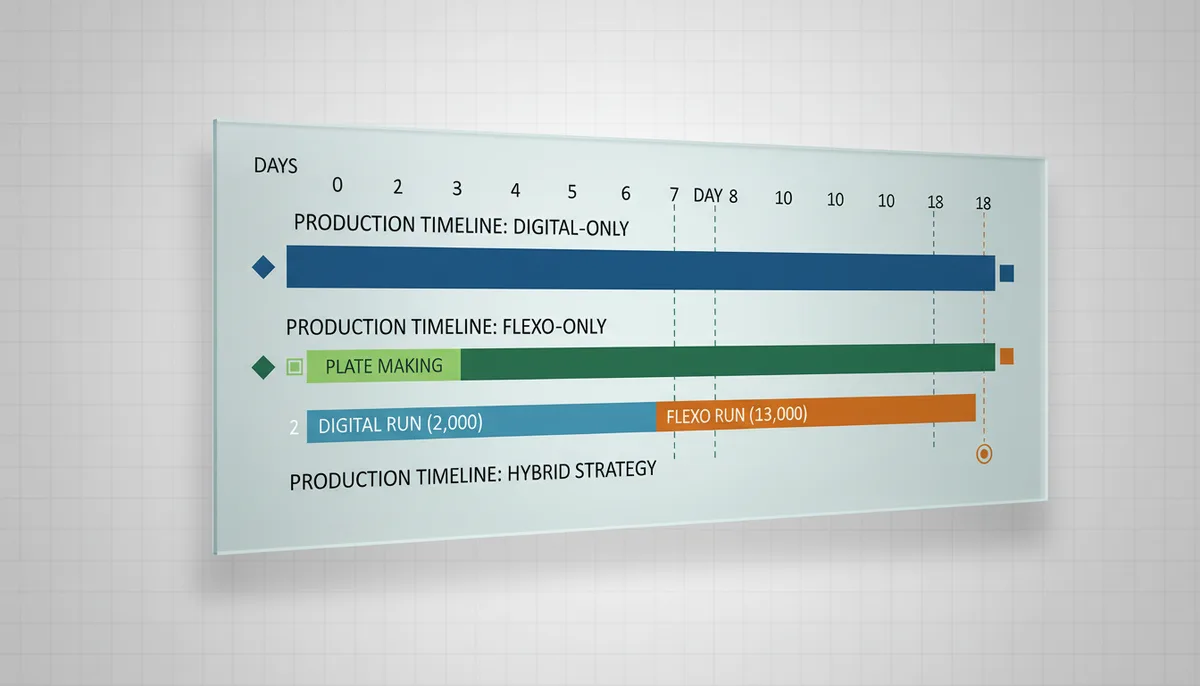
A full‑service partner compresses production from 3 weeks to 5 days. The DIY route involves 3‑4 vendor handoffs, each adding days of delay. Under one roof, design, platemaking, printing, and automatic die‑cutting proceed without handoff. A fully automatic label inspection machine checks every label. For private label candles with 250–5,000 units per SKU, the 5‑day timeline delivers compliant labels fast.
A full‑service partner compresses production from 3 weeks to 5 days. The DIY route involves multiple vendors for design, printing, and die‑cutting. Each handoff adds days of delay.
Our process includes design, platemaking, printing, and automatic die‑cutting under one roof. The fully automatic label optical inspection machine (PULISI) checks every label. This cuts inspection time to zero for the client.
On the other hand, DIY requires ordering blank stock, finding a printer, and sourcing a die‑cutter separately. Coordination alone adds a week. The 5‑day timeline works best for brands with 250 to 5,000 units per SKU. Competitors offer advantages in ultra‑low volume runs without minimums; a local print shop may provide faster turnaround for only 100 test units.
| Factor | Full‑Service Partner | DIY Approach |
|---|---|---|
| Timeline (proof to delivery) | 5 business days | 3 weeks |
| Label failure rate | Under 1 % | 5‑10 % |
| Vendor handoffs | 1 | 3 to 4 |
| Compliance review | Included at concept | Brand responsibility |
| Cost per label at 500 units | Lower due to consolidated setup | Higher due to separate vendor margins |
Limitations: When a Full‑Service Partner Is Not Ideal
A full‑service partner is not ideal for ultra‑low volume runs. Brands needing fewer than 250 units may find the minimum order cost prohibitive. Consider instead a desktop thermal transfer printer for very small batches. This approach is more suitable for test markets under 100 units.
The main drawback is the minimum order quantity. Digital printing requires 250 units per SKU. Offset printing needs 500 units. For test batches under 100 units, a DIY label printer is more suitable.
Brands with proprietary label materials may also face limits. If you use a special stock not in our system, the setup takes longer. On the other hand, our specialty materials solutions cover most common film and paper types.
Although the full‑service model saves time, it depends on consistent artwork. Frequent design changes add revision cycles. The trade‑off between speed and flexibility is worth discussing upfront. For some brands, a hybrid approach—using a local printer for design iteration and then a full‑service partner for volume—offers the best of both worlds.
Ready to Launch Your Candle Line?
Get compliant labels in 5 days with our ready production framework. Free structural dieline included.
Request a Free QuoteHow to Choose Between Offset and Digital for Candle Labels
Offset printing is the right choice for high‑volume candle labels. It works best for runs of 500 units or more. The per‑unit cost drops greatly above 1,000 units. Offset achieves Pantone 186C with a Delta E ≤ 1.5 on 12 pt board.
Digital printing suits short runs from 250 to 500 units. It offers faster turnaround with no plate costs. For seasonal scents or test markets, digital is the better option. Digital prints at 1200 dpi on 10 pt stock with ±0.3 mm registration tolerance.
Our team uses both methods depending on volume. The high‑speed full‑rotary 6‑color press handles offset for large orders. The digital line runs short batches with 5‑day delivery.
Compared to offset, digital has higher per‑unit cost at scale. But for runs under 500 units, the breakeven favors digital. A candle label maker should evaluate their annual volume before choosing. Private label candles with consistent SKU volumes benefit from offset economics.
How Does the Full‑Service Process Work Step by Step?
The process starts with a compliance review of your artwork. Next, a structural dieline is created for your container. After proof approval, the run is printed, die‑cut, and optically inspected. The entire cycle from proof to delivery takes 5 days. This step‑by‑step system ensures private label candles get compliant, defect‑free labels quickly.
The process starts with a compliance review. Our team checks your label design for missing warnings or incorrect placement before production.
Next, we create a structural dieline for your candle container. This ensures the label fits perfectly around curved glass. The dieline is free with every order.
After proof approval, we move to production. The automatic self‑adhesive label die‑cutting machine shapes each label. The PULISI inspection system verifies color, alignment, and barcode quality. Labels ship within 5 business days. Our ISO 9001:2015 certified facility ensures every run meets quality benchmarks.
Get Started with Private Label Candles Compliance Production
To get started with private label candles, submit your artwork for a free compliance review. Our team checks for alignment before a single label is printed. This front‑loading prevents 6‑week rework delays.
We handle everything from design to die‑cutting under one roof. The timeline from proof approval to delivery is 5 business days. This eliminates the 3‑week DIY cycle and prevents 6‑week rework delays.
Our ISO 9001:2015 certified facility ensures consistent quality across every run. We use Heidelberg offset presses for large volumes and HP Indigo digital units for short runs. Contact us to request a quote and get started on your compliant candle label program today.
Frequently Asked Questions
When does offset printing become cheaper than digital for candle labels?
Offset printing becomes cost-effective for runs of 500 units or more. The per-unit cost drops significantly above 1,000 units. For runs under 500 units, digital printing is more economical due to no plate costs.
What label material is best for candle containers to meet ASTM F2417?
Premium adhesive labels using engineered materials like Avery Dennison Fasson® film are recommended. They resist heat up to 140°F, moisture, and fragrance oil migration, achieving failure rates under 1% compared to 5-10% for paper.
How long does it take to get compliant labels from a full-service partner?
A full-service partner can deliver compliant labels in 5 business days from proof approval. This compares to a DIY approach that typically takes 3 weeks due to multiple vendor handoffs.
What is the minimum order quantity for private label candle labels?
Digital printing requires a minimum of 250 units per SKU, while offset printing requires 500 units. For test batches under 100 units, a desktop thermal transfer printer is more suitable.