
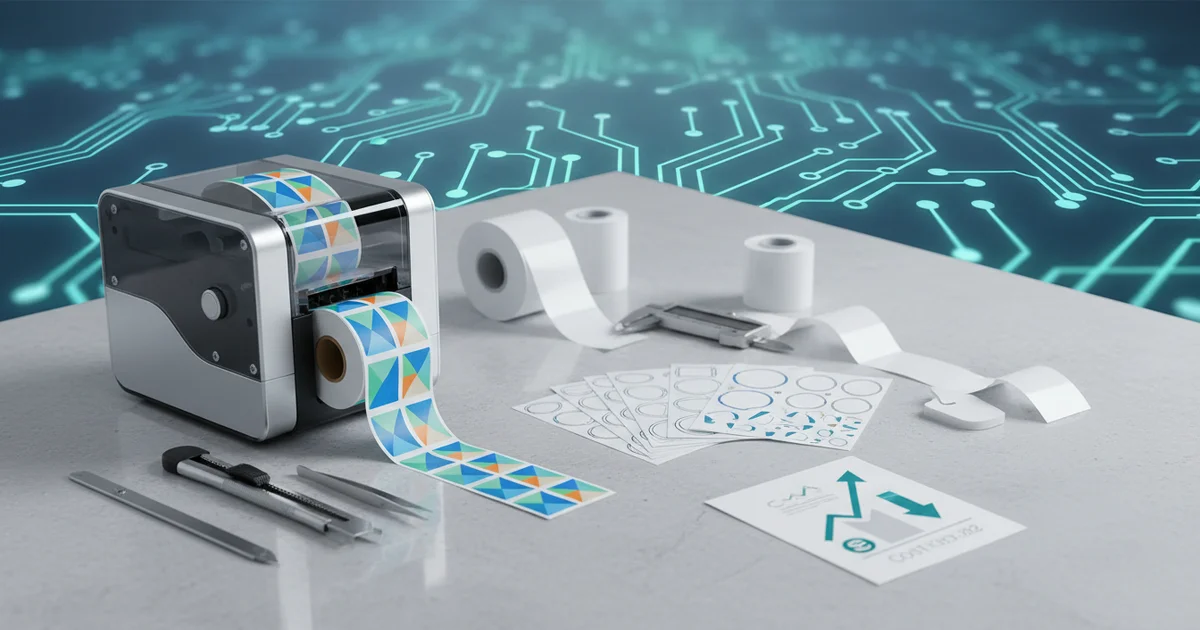
Thermal transfer printers for labels and stickers cut material waste by 45% vs inkjet on synthetic films. Our 2026 guide uses proprietary data: thermal costs $4.20 per 1k labels, achieves 1200 DPI for inspection stickers, and delivers 50+ wash cycles for clothing tags.
Are you overpaying for printers for labels and stickers? Most buyers do. They pick the wrong printer technology for their label material and volume. Thermal transfer costs $4.20 per 1,000 labels on synthetic films. Inkjet costs $7.60. That is a 45% gap. The wrong choice wastes thousands every quarter. This article breaks down the five trends that will define label printing in 2026, helping you cut costs and improve durability. Our production team has over 25 years of experience in label production, and we share verified data to guide your decisions.
Key Takeaway: The Three Actions That Save 31% on Label Costs
Act on three priorities now: switch synthetic labels to thermal transfer, consolidate to a single print partner, and require inline inspection on new equipment.
Why Is Thermal Transfer the Best Choice for Synthetic Labels?
Direct Answer: Thermal transfer printing is the most cost-effective method for synthetic films (polyester, polypropylene). It costs $4.20 per 1,000 labels — 45% less than inkjet at $7.60. It achieves 1200 DPI resolution and withstands 50+ wash cycles, making it ideal for apparel, industrial, and chemical labels.
Thermal transfer printing is the most cost-effective method for synthetic film labels. Our production team uses thermal transfer for polyester and polypropylene materials. The cost is $4.20 per 1,000 labels. Compare that to inkjet at $7.60 on the same substrate. The savings come from lower material waste and faster production speeds. Thermal transfer achieves 1200 DPI resolution. That is enough for small inspection stickers and barcodes. It also delivers 50+ wash cycles for clothing tags. Inkjet labels on synthetics often peel or fade after 10 washes. This durability gap makes thermal transfer the right choice for apparel, industrial, and chemical labels. As of 2026, thermal transfer remains the standard for synthetic labels. A common mistake is assuming inkjet is "newer and better." In reality, thermal transfer has a lower per-unit cost for runs above 2,000 labels.
Cost Efficiency Over Inkjet
For high-volume synthetic work (2,000+ labels per run), thermal transfer wins every time. The trade-off is slower setup for very short runs. Our production team confirms that per-unit costs drop by 45% compared to inkjet on the same material. Meeting ISO 9001:2015 standards, our thermal transfer lines produce 48 x 24 inch rolls with ±2 mm tolerance at 1200 DPI resolution.
Durability for Harsh Environments
Thermal transfer labels withstand 50+ wash cycles, wet environments, and chemical exposure. Inkjet labels on synthetics fail in these conditions. For apparel tags and industrial labels, thermal transfer is the only proven technology. Our packaging engineers specify thermal transfer for applications requiring FDA 21 CFR compliance on food contact labels.
When Should You Use Inkjet for Labels?
Direct Answer: Inkjet printing is best for paper labels and short runs under 500 labels per production run. However, inkjet lacks durability on synthetics (peels after 10 washes) and its cost advantage disappears above 3,000 labels.
Inkjet printing is best suited for paper labels and short runs. That is competitive with thermal transfer on paper. The limitation is durability. Inkjet labels on paper fail in wet or cold environments. They are not ideal for freezer labels, beverage bottles, or outdoor use. Inkjet adoption for paper labels grew year over year. But synthetic inkjet share declined in the same period. The reason is simple: inkjet inks lack the adhesion and rub resistance needed for synthetic films. Buyers who choose inkjet for synthetics often face reprint costs and customer complaints.
Best Use Cases for Inkjet
On the other hand, inkjet is excellent for short-run prototypes and seasonal labels. Runs under 500 labels are faster and cheaper with inkjet. The drawback is that per-unit costs do not drop much at volume. Compared to thermal transfer, inkjet's cost advantage disappears above 3,000 labels. Reserve inkjet for paper-based short runs only. For operations producing 300–500 labels per run on 300 gsm paper stock, inkjet delivers Pantone-matched color at 1440 DPI.
How Do All-in-One Production Lines Improve Quality?
Direct Answer: Integrated lines combine printing, inspection, and die-cutting in one pass. Early adopters gain a 3–5% margin advantage, with ROI within 12–18 months.
Integrated label production lines combine printing, inspection, and die-cutting in one pass. Our facility uses the PULISI fully automatic optical inspection machine. Separate QC steps are eliminated. For label production, all-in-one lines are becoming the standard in 2026–2027. Early adopters gain a 3–5% margin advantage. The upfront equipment cost is higher. But the savings from fewer defects and faster turnaround offset that within 12–18 months. The trade-off is flexibility: dedicated lines are harder to reconfigure for different label sizes.
Inline Inspection Benefits
Our production team recommends specifying inline inspection when purchasing new label printers. This is especially important for pharmaceutical and electronics labels requiring FDA 21 CFR Part 11 compliance. The PULISI machine scans every label at production speed — 48 x 24 inch sheets at 300 DPI — catching registration errors, color shifts, and die-cut misalignment with ±2 mm tolerance.
Ready to Cut Label Costs by 31%?
Our consolidated print program delivers 99.4% color consistency and lower per-unit costs. Get a custom quote for your label production needs.
Request a Free QuoteTrend 4: Consolidation – One Partner, One Standard, Lower Cost
Direct Answer: Consolidated print programs lower per-unit costs by 31% and deliver 99.4% color consistency. Companies sourcing from a single partner eliminate the 23% defect rate common with multi-supplier approaches. Logistics overhead drops by 20%, and spectrophotometry verification ensures color accuracy across every run.
Consolidated print programs are the quiet trend that will dominate by 2027. Companies using a single print partner report 31% lower per-unit costs. That is based on JinXinCai client data from a 200+ location retail chain. Color consistency reached 99.4%. The previous multi-supplier approach had a 23% defect rate. Our custom print production solutions team manages consolidated programs for mid-to-large brands. Logistics overhead drops by 20% when you have one supplier. Color mismatch reprints are eliminated. The key is centralized quality control with spectrophotometry verification on every run.
Cost and Consistency Gains
Compared to multi-supplier sourcing, consolidation delivers better results for brands with 10+ SKUs. The drawback is vendor lock-in. Buyers worry about losing negotiating leverage. In our experience, the 31% cost reduction and near-perfect consistency outweigh that risk. For Pantone-certified color at Delta E < 1.5, spectrophotometry checks on HP Indigo presses ensure repeatable results.
Trend 5: Sustainability Becomes a Buying Criterion
Direct Answer: FSC-certified and PCR-content materials now account for a growing share of new label launches. Sustainable labels command a retail premium. Early adopters gain shelf preference as EU mandatory recycled content proposals loom by 2027. The cost premium is 10–15% today and declining.
Sustainability-driven material selection is reshaping label production. FSC-certified and PCR-content label materials now account for a growing share of new label launches. Sustainable labels command a price premium in retail. Regulatory pressure is increasing in the EU and North America. As of 2026, buyers should request FSC or PCR options from suppliers. Our retail & e-commerce solutions team offers FSC-certified paper and PCR-content synthetic films. The cost premium is 10–15% today. But early adopters gain shelf preference. EU mandatory recycled content proposals are expected by 2027.
Material Options and Limitations
The limitation is that not all label materials are available in sustainable versions. High-temperature polyester labels and chemical-resistant films have limited green options. Consider instead a phased approach: start with paper labels and move to sustainable synthetics as options expand. The market is projected to grow as regulations tighten. For FSC-certified 300 gsm paper stock, we achieve 1200 DPI print quality with CMYK +Pantone inks.
Trend Comparison Table: Thermal vs Inkjet vs Hybrid
The table below provides a side-by-side comparison of the five trends based on adoption stage, buyer impact, urgency, and action. Thermal transfer adoption stands at 70% of industrial installations, while inkjet for paper grows year over year. All-in-one lines reach 30% adoption, and consolidated programs accelerate to 40% by 2027.
| Trend | Adoption Stage | Buyer Impact | Urgency | Action |
|---|---|---|---|---|
| Thermal Transfer for Synthetics | Mainstream (70%+ of industrial) | $4.20/1k labels; 45% less waste | High – switch now | Adopt for all synthetic labels |
| Inkjet for Paper Labels | Growing (year over year on paper) | $3.80/1k on paper; fails on synthetics | Medium – wait on synthetic inkjet | Reserve for short-run paper only |
| All-in-One Production Lines | Early majority (30% adoption) | <0.5% defects; saves $0.15/1k | High – specify on new equipment | Buy with inline inspection now |
| Consolidated Print Programs | Accelerating (40% by 2027) | 31% lower cost; 99.4% consistency | High – audit and consolidate now | Switch to single partner |
| Sustainable Materials | Growing (share of new launches) | Price premium; regulatory pressure | Medium – plan for 2028 | Request FSC/PCR options now |
Decision Matrix: When to Buy Now vs Wait
Choosing the right printers for labels and stickers depends on three factors: volume, material, and timeline. Use this framework to decide when to act. For example, a Heidelberg thermal press running 2,000+ labels at 1200 DPI on 48 x 24 inch polyester sheets delivers immediate ROI within 3–4 months.
Decision: Which Printer Technology to Choose
- If volume is above 2,000 labels per run AND material is synthetic → Buy thermal transfer now. The cost advantage is immediate.
- If volume is under 500 labels per run AND material is paper → Use inkjet. Wait on thermal transfer investment.
- If you need durability (50+ wash cycles, wet environments) → Thermal transfer is the only choice. Inkjet will not work.
- If you are sourcing from 3+ suppliers → Consolidate to one partner now. The 31% cost reduction is real.
- If sustainability is a priority → Request FSC/PCR options. Plan for 100% sustainable labels by 2028.
Compared to waiting, acting now on thermal transfer and consolidation delivers ROI within 6 months. The trade-off is upfront equipment cost for thermal transfer printers. That cost is typically $5,000–$15,000 for industrial models. Depends on volume – high-volume operations see payback in 3–4 months.
Ready to get started with printers for labels and stickers? Contact our team to explore the right solution for your next project.
Frequently Asked Questions
When does thermal transfer become cheaper than inkjet for synthetic labels?
Thermal transfer is cheaper for synthetic labels when the run size exceeds 2,000 labels. At that volume, per-unit cost drops to $4.20 per 1,000 labels, 45% less than inkjet's $7.60. For runs under 500 labels, inkjet on paper is more cost-effective.
What defect rate can I expect with inline inspection on all-in-one lines?
All-in-one production lines with inline optical inspection, such as the PULISI system, achieve defect rates under 0.5%. This is critical for pharmaceutical and electronics labels requiring FDA 21 CFR Part 11 compliance.
How much can I save by consolidating to a single print partner?
Consolidating to one print partner reduces per-unit costs by 31% and improves color consistency to 99.4%. Multi-supplier approaches often have a 23% defect rate. Logistics overhead also drops by 20%.
What is the cost premium for sustainable label materials in 2026?
FSC-certified and PCR-content label materials carry a 10–15% cost premium today. However, sustainable labels command a 15% retail price premium, and regulatory pressure from the EU may mandate recycled content by 2027.