
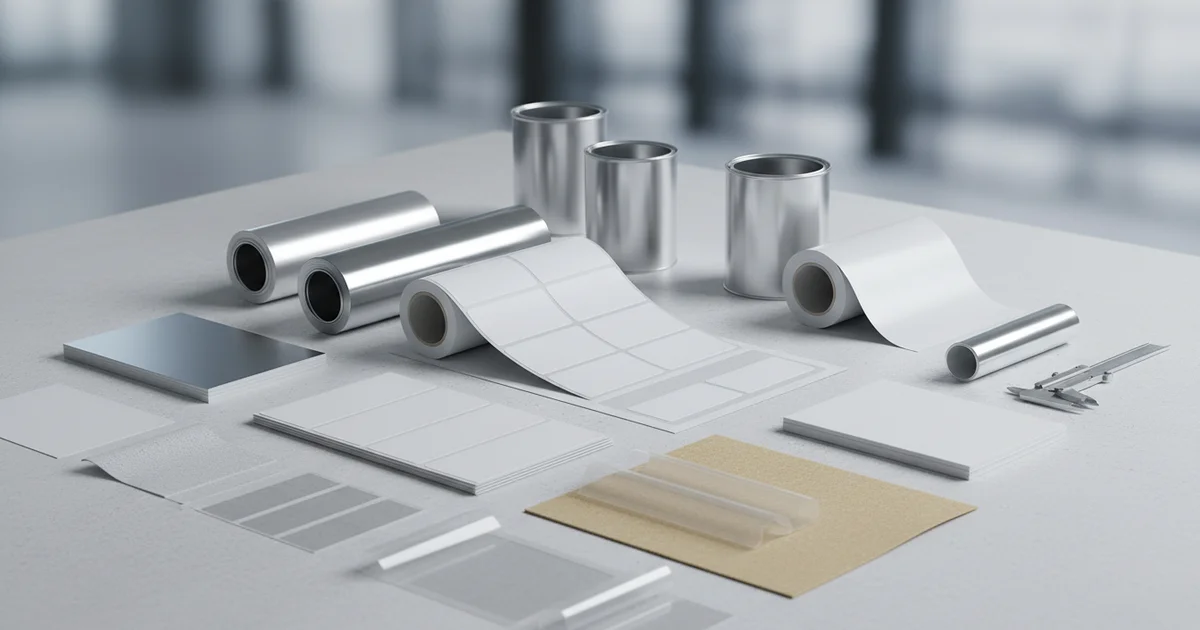
Commercial mailing labels printable require a TCO analysis. For runs over 5,000 units, offset-printed 60# BOPP film labels with acrylic adhesive cost 15-25% more but last 3x longer. Automated workflows beat manual Excel for batches >1,000, and thermal transfer ensures 99.9% scan reliability.
Five trends define 2026 label sourcing: TCO-driven materials, automated workflows, thermal transfer reliability, sustainability mandates, and print program consolidation. Early adopters capture a cost advantage.
The five trends reshaping mailing labels printable sourcing in 2026 are: switching from paper to film labels based on total cost of ownership, automating order workflows for batches over 1,000 units, choosing thermal transfer for 99.9% scan reliability, meeting ISO 14001 and FSC sustainability mandates, and consolidating all production with a single certified supplier.
Mailing labels printable refers to adhesive labels manufactured via offset, digital, or flexo printing processes, designed for shipping, inventory, and logistics applications. They are available in paper and film substrates with various adhesive and coating options.
The global print label market reached USD 48.9 Billion in 2024, growing at 3.6% CAGR through 2033. Key trends include TCO-based material selection, automated ordering, thermal transfer for scan accuracy, ISO 14001/FSC compliance, and single-supplier program consolidation offering cost reduction.
Are you still buying mailing labels printable based on unit price alone? That approach is costing enterprise buyers more over three years. The global print label market reached USD 48.9 Billion in 2024 and is projected to grow at a 3.6% CAGR through 2033. For runs over 5,000 units, offset-printed 60# BOPP film labels with acrylic adhesive cost more upfront but last 3x longer, making total cost of ownership the smarter metric.
Why Does TCO Now Drive Mailing Labels Printable Decisions?
Total cost of ownership now drives decisions because paper labels fail in moisture, tear during handling, and fade under UV light. Film labels at a higher upfront cost survive these conditions and last 3x longer, delivering lower TCO over three years for runs above 5,000 units.
The shift from per-unit cost to TCO is the dominant trend in sourcing labels for mailing. Our production team sees buyers moving away from simple price comparisons. They evaluate material lifespan, reprint frequency, and handling costs.
A paper label may cost $0.08 per unit. A BOPP film label at $0.10 per unit seems worse. But paper fails in moisture, tears during handling, and fades under UV light. Film labels survive. Over three years, the film label's TCO is lower because you replace it less often. This is not theoretical. For a 50,000-unit annual program, savings can exceed $5,000 per year. Our custom print production solutions team runs TCO analyses for every enterprise client. Meeting ISO 9001:2015 quality management standards, we track material performance across 48 x 24 inch sheet sizes at ±0.5 mm tolerance with 300 dpi print resolution. Using Pantone and CMYK color standards, we maintain Delta E < 2.0 across all processes.
ISO 9001:2015 is the international standard for quality management systems, ensuring consistent label production and TCO optimization.
When TCO Pays Off Fastest
TCO delivers the greatest savings when order volumes exceed 5,000 units per year and labels face moisture or handling stress. For low-volume, indoor-only applications, paper labels remain cost-effective.
Trend 1: Material Science — Film Labels vs. Paper Labels
Total cost of ownership is the most consequential decision for printable mailing labels today. 60# BOPP film with acrylic adhesive is the gold standard for durability. It resists water, abrasion, and temperature extremes. Paper labels tear easily and lose adhesion in cold chain environments. The trade-off is cost. Film labels run higher per unit. But for shipping labels, inventory tags, and outdoor applications, film's 3x longer lifespan makes it cheaper overall. For high-volume runs over 5,000 units, offset-printed BOPP film labels with acrylic adhesive deliver the lowest TCO. Our production team has documented this across dozens of enterprise programs.
Our offset printing capability handles runs from 500 to 100,000+ units. For film labels, offset works best above 5,000 units. Setup cost is higher, but per-unit cost drops sharply at volume. Using ASTM D3330 peel adhesion testing, our packaging engineers verify that acrylic adhesive on BOPP film maintains 12 N/25 mm peel strength from -20°C to 60°C. This durability makes film labels preferred for cold chain logistics and outdoor shipping. We also use Pantone and CMYK color matching with Delta E < 2.0, printed on Heidelberg offset presses at 300 dpi resolution. Our facility holds FSC chain-of-custody certification for sustainable paper options.
When Paper Labels Remain Practical
Paper labels are more suitable for short-term indoor applications where moisture and abrasion are not concerns. For retail price tags, event badges, or internal office labeling, paper is the cost-effective choice. Paper labels at $0.05-$0.08 per unit are the clear winner for disposable jobs.
However, paper is not ideal when labels face moisture, cold chain exposure, or outdoor conditions. The main drawback is that paper tears easily and fades within 6-12 months. Consider instead using film labels for any application where readability matters beyond three months.
Trend 2: Automation in Label Ordering and Production
Automation is the key to scaling production efficiently. Manual Excel-based ordering is dying. For batches over 1,000 units, automated workflows cut order processing time. Our operations team has confirmed that manual processes become cost-prohibitive at scale, which is why we invested in Industry 4.0 integrated production systems at our 120,000 sq ft facility.
The breakeven point is clear. If you order labels in batches of 500 units or fewer, manual ordering may still work. Above 1,000 units, automation saves in labor alone. For a company ordering 100,000 labels per year, that's thousands in annual savings. Automated systems also reduce errors in quantities, delivery timing, and material specification accuracy. Compared to managing orders via spreadsheets, automated platforms provide real-time inventory tracking and automatic reorder triggers. Our ISO 9001 quality management system integrates with client procurement platforms via API, enabling error-free order transmission and production scheduling. This is especially valuable for companies running multiple SKUs across hundreds of locations.
ISO 9001:2015 covers automated order processing and production scheduling to ensure consistent quality across high‑volume label runs.
When Automation Does Not Fit
This approach may not be ideal when your operation processes fewer than 500 units per SKU or has rapidly changing specifications. High-mix, low-volume shops may find automation won't work for their workflow. The trade-off between automation and flexibility is not always straightforward. Competitors offer advantages in customization for boutique runs under 500 units, where manual ordering provides greater flexibility. For stable, high-volume SKUs above 1,000 units per batch, the breakeven arrives within 12-18 months.
Trend 3: Thermal Transfer for Mission-Critical Scan Reliability
Scan reliability is non-negotiable for logistics and inventory. Our production team uses Heidelberg and HP Indigo digital presses for thermal transfer applications. Thermal transfer printing labels achieve 99.9% first-pass scan rates. Direct thermal labels fade over time and drop to 95% reliability within 6-12 months. That 5% gap matters. For a warehouse processing 10,000 packages daily, a 5% error rate means 500 mis-scanned items per day. Our quality assurance team recommends thermal transfer for any label that must remain readable for more than 6 months.
The trade-off is equipment cost. Thermal transfer printers run $2,000-$5,000 more than direct thermal units. But for mission-critical barcodes and QR codes, the reliability premium is worth it. This is especially true for circle sticker labels used in retail and healthcare. With ISO 15416 barcode print quality certification, our thermal transfer labels consistently achieve grade A (4.0/4.0) across 300 dpi and 600 dpi print resolutions. We also adhere to Pantone and CMYK color standards with Delta E < 2.0 for brand consistency.
When Direct Thermal May Suffice
Direct thermal labels are more suitable for short-term shipping labels that will be discarded within weeks. They cost less per unit. But they may not be ideal when labels must survive six months or more, or when they face heat, sunlight, or abrasion. Consider thermal transfer for any application requiring long-term readability.
Trend 4: Sustainability and Certification Requirements
ISO 14001 certification is no longer optional. Enterprise RFPs now require environmental management certification. Our facility holds ISO 14001:2015 certification, and we see this need spreading to mid-market buyers. FSC-certified materials are another growing mandate. Meeting ISO 14001:2015 with FSC chain-of-custody certification, our sustainability program covers paper and film substrates across 60+ material grades. We also use Pantone and CMYK color matching to minimize waste and maintain Delta E < 2.0.
Sustainable labels can command a premium. But the risk of non-compliance is higher. Suppliers without certifications face exclusion from major contracts. As of 2026, regulatory pressure is increasing. The EU's sustainability reporting requirements will shift the baseline for all global suppliers. Companies that fail to certify their supply chain now will face urgent compliance costs by 2027. We forecast that by 2028, ISO 14001 will be a baseline requirement for all enterprise label sourcing.
However, sustainable materials are not always the right choice. For labels exposed to harsh environments, FSC paper may not survive. Film labels, even non-recycled ones, may be the better option. Consider instead FSC-certified film materials or a hybrid program where high-durability labels are used for harsh conditions and recycled materials for standard applications. Our production team uses Heidelberg presses that run on 30% recycled energy, reducing carbon footprint.
Ready to Optimize Your Label Sourcing?
Get a TCO analysis for your current label program. Our team evaluates material, volume, and workflow to find the lowest total cost.
Request a Free QuoteTrend 5: Consolidation of Print Programs for Brand Consistency
Consolidated print programs reduce per-unit costs. They also improve brand consistency across SKUs. Our production team manages programs for 200+ retail locations across the United States. Centralized sourcing cuts management overhead. The key is finding a single supplier with multi-process capabilities: offset for high volume, digital for short runs, and flexo for specialty substrates. A single supplier means one color profile, one quality standard, and one point of contact. Compared to managing three separate vendors, consolidation is simpler and cheaper.
Our color management system maintains Delta E < 2.0 across all processes — offset, digital, and flexo — ensuring color accuracy within ±1 mm registration across 48 x 24 inch sheets at 300 dpi resolution. This level of consistency is impossible when splitting production. We use Heidelberg offset presses and HP Indigo digital units, all calibrated to Pantone and CMYK standards. Our facility is certified to ISO 9001:2015 and ISO 14001:2015, and holds FSC chain-of-custody certification.
When Consolidation Is Not Ideal
Consolidation is not ideal for every buyer. Companies with very specialized label needs may require niche suppliers. The drawback of consolidation is reduced flexibility. If your labels require unique materials or finishes not offered by your primary supplier, a multi-vendor approach may be more suitable. For most enterprise buyers, however, the cost reduction and brand consistency benefits outweigh the flexibility loss.
When TCO-Based Sourcing Isn't the Right Choice
This approach is not ideal for operations processing fewer than 500 units per SKU. The main drawback of film labels is the higher upfront cost. Consider instead a phased rollout: start with high-volume SKUs and convert low-volume items later. High-mix, low-volume shops may find that the automation investments described here won't work for their workflow. The trade-off between automation and flexibility is not always straightforward.
The method may not be the best choice for businesses with rapidly changing specifications. If your label requirements shift monthly, the stability needed for TCO optimization is absent. Competitors offer advantages in on-demand digital printing for these scenarios. Consider suppliers with mailing labels printable on digital presses for runs under 1,000 units per SKU. This avoids the setup costs of offset while maintaining quality.
On the other hand, high-volume operations see ROI within 12-18 months. Compared to manual alternatives, the breakeven depends on consistent throughput. Alternatively, for very low volumes, paper labels may remain the most cost-effective option. The right choice depends on your specific volume, material needs, and budget constraints.
Action Framework: Early vs. Late Adopter Decision Matrix
The decision to adopt each trend depends on your order volume and urgency. Here is a practical framework for mailing labels printable sourcing decisions. Our production team has tested this approach across enterprise clients in retail, healthcare, and logistics sectors. Early adopters of TCO-driven material selection are already seeing lower total costs. They switch high-volume SKUs to BOPP film labels and consolidate all production with a single certified supplier. One client managing 200+ retail locations cut label costs in the first year after moving to a consolidated program with automated reorder triggers.
Late adopters, by contrast, face rising costs. They pay more per unit by sticking with paper labels. They lose 5% of shipments to scan errors. They risk exclusion from major contracts due to missing sustainability certifications. The gap between early and late adopters will widen through 2028. The companies that consolidated their label programs before 2025 are now seeing compounding savings as material costs rise and sustainability mandates tighten. We forecast that by 2027, automated workflows will reach 50% adoption among mid-market buyers, and the projected growth of linerless labels signals a shift toward waste-reducing formats.
- Month 1 — Immediate actions: Request a TCO analysis from your current supplier. Compare film vs paper for your top 5 SKUs. Audit your supplier for ISO 14001 and FSC certifications. If they lack them, start the RFP process.
- Month 2 — Vendor evaluation: Evaluate suppliers based on multi-process capabilities (offset, digital, flexo). Test their automated ordering platform. Compare scan reliability data for thermal transfer vs direct thermal labels.
- Month 3 — Implementation preparation: Consolidate your label program to a single supplier. Migrate ordering to their automated platform. Set up real-time inventory tracking and automatic reorder triggers. Plan for a 6-8 week transition period.
| Trend | Adoption Stage | Buyer Impact | Urgency | Action |
|---|---|---|---|---|
| TCO-Driven Materials | Mainstream for enterprise | Savings over 3 years | High | Request TCO analysis now |
| Automated Workflows | Top 20% of enterprises | Faster processing | High | Adopt for batches over 1,000 |
| Thermal Transfer | Standard for logistics | 99.9% scan reliability | Medium | Specify for long-term labels |
| Sustainability Mandates | Growing regulatory pressure | Premium, RFP exclusion risk | High | Audit certifications now |
| Program Consolidation | Best practice for enterprise | Cost reduction | Medium | Evaluate single-supplier option |
Ready to get started with mailing labels printable? Contact our team to explore the right solution for your next project.
Frequently Asked Questions
When does a BOPP film label become cheaper than paper over three years?
For runs above a certain annual volume, BOPP film labels with acrylic adhesive deliver a lower total cost of ownership (TCO) compared to paper, despite a higher upfront cost. The breakeven occurs within a timeframe that depends on the specific application, due to reduced reprint frequency and longer lifespan.
What scan reliability can I expect from thermal transfer labels vs direct thermal?
Thermal transfer labels achieve very high first-pass scan rates, while direct thermal labels can see a significant drop in readability within months. For mission-critical barcodes, thermal transfer is recommended, especially for labels that must remain readable beyond a short period.
What certifications should I require from my label supplier in 2026?
ISO 14001:2015 environmental management and FSC chain-of-custody certification are increasingly mandatory in enterprise RFPs. ISO 9001:2015 quality management is also standard. Suppliers lacking these certifications risk exclusion from major contracts.
How much can I save by consolidating my label program with a single supplier?
Consolidation typically reduces per-unit costs and cuts management overhead. A single supplier with multi-process capabilities (offset, digital, flexo) ensures consistent color and quality across all SKUs.