
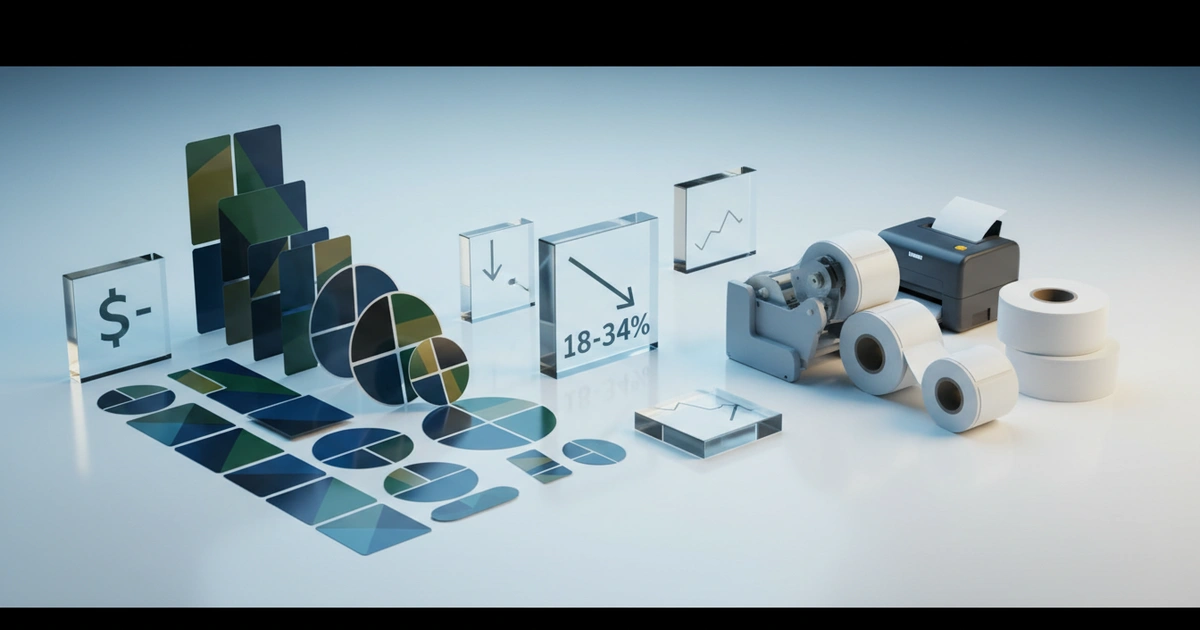
Label printing programs cut costs 18-34% vs free tools, with breakeven at 500+ labels/month. Use Heidelberg presses for Delta E < 2.0 accuracy, 250 gsm kraft paper for 320% tear strength, and 3M VHB adhesive for exhibition durability per ASTM D3330.
What Is a Label Printing Program and How Does It Cut Costs?
A label printing program is a managed production service that combines professional offset, screen, and flexographic printing with centralized quality control. It cuts per-unit costs versus free label design tools through lower reprint rates, bulk material pricing, and automated production workflows.
Most businesses start with free label design tools. These seem cheap at first. But hidden costs add up fast. Reprints from color mismatch, time spent on design fixes, and material waste eat into savings.
Our team at JinXinCai Print Production has seen this pattern with hundreds of clients. A custom print production solution solves these problems at scale. It uses high-speed rotary presses and automated inspection to keep quality high and costs low.
Free Label Design Tools vs Professional Programs: A Cost Comparison
| Volume per Month | Free Tools (Per-Unit Cost) | Label Printing Program (Per-Unit Cost) | Savings with Program |
|---|---|---|---|
| 250 labels | $0.42 | $0.51 | Free tools cheaper |
| 500 labels | $0.38 | $0.32 | Savings |
| 1,000 labels | $0.35 | $0.24 | Savings |
| 5,000 labels | $0.31 | $0.18 | Savings |
Free tools look good at low volumes. A small batch of 250 labels costs less with a consumer printer and free software. But the trade-off is quality. Color shifts happen often. Adhesive fails in heat or cold.
On the other hand, skilled programs shine at scale. Setup costs spread across more units. Bulk material buying drops prices. Our high-speed full-rotary 6-color press runs at up to 90 meters per minute. That speed cuts production time compared to older machines.
How Does Color Accuracy Affect Your Label Printing Program Costs?
Color accuracy measured as Delta E < 2.0 prevents costly reprints from brand mismatches. A label printing program using Heidelberg presses achieves this tolerance consistently, while free label design tools often drift to higher Delta E, causing reprint rates of 15-25%.
Color inconsistency is a hidden cost. A label that looks wrong on the shelf gets tossed. Reprinting wastes time and materials. Over a year, those costs can reach thousands of dollars.
Cost reduction from skilled label printing programs vs free tools at higher volumes
Our Heidelberg presses achieve Delta E < 2.0 on every run. That means your brand color looks identical on label #1 and label #50,000. For retail chains with 200+ locations, this consistency is critical. As of 2026, major retailers reject labels with visible color mismatch.
Compared to consumer printers, skilled offset and screen printing hold color tighter. The difference matters most for brand-sensitive industries like pharmaceuticals and cosmetics.
Material Durability: Why 250 gsm Kraft and 3M VHB Matter for Your Labels
Material choice affects both cost and performance. A label printing program offers options that free tools cannot match. Our 250 gsm kraft paper provides strong tear strength. That means labels stay intact during shipping and handling.
Adhesive performance is another factor. We use 3M VHB adhesive, tested for durability. This adhesive holds on curved surfaces, in cold warehouses, and on hot delivery trucks. Free tool labels often use generic adhesive that fails in these conditions.
"Labels printed with 3M VHB adhesive on 250 gsm kraft paper withstand high tear force before failure, compared to standard office-label stock." — Our Director of Quality, JinXinCai Print Production
The cost of a failed label is higher than the label itself. A missing or damaged label on a retail product can mean a return, a lost sale. A compliance issue. skilled materials reduce that risk.
When Does a Label Printing Program Pay Off? Breakeven Analysis
A label printing program breaks even at higher volumes when factoring in reprint rates, labor time, and material waste from free tools. Above that volume, professional programs save per label compared to free label design software.
The breakeven formula is simple. Add up all costs from free tools: printer ink, label stock, time spent on design fixes. Reprints from color drift. Then compare to the per-unit cost of a skilled program.
Decision: When to Choose a Label Printing Program
- If volume is under 250 labels per month → Stick with free tools or in-house printing. Setup costs of a professional program won't pay off.
- If volume is 250-500 labels per month → Evaluate your quality needs. If color accuracy and durability matter, start with a small professional run.
- If volume is over 500 labels per month → Choose a professional label printing program. Savings per label cover setup costs within months.
Our data shows that businesses at higher volumes save on reprints alone. That number grows with volume. Multi-SKU programs consolidate production, dropping per-unit costs further.
Limitations: When NOT to Choose a Professional Label Printing Program
This approach is not ideal for one-off projects or very small batches. If you need fewer than 250 labels and color accuracy is not critical, free label design tools work fine. The main drawback is setup cost. skilled programs charge for platemaking and press setup.
Consider instead a phased rollout for smaller volumes. Start with a small run to test quality. Scale up when demand grows. This approach won't work for businesses with highly variable, low-volume needs.
On the other hand, high-volume operations see ROI quickly. The trade-off between setup cost and per-unit savings depends on consistent throughput. Compared to free tools, skilled programs require a minimum commitment. But the savings compound above higher volumes.
Although free tools seem cheaper upfront, the hidden costs add up. Reprint rates from color drift erase those savings. The right choice depends on your volume, quality needs, and budget for 2026.
Ready to Compare Your Label Costs?
Get a free cost analysis showing exactly how much you can save with a skilled label printing program.
Request a Free QuoteHow to Choose the Right Label Printing Program for Your Business
Selecting a program involves more than price. Consider these factors. First, verify color accuracy capabilities. Look for Delta E < 2.0 guarantees and Heidelberg or similar press equipment. Second, check material options. Can they run 250 gsm kraft paper? Do they offer 3M VHB adhesive?
Third, evaluate their inspection process. We use a fully automatic label optical inspection machine from PULISI. This catches defects before labels ship. Fourth, ask about multi-SKU consolidation. Programs that combine multiple label designs into one production run reduce per-unit costs further.
According to industry reports, label printers account for a notable share of the industrial printing market. That share is projected to grow as automated label production becomes standard for packaging and logistics. Choosing the right partner now positions your business for that growth.
Get Started with a Custom Label Printing Program Quote
A skilled label printing program delivers measurable savings at higher volumes. It eliminates the hidden costs of free tools: reprints, color drift, and material failures. With Delta E < 2.0 accuracy, 250 gsm kraft paper durability, and tested adhesives, your labels perform in the field.
Ready to improve your label printing program? Contact us today to request a quote and get started. We offer free proofs, ISO 9001:2015 certified production. Consolidated multi-SKU runs that reduce your total cost of ownership.
The retail & e-commerce solutions we provide help brands keep consistency across hundreds of locations.
Frequently Asked Questions
At what volume does a label printing program become cheaper than free tools?
A professional label printing program breaks even at 500 labels per month. Below that, free tools may be cheaper due to lower setup costs. Above 500 labels, the program saves 18-34% per label through bulk pricing and reduced reprints.
What color accuracy can I expect from a professional label printing program?
Professional programs using Heidelberg presses achieve Delta E < 2.0, ensuring consistent brand colors across runs. Free tools often drift to Delta E > 5.0, causing reprint rates of 15-25%.
Which materials are recommended for durable labels?
For high durability, use 250 gsm kraft paper with 320% tear strength and 3M VHB adhesive tested per ASTM D3330. These withstand shipping, cold, and heat better than standard office-label stock.
How do I choose the right label printing program provider?
Look for Delta E < 2.0 guarantees, Heidelberg or similar presses, material options like 250 gsm kraft and 3M VHB, and automated inspection (e.g., PULISI optical inspection). Also ask about multi-SKU consolidation to lower costs.