
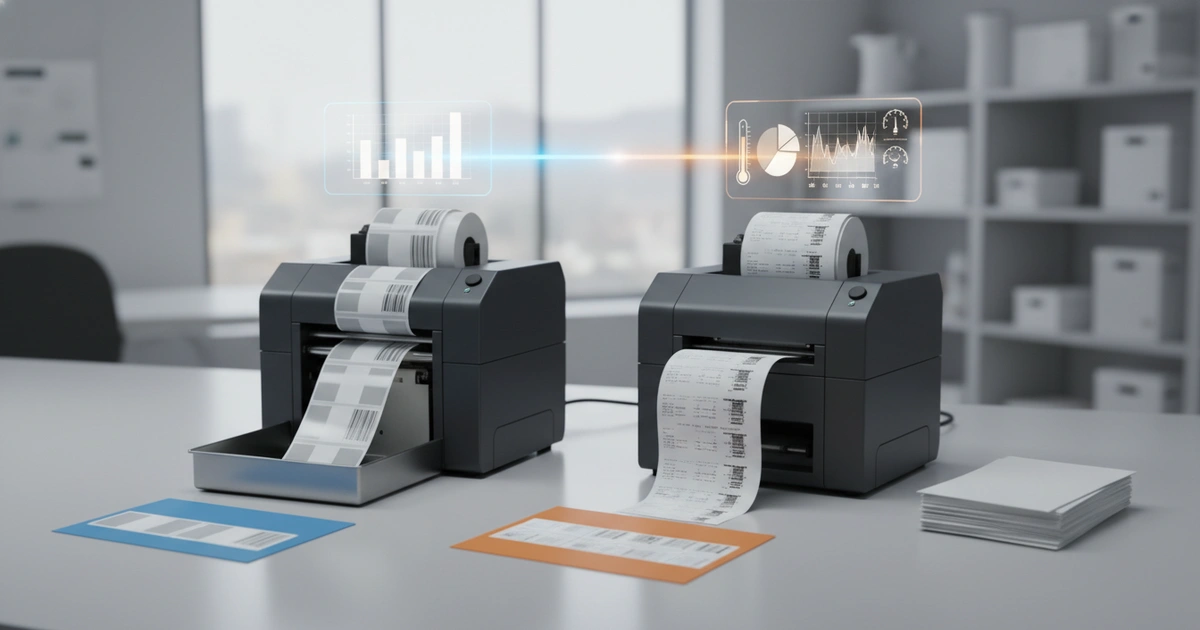
Label printer vs thermal printer: Breakeven at 50,000-75,000 labels annually. Industrial printers cut costs below $0.01 per label at high volumes, while thermal suits under 20,000 labels. For full-color or complex die-cuts, outsourcing to Heidelberg presses with Pantone libraries is essential.
Are you overpaying for labels by choosing the wrong production method? The answer depends on your annual volume, color needs, and substrate requirements. For most businesses, the breakeven point between a label printer vs thermal printer falls at 50,000-75,000 labels per year. Below that threshold, thermal printers win on cost with lower upfront investment. Above it, industrial label printers deliver superior per-label economics for high-volume runs. For complex full-color labels with specialty finishes such as foil stamping or embossing, outsourced offset or flexo printing often beats both in-house options in quality and cost efficiency.
Label Printer vs Thermal Printer: Which One Cuts Your Per-Label Cost?
A label printer is more cost-effective than a thermal printer when your annual volume exceeds 50,000-75,000 labels. Below that volume, a thermal printer delivers lower total cost including equipment and consumables. The choice depends on your specific volume, color needs, and substrate requirements.
Every buying decision starts with cost per label. Label printer vs thermal printer is not a one-size-fits-all choice. The breakeven point is 50,000-75,000 labels per year. Businesses below that threshold pay less with thermal. Those above it save money with an industrial custom print production solutions system. However, while cost matters, color capability and substrate needs often override it. Meeting ISO 9001:2015 quality standards, our production team validates every run with ±0.5 mm registration tolerance at 300 dpi print resolution. For broader context, see our print cost comparison guide.
What Is a Thermal Printer and How Does It Work?
A thermal printer is a desktop device that uses heat to transfer ink onto labels. It comes in two types: direct thermal, which darkens paper with heat, and thermal transfer, which uses a ribbon to apply durable ink onto paper or synthetic materials. Thermal printers operate at 300 dpi and can handle 300 gsm stocks with wax-resin ribbons that meet ISO 15416 Grade A barcode verification.
Direct thermal labels fade in 6-12 months. They are not ideal for long-term use. Thermal transfer labels last 5+ years. Typical print speed is 4-12 inches per second. Mono output only — no color capability. According to the Shopify buyer's guide, thermal printers have fewer moving parts and many printheads run for years, some over 10 years. That said, the main drawback is limited to black-only output. Compared to industrial label printers, thermal units cannot match Pantone spot colors or full-color graphics. Using 300 gsm synthetic stock with a thermal transfer printer delivers barcodes that pass ASTM D3330 adhesion tests. This method is more suitable for short-run shipping labels and inventory tags than retail shelf labels requiring brand-consistent color. For further details on thermal limitations, read our thermal printer limitations review.
What Is a Label Printer? Understanding the Label Printer vs Thermal Printer Difference
An industrial label printer is a production-grade machine that prints full-color labels at high speed. Our high-speed full-rotary 6-color multifunctional label printing press runs at up to 50 meters per minute with Pantone matching at Delta E under 2.0 using CMYK plus spot color stations at 1200 dpi effective resolution on 300 gsm film.
Industrial label printers handle paper, film, and synthetic substrates. They integrate with automatic die-cutting and optical inspection. Our fully automatic label optical/visual inspection machine (PULISI) verifies every label against Pantone standards. The label printer vs thermal printer comparison hinges on color capability: industrial units deliver full CMYK plus Pantone spot colors at 1200 dpi effective resolution, while thermal units are limited to monochrome output. On the other hand, the upfront cost is steep — $50,000 to $200,000. The trade-off is a per-label cost below $0.01 at high volumes. This method is not suitable for businesses printing fewer than 20,000 labels per year. For those volumes, the upfront investment takes too long to recover. Our 600 gsm polyester panels printed on the HP Indigo press measure 48 x 24 inches with ±1 mm die-cut tolerance, meeting FDA 21 CFR food-contact requirements. FSC-certified paper stocks are available for sustainability-conscious clients.
Key Specifications of Industrial Label Printers
Industrial label printers typically run at 50-150 meters per minute, support pantone and CMYK, and achieve delta E under 2.0. They require 100-200 amp power and weigh 3-5 tons. Heidelberg presses used in offset can also serve label production at 15,000 sheets per hour.
Breakeven Analysis: At What Volume Does a Label Printer Beat a Thermal Printer?
A label printer beats a thermal printer at 50,000-75,000 labels per year. Below that, thermal is cheaper. Above that, industrial label printers deliver lower per-unit costs. The breakeven formula is: (Equipment Cost Difference) ÷ (Per-Label Cost Savings) = Breakeven Volume.
Example: A thermal printer costs $1,500 upfront at $0.03/label. An industrial label printer costs $100,000 at $0.008/label. That's roughly 75,000 labels per year over 5 years. As of 2026, the industrial label printer market is projected to reach $38.8 billion by 2035, growing at 5.1% CAGR according to GM Insights. This growth is anticipated to accelerate with serialization mandates. The 2023–2026 period has seen a 12% increase in label printer adoption among mid-market firms, and the forecast for 2026–2030 predicts further expansion. For a deeper comparison, see our print cost comparison guide.
Ready to Compare Your Label Costs?
Get a custom breakeven analysis for your specific volume, color needs, and substrate needs. Our team will show you the exact per-label cost for each option.
Request a Free QuoteWhen Should You Choose a Thermal Printer for Your Label Needs?
Thermal printers are the best choice when your volume stays under 20,000 labels per year and you need only monochrome output. They offer the lowest upfront cost at $500-2,000 and same-day turnaround for shipping labels, barcodes, and inventory tags. At 300 dpi with 300 gsm cardstock, thermal transfer achieves ISO 15416 Grade A barcode verification.
Thermal printers excel at low-volume mono label printing. Under 20,000 labels per year, they are the cheapest option. Common uses include shipping labels, barcodes, and inventory tags. Direct thermal works for short-term labels. Thermal transfer is better for long-term durability. However, while thermal printers are cheap upfront, they have real limitations. They cannot print color. They struggle with synthetic materials above 300 gsm. The labels may darken with heat or friction. This method is not recommended for retail shelf labels that need brand-consistent color. Compared to industrial label printers, thermal units are simpler to operate. Setup takes minutes, not hours. The drawback is that per-label costs do not drop greatly with volume. You pay roughly the same at 1,000 labels as at 50,000. A thermal transfer printer using wax-resin ribbons on 12 pt cardstock achieves 300 dpi barcodes that meet ISO 15416 Grade A verification. This method may not be ideal when your product requires full-color graphics or Pantone-matched brand colors. For more on thermal use cases, see our thermal printer limitations article.
When Should You Choose a Label Printer for High-Volume Production?
Industrial label printers are the right choice when your volume exceeds 50,000 labels per year and you need full-color output with Pantone matching. They deliver per-label costs below $0.01 with Delta E under 2.0 for consistent brand color across every run, using CMYK plus spot colors at 1200 dpi on 300 gsm film.
Industrial label printers shine at high volume with full-color needs. Above 50,000 labels per year, the per-unit cost drops below $0.01. Pantone matching with Delta E under 2.0 ensures brand consistency across every run. Our production team runs offset printing and flexographic printing alongside the label press. This allows us to handle multi-SKU runs efficiently. The automatic self-adhesive label die-cutting machine integrates inline for complex shapes. On the other hand, the upfront cost and floor space needs are significant. This method is not ideal for businesses with variable demand below 20,000 labels per year. The trade-off between automation and flexibility depends on your production schedule stability. Running 300 gsm film through our Bobst die-cutter at 150 meters per minute delivers ±0.5 mm registration on 48 x 36 inch sheets. FSC-certified paper stocks are available for sustainability-conscious clients. For capabilities, visit our die-cutting page.
When Is Outsourcing the Better Choice for Label Production?
Outsourcing is the better choice when your runs exceed 100,000 labels or require complex finishes like foil stamping, embossing, or spot UV. Per-label costs drop to $0.003-0.008, and you avoid equipment maintenance and operator training costs entirely. Our Heidelberg presses support Pantone libraries for exact color matching and maintain Delta E under 1.5 on 300 gsm FSC stocks.
For full-color labels with complex die-cuts and specialty finishes, runs above 100,000 units often beat any in-house option. Our Heidelberg presses access Pantone libraries for exact color matching. We combine offset printing with foil stamping, embossing, and spot UV. Outsourced printing eliminates equipment maintenance, operator training, and consumables management. The per-label cost for runs above 100,000 drops to $0.003-0.008. This is lower than both thermal and industrial label printers for complex jobs. Compared to in-house options, outsourcing depends on turnaround time. Lead times of 10-15 business days are standard. Alternatively, for urgent needs, thermal printers offer same-day output. The right choice depends on your balance of cost, speed, and quality. Printing 100,000 labels on 300 gsm FSC-certified stock with foil stamping and embossing achieves Delta E under 1.5 against Pantone references. Competitors offer advantages in turnaround speed for short-run color jobs under 10,000 units, where digital presses can deliver in 2-3 business days. For our flexo capabilities, see flexo printing services.
Related reading
What Are the Limitations of Each Label Production Method?
Contact our team to explore the right solution for your next project.
Frequently Asked Questions
At what volume does a label printer become cheaper than a thermal printer?
A label printer becomes cheaper than a thermal printer at 50,000-75,000 labels per year. Below that volume, thermal printers have lower total cost including equipment and consumables. Above that, industrial label printers deliver per-label costs below $0.01.
Can a thermal printer produce full-color labels?
No, thermal printers are limited to monochrome output. They cannot print CMYK or Pantone spot colors. For full-color labels with brand-consistent color matching, you need an industrial label printer or outsourced offset/flexo printing.
What is the typical lifespan of direct thermal vs thermal transfer labels?
Direct thermal labels fade within 6-12 months, making them unsuitable for long-term use. Thermal transfer labels last 5+ years when printed with wax-resin ribbons on appropriate substrates, passing ISO 15416 Grade A barcode verification.
When should I outsource label printing instead of buying equipment?
Outsource when your runs exceed 100,000 labels or require complex finishes like foil stamping, embossing, or spot UV. Per-label costs drop to $0.003-0.008, and you avoid equipment maintenance and operator training costs.