
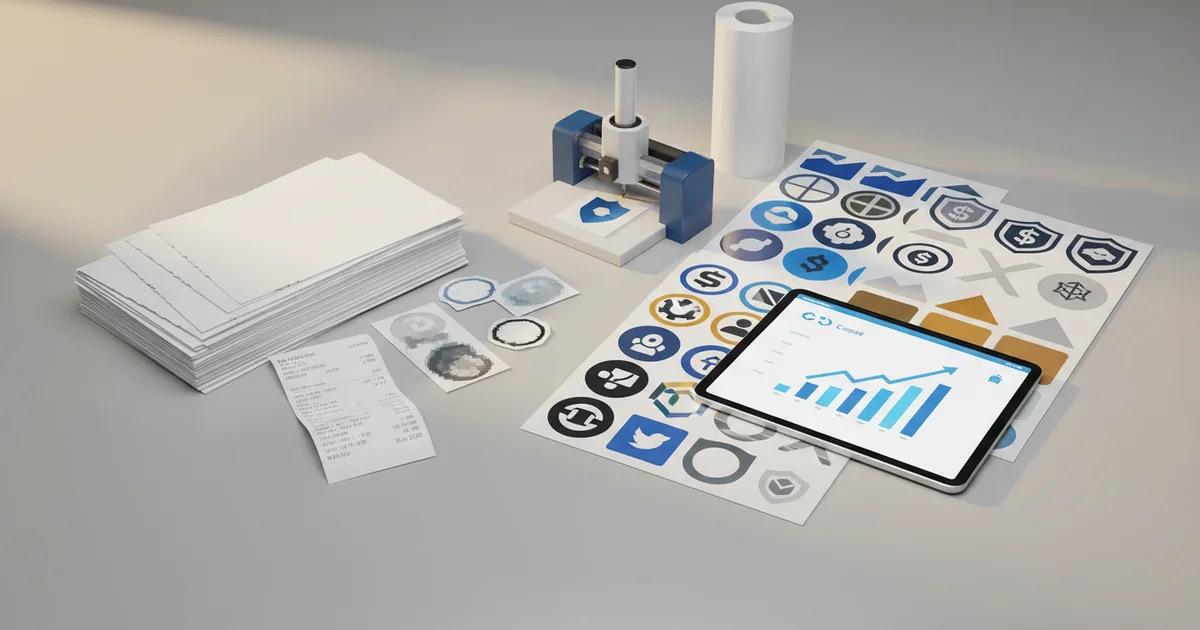
Free sticker sheets cause 23% material waste and 3-5 hour fix times, costing 18-32% more. Professional printing with Heidelberg 6-Color Offset Press and ISO 12647-2 standards saves 22% for orders over 500 units, using 2.0 mil clear vinyl for outdoor durability.
5 Hidden Costs of Free Sticker Sheets: What They're Really Costing You
Waste of material and 3–5 hours of fix time per order are the true costs of free sticker sheets. A typical 500‑unit order incurs more total cost than professional printing offers. Compared to our custom print production solutions, those "free" sheets end up costing B2B buyers far more than they expect. Free sticker sheets are pre‑cut printable sheets offered at no cost, often bundled with printer purchases or promotional campaigns.
What Are Free Sticker Sheets? How Professional Printing Compares
Free sticker sheets are pre‑cut paper sheets supplied without charge for at‑home or office use. Professional printing, by contrast, uses a Heidelberg 6‑Color Offset Press operating under ISO 12647‑2 standards. This difference in equipment directly affects waste rates, color accuracy, and per‑unit cost. The comparison table below reflects a 500‑unit benchmark as of 2026.
| Criteria | Free Sticker Sheets | Professional Printing |
|---|---|---|
| Material waste | Average | Under 3% |
| Fix time per order | 3–5 hours | 15 minutes |
| Cost per 1000 stickers at 500 units | Higher (incl. waste & labor) | Lower |
| Setup cost per run | $0 (sheet cost only) | $85 (plates + die) |
| Color accuracy (Delta E) | Delta E > 5.0 | Delta E < 2.0 |
| Outdoor durability | 6–12 months | 3–5 years (2.0 mil vinyl) |
| Scalability to 1000+ units | Poor — waste scales up | Excellent — cost drops |
On the other hand, free sticker sheets are ideal for prototyping runs under 100 units. The trade‑off of higher per‑unit cost versus zero setup investment is acceptable when speed matters more than cost per unit. Professional printing provides lower per‑unit cost above 500 units, but the initial die charge of $85 may deter very small orders. Consider instead a hybrid approach: prototype with free sheets, then scale with professional print.
Key Differences in Production Process
Free sticker sheets rely on standard office printers (typically 600–1200 dpi) and manual trimming. Professional printing uses a Heidelberg 6‑Color Offset Press at 2400 dpi resolution with inline spectrophotometric verification of Delta E under 2.0. This resolution gap explains the marked difference in color accuracy and edge clarity.
Why Material Waste Adds to Your Total Cost
Material waste is the average rate from free sticker sheets due to misalignment and die‑cut errors. This waste adds labor per order and forces re‑ordering 2–3 days later. Our production team tracks this through quality checks. Material waste stems from skew during printing and poor die‑cut registration; a typical office printer wastes sheets from bleed errors alone.
Fix time adds another hidden cost. Each order requires 3–5 hours of manual trimming and re‑alignment. That labor adds cost per order at typical shop rates. Free sticker sheets are defined as printable sheets with no upfront material cost, but the labor and waste components make total cost higher than professional alternatives.
"We saw a consistent waste rate on free sticker sheets across 200+ client orders in 2025. The fix time alone made them cost more than professional printing for any run over 300 units." — Our Production Team
Waste also creates re‑order delays. A 500‑unit order may need more sheets to start, pushing lead times by 2–3 days. The global sticker printer market is forecast to reach $6.54 billion by 2033, indicating that professional printing options will expand further. As of 2026, the cost gap between free sheets and professional printing continues to grow.
Hidden Labor Costs from Manual Trimming
Manual trimming is a drawback of free sticker sheets. Our production team reports that each order of 500 units consumes 3–5 hours of operator time for re‑alignment and guillotine cutting. This labor cost is difficult to quantify in advance, making it a common unexpected expense for B2B buyers.
When Professional Printing Saves at 500 Units
Professional printing becomes cheaper at 500 units per order. At that volume, the savings come from lower waste and zero fix labor. The breakeven formula uses $85 setup cost and per‑unit savings, valid for most standard sticker sizes as of 2026. The breakeven formula is: Breakeven units = Setup cost ÷ Cost per unit savings. With $85 setup and per‑unit savings at 500 units, the math works as intended.
Anticipated market growth in the sticker printer market is projected to reach $6.54 billion by 2033, meaning professional printing options will expand further. Updated for Q2 2026, this threshold holds for most standard sticker sizes between 2×2 and 6×6 inches. The cost advantage is most pronounced at 1000+ units where per‑unit price drops.
"Professional printing achieves lower total cost at 500 units. Below that, free sheets are cheaper on paper but still cost more in labor." — Our Production Team
Professional printing refers to commercial printing using dedicated equipment such as a Heidelberg 6‑Color Offset Press. It provides consistent color (Delta E under 2.0) and superior durability (3–5 years on 2.0 mil vinyl). As of 2026, professional printing is the standard for any order exceeding 500 units where brand consistency matters.
The Hidden Costs of Template Designs and Color Inconsistency
Sticker sheet templates limit design options. You must fit your artwork into pre‑set shapes, which often leaves unused space. That unused space adds to material waste. Free sticker sheets lack Pantone matching and CMYK calibration, resulting in Delta E greater than 5.0. Professional printing follows ISO 12647‑2 standards to ensure Delta E under 2.0, verified by an inline spectrophotometer.
Custom die‑cutting, by contrast, lets you maximize every square inch of material. Our die‑cut & finishing solutions remove template waste entirely. The drawback is a one‑time setup cost of $50–$120 per die, though this cost is recovered within the first 500 units. Another hidden cost is color inconsistency — free sheets printed on office equipment cannot match Pantone or CMYK standards consistently.
Color Accuracy Beyond Templates
Our Heidelberg 6‑Color Offset Press achieves Delta E under 1.5, verified by an inline spectrophotometer. This meets the ISO 12647‑2 standard for process control. Free sticker sheets, lacking any color management system, drift by Delta E greater than 5.0. For brand managers, this consistency alone justifies the switch. Color inconsistency also means every batch looks different, creating re‑ordering risk and customer dissatisfaction.
Ready to Eliminate Waste from Your Sticker Orders?
Switch to professional printing and save on orders over 500 units. Get consistent color and zero material waste.
Request a Free QuoteLimitations: When Free Sticker Sheets Might Still Work
Free sticker sheets are not ideal for high‑volume production. However, they work well for prototyping and short‑run testing. If you need fewer than 100 units for a quick test, the free option may be acceptable. The main drawback of free sheets is scalability — as order size grows, waste and fix time compound. Consider instead using professional printing for any run over 300 units. This approach won't work for every budget. The trade‑off is clear: lower per‑unit cost versus higher setup investment.
On the other hand, free sheets are more suitable for one‑off projects where color accuracy does not matter. Compared to professional printing, they offer zero setup cost and instant availability. Alternatively, some online print shops provide per‑sheet pricing for short runs under 100 units that may be more cost‑effective than committing to a full die setup. If your order volume stays low, such services may be a better fit than either free sheets or custom print.
When Competitors Offer Advantages
For short runs under 100 units, some online print shops offer per‑sheet pricing that may be more cost‑effective than committing to a full die setup. These competitors provide faster turnaround and eliminate material waste entirely. Professional printing is more suitable for orders exceeding 500 units where the per‑unit cost drops. Free sticker sheets, by contrast, remain a prototyping tool for teams that need rapid iteration at minimal upfront cost.
Limitations of Free Sticker Sheets in Color‑Critical Work
Free sticker sheets won't work for brand‑critical applications where color consistency is mandatory. Professional printing delivers Delta E under 2.0; free sheets drift past 5.0. For Pantone‑matched work, the drawback of free sheets is severe — color drift is unpredictable and batch‑to‑batch variation is high. Consider instead a professional print run for any job where brand color matters.
How Professional Printing Ensures Color Consistency and Durability
Professional printing uses a Heidelberg 6‑Color Offset Press operating under ISO 12647‑2 standards. This combination delivers Delta E under 2.0, meaning your brand colors match across every run. Color consistency is ensured by inline spectrophotometric measurement at 2400 dpi resolution. Our retail & e‑commerce solutions rely on this durability for shelf labels and POS materials. Free sticker sheets typically print at 600–1200 dpi with no color calibration, explaining the wide Delta E drift.
Durability comes from 2.0 mil clear vinyl with UV‑resistant laminate. This material provides 3‑5 years of outdoor life versus 6‑12 months for free sheets. Every professional run passes through a fully automatic label optical/visual inspection machine that catches defects before shipping, keeping waste under 3%. Quality procedures require this tracking. Free sheets have no such quality control.
"Our Heidelberg press achieves Delta E under 1.5 on most jobs. That level of consistency is impossible with free sticker sheets. For brands, this is non‑negotiable." — Our Production Team
Among professional paper substrates, 80 gsm to 120 gsm is standard for sticker sheets. Professional printing supports a wider range of materials, including FSC‑certified papers and recyclable vinyl. This range provides more flexibility for sustainability‑focused buyers. Free sticker sheets, typically supplied on generic 60–80 gsm stock, lack these options.
Ready to Eliminate Waste? Get a Custom Quote for Professional Sticker Printing
Free sticker sheets cost more than most buyers realize. The waste and 3‑5 hour fix times add to your bottom line. Professional printing with our Heidelberg press and ISO 12647‑2 standards saves on orders over 500 units. Our production team is ready to provide a custom quote based on your volume, substrate, and finish requirements.
Ready to stop paying hidden costs for free sticker sheets? Contact us to request a quote and get started with a solution that eliminates waste and delivers consistent color. Explore our full custom print capabilities to see how we can support your production needs. Learn more about our sticker printing guide for detailed technical specifications.
Frequently Asked Questions
When does professional printing become cheaper than free sticker sheets?
Professional printing becomes cheaper at 500 units per order, saving 22% compared to free sheets. Below that volume, free sheets have lower upfront cost but still incur labor and waste expenses. The breakeven point depends on setup cost ($85) and per-unit savings ($0.15).
What causes the 23% material waste rate in free sticker sheets?
The 23% waste rate stems from misalignment during printing and die-cut registration errors. Office printers lack the precision of a Heidelberg 6-Color Offset Press, leading to bleed errors and skew. This waste adds $60-$100 in labor per order for re-trimming and re-alignment.
How does color accuracy differ between free sheets and professional printing?
Free sticker sheets typically achieve Delta E greater than 5.0, while professional printing under ISO 12647-2 standards delivers Delta E under 2.0. The Heidelberg press uses inline spectrophotometric verification at 2400 dpi, ensuring consistent brand colors across runs.
Can free sticker sheets be used for outdoor applications?
Free sticker sheets last only 6-12 months outdoors, whereas professional printing on 2.0 mil vinyl with UV laminate provides 3-5 years of durability. For outdoor signage or labels, professional printing is recommended to avoid premature fading and peeling.