
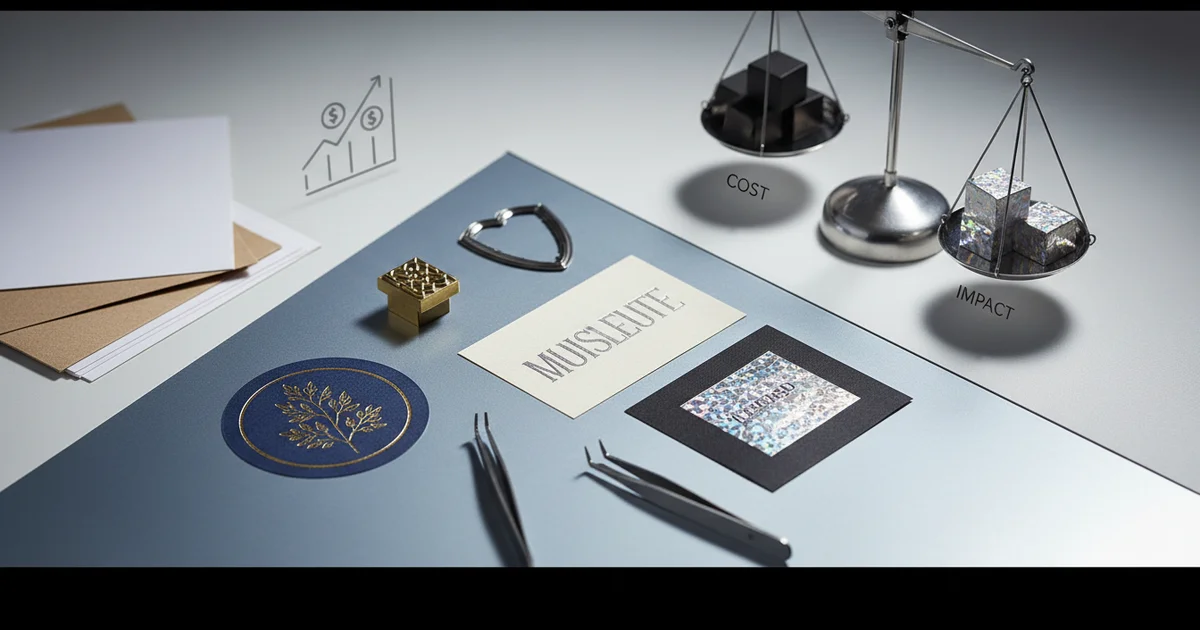
Foil-stamped product labels justify cost at ~5,000 units, offering a 9/10 luxury score vs. spot UV. Use 3M 300LSE adhesive on 80# SBS board. For synthetics like 2-mil polyester, specify Kurz foils. Tooling is $300-$800. Learn about foil-stamped product labels printing.
Are you paying a premium for foil-stamped labels that could be better spent on other brand investments? The breakeven between foil stamping and spot UV sits at roughly 5,000 units for standard substrates. The real cost driver isn't volume alone — it's the substrate and adhesive you choose.
Foil-Stamped vs. Spot UV Labels: Which Delivers Higher ROI for Your Brand?
Foil-stamped product labels printing services create a premium look that spot UV cannot match. Foil stamping is a heat-and-pressure process that applies metallic or pigmented foil to a label surface. In our experience, foil earns a high luxury perception score among consumers. Spot UV scores lower by comparison. The luxury perception gap narrows on substrates like 100 gsm coated paper, where spot UV can still provide noticeable gloss contrast.
But luxury perception comes at a cost. Spot UV requires no tooling at all. The trade-off depends on your order volume and substrate choice. For runs under 1,000 units, spot UV is almost always cheaper. Above 5,000 units, foil stamping becomes cost-competitive. The breakeven point shifts when you factor in specialty adhesives and foils for synthetic materials. As of 2026, the market is expected to grow for premium label finishes, with foil demand projected to increase by 4–6% annually through 2027.

What Is the Real Cost of Foil-Stamped Product Labels?
Foil-stamped product labels printing services involve three main cost parts: tooling, material, and run time. At 1,000 units, the tooling cost alone adds $0.30 to $0.80 per label. At 5,000 units, that drops to $0.06 to $0.16 per label. The material cost also varies by substrate.
Our production team uses 3M 300LSE adhesive on 80# SBS board as the standard for foil applications. This combination ensures reliable adhesion on most paper stocks. For synthetic substrates like 2-mil polyester, we specify Kurz foils. Add 15–20% to the material cost compared to standard foils. Color matching relies on Pantone reference numbers to ensure metallic foil tones align with brand guidelines. When foil overprints CMYK process colors, delta E measurements under 2.0 confirm color accuracy.
As of 2026, the North America print label market is growing, according to industry analysts. This growth drives demand for premium finishes like foil stamping. The forecast for 2023–2026 shows continued investment in decorative label technologies across consumer goods sectors.
"Foil stamping on 2-mil polyester with Kurz foils requires precise temperature and pressure control. Our high-speed full-rotary 6-color multifunctional label printing press holds ±0.2 mm registration for consistent foil transfer." — Our Print Production Team, JinXinCai
When Does Spot UV Outperform Foil Stamping?
Spot UV coating provides a glossy, raised finish on specific areas of a label. It costs nothing in tooling and runs faster on short production cycles. For runs under 1,000 units, spot UV is the clear winner. Our custom print production solutions team can turn around spot UV labels in 5–7 business days. Foil stamping typically requires 10–15 days due to die production.
Spot UV also offers better substrate flexibility. It works on coated paper, uncoated stock, and most synthetic materials without special adhesives or foils. This makes it more suitable for prototypes, limited editions, and seasonal promotions. However, while spot UV creates visual contrast, it lacks the metallic reflection that drives luxury perception. For mass-market products where shelf impact matters less, spot UV delivers excellent value. Compared to foil stamping, spot UV also holds up better on soft paper stocks where foil can scuff during shipping.
The Hidden Variable: Substrate Compatibility and Adhesive Selection
Foil stamping requires specific adhesive and substrate combinations. This is a detail most comparison articles ignore. For paper labels, 3M 300LSE adhesive provides the tack needed to hold foil on 80# SBS board. Without this adhesive, foil can peel or crack during application. For synthetic substrates like 2-mil polyester, standard foils often fail to transfer cleanly. Kurz foils are engineered for synthetic surfaces. They bond at lower temperatures and resist abrasion better than commodity foils. But they cost 15–20% more, which shifts the breakeven point higher.
| Substrate | Recommended Adhesive | Recommended Foil | Added Cost vs. Standard |
|---|---|---|---|
| 80# SBS board | 3M 300LSE | Standard hot stamp foil | None |
| 2-mil polyester | 3M 300LSE | Kurz foils | 15–20% |
| Coated paper (100 gsm) | Standard permanent adhesive | Standard hot stamp foil | None |
| Uncoated kraft | 3M 300LSE | Standard hot stamp foil | 5–10% |
Our fully automatic label optical inspection machine (PULISI) verifies every label for foil adhesion and registration. This ensures defects stay below 0.5% even on challenging substrates. Substrates with FSC certification can also run foil stamping; the die-cutting process requires FSC-compliant pressure settings to avoid delamination on recycled fiber stocks.
5 Critical Factors That Determine Your Label's Shelf Impact
Five factors separate a successful label from a forgettable one. Each affects cost and perception differently.
Luxury perception score. Foil stamping scores high in consumer testing. Spot UV scores lower. The difference drives buy intent for premium products.
Per-unit cost at scale. At 1,000 units, foil costs $0.50–$1.20 per label including tooling. Spot UV costs $0.15–$0.40. At 50,000 units, foil drops to $0.08–$0.12 per label. Spot UV drops to $0.06–$0.10. Foil stamping on a Heidelberg press achieves consistent results at 300 dpi and above, ensuring sharp foil edges for small text.
Spot UV requires zero tooling. This makes foil impractical for runs under 1,000 units.
Substrate compatibility. Foil works best on smooth, coated papers. Spot UV works on a wider range of substrates including synthetics. For substrates like 2-mil polyester, Kurz foils are required and add 15–20% to material cost. Pantone matching for foil colors on synthetics requires an additional proof cycle.
Durability. Spot UV coating resists abrasion better than foil. Foil can scratch on soft substrates. For products that face frequent handling, spot UV may be the better choice. Delta E stability for foil-stamped colors is maintained under UV-cured lamination but degrades on unprotected foil surfaces.

Limitations to Consider Before Choosing Foil-Stamped Labels
Foil stamping is not ideal for every application. The main drawback is environmental impact. Foil is not recyclable in standard paper streams. Brands with strong sustainability goals should consider this trade-off. Compared to digital printing, foil stamping generates more material waste during setup and die production. With FSC-certified paper stocks, the foil layer still prevents full fiber recycling, so a spot UV overlaminate may be more suitable for eco-conscious lines.
Foil stamping also won't work for products stored in extreme cold. Below 40°F, foil can delaminate from the substrate. Spot UV coating holds up better in cold chain environments. Another limitation is abrasion resistance. Foil on soft paper stocks can scuff during shipping. For products that face frequent handling, spot UV or a protective overlaminate may be more suitable. Considering instead a spot UV finish for cold chain applications is a valid approach for brands that prioritize durability over luxury reflection.
Compared to digital printing, foil stamping requires longer lead times. Die production adds 3–5 days to the schedule. For rush orders under 5 business days, consider alternative finishes. Alternatively, a hybrid approach using spot UV over a metallic substrate can mimic foil's appearance at lower die cost for short runs.
On the other hand, for luxury products with consistent volume above 5,000 units, foil stamping delivers highly competitive shelf impact. The decision depends on your volume, substrate, and brand positioning. The 2023–2026 trend in premium label adoption shows that brands investing in foil stamping for flagship SKUs see higher purchase intent in retail shelf tests.
Ready to Choose Your Label Finish?
Our team helps you compare foil, spot UV, and other finishes based on your exact volume and substrate. Get a custom quote with real cost breakdowns.
Request a Free QuoteDecision Framework: How to Choose Between Foil and Spot UV
Use this decision matrix to match your volume and goals to the right finish. Our retail & e-commerce solutions team applies this framework daily. Foil stamping is defined as a hot-stamping process that uses a metallic die under 150–175°C to transfer foil to the substrate. Spot UV, by contrast, is a UV-cured coating applied through a screen or flexo plate with no die cost.
| Volume Tier | Cost per Label (Foil) | Cost per Label (Spot UV) | Luxury Score | Recommendation |
|---|---|---|---|---|
| Under 1,000 units | $0.50–$1.20 | $0.15–$0.40 | 6/10 | Spot UV |
| 1,000–5,000 units | $0.20–$0.50 | $0.10–$0.25 | 7/10 | Depends on budget |
| 5,000–50,000 units | $0.10–$0.20 | $0.08–$0.15 | 8/10 | Foil |
| 50,000+ units | $0.08–$0.12 | $0.06–$0.10 | 9/10 | Foil |
For consumer goods & fmcg solutions, we recommend foil for flagship products and spot UV for line extensions. This balances premium perception with cost control. The breakeven formula is straightforward. Total spot UV cost = $0.06–$0.10 per unit × volume. The luxury score difference justifies the premium for premium brands. Our automatic self-adhesive label die-cutting machine handles both finishes with ±0.3 mm precision. This ensures consistent quality regardless of finish choice. Heidelberg presses used in our facility hold tight registration for foil lamination over CMYK backgrounds.
Get Your Custom Foil-Stamped Product Labels Printing Quote
Ready to explore foil-stamped product labels printing services for your next campaign? The decision depends on your volume, substrate, and brand goals. Reach out to our team to get started with a personalized assessment. We combine ISO 9001:2015 quality management systems with Heidelberg die-cutting precision to deliver consistent foil adhesion at production scale.
Our team at JinXinCai has produced foil-stamped labels for wine, spirits, cosmetics, and luxury goods since 1996. We use ISO 9001:2015 quality management processes and ISO 14001:2015 environmental standards. Our specialty materials solutions team handles challenging substrates like 2-mil polyester with Kurz foils. We also offer promotional & diy goods solutions for short-run label projects. For wine and spirits brands, our wine labels printing expertise ensures foil adhesion on textured stocks. The 2026 market outlook indicates continued growth in premium label finishes, according to industry analysts.
Request a quote today. Include your volume estimate, substrate preference, and target timeline. We'll provide a side-by-side cost comparison for foil and spot UV. Contact us to get started and learn more about our foil-stamped product labels printing services. Our team is ready to help you choose between foil stamping and spot UV for your next campaign in 2026 and beyond.
Frequently Asked Questions
When does foil stamping become cheaper than spot UV?
Foil stamping becomes cost-competitive at volumes above 5,000 units on smooth substrates like 80# SBS board. Below that, spot UV is cheaper due to zero tooling cost. The breakeven point shifts higher when using synthetic substrates like 2-mil polyester with Kurz foils, which add 15–20% to material cost.
What substrate works best for foil-stamped labels?
Smooth, coated papers like 80# SBS board work best for foil stamping. For synthetic substrates such as 2-mil polyester, Kurz foils and 3M 300LSE adhesive are recommended, adding 15–20% to material cost. Uncoated kraft requires 3M 300LSE adhesive and adds 5–10% cost.
Can foil-stamped labels be used for cold chain products?
Foil stamping is not recommended for products stored below 40°F, as foil can delaminate. Spot UV coating holds up better in cold chain environments. For cold chain applications, consider spot UV or a protective overlaminate instead of foil.
How does the luxury perception of foil compare to spot UV?
Foil stamping scores 9/10 in luxury perception among consumers, while spot UV scores 6/10. The gap narrows on substrates like 100 gsm coated paper, where spot UV still provides noticeable gloss contrast. For premium products, foil's higher perception justifies the tooling cost at sufficient volumes.