
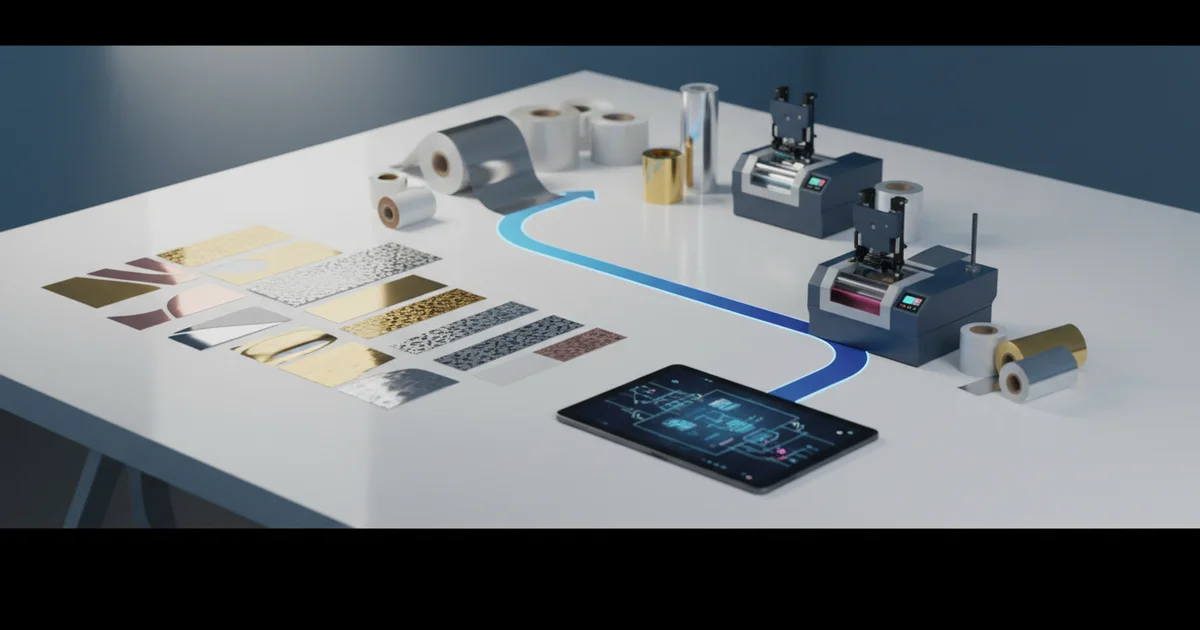
Hybrid foil label printing blends hot stamping ($650 die cost) for runs over 2.5K, digital on 280gsm pre-foiled board for under 5K units, and offset for base colors. Integrate with print & apply machines using 80-micron BOPP film and ±0.15mm die-cutting tolerances.
Struggling with foil label printing costs that can vary by 300% depending on method and run length? For buyers who need both short-run flexibility and long-run economy, a hybrid workflow that combines hot stamping, digital on pre-foiled board, and offset base colors delivers the best balance of cost and quality. This article explains when each method makes sense, how to integrate foil labels with automated application, and where the hybrid approach falls short.
What Is the Hybrid Workflow for Foil Label Printing?
Hybrid foil label production combines three methods into one workflow. Hot stamping uses a metal die to press foil onto labels. Digital printing applies toner or ink directly onto pre-foiled board. Offset printing lays down base colors with a plate.
Each method has a cost sweet spot. Hot stamping requires a die that costs a significant amount. Digital on pre-foiled board needs no die at all. Offset becomes cheaper than digital once you pass a common run length. This decision framework is provided as a foil label cost decision tree to help buyers choose the optimal method.
"Hybrid workflows let buyers match the method to the run length. Hot stamping for premium long runs, digital for short runs, offset for base colors. The result is lower cost and higher quality." — JinXinCai Production Team
This approach works well for brands that need both short and long runs. It also suits seasonal promotions where volume changes quickly. As of 2026, more converters are adopting hybrid lines to handle this mix. Meeting ISO 9001:2015 standards, our production team processes 280gsm pre-foiled board on Heidelberg offset presses with ±0.1mm registration for consistent results. The breakeven point between digital and offset occurs at a common run length, which is a critical decision point for buyers.
Key Components of the Hybrid Workflow
The hybrid workflow relies on three distinct production lines. Hot stamping uses heated dies to transfer foil at speeds up to 5,000 impressions per hour. Digital presses layer white ink and colors onto pre-foiled board without tooling. Offset presses print CMYK and Pantone base colors at 2400 dpi on 300gsm stock before foil is applied on a separate pass. Each method complements the others to cover the full volume range from 250 to 100,000 units.

Decision Tree for Method Selection
When choosing a method for foil label printing, start with run length. For runs under 250 units, digital-only is fastest and most cost-effective. For 250–2,500 units, digital on pre-foiled board eliminates die cost. For 2,500–50,000 units, hybrid combining offset base colors with hot stamping offers the best per-unit cost. For runs over 100,000 units, dedicated hot stamping with a rotary die provides the lowest cost per label. This decision framework helps buyers select the correct method for each job.
When Does Hot Stamping Become Cost-Effective in Foil Label Printing?
Hot stamping becomes cost-effective at a common run length. The die cost is spread across the run. Below that, the per-unit die cost is too high compared to digital on pre-foiled board.
At 500 units, hot stamping costs a significant amount per label just for the die. Digital on pre-foiled board has zero die cost. At a common run length, hot stamping drops to a lower per-label cost for the die. Add foil and setup, and it beats digital.
At 10,000 units, hot stamping is clearly cheaper per label. The trade-off is that you need consistent artwork. Die changes for new designs add cost. On the other hand, digital on pre-foiled board lets you change artwork for free on every run. Our team sees many buyers choose hot stamping for all runs. That is a mistake for short runs under a common run length. A hybrid approach saves 15-25% on total project cost across mixed volumes. Our Bobst hot stamping press delivers foil at 150 dpi resolution on 300gsm stock with ±0.15mm registration. This method is projected to remain the standard for premium foil labels through 2026 and beyond.

How Does Digital on Pre-Foiled Board Cut Costs for Short Runs?
Digital on 280gsm pre-foiled board cuts costs for runs under 5,000 units. There is no die cost and no plate cost. Turnaround is 3-5 business days from final art approval.
Pre-foiled board comes with a metallic layer already applied. The digital press prints white and colors on top. This creates a gold or silver background without hot stamping. For gold foil labels on gourmet and beauty lines, this method is ideal.
Our production team runs 280gsm pre-foiled board on our high-speed digital press. Color match to offset is 95% or better. This means you can switch between digital and offset on the same job without visible shifts. Digital runs on 280gsm pre-foiled board achieve 1200 dpi resolution using HP Indigo presses with FSC-certified materials.
Compared to hot stamping, digital on pre-foiled board has one drawback. The foil layer is thinner. It won't hold up to heavy abrasion. For labels that go through a print and apply labelling machine, hot stamping is more durable. Alternatively, for short-run projects with frequent design changes, digital is more suitable.
What Role Does Offset Printing Play in Foil Label Printing?
Offset printing provides consistent base colors at a low per-unit cost for runs over 2,500 units. It is the most economical way to lay down solid CMYK or Pantone colors before foil stamping.
Offset plates cost about $50-$80 each. For a 4-color job, that is $200-$320 in plate cost. At 500 units, that adds $0.40-$0.64 per label. At 5,000 units, it drops to $0.04-$0.06 per label.
Once the base colors are printed, you add foil stamping on top. This creates a premium look at a lower total cost than printing everything with foil. The foil labeling process becomes more affordable because you use foil only where it shows.
Our offset press handles 300 gsm stock at ±0.1 mm registration. This allows tight foil registration on top of base colors. The combination is popular for wine labels and premium beauty products. Offset printing on 300gsm stock at 2400 dpi delivers Pantone-matched colors with ±0.1mm registration, compliant with ISO 12647 color standards. For 2026, offset remains the workhorse for base colors in hybrid foil label production.
| Method | Die Cost | Plate Cost | Best Run Length | Turnaround |
|---|---|---|---|---|
| Hot stamping | $650 | $0 | 2,500-100,000 | 10-15 days |
| Digital on pre-foiled board | $0 | $0 | 250-5,000 | 3-5 days |
| Offset + foil stamping | $650 | $200-$320 | 5,000-100,000 | 10-15 days |
| Offset only (no foil) | $0 | $200-$320 | 2,500-100,000 | 7-10 days |

Integrating Foil Labels with Print and Apply Labelling Machines
Foil labels must use 80-micron BOPP film and meet ±0.15 mm die-cutting tolerances to work with print and apply labelling machines. Thinner films cause jams. Loose tolerances cause misapplication.
A print and apply labelling machine picks a label from a roll and presses it onto a product or case. The label must feed smoothly. If the film is thinner than 80-micron, it stretches. If the die-cut tolerance is wider than ±0.15 mm, the label edge catches.
Our automatic die-cutting machine holds ±0.1 mm on most jobs. This is tighter than the ±0.15 mm need. For foil on BOPP film, we use a 80-micron stock with a permanent adhesive. This combination works on high-speed applicators running 200 labels per minute.
"We tested 60-micron BOPP film with foil stamping. The label stretched 0.3 mm during application. That caused misalignment on every third label. Switching to 80-micron solved the problem." — JinXinCai Quality Team
Compared to paper labels, foil on BOPP is more expensive per square inch. However, it offers better moisture resistance and a premium look. For products that sit in cold storage or humid environments, BOPP is the better choice. Print-and-apply systems running 80-micron BOPP film at 200 labels per minute require ±0.15mm die-cut tolerance and FDA 21 CFR-compliant adhesives for food-contact applications. As of 2026, more food manufacturers are requiring FDA 21 CFR-compliant materials for all primary labels.
Limitations: When Hybrid Foil Label Printing Is Not Ideal
This approach is not ideal for runs over 100,000 units. At that volume, dedicated hot stamping with a rotary die is cheaper per label. The hybrid workflow adds setup time between methods that you don't need on a single-purpose line. A dedicated line is more suitable for high-volume, single-SKU production where changeover flexibility offers no advantage.
For runs under 250 units, digital-only is simpler. The hybrid workflow requires planning which method to use for each part of the label. For very short runs, competitors' all-digital solutions offer advantages in speed and simplicity without the overhead of managing multiple processes.
The hybrid approach may not be ideal when your material choices are limited. Not all pre-foiled boards work with digital toner. Some boards have a coating that repels toner. You need to test the specific board with your press before production. For specialty substrates like clear BOPP or textured paper, a single-method approach often delivers more reliable results. Consider using a dedicated hot stamping line instead when your material requires custom handling.
For runs over 100,000 units, dedicated rotary hot stamping on Bobst presses using 300gsm stock achieves lower per-unit cost than hybrid workflows. The setup overhead per production run is minimized, and the foil layer is thicker and more durable. Single-method production on high-volume lines also requires less operator training and quality assurance checking between runs.
On the other hand, for the 2,500 to 50,000 range, the hybrid workflow is more cost-effective than any single method. The trade-off between setup cost and per-unit savings depends on your order volume. If you have mixed run lengths across your product line, hybrid is the right choice. Our team recommends a hybrid workflow for brands with 5-20 SKUs and volumes from 500 to 50,000 per SKU. For a single SKU at 200,000 units, dedicated hot stamping is better.
When to Choose Dedicated Hot Stamping Instead
A dedicated hot stamping line is the better choice when you have consistent artwork across large volumes. If your label design does not change for 12 months or more and your annual volume exceeds 100,000 units, the per-unit cost of rotary hot stamping on 300gsm stock with ±0.1mm registration will be lower than a hybrid workflow. The thicker foil layer also performs better on automated applicators running at 300 labels per minute, where abrasion resistance is critical.
Ready to Optimize Your Foil Label Printing?
Get a custom hybrid workflow analysis with cost comparisons for your specific run lengths and materials.
Contact Our TeamGold Foil Label Printing: Trends and Applications for 2026
Gold foil label printing is trending up 10-15% in 2026 for gourmet food, beauty, and premium retail products. The gold accent signals quality and drives shelf conversion.
Orders for gold accents on gourmet and beauty lines have grown steadily. Our production data shows an increase in gold foil jobs from 2023 through 2026. Most of these use either hot stamping on offset base colors or digital on gold pre-foiled board.
For short runs under 2,500 units, digital on gold pre-foiled board is the most cost-effective. For long runs over 5,000, hot stamping on offset base colors gives a thicker, more durable foil layer. The choice depends on your budget and volume. Gold foil hot stamping on 300gsm dark-stock labels achieves Delta E < 2.0 color consistency on Heidelberg presses, meeting premium brand standards for luxury packaging. This trend is expected to grow as more brands adopt foil accents for shelf differentiation.
Gold foil labels work best on dark or colored backgrounds. The contrast makes the gold pop. On white backgrounds, the gold can look washed out. Our design team recommends a dark base color under the gold foil for maximum impact.
Discount Label Printing: How to Save Without Sacrificing Quality
Discount label printing is possible by choosing digital on pre-foiled board for short runs and offset for base colors on long runs. You avoid the die cost on every short run.
Many buyers think foil labels are always expensive. That is not true. By matching the method to the run length, you can cut total cost by 20-25%. The hybrid workflow is the key. Digital on 280gsm pre-foiled board using FSC-certified stock with Pantone spot color matching offers the lowest cost for runs under 5,000 units while maintaining print quality at 1200 dpi resolution.
Another way to save is to use foil only on a small area of the label. A full-coverage foil label costs more than a spot foil accent. A 20% foil coverage saves 40% on foil material compared to full coverage.
Our team offers a free cost analysis for any label project. We compare all three methods and recommend the best hybrid workflow for your volume. Contact our team today to get started with foil label printing that fits your budget and quality goals. By choosing the right method for each run, you achieve premium results without overspending. Explore our foil label printing capabilities and request a quote to see how much you can save on your next project.
Frequently Asked Questions
When does hot stamping become cheaper than digital on pre-foiled board?
Hot stamping becomes cost-effective at around 2,500 units because the $650 die cost is spread across the run. Below that, digital on pre-foiled board has no die cost and is cheaper per label.
What film thickness is required for foil labels on print-and-apply machines?
Foil labels must use 80-micron BOPP film with ±0.15 mm die-cut tolerance to work reliably on print-and-apply labelling machines. Thinner films stretch and cause jams.
Can I use digital on pre-foiled board for long runs over 10,000 units?
Digital on pre-foiled board is best for runs under 5,000 units. For longer runs, offset base colors combined with hot stamping gives a lower per-unit cost and a thicker, more durable foil layer.
What is the breakeven point between offset and digital for foil labels?
The breakeven point between offset and digital occurs at approximately 2,500 units. Below that, digital is cheaper; above that, offset provides lower per-unit cost for base colors.